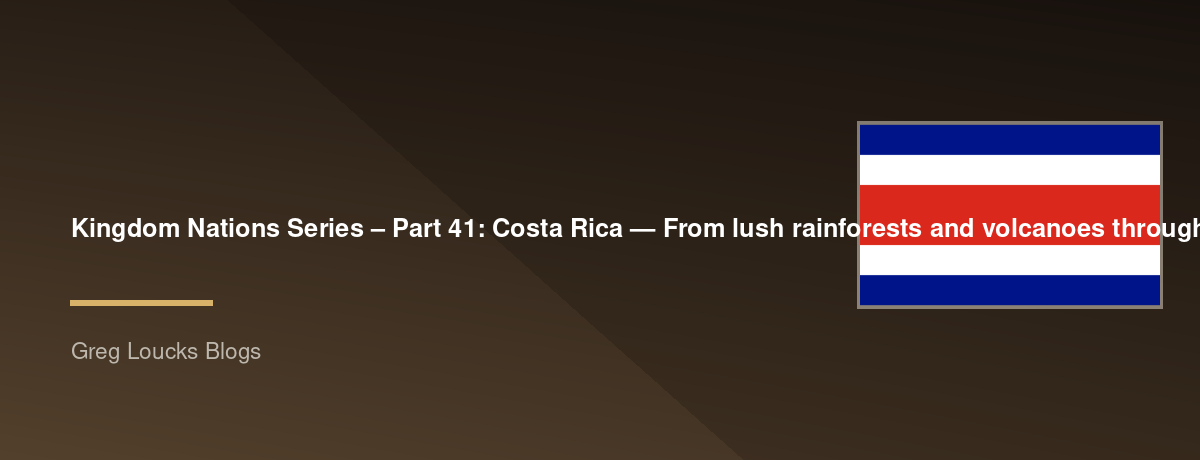
🌎 Kingdom Nations Series – Part 41: 🇨🇷 Costa Rica — From lush rainforests and volcanoes through Indigenous cultures, Spanish colonization, independence, democratic stability, environmental stewardship, and God's continuing work in one of Latin America'

🌎 Kingdom Nations Series – Part 42 🇨🇷 Chapter 1 – Part 1 Costa Rica: The Rich Coast Geography, Rainforests, Volcanoes, and God's Providential Design "The mountains and the hills before you shall break forth into singing, and all the trees of the field shall clap their hands." — Isaiah 55:12 Introduction Nestled between Nicaragua and Panama, Costa Rica is one of the world's most celebrated examples of natural beauty and environmental stewardship. Its cloud forests. Active volcanoes. Pacific beaches. Caribbean coastline. Tropical rainforests. Rushing rivers. And extraordinary wildlife have earned it a reputation as one of Earth's richest biodiversity hotspots. Although Costa Rica occupies less than 0.03% of the Earth's land surface, it contains nearly 5% of the world's known biodiversity. This remarkable concentration of life reflects the creativity of the Creator. Long before Indigenous peoples settled these lands... Long before Spanish explorers arrived... Long before modern democracy emerged... God prepared this beautiful country. He raised volcanic mountains. He filled forests with orchids and towering trees. He guided sea turtles to ancient nesting beaches. He carved rivers through valleys. The Psalmist declared: "Let the heavens be glad, and let the earth rejoice; let the sea roar, and all that fills it."(Psalm 96:11) Every rainforest. Every volcano. Every hummingbird. Every coastline. Declares the glory of God. Where Is Costa Rica? Costa Rica lies in Central America. It borders: Nicaragua to the north Panama to the southeast Its coastlines border: Pacific Ocean Caribbean Sea Its central location has made Costa Rica a natural bridge connecting North and South America for both wildlife and human migration. Size and Geography Costa Rica covers approximately 51,100 square kilometers (19,700 square miles). Major geographic regions include: Central Valley Guanacaste Plains Caribbean Lowlands Pacific Coast Talamanca Mountains Northern Plains Osa Peninsula Nicoya Peninsula Despite its modest size, Costa Rica possesses extraordinary geographic diversity. Mountain Ranges Several mountain systems cross the country. Major ranges include: Cordillera Central Cordillera de Talamanca Cordillera de Guanacaste Cordillera de Tilarán These mountains influence: Climate. Agriculture. Transportation. Settlement. Water resources. Many communities are located within the cooler Central Valley. Volcanoes Costa Rica forms part of the Pacific Ring of Fire. Important volcanoes include: Arenal Volcano Poás Volcano Irazú Volcano Turrialba Volcano Rincón de la Vieja Volcano Volcanic soils have created some of the country's most fertile farmland. The volcanoes also remind us of the immense power displayed within God's creation. Rivers Although relatively short, Costa Rica's rivers are essential to national life. Major rivers include: Reventazón River Tempisque River San Juan River (forming much of the northern border) Térraba River Pacuare River These rivers provide: Hydroelectric power. Fresh water. Agriculture. Transportation. Recreation. Wildlife habitat. Hydroelectric energy supplies much of the nation's electricity. Rainforests and Cloud Forests Costa Rica contains numerous rainforest ecosystems. Among the most famous are: Monteverde Cloud Forest Corcovado National Park Tortuguero National Park Braulio Carrillo National Park These forests support: Towering trees. Orchids. Ferns. Rare mammals. Birdlife. Amphibians. Insects. The cloud forests are among the world's most biologically diverse environments. Coastlines Costa Rica enjoys more than 1,200 kilometers (750 miles) of coastline. Its Pacific coast features: Rocky peninsulas. Sandy beaches. Mangrove forests. Marine parks. Excellent surfing conditions. Its Caribbean coast includes: Coral reefs. Sea turtle nesting beaches. Tropical wetlands. Coastal forests. These coastlines support both tourism and marine biodiversity. Climate Costa Rica experiences a tropical climate. Climate zones include: Tropical rainforest. Cloud forest. Dry tropical forest. Mountain climate. Coastal lowlands. Rainfall varies greatly depending upon elevation and season. Wildlife Costa Rica is one of Earth's biodiversity treasures. Animals include: Jaguars. Pumas. Tapirs. Sloths. Capuchin monkeys. Howler monkeys. Spider monkeys. Scarlet macaws. Quetzals. Toucan species. Poison dart frogs. Sea turtles. More than 900 bird species have been recorded within the country. National Parks Nearly one-quarter of Costa Rica's land is protected through parks and reserves. Major protected areas include: Corcovado National Park Tortuguero National Park Arenal Volcano National Park Manuel Antonio National Park Monteverde Cloud Forest Reserve Chirripó National Park These preserve: Rainforests. Cloud forests. Volcanoes. Mangroves. Marine ecosystems. Wildlife corridors. Costa Rica has become a global model for environmental conservation. Natural Resources Costa Rica's greatest natural resources include: Fresh water. Forests. Hydroelectric power. Fertile farmland. Marine fisheries. Tourism. Renewable energy. Biodiversity. Unlike many nations, Costa Rica's economy increasingly benefits from protecting rather than exploiting its natural environment. Agriculture Agriculture continues contributing significantly to the national economy. Major products include: Coffee. Bananas. Pineapples. Sugarcane. Rice. Palm oil. Cocoa. Ornamental plants. Vegetables. Tropical fruits. Costa Rican coffee is internationally recognized for its exceptional quality. Cities Several cities play important national roles. San José The national capital. Largest city. Political center. Economic hub. Located in the Central Valley. Alajuela Important commercial center. Gateway to the international airport. Cartago Costa Rica's former colonial capital. Historic religious center. Agricultural region. Heredia Known as the "City of Flowers." University center. Coffee-growing region. Limón Principal Caribbean port. Important center for international trade. Population Costa Rica has a population of approximately 5.3 million people. Most residents live in the Central Valley around San José. The nation enjoys one of the highest life expectancies in Latin America. Languages The official language is: Spanish Other languages spoken include: English (especially along parts of the Caribbean coast) Bribri Cabécar Maleku Ngäbere Boruca Chorotega (historically) Additional Indigenous languages One day believers from every language spoken throughout Costa Rica will worship Jesus Christ together before His throne. Geography and Providence Costa Rica's geography has shaped its history. Its mountains protected communities. Its coastlines welcomed trade. Its fertile volcanic soils supported agriculture. Its forests preserved extraordinary biodiversity. Long before the modern republic existed, God prepared this land according to His sovereign purposes. Lessons from Costa Rica's Geography Several enduring truths emerge. Creation Displays God's Creativity Costa Rica's extraordinary biodiversity reflects the limitless imagination of the Creator. Stewardship Brings Blessing Responsible care for forests, wildlife, and rivers benefits both people and creation. Small Nations Can Have Great Influence Though geographically small, Costa Rica has become a global example of conservation and sustainable development. Every Nation Has a Place in God's Plan From the cloud forests to the Caribbean coast, Costa Rica occupies an important place within God's redemptive purposes. Looking Ahead The next chapter explores Costa Rica before independence. We will examine: The first peoples Indigenous cultures Spanish exploration Colonial Costa Rica The arrival of Christianity Independence from Spain The early republic Foundations of modern democracy Though lacking the great empires found elsewhere in the Americas, Costa Rica would become one of Latin America's most stable and peaceful nations. End of Chapter 1 – Part 1 Next: Chapter 1 – Part 2: Ancient Costa Rica—Indigenous Peoples, Spanish Rule, Christianity, and Independence 🌎 Kingdom Nations Series – Part 42 🇨🇷 Chapter 1 – Part 2 Ancient Costa Rica Indigenous Peoples, Spanish Rule, Christianity, and Independence (Prehistory–1821) "Remember the days of old; consider the years of many generations." — Deuteronomy 32:7 Introduction Long before Costa Rica became one of Latin America's most peaceful democracies, its mountains, forests, and coastlines were home to vibrant Indigenous communities. Farmers cultivated fertile valleys. Artisans crafted magnificent gold ornaments. Traders crossed mountain passes. Chiefs governed prosperous villages. Spanish explorers later arrived. Missionaries established churches. Colonial settlements slowly developed. Throughout every generation, however, God remained sovereign over history. The prophet Daniel declared: "Blessed be the name of God forever and ever, to whom belong wisdom and might."(Daniel 2:20) Every civilization rises and falls under His sovereign hand. The First Peoples Archaeological evidence indicates that people have lived in present-day Costa Rica for more than 12,000 years. Early communities gradually transitioned from hunting and gathering to agriculture. They cultivated: Maize. Beans. Squash. Cassava. Cacao. Fruit trees. These early societies established villages throughout the country's diverse environments. Indigenous Peoples Before European contact, Costa Rica was home to numerous Indigenous peoples, including: Bribri Cabécar Boruca Chorotega Huetar Maleku Térraba Ngäbe (Guaymí) Brunka Each developed unique: Languages. Religious traditions. Agricultural systems. Trade networks. Artistic styles. Social structures. Their descendants continue preserving important cultural traditions today. The Huetar The Huetar became one of the most influential Indigenous groups in central Costa Rica. They developed: Organized chiefdoms. Agriculture. Trade routes. Stonework. Gold craftsmanship. Regional alliances. When the Spanish arrived, the Huetar occupied much of the Central Valley. The Chorotega The Chorotega, who migrated from Mesoamerica, settled primarily in northwestern Costa Rica. Their culture reflected strong Mesoamerican influences. They became known for: Pottery. Agriculture. Market trade. Religious ceremonies. Community organization. Their artistic pottery remains among Costa Rica's greatest archaeological treasures. Goldworking Costa Rica's Indigenous peoples became renowned for remarkable gold craftsmanship. Artisans produced: Animal figures. Ceremonial ornaments. Jewelry. Symbols of leadership. Religious objects. Many pieces reveal extraordinary artistic skill and remain treasured examples of pre-Columbian art. Unlike some neighboring civilizations, however, Costa Rica never developed large centralized empires. Christopher Columbus During his fourth voyage, Christopher Columbus reached Costa Rica's Caribbean coast in 1502. Impressed by the gold ornaments worn by local peoples, Europeans eventually named the region Costa Rica, meaning "Rich Coast." Although the expected vast riches never materialized, the name endured. Spanish Colonization Spanish settlement developed more slowly in Costa Rica than elsewhere in Central America. Several factors contributed: Limited large Indigenous populations. Absence of massive gold or silver deposits. Mountainous terrain. Geographic isolation. As a result, Costa Rica developed relatively small farming communities rather than large colonial estates. Colonial Society Costa Rica became part of the Captaincy General of Guatemala, administered within the Spanish Empire. Colonial life centered on: Agriculture. Small towns. Family farms. Catholic churches. Local trade. Compared with many other Spanish colonies, Costa Rica developed a relatively modest colonial economy. Christianity Arrives Roman Catholic missionaries accompanied Spanish settlers. Missionaries established: Churches. Schools. Mission settlements. Religious instruction. Community ministries. The Christian faith gradually spread throughout colonial society. Missionaries also learned Indigenous languages to communicate more effectively with local communities. Agriculture Colonial agriculture emphasized: Cacao. Tobacco. Sugarcane. Corn. Beans. Livestock. Coffee would later become one of Costa Rica's defining exports during the nineteenth century. Education Religious instruction became central to colonial education. Students learned: Reading. Writing. Catechism. Basic mathematics. Spanish. Christian doctrine. Churches remained the primary educational institutions throughout much of the colonial era. Toward Independence During the early nineteenth century, independence movements spread throughout Latin America. Influences included: The American Revolution. The French Revolution. Napoleon's invasion of Spain. Regional movements for self-government. Residents of Central America increasingly desired political independence from Spain. Independence On September 15, 1821, Costa Rica peacefully gained independence as part of the broader independence of Central America. Unlike many neighboring countries, Costa Rica achieved independence without a prolonged war. Initially, the country joined the Federal Republic of Central America. After that federation dissolved, Costa Rica became a fully independent republic. The peaceful transition helped establish a tradition of political stability that continues to influence the nation today. Lessons from Ancient Costa Rica Several enduring truths emerge. Faithfulness Often Grows Quietly Without great empires or vast military conquests, Costa Rica developed through family life, agriculture, education, and community. The Gospel Crosses Every Culture Christianity gradually became rooted among diverse communities while continuing to spread across generations. Humility Can Become Strength Costa Rica's relatively modest colonial development helped shape a society that often valued cooperation and local responsibility. God's Kingdom Outlasts Every Empire The Indigenous chiefdoms. The Spanish Empire. The Captaincy General of Guatemala. The Federal Republic of Central America. Every earthly government eventually changes. The Kingdom of Jesus Christ alone is everlasting. Looking Ahead The next chapter explores modern Costa Rica. We will examine: The independent republic Coffee and economic growth Democratic development Abolition of the military Environmental leadership Contemporary society The growth of Christianity Hope for the future Costa Rica would become internationally recognized for its democracy, peaceful institutions, environmental conservation, and commitment to education. End of Chapter 1 – Part 2 Next: Chapter 2 – Part 1: Modern Costa Rica—Democracy, Peace, Environmental Stewardship, and Contemporary Society (1821–Present) 🌎 Kingdom Nations Series – Part 42 🇨🇷 Chapter 2 – Part 1 Modern Costa Rica Democracy, Peace, Environmental Stewardship, and Contemporary Society (1821–Present) "Seek peace and pursue it." — Psalm 34:14 Introduction Since gaining independence in 1821, Costa Rica has become one of the world's most stable democracies. While many neighboring nations experienced prolonged wars and military rule, Costa Rica developed a reputation for: Peace. Democracy. Education. Environmental stewardship. Economic innovation. Political stability. Though not without challenges, the nation has consistently sought peaceful solutions and investment in its people. Throughout every generation, God has remained faithful. The prophet Jeremiah declared: "For I know the plans I have for you, declares the LORD, plans for welfare and not for evil, to give you a future and a hope."(Jeremiah 29:11) The story of modern Costa Rica demonstrates how wise stewardship, strong institutions, and peaceful cooperation can bless a nation. Independence Following independence from Spain in 1821, Costa Rica briefly became part of: The Mexican Empire The Federal Republic of Central America When the federation dissolved in 1838, Costa Rica emerged as a fully sovereign republic. The young nation focused upon: Agriculture. Education. Infrastructure. Representative government. Unlike many newly independent nations, Costa Rica experienced relatively limited armed conflict during its early years. Coffee and Economic Growth During the nineteenth century, coffee became Costa Rica's principal export. Coffee transformed the nation by encouraging: International trade. Road construction. Economic growth. Education. A growing middle class. Coffee earned the nickname "the golden bean" because of its importance to national development. Later, bananas also became a major export. Democratic Development Costa Rica gradually strengthened democratic institutions through: Constitutional government. Regular elections. Independent courts. Civil liberties. Peaceful transfers of power. Democratic traditions became deeply rooted within national life. The 1948 Civil War In 1948, Costa Rica experienced a brief civil war following disputed presidential elections. Although the conflict lasted only 44 days, it profoundly shaped the nation's future. After the conflict, leaders pursued reforms that strengthened democratic governance. One of the most significant decisions soon followed. Abolition of the Military In 1948, under the leadership of José Figueres Ferrer, Costa Rica abolished its standing military. Instead of maintaining armed forces, the nation invested more heavily in: Education. Healthcare. Infrastructure. Public security. Environmental conservation. Costa Rica remains one of the few countries in the world without a permanent military. This decision became one of the defining characteristics of modern Costa Rican identity. Education Costa Rica has long emphasized education. The nation invests heavily in: Primary schools. Secondary schools. Universities. Scientific research. Vocational training. Teacher education. Literacy rates remain among the highest in Latin America. Education continues serving as a foundation for national development. Healthcare Costa Rica has developed one of Latin America's strongest healthcare systems. Healthcare includes: Public hospitals. Community clinics. Preventive medicine. Maternal healthcare. Vaccination programs. Medical education. The nation's healthcare system contributes to one of the highest life expectancies in the region. Environmental Leadership Costa Rica has become a global leader in environmental conservation. National initiatives include: Rainforest protection. Reforestation. Wildlife conservation. Renewable energy. Sustainable tourism. Marine conservation. More than one-quarter of the nation's territory is protected through parks and reserves. Costa Rica demonstrates that economic development and environmental stewardship can work together. Genesis reminds believers that humanity has been entrusted with caring for God's creation. Renewable Energy Costa Rica generates much of its electricity from renewable sources, including: Hydroelectric power. Wind energy. Geothermal energy. Solar energy. Biomass. Its volcanic geography provides abundant geothermal resources. The nation continues investing in clean energy technologies. Economy Costa Rica's economy has diversified considerably. Major industries include: Tourism. Agriculture. Medical technology. Electronics manufacturing. Financial services. Software development. Renewable energy. Coffee. Bananas. Pineapples. Ecotourism has become one of the nation's most important industries. Tourism Millions of visitors travel to Costa Rica each year. Popular attractions include: National parks. Volcanoes. Cloud forests. Wildlife. Surfing. Adventure tourism. Birdwatching. Marine reserves. Sustainable tourism provides employment while encouraging conservation. Christianity Today Christianity remains the largest religion in Costa Rica. Major Christian traditions include: Roman Catholic Church. Evangelical churches. Pentecostal churches. Baptist churches. Presbyterian churches. Methodist churches. Lutheran churches. Independent Christian fellowships. Churches minister through: Biblical teaching. Education. Hospitals. Youth ministry. Family counseling. Community outreach. Disaster relief. Compassion ministries. Evangelical churches have grown steadily during recent decades. Contemporary Challenges Modern Costa Rica continues addressing important issues. These include: Affordable housing. Migration. Economic inequality. Infrastructure. Healthcare costs. Environmental protection. Climate change. Urban growth. Employment. The Church continues responding through: Prayer. Discipleship. Compassion. Education. Family ministry. Community development. Christian witness remains an important source of hope throughout the nation. Hope for the Future Costa Rica possesses remarkable strengths. Stable democracy. Highly educated population. Strong healthcare. Environmental leadership. Growing technology sector. Rich biodiversity. Peaceful institutions. These strengths provide opportunities for future generations. Yet Scripture reminds believers that no political system or economic success can replace humanity's need for Jesus Christ. Jesus declared: "Peace I leave with you; My peace I give to you. Not as the world gives do I give to you."(John 14:27) True peace begins with reconciliation to God. Lessons from Modern Costa Rica Several enduring truths emerge. Peace Is Worth Pursuing Costa Rica demonstrates the value of investing in peace, education, and human development. Stewardship Honors God Protecting creation reflects gratitude toward the Creator. Education Strengthens Society Knowledge equips future generations to serve both their nation and their neighbors. Christ Is Costa Rica's Lasting Hope Governments change. Economies fluctuate. Natural beauty fades. Jesus Christ alone remains the eternal King whose Kingdom will never end. Looking Ahead The final chapter explores Costa Rica through a Kingdom perspective. We will examine: Religious demographics Worldview analysis Reached and less-reached peoples Bible translation Evangelism opportunities Strategic prayer Costa Rica in God's redemptive plan Why gregloucks.com/costa-rica matters Costa Rica before the throne in Revelation 7 History tells the story of peace, democracy, and wise stewardship. The Kingdom perspective reveals God's continuing work among the people of Costa Rica. End of Chapter 2 – Part 1 Next: Chapter 3 – Part 1: Costa Rica Before the Throne—Kingdom Vision, Mission Strategy, and Final Reflections 🌎 Kingdom Nations Series – Part 42 🇨🇷 Chapter 3 – Part 1 Costa Rica Before the Throne Kingdom Vision, Mission Strategy, and Final Reflections "After this I looked, and behold, a great multitude that no one could number, from every nation, from all tribes and peoples and languages, standing before the throne and before the Lamb." — Revelation 7:9 Introduction Costa Rica is often called one of the most peaceful and beautiful nations on Earth. Its cloud forests. Volcanic mountains. Tropical beaches. Dense rainforests. Rushing rivers. And extraordinary wildlife reflect the majesty of the Creator. Yet Costa Rica's greatest treasure is not its biodiversity. Not its national parks. Not its coffee. Not its peaceful democracy. Its greatest treasure is its people. Every child. Every family. Every farmer. Every student. Every Indigenous community. Every believer. Created in the image of God. The Lord who planted Costa Rica's forests knows every heart throughout the nation. The Psalmist proclaimed: "Know that the LORD, He is God! It is He who made us, and we are His."(Psalm 100:3) That truth extends from the Caribbean coast to the Pacific Ocean. Costa Rica in God's Redemptive Story God has faithfully worked throughout Costa Rica for centuries. He has used: Missionaries. Pastors. Bible translators. Teachers. Christian physicians. Evangelists. Church planters. Faithful parents. Youth leaders. Christian humanitarian organizations. Churches have established: Schools. Hospitals. Bible institutes. Universities. Children's ministries. Family ministries. Community outreach. Disaster relief ministries. Christian education and compassionate service have helped shape generations of Costa Ricans. Jesus promised: "You are the light of the world."(Matthew 5:14) The Church continues shining Christ's light throughout the nation. A Nation of Many Peoples Costa Rica reflects a rich blend of cultures. Among its peoples are: Mestizo Costa Ricans Afro-Costa Ricans Bribri Cabécar Boruca (Brunka) Maleku Ngäbe Térraba Huetar descendants Chorotega descendants International immigrant communities Together they contribute unique: Languages. Music. Dance. Cuisine. Art. Agricultural traditions. Family customs. The Gospel proclaims one Savior for every tribe and language. Paul reminds believers: "For there is no distinction... the same Lord is Lord of all."(Romans 10:12) The Church Today Christianity remains the largest religion in Costa Rica. Major Christian traditions include: Roman Catholic Church Evangelical churches Pentecostal churches Baptist churches Methodist churches Presbyterian churches Lutheran churches Independent Christian fellowships Churches minister through: Biblical preaching. Church planting. Youth ministry. Christian education. Family counseling. University outreach. Compassion ministries. Disaster relief. Community development. The evangelical movement continues growing throughout the country. Religious Demographics Religion continues influencing Costa Rican society. Broadly speaking: Christianity is the faith of the overwhelming majority of the population. Roman Catholicism has shaped the nation's history for centuries. Evangelical and Pentecostal churches have experienced significant growth. Small Jewish, Muslim, Buddhist, Hindu, and other religious communities are also present. Some Costa Ricans identify with no religious affiliation. Followers of Christ are called to reflect His grace with humility, integrity, and love. Worldview Analysis Several worldviews continue shaping Costa Rica today. Historic Christianity Christianity influences: Family life. Education. Healthcare. National celebrations. Community service. Charitable ministries. Churches remain central to many communities. Secular Society Modernization has encouraged increasingly secular perspectives among some people. Many pursue: Career success. Financial security. Personal fulfillment. Consumer lifestyles. Jesus reminds His followers: "Seek first the kingdom of God and His righteousness."(Matthew 6:33) Environmental Stewardship Costa Rica's commitment to conservation reflects an appreciation for creation. Christians recognize that creation is not merely to be admired but faithfully stewarded as God's gift. Genesis teaches humanity to care for the earth responsibly. Hope Through Christ Peaceful institutions. Economic opportunity. Beautiful landscapes. Healthy communities. All are blessings. Yet none can replace reconciliation with God through Jesus Christ. Only Christ offers eternal peace. Reached and Less-Reached Communities Significant ministry opportunities remain among: University students. Children and youth. Immigrant communities. Indigenous villages. Urban neighborhoods. Business professionals. Tourism workers. International visitors. The Great Commission continues calling believers to make disciples throughout every province of Costa Rica. Bible Translation God's Word is available in: Spanish. Bribri. Cabécar. Ngäbere. Several additional Indigenous languages. Audio Scriptures. Children's Bibles. Digital Bible resources. Translation work continues where additional Scripture resources are needed. Isaiah declared: "The word of our God will stand forever."(Isaiah 40:8) Opportunities for Evangelism Costa Rica offers many opportunities for Kingdom ministry. University Ministry Young adults continue shaping the nation's future. Churches serve through: Campus Bible studies. Leadership development. Mentoring. Apologetics. Discipleship. Tomorrow's leaders are being equipped today. Family Ministry Healthy families strengthen healthy communities. Churches invest in: Marriage ministry. Parenting. Children's discipleship. Counseling. Home Bible studies. Strong families strengthen the Church. Indigenous Ministry Christian ministries continue serving Indigenous communities through: Bible translation. Leadership development. Education. Healthcare. Local church partnerships. The Gospel reaches every culture while honoring the dignity of every people. Compassion Ministry Churches demonstrate Christ's love through: Medical care. Food assistance. Disaster response. Education. Community development. Support for vulnerable families. Practical compassion reflects the heart of Jesus. Creation and Stewardship Costa Rica's: Rainforests. Cloud forests. Volcanoes. Sea turtles. Scarlet macaws. Quetzals. Mangroves. Coral reefs. All proclaim God's creative power. Believers are called to steward these gifts wisely for future generations. Prayer for Costa Rica Pray: For wisdom for national leaders. For pastors and church leaders. For continued spiritual renewal. For Christian families. For university students and young adults. For Bible translation ministries. For Indigenous communities. For environmental stewardship. For churches serving the poor and vulnerable. For every Costa Rican to hear and respond to the Gospel. Paul encouraged believers: "Continue steadfastly in prayer."(Colossians 4:2) Why gregloucks.com/costa-rica Matters The Costa Rica page exists to help believers understand the nation through a biblical worldview. Each country profile includes: Geography Administrative divisions Cities Government Economy History Languages Christian history Religious demographics Worldview analysis Mission opportunities Evangelism strategies Strategic prayer Biblical reflection Together these studies form a global Kingdom atlas designed to encourage: Prayer. Discipleship. Mission. Biblical understanding. Love for the nations. History becomes a testimony of God's providence. Knowledge becomes an act of worship. Costa Rica Before the Throne History does not end with Indigenous chiefdoms. Nor with Spanish rule. Nor with independence. Nor with democracy. Nor with environmental achievements. History culminates before the throne of Jesus Christ. John saw that glorious future. Believers from: San José. Alajuela. Cartago. Heredia. Limón. Liberia. Puntarenas. The Nicoya Peninsula. The Osa Peninsula. The Talamanca Mountains. Every province. Every village. Every language. Every people. Will stand before the Lamb. Some first heard the Gospel through missionaries. Others through faithful parents. Some through local churches. Others through Christian schools, Bible translators, university ministries, or acts of compassion. Their stories will differ. Their Redeemer will be the same. Together they will proclaim: "Salvation belongs to our God who sits on the throne, and to the Lamb!"(Revelation 7:10) That is Costa Rica's eternal destiny. Not merely peace. Not merely prosperity. Not merely breathtaking natural beauty. But redeemed men, women, and children from every tribe and language worshiping Jesus Christ forever. Final Reflections Costa Rica teaches us that: Peace is a blessing worth pursuing. Creation reflects God's glory. Stewardship honors the Creator. Strong families strengthen society. The Gospel transforms lives across every culture. Most importantly, Costa Rica reminds us that history belongs to Jesus Christ. The mountains. The forests. The volcanoes. The coastlines. The churches. The families. The people. All ultimately belong to the King of Kings. His Kingdom alone will never end. Final Commission As you study Costa Rica, remember that this series is more than a history of nations. It is an invitation to see the world through the lens of Scripture. Every nation matters. Every language matters. Every people group matters. Every believer has a place in God's global mission. May the Church in Costa Rica continue proclaiming Christ with wisdom, humility, compassion, courage, and unwavering faith. May future generations know both the remarkable history of their nation and the eternal hope found only in Jesus Christ. And may the Lamb receive the full reward of His sacrifice from the people of Costa Rica. Amen. End of Kingdom Nations Series – Part 42: 🇨🇷 Costa Rica Coming Next: 🌎 Kingdom Nations Series – Part 43: 🇨🇮 Côte d'Ivoire (Ivory Coast) — From the great forests and lagoons of West Africa through ancient trading kingdoms, French colonial rule, independence, modern economic growth, the expansion of Christianity, and God's continuing work among the many peoples of the Ivory Coast.
Read more 🌎 Kingdom Nations Series – Part 41: 🇨🇷 Costa Rica — From lush rainforests and volcanoes through Indigenous cultures, Spanish colonization, independence, democratic stability, environmental stewardship, and God's continuing work in one of Latin America'

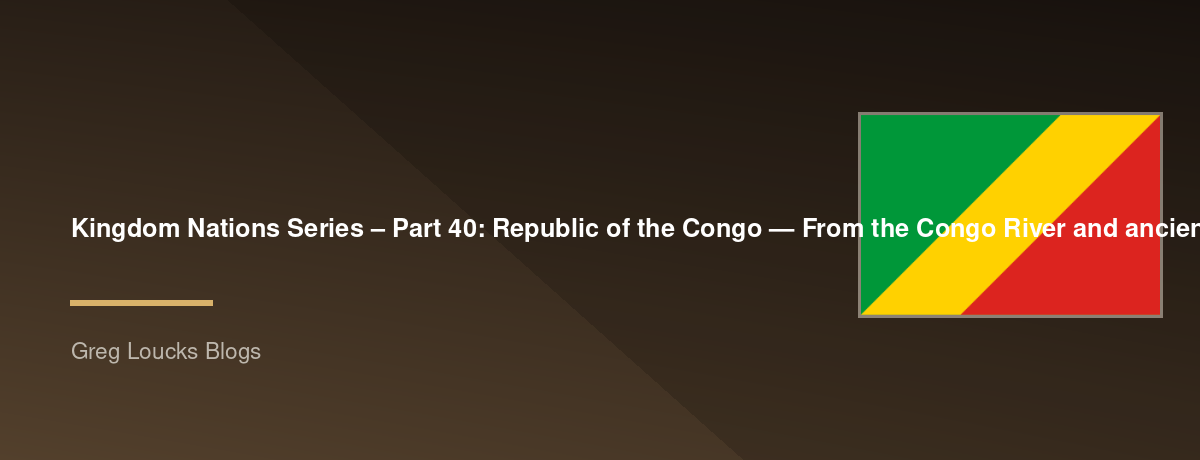
🌎 Kingdom Nations Series – Part 40: 🇨🇬 Republic of the Congo — From the Congo River and ancient Bantu kingdoms through French Equatorial Africa, independence, modern Central Africa, the growth of Christianity, and God's continuing work along the wester

🌎 Kingdom Nations Series – Part 41 🇨🇬 Chapter 1 – Part 1 Republic of the Congo: The Green Heart of Central Africa Geography, Rivers, Rainforests, and God's Providential Design "The earth is the LORD's and everything in it, the world and all who live in it." — Psalm 24:1 Introduction Nestled along the western banks of the mighty Congo River, the Republic of the Congo is a land of lush rainforests, winding rivers, fertile plains, and rich biodiversity. Though often overshadowed by its much larger neighbor, the Democratic Republic of the Congo, this nation occupies an important place in the geography, history, and future of Central Africa. Its tropical forests. Broad rivers. Atlantic coastline. Savannas. Wetlands. And wildlife-rich ecosystems reveal the creativity and wisdom of God. For thousands of years these forests sheltered Indigenous peoples. The rivers connected distant communities. The Atlantic coast welcomed merchants, explorers, missionaries, and travelers from across the world. Long before kingdoms arose or modern borders were drawn, God prepared this land. He filled the forests with life. He carved the Congo River. He created fertile valleys. He established every season. The Psalmist declared: "You visit the earth and water it; You greatly enrich it."(Psalm 65:9) Every tree. Every river. Every village. Every creature. Proclaims the glory of its Creator. Where Is the Republic of the Congo? The Republic of the Congo is located in Central Africa. It borders: Gabon Cameroon Central African Republic Democratic Republic of the Congo Angola (Cabinda Province) Its western shoreline borders the Atlantic Ocean. The capital city, Brazzaville, sits directly across the Congo River from Kinshasa, making them the two closest national capitals in the world separated by a river. Its location has long made the country a gateway between Central Africa and the Atlantic. Size and Geography The Republic of the Congo covers approximately 342,000 square kilometers (132,000 square miles). Major geographic regions include: Congo Basin Atlantic Coastal Plain Mayombe Mountains Batéké Plateau Northern Rainforests Niari Valley Coastal Lagoons The country's landscapes range from tropical coastline to dense equatorial rainforest. The Congo River The Congo River forms much of the nation's southeastern border. It is: Africa's second-longest river. The world's second-largest river by volume after the Amazon. The river provides: Transportation. Fishing. Trade. Fresh water. Hydroelectric potential. Agriculture. For centuries it has served as one of Africa's great highways. Rainforests Nearly two-thirds of the Republic of the Congo is covered by tropical rainforest. These forests form part of the vast Congo Basin, the second-largest rainforest on Earth. The forests provide: Climate regulation. Freshwater protection. Medicinal plants. Wildlife habitat. Timber resources. Livelihoods for rural communities. Protecting these forests benefits both Africa and the world. Mountains and Plateaus Although much of the nation is relatively low in elevation, several important upland regions include: Mayombe Mountains Chaillu Massif Batéké Plateau These regions support unique forests, rivers, waterfalls, and diverse ecosystems. Rivers In addition to the Congo River, important waterways include: Ubangi River Sangha River Likouala River Alima River Kouilou River Niari River These rivers remain essential for: Transportation. Fishing. Commerce. Agriculture. Community life. Many remote villages remain accessible primarily by river. Climate The Republic of the Congo has an equatorial tropical climate. Conditions include: Warm temperatures year-round. Distinct rainy seasons. High humidity. Abundant rainfall. The climate supports rich forests and productive agriculture. Wildlife The Republic of the Congo is among Africa's richest wildlife habitats. Animals include: Western lowland gorillas. Forest elephants. Chimpanzees. Bonobos (near border regions). Leopards. Buffalo. Bongo antelope. Mandrills. African grey parrots. Crocodiles. Thousands of additional species. Many endangered animals find refuge within the country's protected forests. National Parks The Republic of the Congo has established several internationally recognized conservation areas. Major parks include: Odzala-Kokoua National Park Nouabalé-Ndoki National Park Conkouati-Douli National Park Lefini Reserve These protect: Rainforests. Forest elephants. Western lowland gorillas. Chimpanzees. Wetlands. Birdlife. Rare plant species. The nation plays a globally significant role in rainforest conservation. Natural Resources The Republic of the Congo possesses abundant natural resources. Major resources include: Petroleum. Natural gas. Timber. Iron ore. Potash. Gold. Hydroelectric potential. Fisheries. Forests. Oil production has become one of the nation's largest sources of revenue. Agriculture Agriculture supports many Congolese families. Major crops include: Cassava. Plantains. Corn. Rice. Peanuts. Palm oil. Sugarcane. Coffee. Cocoa. Bananas. Most farming remains small-scale and family-based. Cities Several cities play important national roles. Brazzaville The national capital. Largest city. Government center. Major river port. Cultural center. Pointe-Noire Largest Atlantic port. Economic center. Oil industry hub. Commercial gateway. Dolisie Transportation center. Railway hub. Regional commercial city. Owando Administrative center for northern regions. Agricultural and river community. Population The Republic of the Congo has a population of approximately 6 million people. Most citizens live in urban areas, particularly around: Brazzaville. Pointe-Noire. The nation remains one of Central Africa's least densely populated countries. Languages The official language is: French Widely spoken national languages include: Lingala Kituba (Munukutuba) More than 60 Indigenous languages are also spoken throughout the country. This linguistic diversity reflects centuries of migration and cultural development. One day believers from every language spoken throughout the Republic of the Congo will worship Jesus Christ together before His throne. Geography and Providence The Republic of the Congo's geography has shaped its history. Its rivers encouraged trade. Its forests sheltered civilizations. Its Atlantic coast connected Africa with the wider world. Its natural resources supported communities for generations. Long before national borders existed, God prepared this land according to His sovereign purposes. Lessons from the Republic of the Congo's Geography Several enduring truths emerge. God's Creation Sustains Life The forests, rivers, and fertile lands demonstrate God's faithful provision. Stewardship Is a Sacred Responsibility Protecting forests, wildlife, and waterways honors the Creator and blesses future generations. Diversity Displays God's Glory The nation's ecosystems, languages, and cultures reveal the richness of God's creative design. Every Nation Has a Place in God's Plan Though smaller than many neighboring countries, the Republic of the Congo occupies an important place within God's redemptive purposes. Looking Ahead The next chapter explores the Republic of the Congo before independence. We will examine: The first peoples Bantu migrations The Kingdom of Kongo French exploration French Equatorial Africa The arrival of Christianity Colonial development The road to independence The forests and rivers of the Republic of the Congo witnessed the rise of kingdoms, the arrival of missionaries, colonial transformation, and ultimately the birth of an independent nation. End of Chapter 1 – Part 1 Next: Chapter 1 – Part 2: Ancient Republic of the Congo—Kingdoms, French Colonial Rule, Christianity, and Independence 🌎 Kingdom Nations Series – Part 41 🇨🇬 Chapter 1 – Part 2 Ancient Republic of the Congo Kingdoms, French Colonial Rule, Christianity, and Independence (Prehistory–1960) "Remember the days of old; consider the years of many generations." — Deuteronomy 32:7 Introduction Long before the Republic of the Congo became an independent nation, its rainforests, rivers, and coastal plains were home to thriving communities and powerful kingdoms. Hunters traveled the forests. Farmers cultivated fertile valleys. Merchants navigated the Congo River. Kings governed prosperous kingdoms. Missionaries established churches and schools. French colonial administration reshaped political life. Yet throughout every generation, God remained sovereign over history. The prophet Daniel declared: "His dominion is an everlasting dominion, and His kingdom endures from generation to generation."(Daniel 4:34) Every earthly kingdom eventually passes away. God's Kingdom alone endures forever. The First Peoples Archaeological evidence indicates that people have lived in present-day Republic of the Congo for thousands of years. Among the earliest inhabitants were forest hunter-gatherer peoples, including ancestors of many communities often referred to today as Central African rainforest peoples. These early communities relied upon: Hunting. Fishing. Gathering. Forest knowledge. Trade. Oral tradition. Their deep understanding of the rainforest allowed them to flourish for generations. The Bantu Expansion Beginning more than two thousand years ago, Bantu-speaking peoples gradually migrated into Central Africa. They introduced: Agriculture. Ironworking. Animal husbandry. Permanent villages. Organized trade. These migrations transformed the cultural landscape of the region. Many of today's Congolese languages belong to the Bantu language family. The Kingdom of Kongo By the fourteenth century, the Kingdom of Kongo emerged as one of Africa's greatest kingdoms. Its territory included parts of modern: Republic of the Congo Democratic Republic of the Congo Angola Gabon The kingdom developed: Provincial administration. Agriculture. Ironworking. Regional diplomacy. Long-distance trade. The capital, Mbanza Kongo, became one of Central Africa's largest cities. Portuguese Contact Portuguese explorers reached the Kingdom of Kongo in 1483. Relations included: Trade. Diplomatic alliances. Missionary activity. Cultural exchange. Several rulers accepted Christianity. King Nzinga a Nkuwu was baptized, and his son Afonso I became one of Africa's earliest Christian monarchs. Afonso promoted: Christian education. Church construction. Diplomatic relations with Europe. Biblical learning. Although Christianity spread within parts of the kingdom, traditional beliefs also remained influential. Trade Networks The Republic of the Congo occupied an important position along regional trade routes. Merchants exchanged: Salt. Copper. Ivory. Iron tools. Agricultural products. Textiles. Forest goods. The Congo River and its tributaries connected communities throughout Central Africa. The Slave Trade From the sixteenth century onward, Central Africa became deeply affected by the Atlantic slave trade. Many communities experienced: Violence. Forced migration. Family separation. Economic disruption. Population decline. The slave trade left lasting wounds across the region. Scripture reminds believers that every person bears the image of God and possesses equal dignity before Him. French Exploration During the nineteenth century, French explorers expanded their presence in Central Africa. Among the most significant was Pierre Savorgnan de Brazza, whose diplomatic efforts established French influence along the northern bank of the Congo River. The city of Brazzaville bears his name. His negotiations enabled France to establish colonial administration without some of the military campaigns seen elsewhere, although colonial rule still profoundly altered local societies. French Equatorial Africa The territory became part of French Equatorial Africa in 1910. This federation also included: Gabon Chad Ubangi-Shari (modern Central African Republic) French administration introduced: Road construction. Railways. Public administration. Commercial agriculture. Education. Healthcare services. At the same time, many Congolese experienced: Forced labor. Heavy taxation. Limited political representation. Economic inequality. Christianity Expands Roman Catholic and Protestant missionaries established: Churches. Schools. Hospitals. Medical clinics. Bible translation projects. Teacher training centers. Agricultural missions. Christian education spread throughout many regions. Congolese believers increasingly became pastors, evangelists, teachers, and church leaders. The Gospel gradually became deeply rooted within the nation. Bible Translation Missionaries and Congolese Christians worked together to translate Scripture into: Lingala. Kituba. French. Additional local languages. God's Word became increasingly available to ordinary families throughout the country. Education Mission schools played a major role in education. Students studied: Reading. Writing. Mathematics. Agriculture. Vocational skills. Biblical instruction. Many future national leaders first received formal education through Christian schools. Toward Independence Following World War II, African independence movements gained momentum. Congolese leaders increasingly advocated: Self-government. Political representation. Economic opportunity. National independence. Constitutional reform. Political participation expanded during the 1950s. Independence On August 15, 1960, the Republic of the Congo gained independence from France. Fulbert Youlou, a former Roman Catholic priest, became the nation's first President. The new republic inherited: Rich natural resources. Growing cities. Strong cultural traditions. Expanding educational institutions. It also faced the challenge of building stable democratic institutions within a rapidly changing Africa. Lessons from Ancient Congo Several enduring truths emerge. The Gospel Crosses Every Culture Christianity took root among diverse peoples while preserving the truth of God's Word. Leadership Carries Responsibility The rise and fall of kingdoms remind us that leaders are accountable before God for how they govern. Human Dignity Must Be Protected The suffering caused by slavery and colonial injustice reminds us that every life possesses immeasurable value because every person is created in God's image. God's Kingdom Outlasts Every Empire The Kingdom of Kongo. French Equatorial Africa. Colonial administrations. Every earthly government eventually comes to an end. The Kingdom of Jesus Christ alone is everlasting. Looking Ahead The next chapter explores the modern Republic of the Congo. We will examine: Fulbert Youlou Political transitions Marxist-Leninist government Democratic reforms Economic development Contemporary society The growth of Christianity Hope for the future The newly independent republic would navigate political change while the Church continued growing as one of the nation's most enduring sources of hope. End of Chapter 1 – Part 2 Next: Chapter 2 – Part 1: Modern Republic of the Congo—Independence, Political Change, and Contemporary Society (1960–Present) 🌎 Kingdom Nations Series – Part 41 🇨🇬 Chapter 2 – Part 1 Modern Republic of the Congo Independence, Political Change, and Contemporary Society (1960–Present) "He has shown you, O man, what is good; and what does the LORD require of you but to do justice, to love mercy, and to walk humbly with your God?" — Micah 6:8 Introduction When the Republic of the Congo gained independence on August 15, 1960, its people looked toward the future with hope. The nation possessed: Rich rainforests. Abundant petroleum resources. Fertile farmland. Important river systems. Growing cities. Strong cultural traditions. Yet independence also brought political transitions, economic challenges, ideological change, periods of civil conflict, and ongoing efforts to strengthen democratic institutions. Throughout every generation, however, God has remained faithful. The Psalmist declared: "The LORD is faithful in all His words and kind in all His works."(Psalm 145:13) Even through seasons of uncertainty, Christ continues building His Church. Independence On August 15, 1960, the Republic of the Congo became independent from France. Its first president was: Fulbert Youlou The new republic inherited: Government institutions. Educational systems. Transportation networks. Expanding cities. Great economic potential. Like many newly independent African nations, Congo faced the challenge of establishing stable national leadership. Fulbert Youlou Fulbert Youlou, a former Roman Catholic priest, became the country's first president. His administration sought to promote: National unity. Economic development. International cooperation. However, political tensions increased during the early years of independence. Public protests eventually led to his resignation in 1963. Political Transition Following Youlou's resignation, the nation experienced several changes in government. Leaders pursued differing visions for: Economic policy. National development. Political organization. Regional cooperation. During this period the Republic of the Congo increasingly aligned with socialist political models. The People's Republic of the Congo In 1969, the nation officially became the People's Republic of the Congo, adopting a Marxist-Leninist system. It became Africa's first officially Marxist-Leninist state. Government emphasized: State ownership. Central economic planning. Expanded public education. Healthcare development. Political organization through a single ruling party. During this period, relations with the Soviet Union, Cuba, and other socialist countries strengthened. Denis Sassou Nguesso One of the most significant figures in modern Congolese history is Denis Sassou Nguesso. He first became president in 1979. His leadership has spanned multiple political eras, including: The socialist period. Democratic reforms. Contemporary constitutional government. His influence has shaped national politics for decades. Democratic Reform Following the end of the Cold War, many African nations pursued political reforms. In 1991, the Republic of the Congo began transitioning toward: Multiparty democracy. Constitutional reform. Competitive elections. Expanded political participation. The nation adopted a new constitution and held democratic elections. Civil Conflict During the 1990s, political disagreements escalated into armed conflict. The Republic of the Congo Civil War (1997) caused: Loss of life. Displacement. Damage to infrastructure. Economic disruption. Following the conflict, reconstruction efforts gradually restored many public institutions. The Church played an important role in encouraging reconciliation and community healing. Economic Development Today the Republic of the Congo has one of Central Africa's higher per-capita incomes, although wealth remains unevenly distributed. Major industries include: Petroleum. Natural gas. Forestry. Agriculture. Mining. Fishing. Construction. Transportation. Oil exports remain the country's largest source of government revenue. Transportation Transportation continues improving through investment in: Roads. Railways. River transport. Ports. Airports. The Congo-Ocean Railway remains an important link between Brazzaville and Pointe-Noire. River transportation continues serving communities throughout the Congo Basin. Education Educational opportunities have expanded significantly. The country now includes: Primary schools. Secondary schools. Universities. Teacher training institutions. Vocational education. Christian schools. Education remains essential for future national development. Healthcare Healthcare services continue developing through cooperation among: Government agencies. Churches. Mission hospitals. International organizations. Medical professionals. Healthcare priorities include: Maternal care. Vaccination. Disease prevention. Community health. Medical education. Continued investment remains important for expanding healthcare access throughout rural regions. Christianity Today Christianity remains the largest religion in the Republic of the Congo. Major Christian traditions include: Roman Catholic Church. Evangelical churches. Protestant churches. Pentecostal churches. Baptist churches. Methodist churches. Independent African churches. Churches minister through: Biblical teaching. Church planting. Schools. Hospitals. Youth ministry. Compassion ministries. Discipleship. Community development. Christian organizations continue serving communities across the nation. Contemporary Challenges Modern Congo continues addressing important issues. These include: Economic diversification. Youth employment. Environmental conservation. Healthcare. Education. Infrastructure. Government transparency. Responsible resource management. Protection of rainforests. The Church continues responding through: Prayer. Education. Medical ministry. Family support. Community outreach. Discipleship. Practical compassion. Environmental Stewardship The Republic of the Congo possesses one of Earth's most valuable rainforest ecosystems. Protecting: Forest elephants. Western lowland gorillas. Chimpanzees. River systems. Wetlands. Rainforests. Benefits both local communities and the global environment. Faithful stewardship honors God's creation. Hope for the Future The Republic of the Congo possesses remarkable strengths. Strategic location. Natural resources. Young population. Growing churches. Rich biodiversity. Cultural diversity. Resilient communities. These strengths provide opportunities for future generations. Yet Scripture reminds believers that lasting hope rests not in political systems or natural resources but in Jesus Christ. The Apostle Paul wrote: "Now may the God of hope fill you with all joy and peace in believing."(Romans 15:13) Lessons from Modern Congo Several enduring truths emerge. Peace Requires Wisdom Stable societies are strengthened through justice, integrity, reconciliation, and wise leadership. Creation Is a Sacred Trust The nation's forests and wildlife are gifts entrusted by God for responsible stewardship. The Church Brings Hope Faithful churches continue serving communities through education, healthcare, compassion, and discipleship. Christ Is the Republic of the Congo's Lasting Hope Governments change. Economies rise and fall. Political systems evolve. Jesus Christ alone remains the eternal King whose Kingdom will never fail. Looking Ahead The final chapter explores the Republic of the Congo through a Kingdom perspective. We will examine: Religious demographics Worldview analysis Reached and less-reached peoples Bible translation Evangelism opportunities Strategic prayer The Republic of the Congo in God's redemptive plan Why gregloucks.com/republic-of-the-congo matters The Republic of the Congo before the throne in Revelation 7 History tells the story of political change and national perseverance. The Kingdom perspective reveals God's continuing work among the people of the Republic of the Congo. End of Chapter 2 – Part 1 Next: Chapter 3 – Part 1: Republic of the Congo Before the Throne—Kingdom Vision, Mission Strategy, and Final Reflections 🌎 Kingdom Nations Series – Part 41 🇨🇬 Chapter 3 – Part 1 Republic of the Congo Before the Throne Kingdom Vision, Mission Strategy, and Final Reflections "After this I looked, and behold, a great multitude that no one could number, from every nation, from all tribes and peoples and languages, standing before the throne and before the Lamb." — Revelation 7:9 Introduction The Republic of the Congo is a nation where mighty rivers meet ancient forests. Where gorillas roam beneath towering trees. Where villages stand beside winding waterways. Where bustling cities look toward a hopeful future. From the Atlantic coast... To the forests of the Congo Basin... To the streets of Brazzaville... God has never ceased working among His people. Yet the nation's greatest treasure is not its petroleum. Not its forests. Not its rivers. Not its wildlife. Its greatest treasure is its people. Every child. Every family. Every village. Every language. Every believer. Created in the image of God. The Lord who formed the Congo River knows every heart throughout this beautiful nation. The prophet Isaiah declares: "Fear not, for I have redeemed you; I have called you by name, you are Mine."(Isaiah 43:1) That promise extends across every community in the Republic of the Congo. The Republic of the Congo in God's Redemptive Story For centuries, God has faithfully worked throughout this land. He has used: Missionaries. Congolese pastors. Bible translators. Christian teachers. Medical missionaries. Evangelists. Church planters. Faithful families. Youth leaders. Christian humanitarian organizations. Churches have established: Schools. Hospitals. Bible institutes. Seminaries. Leadership training programs. Community development ministries. Children's ministries. Compassion ministries. Christian education has strengthened generations of believers. The Gospel continues bearing fruit across the nation. Jesus declared: "The harvest is plentiful, but the laborers are few."(Matthew 9:37) The Republic of the Congo remains an important field within God's global harvest. A Nation of Many Peoples The Republic of the Congo is home to many ethnic communities. Among them are: Kongo Teke Mbochi Sangha Kota Vili Yombe Lari Punu Bembe Numerous forest peoples Additional Bantu-speaking communities Each contributes unique: Languages. Music. Dance. Art. Oral history. Agricultural knowledge. Family traditions. The Gospel proclaims one Savior for every tribe and language. Paul reminds believers: "There is one body and one Spirit... one Lord, one faith, one baptism."(Ephesians 4:4–5) The Church Today Christianity remains the largest religion in the Republic of the Congo. Major Christian traditions include: Roman Catholic Church Evangelical churches Protestant churches Pentecostal churches Baptist churches Methodist churches Independent African churches Churches minister through: Biblical preaching. Church planting. Discipleship. Schools. Hospitals. Youth ministry. Women's ministry. Community outreach. Bible translation. Compassion ministries. Many churches also provide leadership in reconciliation, education, and family support. Religious Demographics Religion continues shaping national life. Broadly speaking: Christianity is the faith of the overwhelming majority of the population. Roman Catholicism has historically been the largest Christian tradition. Protestant and evangelical churches continue growing. Small Muslim communities are present. Traditional African religious beliefs continue influencing some cultural practices. Christians are called to reflect Christ through humility, integrity, wisdom, and love. Worldview Analysis Several worldviews continue shaping the Republic of the Congo. Historic Christianity Christianity influences: Education. Healthcare. Marriage. Community celebrations. Charitable ministries. Public life. Churches remain central to many local communities. Traditional African Beliefs Some traditional customs continue influencing: Family ceremonies. Respect for ancestors. Community celebrations. Healing practices. Oral traditions. The Gospel calls every culture to submit all beliefs and traditions to the authority of God's Word. Community Life Congolese society highly values: Extended families. Hospitality. Respect for elders. Village cooperation. Shared responsibility. These values provide opportunities for Christians to demonstrate biblical love and servant leadership. Hope Through Christ Economic uncertainty. Political change. Natural disasters. Personal suffering. Cannot overcome the hope found in Jesus Christ. The Apostle Peter wrote: "According to His great mercy, He has caused us to be born again to a living hope."(1 Peter 1:3) Reached and Less-Reached Communities Important ministry opportunities remain among: Remote rainforest villages. River communities. University students. Urban neighborhoods. Children and youth. Minority language groups. Forest peoples. Growing cities. The Great Commission continues calling believers to make disciples throughout every province. Bible Translation God's Word is available in: French. Lingala. Kituba. Numerous Indigenous languages. Audio Scriptures. Children's Bibles. Digital Bible resources. Translation efforts continue so that every language community may hear God's Word in its own heart language. The Psalmist declared: "Forever, O LORD, Your word is firmly fixed in the heavens."(Psalm 119:89) Opportunities for Evangelism The Republic of the Congo offers many opportunities for Kingdom ministry. Leadership Development The growing Church benefits from continued training for: Pastors. Teachers. Evangelists. Church planters. Youth leaders. Biblically grounded leaders strengthen future generations. Bible Translation Translation ministries continue making Scripture available in additional local languages. Every language deserves access to God's Word. Compassion Ministry Churches continue serving communities through: Healthcare. Education. Food assistance. Disaster relief. Agricultural training. Community development. Practical service demonstrates the compassion of Christ. Youth Ministry Young people represent one of the nation's greatest opportunities. Churches invest through: Discipleship. Christian education. Leadership training. Sports ministries. Bible camps. Tomorrow's leaders are being shaped today. Creation and Stewardship The Republic of the Congo's creation reflects God's glory. Its: Rainforests. Congo River. Forest elephants. Western lowland gorillas. Chimpanzees. Wetlands. Savannas. Atlantic coastline. All proclaim the greatness of their Creator. Believers are called to steward these gifts wisely. Prayer for the Republic of the Congo Pray: For wisdom for national leaders. For pastors and church leaders. For Bible translation ministries. For Christian schools and hospitals. For protection of the Congo Basin rainforest. For young people and future leaders. For families. For economic opportunity with integrity. For peace and unity. For every citizen of the Republic of the Congo to hear and respond to the Gospel. Paul encouraged believers: "Pray without ceasing."(1 Thessalonians 5:17) Why gregloucks.com/republic-of-the-congo Matters The Republic of the Congo page exists to help believers understand this nation through a biblical worldview. Each country profile includes: Geography Administrative divisions Cities Government Economy History Languages Christian history Religious demographics Worldview analysis Mission opportunities Evangelism strategies Strategic prayer Biblical reflection Together these studies form a global Kingdom atlas designed to encourage: Prayer. Discipleship. Mission. Biblical understanding. Love for the nations. History becomes a testimony of God's providence. Knowledge becomes an act of worship. The Republic of the Congo Before the Throne History does not end with the Kingdom of Kongo. Nor with French Equatorial Africa. Nor with independence. Nor with political transitions. Nor with economic development. History culminates before the throne of Jesus Christ. John saw that glorious future. Believers from: Brazzaville. Pointe-Noire. Dolisie. Owando. The Congo River. The Sangha Forest. The Atlantic coast. The Batéké Plateau. Every village. Every language. Every people. Will stand before the Lamb. Some first heard the Gospel through missionaries. Others through faithful parents. Some through Bible translators. Others through pastors, teachers, Christian schools, medical ministries, or acts of compassion. Their stories will differ. Their Redeemer will be the same. Together they will proclaim: "Salvation belongs to our God who sits on the throne, and to the Lamb!"(Revelation 7:10) That is the Republic of the Congo's eternal destiny. Not merely political stability. Not merely economic growth. Not merely abundant forests. But redeemed men, women, and children from every tribe and language worshiping Jesus Christ forever. Final Reflections The Republic of the Congo teaches us that: God's grace reaches every nation. The Church remains a source of hope. Creation reflects God's majesty. Faithful stewardship honors the Creator. The Gospel unites diverse peoples into one family. Most importantly, the Republic of the Congo reminds us that history belongs to Jesus Christ. The forests. The rivers. The wildlife. The villages. The churches. The families. The people. All ultimately belong to the King of Kings. His Kingdom alone will never end. Final Commission As you study the Republic of the Congo, remember that this series is more than a history of nations. It is an invitation to see the world through the lens of Scripture. Every nation matters. Every language matters. Every people group matters. Every believer has a place in God's global mission. May the Church in the Republic of the Congo continue proclaiming Christ with wisdom, humility, courage, compassion, and unwavering faith. May future generations know both the remarkable history of their nation and the eternal hope found only in Jesus Christ. And may the Lamb receive the full reward of His sacrifice from the people of the Republic of the Congo. Amen. End of Kingdom Nations Series – Part 41: 🇨🇬 Republic of the Congo Coming Next: 🌎 Kingdom Nations Series – Part 42: 🇨🇷 Costa Rica — From lush rainforests and volcanoes through Indigenous cultures, Spanish colonization, independence, democratic stability, environmental stewardship, and God's continuing work in one of Latin America's most peaceful nations.

Read more 🌎 Kingdom Nations Series – Part 40: 🇨🇬 Republic of the Congo — From the Congo River and ancient Bantu kingdoms through French Equatorial Africa, independence, modern Central Africa, the growth of Christianity, and God's continuing work along the wester

🌎 Kingdom Nations Series – Part 39: 🇨🇩 Democratic Republic of the Congo — From the Congo River Basin, ancient kingdoms, and rainforest civilizations through European colonization, independence, modern challenges, the remarkable growth of the Church, an

🌎 Kingdom Nations Series – Part 40 🇨🇩 Chapter 1 – Part 1 Democratic Republic of the Congo: The Heart of Africa Geography, Rainforests, Rivers, and God's Providential Design "The earth is the LORD's and the fullness thereof, the world and those who dwell therein." — Psalm 24:1 Introduction Located at the very heart of the African continent, the Democratic Republic of the Congo (DRC) is one of the world's most resource-rich and geographically magnificent nations. Its vast rainforests. The mighty Congo River. Towering mountains. Active volcanoes. Immense wetlands. Rolling savannas. And extraordinary wildlife make it one of Earth's greatest natural treasures. The DRC contains the second-largest rainforest in the world, surpassed only by the Amazon. Its forests help regulate Earth's climate. Its rivers carry enormous volumes of freshwater. Its soil contains extraordinary mineral wealth. Its people represent hundreds of cultures and languages. Long before kingdoms emerged or modern borders were drawn, God prepared this land. He carved the Congo River. He clothed the forests with life. He raised volcanoes above the Rift Valley. He filled the forests with creatures of astonishing diversity. The Psalmist declared: "How many are Your works, O LORD! In wisdom You have made them all."(Psalm 104:24) Every river. Every forest. Every mountain. Every village. Declares the wisdom of the Creator. Where Is the Democratic Republic of the Congo? The Democratic Republic of the Congo lies in Central Africa. It borders: Republic of the Congo Central African Republic South Sudan Uganda Rwanda Burundi Tanzania (across Lake Tanganyika) Zambia Angola It also possesses a short coastline along the Atlantic Ocean near the mouth of the Congo River. Its central location has made it an important crossroads within Africa for centuries. Size and Geography The DRC covers approximately 2.34 million square kilometers (905,000 square miles). It is: The second-largest country in Africa The largest country in Sub-Saharan Africa One of the world's largest nations by land area Major geographic regions include: Congo Basin Congo Rainforest Albertine Rift Virunga Mountains Katanga Plateau Eastern Highlands Atlantic Coastal Plain Great Lakes Region Its immense size creates extraordinary environmental diversity. The Congo River The Congo River is one of Earth's greatest rivers. It is: Approximately 4,700 kilometers (2,920 miles) long Africa's second-longest river The world's second-largest river by discharge after the Amazon The river provides: Transportation. Fishing. Hydroelectric potential. Fresh water. Agriculture. Commerce. For countless communities, the Congo River serves as the nation's lifeline. The Congo Rainforest The Congo Rainforest covers much of the nation. It is the world's second-largest tropical rainforest. The forest provides: Freshwater regulation. Climate stability. Medicinal plants. Timber. Food. Wildlife habitat. Livelihoods for millions of people. Its protection benefits not only Africa but the entire world. Mountains Eastern Congo contains dramatic mountain landscapes. Major ranges include: Rwenzori Mountains Virunga Mountains Mitumba Mountains Several peaks remain snow-capped despite their proximity to the equator. These mountains support unique ecosystems found nowhere else on Earth. Volcanoes The eastern DRC contains several active volcanoes. Among the most famous are: Mount Nyiragongo Mount Nyamuragira Nyiragongo is known for possessing one of the world's largest persistent lava lakes. These volcanoes periodically reshape surrounding landscapes while enriching nearby soils. The Great Lakes The eastern border includes portions of Africa's Great Lakes. These include: Lake Tanganyika Lake Kivu Lake Edward Lake Albert These lakes provide: Fishing. Transportation. Fresh water. Trade. Tourism. Remarkable biodiversity. Climate Most of the country experiences a tropical climate. Climate zones include: Equatorial rainforest. Tropical savanna. Mountain climate. Highland forests. Wetlands. Because the country straddles the equator, rainfall patterns vary between northern and southern regions. Wildlife The DRC supports some of the world's richest biodiversity. Animals include: Mountain gorillas. Eastern lowland gorillas. Bonobos. Forest elephants. Okapi. Chimpanzees. Lions. Leopards. Hippos. African buffalo. Thousands of bird species. Countless reptiles, amphibians, and insects. Many species exist nowhere else on Earth. National Parks The Democratic Republic of the Congo established Africa's first national park. Major protected areas include: Virunga National Park Kahuzi-Biega National Park Garamba National Park Salonga National Park Okapi Wildlife Reserve These parks protect: Rainforests. Volcanoes. Mountain gorillas. Bonobos. Elephants. Rare birds. Unique ecosystems. Several are recognized as UNESCO World Heritage Sites. Natural Resources The DRC possesses some of the world's richest mineral deposits. Major resources include: Copper. Cobalt. Coltan. Diamonds. Gold. Tin. Zinc. Petroleum. Hydroelectric power. Forests. Many of these minerals play essential roles in modern electronics, batteries, renewable energy technologies, and global manufacturing. Agriculture Agriculture supports millions of Congolese families. Major crops include: Cassava. Maize. Plantains. Rice. Coffee. Cocoa. Palm oil. Peanuts. Bananas. Sweet potatoes. Small-scale farming remains central to rural life. Cities Several cities play important national roles. Kinshasa The national capital. Largest city. Political center. One of Africa's largest metropolitan areas. Located on the Congo River. Lubumbashi Mining center. Commercial hub. Second-largest city. Goma Gateway to Virunga National Park. Located near Mount Nyiragongo. Regional commercial center. Kisangani Historic river port. Transportation center. Located deep within the Congo Basin. Mbuji-Mayi Major diamond-producing region. Important economic center. Population The Democratic Republic of the Congo has a population of approximately 115 million people. It is among Africa's most populous nations. The population continues growing rapidly, with a large proportion under the age of 25. Languages The official language is: French Four national languages are widely recognized: Lingala Swahili Kikongo Tshiluba More than 200 additional Indigenous languages are spoken throughout the country. This remarkable linguistic diversity reflects centuries of migration and cultural development. One day believers from every language spoken in the Congo will worship Jesus Christ together before His throne. Geography and Providence The geography of the Congo has shaped its history. Its rivers connected distant communities. Its forests protected ancient cultures. Its mountains sheltered remarkable wildlife. Its mineral wealth attracted global attention. Long before modern nations existed, God prepared this land according to His sovereign purposes. Lessons from the Congo's Geography Several enduring truths emerge. God's Creation Is Wonderfully Diverse Few places on Earth display the richness of creation as vividly as the Congo Basin. Natural Wealth Requires Wise Stewardship Minerals, forests, rivers, and wildlife are gifts entrusted to humanity for responsible care. Every Ecosystem Has Purpose From mountain gorillas to rainforest rivers, every part of creation reflects God's wisdom. Every Nation Matters to God Though often known for its challenges, the Democratic Republic of the Congo occupies an important place within God's redemptive plan. Looking Ahead The next chapter explores the Congo before independence. We will examine: The first peoples The Kingdom of Kongo The Luba and Lunda kingdoms Arab and European trade The Congo Free State Belgian colonial rule The arrival of Christianity The road to independence The history of the Congo includes remarkable kingdoms, extraordinary cultural achievements, profound suffering, and enduring hope that continues to shape the nation today. End of Chapter 1 – Part 1 Next: Chapter 1 – Part 2: Ancient Congo—Kingdoms, Colonial Rule, Christianity, and Independence 🌎 Kingdom Nations Series – Part 40 🇨🇩 Chapter 1 – Part 2 Ancient Congo Kingdoms, Colonial Rule, Christianity, and Independence (Prehistory–1960) "Remember the days of old; consider the years of many generations." — Deuteronomy 32:7 Introduction Long before the Democratic Republic of the Congo became an independent nation, its forests, rivers, and savannas were home to thriving civilizations. Great kingdoms governed vast territories. Skilled craftsmen produced remarkable works of art. Merchants navigated the Congo River. Communities cultivated fertile lands. Christian missionaries later established churches, schools, and hospitals. European colonialism transformed the region, bringing both modernization and profound suffering. Yet throughout every generation, God remained sovereign over history. The prophet Daniel declared: "The Most High rules the kingdom of mankind and gives it to whom He will."(Daniel 4:17) No earthly kingdom lasts forever. Only God's Kingdom is eternal. The First Peoples Archaeological evidence shows that people have lived in the Congo Basin for thousands of years. Among the earliest inhabitants were hunter-gatherer communities, including ancestors of many present-day forest peoples. Over time, Bantu-speaking peoples migrated into the region, bringing: Agriculture. Ironworking. Animal husbandry. Permanent villages. Trade. These migrations profoundly shaped Central African civilization. Bantu Expansion Beginning more than two thousand years ago, Bantu-speaking peoples gradually spread throughout much of Central and Southern Africa. In the Congo Basin they established communities that developed: Agriculture. Fishing. Metalworking. Trade. Complex political systems. Many of today's Congolese languages belong to the Bantu language family. The Kingdom of Kongo By the fourteenth century, the Kingdom of Kongo emerged as one of Africa's most influential kingdoms. Centered near the lower Congo River, it included parts of present-day: Democratic Republic of the Congo. Republic of the Congo. Angola. Gabon. Its rulers governed through organized provincial administrations. The kingdom prospered through: Agriculture. Ironworking. Trade. Craftsmanship. Regional diplomacy. Portuguese Contact Portuguese explorers reached the Kingdom of Kongo in 1483. Relations initially included: Diplomatic exchanges. Trade. Missionary activity. Cultural interaction. Several Kongolese rulers embraced Christianity, and members of the royal family were baptized. Christianity became established among portions of the kingdom, although many traditional beliefs continued alongside it. The Luba Kingdom Farther inland, the Luba Kingdom became one of Central Africa's greatest states. Founded around the sixteenth century, the Luba developed: Centralized leadership. Trade networks. Ironworking. Agriculture. Oral historical traditions. The Luba are especially remembered for preserving history through highly trained storytellers and court historians. The Lunda Kingdom The neighboring Lunda Kingdom also became a major regional power. Its influence extended across parts of modern: Democratic Republic of the Congo. Angola. Zambia. The kingdom prospered through: Trade. Agriculture. Political alliances. Skilled administration. Both the Luba and Lunda profoundly influenced Central African history. River Trade The Congo River and its tributaries became major transportation routes. Merchants exchanged: Salt. Copper. Iron tools. Ivory. Textiles. Agricultural products. Forest goods. River systems connected communities across enormous distances long before modern roads existed. The Slave Trade Beginning in the sixteenth century, the region became increasingly affected by both the Atlantic and East African slave trades. Millions of Africans suffered through: Violence. Family separation. Forced labor. Human trafficking. Communities throughout Central Africa experienced lasting social and economic disruption. Scripture teaches that every human being bears God's image and possesses inherent dignity. The suffering caused by slavery remains one of history's greatest tragedies. European Exploration During the nineteenth century, European explorers mapped much of the Congo River Basin. Among the most famous was Henry Morton Stanley, whose expeditions attracted international attention. These explorations were soon followed by European political ambitions. The Congo Free State In 1885, the territory became the personal possession of King Leopold II of Belgium, known as the Congo Free State. Although presented as a humanitarian enterprise, the administration became notorious for widespread abuses associated with the extraction of rubber and ivory. Millions of Congolese suffered through: Forced labor. Violence. Displacement. Starvation. Disease. Family separation. This period is widely recognized as one of the darkest chapters in African colonial history. Belgian Congo International criticism eventually led Belgium to assume direct control of the territory in 1908. The colony became known as the Belgian Congo. Belgian administration expanded: Roads. Railways. Schools. Hospitals. Mining. Commercial agriculture. At the same time, political participation for Congolese people remained extremely limited, and many inequalities persisted. Christianity Expands The colonial era saw significant growth of Christianity. Roman Catholic and Protestant missionaries established: Churches. Schools. Hospitals. Medical clinics. Bible translation projects. Teacher training colleges. Agricultural programs. Mission stations often became important centers of education and healthcare. Many Congolese believers also emerged as pastors, evangelists, teachers, and church leaders. Bible Translation Missionaries and Congolese Christians translated Scripture into many local languages. Among the languages receiving Bible translations were: Lingala. Swahili. Kikongo. Tshiluba. Numerous additional Indigenous languages. God's Word became increasingly accessible throughout the country. Education Mission schools educated generations of Congolese students. Subjects included: Reading. Writing. Mathematics. Agriculture. Vocational training. Biblical instruction. Many future national leaders received part of their education through Christian schools. Toward Independence Following World War II, movements for African self-government accelerated. Congolese leaders increasingly called for: Political representation. Economic opportunity. National independence. Equal rights. Public participation. Pressure for reform grew rapidly during the 1950s. Independence On June 30, 1960, the Republic of the Congo (later renamed the Democratic Republic of the Congo) gained independence from Belgium. Patrice Lumumba became the country's first Prime Minister, while Joseph Kasa-Vubu became its first President. The new nation entered independence with enormous opportunities but also significant political and economic challenges. Lessons from Ancient Congo Several enduring truths emerge. Human Dignity Must Be Protected The suffering experienced during the slave trade and the Congo Free State reminds us that every person bears God's image and deserves justice. The Gospel Brings Hope Churches, schools, hospitals, and Bible translation ministries became enduring testimonies to Christ's compassion throughout the Congo. Knowledge Strengthens Nations Education provided through mission schools helped prepare future generations of Congolese leaders. God's Kingdom Outlasts Every Empire The Kingdom of Kongo. The Luba Kingdom. The Lunda Kingdom. The Congo Free State. Belgian colonial rule. All eventually passed away. The Kingdom of Jesus Christ alone is everlasting. Looking Ahead The next chapter explores the modern Democratic Republic of the Congo. We will examine: Patrice Lumumba The Congo Crisis Mobutu Sese Seko The Congo Wars Modern democracy Economic development The remarkable growth of Christianity Contemporary society The newly independent nation would soon face enormous political upheaval while witnessing one of the most significant expansions of Christianity in modern Africa. End of Chapter 1 – Part 2 Next: Chapter 2 – Part 1: Modern Democratic Republic of the Congo—Independence, Conflict, Renewal, and Contemporary Society (1960–Present) 🌎 Kingdom Nations Series – Part 40 🇨🇩 Chapter 2 – Part 1 Modern Democratic Republic of the Congo Independence, Conflict, Renewal, and Contemporary Society (1960–Present) "God is our refuge and strength, a very present help in trouble." — Psalm 46:1 Introduction When the Democratic Republic of the Congo (DRC) gained independence on June 30, 1960, many believed the nation stood at the beginning of a bright new future. It possessed: Immense natural resources. Fertile farmland. Powerful rivers. Rich forests. Growing cities. Hundreds of vibrant cultures. Yet independence also ushered in decades of political instability, armed conflict, foreign intervention, economic challenges, and humanitarian crises. Despite these hardships, the Congolese people have demonstrated extraordinary resilience. Perhaps nowhere in modern Africa has the Church grown more remarkably amid suffering. The Apostle Paul wrote: "We are afflicted in every way, but not crushed; perplexed, but not driven to despair."(2 Corinthians 4:8) These words have often reflected the perseverance of many believers throughout the Congo. Independence On June 30, 1960, the Republic of the Congo became independent from Belgium. Its first national leaders included: Joseph Kasa-Vubu, President Patrice Lumumba, Prime Minister The new nation inherited enormous opportunities but also significant challenges. Many experienced administrators had departed, and political institutions were still developing. Regional tensions soon emerged. Patrice Lumumba Patrice Lumumba became one of Africa's most influential independence leaders. He advocated: National unity. Political independence. Economic sovereignty. Equal opportunity. However, political divisions quickly deepened following independence. During the Congo Crisis, Lumumba was removed from office and was assassinated in 1961. His death remains one of the most significant and tragic events in modern African history. The Congo Crisis Between 1960 and 1965, the young nation experienced severe instability. Major challenges included: Regional secession movements. Military mutinies. Foreign intervention. Political rivalry. Economic disruption. United Nations peacekeeping forces became involved in efforts to stabilize the country. The Congo Crisis demonstrated the immense difficulty of nation-building following colonial rule. Mobutu Sese Seko In 1965, Mobutu Sese Seko assumed power. He governed for more than three decades. During his presidency: Government became highly centralized. Infrastructure expanded in some areas. National identity campaigns were introduced. The country's name was changed to Zaire in 1971. Mobutu encouraged a policy known as Authenticité, promoting African cultural identity through changes in names, dress, and public institutions. At the same time, his government faced widespread criticism for: Corruption. Authoritarian rule. Political repression. Economic mismanagement. These challenges weakened many national institutions. Return to the Democratic Republic of the Congo In 1997, Mobutu's government fell. The nation's historic name, Democratic Republic of the Congo, was restored. A new period of political transition began. The First Congo War The First Congo War (1996–1997) brought major political change. Regional conflicts and armed movements contributed to the collapse of Mobutu's government. Laurent-Désiré Kabila became president following the conflict. The Second Congo War Soon afterward, the Second Congo War (1998–2003) erupted. Often called "Africa's World War," it involved numerous African nations and many armed groups. The conflict caused immense suffering through: Violence. Disease. Displacement. Food insecurity. Economic hardship. Millions of lives were affected. It remains one of the deadliest conflicts since World War II. Peace and Reconstruction Following peace agreements, the DRC began rebuilding national institutions. Efforts have included: Constitutional reform. National elections. Infrastructure reconstruction. Educational expansion. Healthcare development. Community reconciliation. While significant challenges remain, many communities continue working toward lasting peace. Economy The Democratic Republic of the Congo possesses extraordinary economic potential. Major industries include: Mining. Agriculture. Hydroelectric power. Forestry. Fishing. Manufacturing. Telecommunications. Trade. The country's reserves of cobalt, copper, and coltan play an essential role in global technology industries. Responsible stewardship of these resources remains vital for future development. Education Education has expanded throughout the country. The DRC now includes: Primary schools. Secondary schools. Universities. Teacher-training colleges. Technical institutes. Christian schools. Churches continue playing an important role in education throughout many regions. Healthcare Healthcare services continue developing through cooperation among: Government agencies. Churches. Mission hospitals. International organizations. Community health workers. Services include: Hospitals. Medical clinics. Vaccination programs. Maternal healthcare. Disease prevention. Nutrition programs. Continued investment remains essential for improving access throughout rural regions. Christianity Today The Democratic Republic of the Congo is one of the most Christian-majority nations in Africa. Major Christian traditions include: Roman Catholic Church. Protestant churches. Pentecostal churches. Baptist churches. Methodist churches. Presbyterian churches. Independent African churches. Evangelical fellowships. Churches minister through: Biblical preaching. Bible translation. Schools. Hospitals. Discipleship. Youth ministry. Community development. Peacebuilding. Relief work. Christian leaders continue serving millions throughout the nation. Contemporary Challenges Modern Congo continues addressing important issues. These include: Regional armed conflict. Displacement. Healthcare. Education. Infrastructure. Corruption. Environmental conservation. Illegal mining. Economic development. Protection of wildlife. The Church continues responding through: Prayer. Compassion ministries. Medical care. Education. Peacebuilding. Discipleship. Humanitarian relief. The Gospel continues bringing hope amid hardship. Environmental Stewardship The Congo Basin remains globally important. Protecting: Rainforests. Mountain gorillas. Bonobos. Okapi. River ecosystems. Freshwater resources. Benefits both the Congolese people and the wider world. Faithful stewardship honors the Creator. Hope for the Future The Democratic Republic of the Congo possesses extraordinary strengths. Young population. Abundant resources. Growing churches. Rich cultures. Agricultural potential. Remarkable biodiversity. Resilient communities. These strengths offer tremendous opportunities for future generations. Yet Scripture reminds believers that ultimate hope rests not in mineral wealth or political systems but in Jesus Christ. The Psalmist declared: "The LORD is my light and my salvation; whom shall I fear?"(Psalm 27:1) Lessons from Modern Congo Several enduring truths emerge. Hope Can Flourish in Difficult Places Even amid conflict, God continues building His Church. Human Dignity Must Be Protected Every person deserves justice, peace, and the opportunity to flourish because every human being bears God's image. Stewardship Brings Blessing The Congo's forests, rivers, wildlife, and mineral resources are gifts entrusted for wise and faithful care. Christ Is the Congo's Lasting Hope Governments change. Conflicts eventually end. Economies rise and fall. Jesus Christ alone remains the eternal King whose Kingdom will never fail. Looking Ahead The final chapter explores the Democratic Republic of the Congo through a Kingdom perspective. We will examine: Religious demographics Worldview analysis Reached and less-reached peoples Bible translation Evangelism opportunities Strategic prayer The Congo in God's redemptive plan Why gregloucks.com/dr-congo matters The Congo before the throne in Revelation 7 History tells the story of both suffering and extraordinary resilience. The Kingdom perspective reveals God's continuing work among one of Africa's fastest-growing Christian populations. End of Chapter 2 – Part 1 Next: Chapter 3 – Part 1: Democratic Republic of the Congo Before the Throne—Kingdom Vision, Mission Strategy, and Final Reflections 🌎 Kingdom Nations Series – Part 40 🇨🇩 Chapter 3 – Part 1 Democratic Republic of the Congo Before the Throne Kingdom Vision, Mission Strategy, and Final Reflections "After this I looked, and behold, a great multitude that no one could number, from every nation, from all tribes and peoples and languages, standing before the throne and before the Lamb." — Revelation 7:9 Introduction The Democratic Republic of the Congo is often called the heart of Africa. Its mighty rivers. Vast rainforests. Snow-capped mountains. Volcanic landscapes. Rich mineral deposits. And extraordinary wildlife reveal the breathtaking creativity of God. Yet the nation's greatest treasure is not found beneath its soil. Not in its cobalt. Not in its diamonds. Not in its forests. Its greatest treasure is its people. Every child. Every family. Every village. Every language. Every tribe. Every believer. Created in the image of God. The Lord who carved the Congo River knows every heart throughout this vast nation. Isaiah declared: "I have called you by name; you are Mine."(Isaiah 43:1) That promise extends from Kinshasa to the forests of Ituri, from the mountains of Virunga to the villages along the Congo River. The Congo in God's Redemptive Story Throughout the Congo's history, God has faithfully continued His work. He has used: Missionaries. Congolese pastors. Bible translators. Teachers. Christian physicians. Evangelists. Church planters. Faithful parents. Christian educators. Relief workers. The Church has established: Schools. Hospitals. Universities. Bible institutes. Leadership training centers. Community development programs. Agricultural ministries. Orphan care. Compassion ministries. Today the Democratic Republic of the Congo is home to one of the largest Christian populations in Africa. Jesus promised: "I will build My church, and the gates of Hades shall not prevail against it."(Matthew 16:18) Despite conflict and hardship, Christ continues building His Church. A Nation of Many Peoples The Democratic Republic of the Congo is one of Africa's most culturally diverse nations. Among its many peoples are: Kongo Luba Mongo Lunda Tetela Hema Lendu Nande Chokwe Mangbetu Azande Lega Bembe Hunde Nyanga Shi Numerous additional peoples Together they speak more than 200 languages. Each contributes unique: Music. Dance. Art. Storytelling. Craftsmanship. Agricultural traditions. Family customs. The Gospel proclaims one Savior for every tribe and language. Paul reminds believers: "For by one Spirit we were all baptized into one body."(1 Corinthians 12:13) The Church Today The Democratic Republic of the Congo is one of the most vibrant centers of Christianity in the world. Major Christian traditions include: Roman Catholic Church Protestant churches Pentecostal churches Baptist churches Methodist churches Presbyterian churches Anglican churches Independent African churches Evangelical fellowships Churches minister through: Biblical preaching. Church planting. Bible translation. Schools. Universities. Hospitals. Youth ministry. Women's ministries. Disaster relief. Agricultural training. Peacebuilding. Community development. The Church remains one of the nation's strongest institutions. Religious Demographics Religion remains central to Congolese society. Broadly speaking: Christianity is the faith of the overwhelming majority of the population. Roman Catholic and Protestant traditions have long histories throughout the country. Pentecostal and evangelical churches have experienced significant growth. Islam is practiced by minority communities, particularly in some eastern and northeastern regions. Traditional African religious beliefs continue influencing some cultural practices and family traditions. Christians are called to demonstrate Christ's love through humility, integrity, compassion, and faithful witness. Worldview Analysis Several major worldviews influence the Democratic Republic of the Congo today. Historic Christianity Christianity influences: Education. Healthcare. Family life. Public celebrations. Community leadership. Compassion ministries. Churches remain central to many communities. Traditional African Beliefs Some communities continue practicing traditions involving: Ancestral customs. Traditional ceremonies. Spiritual healers. Sacred places. Community rituals. The Gospel honors every person's dignity while calling every culture to submit all beliefs and practices to God's Word. Community and Family Strong family relationships remain deeply valued. Churches strengthen communities through: Marriage ministry. Parenting. Children's discipleship. Biblical counseling. Care for widows and orphans. Healthy families strengthen healthy churches. Hope Through Christ Many Congolese communities have experienced war, displacement, and loss. The Gospel offers: Forgiveness. Healing. Hope. Peace. Reconciliation. The Apostle Paul wrote: "If anyone is in Christ, he is a new creation."(2 Corinthians 5:17) Reached and Less-Reached Communities Important ministry opportunities remain among: Remote rainforest villages. Mountain communities. Urban neighborhoods. Children and youth. University students. Refugees and internally displaced people. Minority language groups. Muslim communities. The Great Commission continues calling believers to make disciples throughout every province of the Congo. Bible Translation God's Word is available in: French. Lingala. Swahili. Kikongo. Tshiluba. Many additional Congolese languages. Audio Scriptures. Children's Bibles. Digital Bible resources. Bible translation continues among additional language communities so that every people group may encounter God's Word in its own heart language. The prophet Isaiah declared: "The grass withers, the flower fades, but the word of our God will stand forever."(Isaiah 40:8) Opportunities for Evangelism The Democratic Republic of the Congo offers tremendous opportunities for Kingdom ministry. Bible Translation Many language communities continue benefiting from Scripture translation. God's Word transforms lives in every language. Leadership Development The rapidly growing Church requires continued training for: Pastors. Teachers. Evangelists. Church planters. Youth leaders. Strong biblical leadership strengthens future generations. Compassion Ministry Churches continue serving through: Medical care. Food assistance. Trauma counseling. Orphan care. Education. Disaster relief. Practical compassion demonstrates Christ's love. Peace and Reconciliation Christian ministries continue working toward: Community reconciliation. Conflict resolution. Forgiveness. Healing. Justice. The Gospel remains the foundation for lasting peace. Creation and Stewardship The Congo Basin contains one of God's greatest natural treasures. Its: Rainforests. Rivers. Mountain gorillas. Bonobos. Okapi. Volcanoes. Wetlands. Mineral resources. All proclaim the majesty of their Creator. Believers are called to steward these gifts wisely for future generations. Prayer for the Democratic Republic of the Congo Pray: For wisdom for national leaders. For lasting peace throughout the eastern provinces. For pastors and church leaders. For Bible translation ministries. For displaced families and refugees. For Christian schools and hospitals. For protection of the Congo rainforest. For justice and integrity in public life. For young people and future leaders. For every Congolese person to hear and respond to the Gospel. Paul encouraged believers: "Pray at all times in the Spirit."(Ephesians 6:18) Why gregloucks.com/dr-congo Matters The Democratic Republic of the Congo page exists to help believers understand this remarkable nation through a biblical worldview. Each country profile includes: Geography Administrative divisions Cities Government Economy History Languages Christian history Religious demographics Worldview analysis Mission opportunities Evangelism strategies Strategic prayer Biblical reflection Together these studies form a global Kingdom atlas designed to encourage: Prayer. Discipleship. Mission. Biblical understanding. Love for the nations. History becomes a testimony of God's providence. Knowledge becomes an act of worship. The Democratic Republic of the Congo Before the Throne History does not end with ancient kingdoms. Nor with colonial rule. Nor with independence. Nor with conflict. Nor with political change. History culminates before the throne of Jesus Christ. John saw that glorious future. Believers from: Kinshasa. Lubumbashi. Goma. Kisangani. Bukavu. Mbuji-Mayi. The Congo River. The Virunga Mountains. The Ituri Forest. The Kasai Region. Every province. Every village. Every language. Every people. Will stand before the Lamb. Some first heard the Gospel through missionaries. Others through faithful parents. Some through Bible translators. Others through pastors, Christian teachers, medical ministries, or ministries of compassion. Their stories will differ. Their Redeemer will be the same. Together they will proclaim: "Salvation belongs to our God who sits on the throne, and to the Lamb!"(Revelation 7:10) That is the Congo's eternal destiny. Not merely peace. Not merely prosperity. Not merely abundant natural resources. But redeemed men, women, and children from every tribe and language worshiping Jesus Christ forever. Final Reflections The Democratic Republic of the Congo teaches us that: God's grace is greater than suffering. The Church flourishes even amid hardship. Creation reflects God's majesty. Every people group matters to Christ. Hope remains alive wherever the Gospel is proclaimed. Most importantly, the Congo reminds us that history belongs to Jesus Christ. The rivers. The rainforests. The volcanoes. The villages. The churches. The families. The people. All ultimately belong to the King of Kings. His Kingdom alone will never end. Final Commission As you study the Democratic Republic of the Congo, remember that this series is more than a history of nations. It is an invitation to see the world through the lens of Scripture. Every nation matters. Every language matters. Every people group matters. Every believer has a place in God's global mission. May the Church in the Democratic Republic of the Congo continue proclaiming Christ with wisdom, humility, courage, compassion, and unwavering faith. May future generations know both the remarkable history of their nation and the eternal hope found only in Jesus Christ. And may the Lamb receive the full reward of His sacrifice from the people of the Democratic Republic of the Congo. Amen. End of Kingdom Nations Series – Part 40: 🇨🇩 Democratic Republic of the Congo Coming Next: 🌎 Kingdom Nations Series – Part 41: 🇨🇬 Republic of the Congo — From the Congo River and ancient Bantu kingdoms through French Equatorial Africa, independence, modern Central Africa, the growth of Christianity, and God's continuing work along the western banks of the Congo River.

Read more 🌎 Kingdom Nations Series – Part 39: 🇨🇩 Democratic Republic of the Congo — From the Congo River Basin, ancient kingdoms, and rainforest civilizations through European colonization, independence, modern challenges, the remarkable growth of the Church, an

🌎 Kingdom Nations Series – Part 38: 🇰🇲 Comoros — From the volcanic islands of the Indian Ocean through Arab, African, and Malagasy influences, the coming of Islam, French colonial rule, independence, and God's continuing work among one of the world's s

🌎 Kingdom Nations Series – Part 39 🇰🇲 Chapter 1 – Part 1 Comoros: The Perfume Islands of the Indian Ocean Geography, Volcanoes, Islands, and God's Providential Design "The sea is His, for He made it, and His hands formed the dry land." — Psalm 95:5 Introduction Scattered across the warm waters of the Indian Ocean, the Union of the Comoros is one of Africa's smallest nations yet one of its most unique. Its volcanic islands. Coral reefs. Tropical forests. Fragrant ylang-ylang plantations. White-sand beaches. And rich marine life have earned it the nickname "The Perfume Islands." Located between the eastern coast of Africa and the island of Madagascar, Comoros has served as a crossroads for African, Arab, Persian, Malagasy, and later European cultures for more than a thousand years. Though small in land area, these islands occupy an important place along historic Indian Ocean trade routes. Long before sailors crossed these waters, God prepared these islands. He raised volcanoes from the ocean floor. He surrounded them with coral reefs. He filled their forests with life. He guided the ocean currents that would bring people from many nations to their shores. The Psalmist declared: "Your way was through the sea, Your path through the great waters."(Psalm 77:19) The same God who rules the oceans has watched over these islands throughout history. Where Is Comoros? Comoros is an island nation in the Mozambique Channel of the western Indian Ocean. It lies between: Mozambique Madagascar Tanzania Nearby island nations include: Madagascar Seychelles Mauritius The Union of the Comoros governs three principal islands: Grande Comore (Ngazidja) Mohéli (Mwali) Anjouan (Nzwani) France continues to administer the nearby island of Mayotte, which Comoros also claims as part of its territory. Size and Geography Comoros covers approximately 1,861 square kilometers (719 square miles). It is among the smallest nations in Africa. Major geographic regions include: Grande Comore Mohéli Anjouan Coastal plains Volcanic highlands Coral reefs Tropical forests Despite its small size, each island possesses its own distinct landscape and character. Grande Comore Grande Comore is the largest island. It is dominated by Mount Karthala, one of the world's largest active shield volcanoes. The island features: Volcanic lava fields. Mountain forests. Coastal villages. Black volcanic beaches. Rich agricultural land. The volcanic origin of the island shapes nearly every aspect of its geography. Mount Karthala Rising to approximately 2,361 meters (7,746 feet) above sea level, Mount Karthala is the highest point in Comoros. It remains one of Africa's most active volcanoes. Its eruptions have periodically reshaped the island's landscape while creating fertile volcanic soils that support agriculture. The mountain reminds us that God's creation displays both beauty and immense power. Mohéli Mohéli is the smallest of the three principal islands. It is known for: Marine parks. Mangrove forests. Sea turtle nesting beaches. Dense tropical vegetation. Quiet fishing villages. Much of its natural beauty has been carefully protected. Anjouan Anjouan is often called the "Pearl of the Comoros." Its steep mountains receive abundant rainfall. The island contains: Waterfalls. Lush forests. Plantations. Mountain villages. Deep valleys. Its fertile landscape supports many agricultural products. Climate Comoros experiences a tropical maritime climate. The seasons include: A warm, rainy season. A cooler, drier season. The surrounding Indian Ocean moderates temperatures throughout the year. Rainfall supports rich vegetation across much of the islands. Wildlife Although small, Comoros supports remarkable biodiversity. Wildlife includes: Livingstone's fruit bat. Sea turtles. Flying foxes. Fruit doves. Coelacanth fish (near surrounding waters). Dolphins. Whales. Coral reef fish. Numerous tropical birds. Many species are found nowhere else on Earth. Marine Environment The surrounding ocean provides: Coral reefs. Seagrass beds. Mangrove ecosystems. Rich fisheries. Whale migration routes. Sea turtle nesting grounds. Marine conservation remains vital for the nation's future. Protected Areas Comoros has established several conservation areas. These protect: Marine ecosystems. Volcanic forests. Coral reefs. Rare wildlife. Sea turtle nesting beaches. Mangrove habitats. Responsible stewardship helps preserve God's creation for future generations. Natural Resources Comoros possesses relatively limited mineral resources. Its greatest natural assets include: Fertile volcanic soils. Marine fisheries. Forests. Fresh water. Tourism potential. Essential oil crops. Renewable energy opportunities. The nation's economy depends heavily upon its agricultural resources. Agriculture Agriculture remains central to daily life. Major products include: Ylang-ylang flowers. Vanilla. Cloves. Coconuts. Bananas. Cassava. Rice. Breadfruit. Spices. These fragrant exports have made Comoros internationally famous. Ylang-ylang oil is widely used in perfumes around the world. Cities Several communities play important national roles. Moroni The national capital. Largest city. Principal seaport. Government center. Located on Grande Comore. Mutsamudu Largest city on Anjouan. Historic trading port. Commercial center. Fomboni Capital of Mohéli. Known for its quiet coastal setting. Administrative center. Population Comoros has a population of approximately 900,000 people. Most people live in small towns and villages along the coast. Population density is relatively high because of the nation's limited land area. Languages Comoros has three official languages: Comorian (Shikomori) French Arabic Shikomori belongs to the Bantu language family and includes several regional varieties spoken across the islands. These languages reflect the nation's African, Arab, and French heritage. One day believers from every language spoken in Comoros will worship Jesus Christ together before His throne. Geography and Providence Comoros' geography has shaped its history. The Indian Ocean connected traders. Volcanoes created fertile land. Coral reefs sustained fishing communities. The islands became a meeting place for cultures from Africa, Arabia, Persia, and Asia. Long before ships crossed these waters, God prepared these islands according to His sovereign purposes. Lessons from Comoros' Geography Several enduring truths emerge. God Rules Both Land and Sea The same Creator who formed continents also raised these volcanic islands from the ocean. Small Nations Matter Though geographically small, Comoros holds a unique place within God's creation and His redemptive plan. Creation Is Both Beautiful and Powerful Volcanoes, coral reefs, tropical forests, and oceans reveal God's wisdom, creativity, and majesty. Stewardship Is Essential Protecting marine life, forests, and fertile land reflects faithful care for God's gifts. Looking Ahead The next chapter explores Comoros before independence. We will examine: The first settlers African and Malagasy migrations Arab and Persian influence The spread of Islam Indian Ocean trade French colonial rule The arrival of Christianity The road to independence For centuries these islands served as an important crossroads where African, Arab, and Asian civilizations met across the waters of the Indian Ocean. End of Chapter 1 – Part 1 Next: Chapter 1 – Part 2: Ancient Comoros—Indian Ocean Trade, Islam, Colonial Rule, and Independence 🌎 Kingdom Nations Series – Part 39 🇰🇲 Chapter 1 – Part 2 Ancient Comoros Indian Ocean Trade, Islam, Colonial Rule, and Independence (Prehistory–1975) "Remember the days of old; consider the years of many generations." — Deuteronomy 32:7 Introduction Long before the Union of the Comoros became an independent nation, these volcanic islands served as an important crossroads of the Indian Ocean. African sailors crossed the Mozambique Channel. Malagasy settlers established communities. Arab merchants built trading ports. Persian influences shaped coastal culture. European explorers later arrived. French colonial rule followed. Throughout every generation, however, God remained sovereign over history. The prophet Daniel declared: "He removes kings and sets up kings."(Daniel 2:21) Every kingdom and every island ultimately belongs to the Lord. The First Settlers Archaeological evidence suggests that the Comoros were first settled between the sixth and eighth centuries AD. Early settlers likely came from: The East African coast. Madagascar. Other nearby islands of the western Indian Ocean. These communities established villages based upon: Fishing. Agriculture. Animal husbandry. Trade. Seafaring. Because the islands lie along major maritime routes, they quickly became connected with surrounding civilizations. African and Malagasy Heritage The earliest inhabitants brought rich cultural traditions from East Africa and Madagascar. These influences shaped: Language. Agriculture. Architecture. Music. Navigation. Family life. The modern Comorian language reflects this heritage through its Bantu roots while also incorporating many Arabic and French words. Arab and Persian Influence Beginning around the ninth century, Arab and Persian merchants regularly visited the islands. They established commercial relationships involving: Spices. Ivory. Gold. Textiles. Coconut products. Slaves. Perfumed oils. These merchants also introduced new architectural styles, writing traditions, and religious ideas. Over time, many families of Arab and African ancestry became influential leaders throughout the islands. The Spread of Islam Islam gradually spread throughout the Comoros between the tenth and fifteenth centuries. Muslim merchants, scholars, and local rulers encouraged the establishment of: Mosques. Islamic schools. Arabic literacy. Religious scholarship. Judicial traditions. By the sixteenth century, Islam had become the dominant religion across the islands. Today it continues to shape much of Comorian culture and national identity. Indian Ocean Trade For centuries Comoros occupied an important position along Indian Ocean trade routes. Ships regularly traveled between: East Africa. Arabia. Persia. India. Madagascar. Southeast Asia. Merchants exchanged: Spices. Cloves. Vanilla. Ivory. Timber. Textiles. Ceramics. Perfumes. These trade networks connected Comoros with civilizations stretching from China to the Middle East. Island Sultanates Over time, local rulers established independent sultanates on the islands. These small kingdoms governed: Trade. Agriculture. Maritime commerce. Diplomatic relations. Religious affairs. Although rivalries occasionally developed between different sultanates, the islands shared many cultural and religious traditions. European Exploration Portuguese sailors reached the region during the early sixteenth century. Later, ships from: France. Britain. The Netherlands. Visited the islands while sailing between Europe, Africa, and Asia. Unlike some neighboring territories, however, European settlement remained relatively limited for several centuries. French Colonial Rule During the nineteenth century, France gradually established control over the islands. The island of Mayotte came under French administration first in 1841. Eventually, France expanded its authority over: Grande Comore. Mohéli. Anjouan. Together the islands became part of the French colonial empire. French administration introduced: Modern government structures. Public education. Infrastructure improvements. Commercial agriculture. French language instruction. Colonial administration also brought economic inequality and increasing political dependence upon France. Agriculture and Trade Under French administration, commercial agriculture expanded significantly. Major exports included: Ylang-ylang. Vanilla. Cloves. Copra. Coconuts. Essential oils. These fragrant products became internationally important and continue supporting the economy today. Christianity Arrives Although Christianity reached the islands through occasional missionaries and European visitors, Islam remained the overwhelmingly dominant religion. Christian communities remained small throughout the colonial period. Nevertheless, the Gospel continued reaching individuals through: Missionaries. Medical ministries. Education. Personal relationships. Scripture translation. The New Testament message reached some islanders despite many challenges. Education French colonial schools introduced formal education. Students studied: Reading. Writing. Mathematics. French. Geography. History. Religious instruction. Arabic schools likewise continued providing Islamic education throughout the islands. Toward Independence Following World War II, movements for self-government expanded throughout Africa. Comorian leaders increasingly advocated: Greater local authority. Political representation. Economic opportunity. National independence. Public discussions intensified regarding the future relationship between Comoros and France. Independence In 1975, the Comoros declared independence from France. Three islands joined together as the independent nation now known as the Union of the Comoros. However, Mayotte chose through referendums to remain under French administration. This question has remained a continuing point of diplomatic discussion between France and Comoros. Lessons from Ancient Comoros Several enduring truths emerge. The Sea Connects Nations The Indian Ocean served not as a barrier but as a bridge connecting peoples, cultures, and ideas. Trade Shapes Civilizations Commerce brought prosperity, learning, and cultural exchange. It also spread practices, including the slave trade, that brought suffering and injustice. Human enterprise always requires moral wisdom. The Gospel Crosses Oceans Even where Christianity remained a small minority, faithful believers continued sharing the hope of Jesus Christ. The Great Commission reaches every island as well as every continent. God's Kingdom Outlasts Every Sultanate and Empire The island sultanates. Arab trading networks. French colonial rule. Every earthly government eventually passes away. The Kingdom of Jesus Christ alone is everlasting. Looking Ahead The next chapter explores modern Comoros. We will examine: The early republic Political instability Constitutional reforms Economic development Contemporary society The role of Islam Christianity today Opportunities for peace and national renewal Though one of Africa's smallest nations, Comoros would face many of the same political and economic challenges experienced by larger countries while continuing to preserve its unique island identity. End of Chapter 1 – Part 2 Next: Chapter 2 – Part 1: Modern Comoros—Independence, Political Change, and Contemporary Society (1975–Present) 🌎 Kingdom Nations Series – Part 39 🇰🇲 Chapter 2 – Part 1 Modern Comoros Independence, Political Change, and Contemporary Society (1975–Present) "Righteousness exalts a nation, but sin is a reproach to any people." — Proverbs 14:34 Introduction When the Union of the Comoros gained independence in 1975, its people hoped to build a peaceful and prosperous island nation. The country inherited: Rich cultural traditions. Strategic Indian Ocean location. Fertile volcanic soils. Strong family structures. Historic trade connections. Extraordinary natural beauty. Yet the years following independence brought political instability, economic challenges, constitutional reforms, and efforts to strengthen national unity. Despite these difficulties, the people of Comoros have demonstrated remarkable resilience. Throughout every generation, God has remained faithful. The prophet Jeremiah wrote: "Great is Your faithfulness."(Lamentations 3:23) The Lord continues watching over these islands in the Indian Ocean. Independence On July 6, 1975, Comoros declared independence from France. The new nation consisted of: Grande Comore Anjouan Mohéli The island of Mayotte, however, voted to remain under French administration. France continues to govern Mayotte as an overseas department, while Comoros maintains its claim to the island. This issue has remained an important subject of diplomatic discussion. Early Political Instability The first decades of independence were marked by frequent political change. Comoros experienced: Military coups. Changes of government. Constitutional revisions. Political uncertainty. Economic hardship. For a period, Comoros became known for having one of the highest numbers of successful coups in post-colonial Africa. These events slowed economic development and challenged national stability. Constitutional Reform Beginning in the late twentieth century, leaders introduced reforms designed to strengthen unity among the islands. One important innovation established a rotating presidency, allowing each principal island to periodically hold the national presidency. The reforms sought to: Promote political balance. Reduce regional tensions. Strengthen national cooperation. Encourage peaceful transfers of power. Although the constitutional system has evolved over time, these reforms reflected efforts to preserve national unity. Democratic Development Modern Comoros continues working to strengthen: Constitutional government. Representative institutions. Judicial systems. Public administration. Civic participation. Elections have become an increasingly important part of political life, although challenges remain. Economy Comoros has one of Africa's smaller economies. Major industries include: Agriculture. Fishing. Tourism. Essential oils. Trade. Small businesses. Remittances from Comorians living abroad also contribute significantly to the national economy. Agriculture Agriculture remains the livelihood of many families. Major products include: Ylang-ylang. Vanilla. Cloves. Cassava. Bananas. Rice. Coconuts. Breadfruit. Spices. Comoros remains one of the world's leading producers of ylang-ylang essential oil, widely used in the perfume industry. Fisheries The surrounding Indian Ocean provides valuable fisheries. Fishing supports: Food security. Employment. Local commerce. Traditional coastal communities. Marine conservation remains increasingly important for sustaining these resources. Education Educational opportunities have expanded since independence. The nation now includes: Primary schools. Secondary schools. Teacher training institutions. Vocational education. Higher education partnerships. Education remains an important priority for future national development. Healthcare Healthcare continues improving through cooperation between: Government institutions. International organizations. Medical professionals. Community health workers. Services include: Hospitals. Clinics. Maternal healthcare. Vaccination programs. Preventive medicine. Continued investment remains essential for expanding healthcare access throughout the islands. Islam Today Islam remains central to Comorian society. The overwhelming majority of citizens identify as Sunni Muslims. Islam influences: Family life. Education. National holidays. Community traditions. Cultural identity. Mosques serve as important centers of worship and community life throughout the islands. Christianity in Comoros Christianity represents a very small minority within Comoros. Christian believers gather in small fellowships and churches. The Gospel continues spreading primarily through: Personal relationships. Scripture. Acts of compassion. Faithful witness. Christians are called to demonstrate the love of Jesus with humility, wisdom, patience, and respect toward their neighbors. Contemporary Challenges Modern Comoros continues addressing important national issues. These include: Economic development. Youth employment. Healthcare. Education. Climate change. Coastal erosion. Infrastructure. Renewable energy. Food security. Political stability. Because the islands are surrounded by the ocean, rising sea levels and changing weather patterns also present long-term challenges. Environmental Stewardship The islands possess remarkable natural treasures. These include: Coral reefs. Marine wildlife. Volcanic forests. Sea turtle nesting beaches. Rare fruit bats. Tropical ecosystems. Conservation efforts seek to preserve these gifts for future generations. Genesis reminds believers that humanity has been entrusted with caring for God's creation. Tourism Comoros possesses exceptional tourism potential. Visitors are drawn by: Volcanic landscapes. White-sand beaches. Coral reefs. Marine wildlife. Traditional villages. Cultural heritage. Fragrant spice plantations. Sustainable tourism offers opportunities for economic growth while protecting the environment. Hope for the Future Comoros possesses remarkable strengths. Strategic location. Young population. Rich cultural heritage. Agricultural exports. Natural beauty. Strong family networks. Resilient communities. These strengths provide opportunities for future development. Yet Scripture reminds believers that lasting hope rests not in economies or governments but in Jesus Christ. The Apostle Peter wrote: "Cast all your anxieties on Him, because He cares for you."(1 Peter 5:7) Lessons from Modern Comoros Several enduring truths emerge. Unity Strengthens Nations Peaceful cooperation among diverse communities strengthens both governments and families. Small Nations Have Great Value God's purposes are never measured by population or land area. Every nation matters to Him. Stewardship Protects Future Generations Wise care of oceans, forests, and farmland reflects faithful obedience to the Creator. Christ Is Comoros' Lasting Hope Governments change. Constitutions evolve. Economies rise and fall. Jesus Christ alone remains the unchanging King whose Kingdom will never end. Looking Ahead The final chapter explores Comoros through a Kingdom perspective. We will examine: Religious demographics Worldview analysis Reached and less-reached peoples Bible translation Evangelism opportunities Strategic prayer Comoros in God's redemptive plan Why gregloucks.com/comoros matters Comoros before the throne in Revelation 7 History tells the story of a small island nation shaped by trade, culture, and resilience. The Kingdom perspective reveals God's continuing work among the people of Comoros. End of Chapter 2 – Part 1 Next: Chapter 3 – Part 1: Comoros Before the Throne—Kingdom Vision, Mission Strategy, and Final Reflections 🌎 Kingdom Nations Series – Part 39 🇰🇲 Chapter 3 – Part 1 Comoros Before the Throne Kingdom Vision, Mission Strategy, and Final Reflections "After this I looked, and behold, a great multitude that no one could number, from every nation, from all tribes and peoples and languages, standing before the throne and before the Lamb." — Revelation 7:9 Introduction Far from the world's largest cities... Hidden among the warm waters of the Indian Ocean... Lie the beautiful volcanic islands of Comoros. Their coral reefs. Fragrant ylang-ylang fields. Towering volcanoes. Fishing villages. Ancient mosques. And tropical forests all testify to the creativity of God. Yet the greatest treasure of Comoros is not its spices. Not its perfume oils. Not its breathtaking scenery. Its greatest treasure is its people. Every fisherman. Every farmer. Every child. Every mother. Every elder. Every family. Every person created in the image of God. The Lord who formed these islands knows every heart that lives upon them. Isaiah proclaimed: "Turn to Me and be saved, all the ends of the earth! For I am God, and there is no other."(Isaiah 45:22) Even these small islands are included in God's invitation to the nations. Comoros in God's Redemptive Story Throughout history, God has continued His work among the people of Comoros. Though Christianity has remained a small minority, faithful believers have continued serving through: Prayer. Personal witness. Bible translation. Medical ministry. Education. Acts of compassion. Christian families. Church planting. The Gospel continues reaching individuals one life at a time. Jesus promised: "The kingdom of God is like a mustard seed... though it is the smallest of all seeds, yet when it grows, it becomes a tree."(Matthew 13:31–32) The Kingdom often begins quietly but grows according to God's perfect timing. A Nation of Many Influences Comoros reflects centuries of cultural exchange. Its heritage includes influences from: East Africa Madagascar Arabia Persia France The wider Indian Ocean world These traditions have shaped: Language. Architecture. Cuisine. Music. Navigation. Family life. Religious customs. The Gospel proclaims one Savior for every culture and every people. Paul reminds believers: "For there is one God, and there is one mediator between God and men, the man Christ Jesus."(1 Timothy 2:5) The Church Today Christian believers in Comoros remain a very small minority. Many Christians worship quietly in small fellowships. Some gather with expatriate congregations. Others meet in homes. Faithful believers continue ministering through: Prayer. Friendship. Hospitality. Acts of kindness. Bible study. Personal discipleship. The Church demonstrates Christ's love with humility, patience, wisdom, and respect. Religious Demographics Religion shapes nearly every aspect of public life in Comoros. Broadly speaking: The overwhelming majority of citizens identify as Sunni Muslims. Islam has influenced the islands for nearly a thousand years. Small Christian communities are present. A limited number of people follow other religious traditions or identify with no religion. Christians are called to live peaceful, respectful, Christ-centered lives while faithfully sharing the hope of the Gospel. Worldview Analysis Several major worldviews influence Comoros today. Islam Islam shapes: Family life. Education. Community leadership. National celebrations. Daily routines. Hospitality. The Gospel calls believers to love their Muslim neighbors while faithfully proclaiming Jesus Christ. Traditional African Heritage Some traditional customs continue influencing: Family ceremonies. Community celebrations. Oral traditions. Respect for elders. Cultural identity. Every culture contains gifts that reflect God's common grace while also needing the transforming truth of Scripture. Community-Centered Life Island life emphasizes: Extended families. Hospitality. Mutual support. Village relationships. Shared responsibility. These values often provide meaningful opportunities for Christians to demonstrate Christ-like love. Hope in Christ Earthly security remains uncertain. Storms come. Volcanoes erupt. Governments change. Economies fluctuate. Jesus alone remains the unchanging foundation. "Jesus Christ is the same yesterday and today and forever."(Hebrews 13:8) Reached and Less-Reached Communities Important ministry opportunities remain among: Island villages. Young adults. Students. Fishing communities. Women. Children. Remote mountain communities. Those with limited access to Scripture. The Great Commission extends to every island, every village, and every family. Bible Translation God's Word is available in: French. Arabic. Portions in Comorian (Shikomori) and related dialects. Audio Scripture resources. Digital Bible platforms. Translation and Scripture engagement continue to expand so that more people can encounter God's Word in the language they understand best. The Psalmist declared: "Your word is a lamp to my feet and a light to my path."(Psalm 119:105) Opportunities for Evangelism Comoros presents unique opportunities for Kingdom ministry. Personal Relationships Friendship remains one of the most effective ways to demonstrate Christ's love. Faithful witness often grows through: Trust. Hospitality. Service. Respectful conversation. Prayer. Compassion Ministry Christian compassion can be expressed through: Healthcare. Education. Disaster relief. Clean water projects. Community development. Practical service reflects the heart of Jesus. Children's Ministry Children benefit from: Education. Literacy. Health programs. Bible stories. Family support. Investing in children blesses future generations. Bible Translation Every language deserves access to God's Word. Translation ministries continue serving communities throughout the islands. Creation and Stewardship Comoros' creation reflects God's glory. Its: Volcanoes. Coral reefs. Mangrove forests. Sea turtles. Flying foxes. Tropical forests. Indian Ocean waters. All proclaim the greatness of their Creator. Believers are called to care wisely for these gifts. Prayer for Comoros Pray: For wisdom for national leaders. For peace and political stability. For pastors and Christian believers. For opportunities to share the Gospel with love and wisdom. For Bible translation and Scripture distribution. For healthcare workers and teachers. For protection of coral reefs and marine ecosystems. For young people. For strong families. For every person in Comoros to hear and respond to the Gospel. Paul encouraged believers: "Continue steadfastly in prayer, being watchful in it with thanksgiving."(Colossians 4:2) Why gregloucks.com/comoros Matters The Comoros page exists to help believers understand this island nation through a biblical worldview. Each country profile includes: Geography Administrative divisions Cities Government Economy History Languages Christian history Religious demographics Worldview analysis Mission opportunities Evangelism strategies Strategic prayer Biblical reflection Together these studies form a global Kingdom atlas designed to encourage: Prayer. Discipleship. Mission. Biblical understanding. Love for the nations. History becomes a testimony of God's providence. Knowledge becomes an act of worship. Comoros Before the Throne History does not end with the island sultanates. Nor with Indian Ocean trade. Nor with French colonial rule. Nor with independence. Nor with political change. History culminates before the throne of Jesus Christ. John saw that glorious future. Believers from: Moroni. Mutsamudu. Fomboni. Grande Comore. Anjouan. Mohéli. Every fishing village. Every mountain community. Every coastal town. Every island. Every language. Every family. Will stand before the Lamb. Some first heard the Gospel through missionaries. Others through faithful friends. Some through Bible translation. Others through Christian educators, medical ministries, or simple acts of kindness. Their stories will differ. Their Redeemer will be the same. Together they will proclaim: "Salvation belongs to our God who sits on the throne, and to the Lamb!"(Revelation 7:10) That is Comoros' eternal destiny. Not merely beautiful islands. Not merely peaceful villages. Not merely economic growth. But redeemed men, women, and children from every people and language worshiping Jesus Christ forever. Final Reflections Comoros teaches us that: God values small nations. The Gospel reaches even the most remote islands. Faithfulness often begins quietly. Creation proclaims the glory of God. Christ's Kingdom extends across every ocean. Most importantly, Comoros reminds us that history belongs to Jesus Christ. The volcanoes. The reefs. The forests. The villages. The churches. The families. The people. All ultimately belong to the King of Kings. His Kingdom alone will never end. Final Commission As you study Comoros, remember that this series is more than a history of nations. It is an invitation to see the world through the lens of Scripture. Every nation matters. Every island matters. Every language matters. Every people group matters. Every believer has a place in God's global mission. May the Church in Comoros continue proclaiming Christ with wisdom, humility, perseverance, compassion, and courage. May future generations know both the remarkable history of their islands and the eternal hope found only in Jesus Christ. And may the Lamb receive the full reward of His sacrifice from the people of Comoros. Amen. End of Kingdom Nations Series – Part 39: 🇰🇲 Comoros Coming Next: 🌎 Kingdom Nations Series – Part 40: 🇨🇩 Democratic Republic of the Congo — From the Congo River Basin, ancient kingdoms, and rainforest civilizations through European colonization, independence, modern challenges, the remarkable growth of the Church, and God's continuing work in the heart of Africa.

Read more 🌎 Kingdom Nations Series – Part 38: 🇰🇲 Comoros — From the volcanic islands of the Indian Ocean through Arab, African, and Malagasy influences, the coming of Islam, French colonial rule, independence, and God's continuing work among one of the world's s

🌎 Kingdom Nations Series – Part 37: 🇨🇴 Colombia — From the Andes, Amazon, and Caribbean coast through the Muisca and Tairona civilizations, Spanish colonization, independence under Simón Bolívar, modern democracy, the growth of Christianity, and God's

🌎 Kingdom Nations Series – Part 38 🇨🇴 Chapter 1 – Part 1 Colombia: Gateway Between Two Continents Geography, Mountains, Rainforests, and God's Providential Design "The heavens declare the glory of God, and the sky above proclaims His handiwork." — Psalm 19:1 Introduction Positioned at the meeting point of Central and South America, Colombia is one of the most geographically diverse nations on Earth. Its snow-capped Andes. Dense Amazon rainforests. Caribbean beaches. Pacific coastline. Rolling plains. Active volcanoes. Mighty rivers. And tropical jungles create an extraordinary tapestry of creation. Colombia is the only South American nation with coastlines on both the Caribbean Sea and the Pacific Ocean, making it a natural bridge between continents and cultures. For thousands of years its mountains have sheltered civilizations. Its rivers have carried traders. Its forests have sustained Indigenous peoples. Its oceans have connected the Americas with the wider world. Long before human history unfolded, God prepared this remarkable land. The Psalmist proclaimed: "O LORD, how manifold are Your works! In wisdom have You made them all."(Psalm 104:24) Every mountain. Every rainforest. Every river. Every coastline. Declares the wisdom of the Creator. Where Is Colombia? Colombia lies in the northwestern corner of South America. It borders: Panama to the northwest Venezuela to the east Brazil to the southeast Peru to the south Ecuador to the southwest Its coastlines border: Caribbean Sea Pacific Ocean Its strategic location has made Colombia an important center of trade, migration, and cultural exchange for centuries. Size and Geography Colombia covers approximately 1.14 million square kilometers (440,800 square miles). It is the fourth-largest country in South America. Major geographic regions include: Caribbean Lowlands Pacific Coast Andes Mountains Magdalena River Valley Orinoco Plains (Llanos) Amazon Rainforest Sierra Nevada de Santa Marta Few nations possess such extraordinary environmental diversity. The Andes Mountains The Andes Mountains enter Colombia from Ecuador and divide into three major mountain ranges, known as the: Western Cordillera Central Cordillera Eastern Cordillera These mountain systems shape: Climate. Agriculture. Transportation. Settlement. Culture. Most of Colombia's largest cities are located within these highland valleys. Sierra Nevada de Santa Marta Near the Caribbean coast rises the Sierra Nevada de Santa Marta. This isolated mountain range contains peaks reaching nearly 5,700 meters (18,700 feet) above sea level. It is the world's highest coastal mountain range. The Sierra Nevada supports: Glaciers. Cloud forests. Indigenous communities. Unique wildlife. Sacred cultural landscapes. Rivers Colombia contains one of the world's richest river systems. Major rivers include: Magdalena River Cauca River Amazon River (southern region) Orinoco tributaries Meta River Guaviare River Putumayo River These waterways provide: Transportation. Fishing. Agriculture. Hydroelectric power. Trade. Fresh water. The Magdalena River has served as Colombia's principal transportation corridor for centuries. Rainforests Southern Colombia forms part of the vast Amazon Rainforest. The country also contains portions of the Chocó Rainforest, one of the wettest regions on Earth. These forests support: Extraordinary biodiversity. Medicinal plants. Indigenous communities. Rare wildlife. Vital watersheds. They represent some of the most important ecosystems on the planet. The Llanos Eastern Colombia includes the vast tropical grasslands known as the Llanos. These plains support: Cattle ranching. Agriculture. Wildlife. Seasonal wetlands. River systems. The Llanos are shared with neighboring Venezuela. Climate Because of its varied elevations, Colombia experiences numerous climate zones despite being near the equator. These include: Tropical rainforest. Mountain climate. Cloud forest. Savanna. Dry tropical forest. High-altitude alpine environments. Elevation often influences temperature more than latitude. Volcanoes Colombia lies along the Pacific Ring of Fire. Important volcanoes include: Nevado del Ruiz Galeras Nevado del Huila Puracé Volcanic soils have contributed to highly productive agricultural regions. These mountains also remind us of the immense power within God's creation. Wildlife Colombia is recognized as one of the world's most biodiverse countries. Its wildlife includes: Jaguars. Andean bears. Tapirs. Pink river dolphins. Capybaras. Harpy eagles. Poison dart frogs. Macaws. Toucan species. Sloths. Hummingbirds. Colombia has more bird species than any other country in the world. National Parks Colombia protects much of its natural heritage through national parks. Major parks include: Tayrona National Natural Park Los Nevados National Natural Park Chiribiquete National Park Amacayacu National Park Sierra Nevada de Santa Marta National Park These preserve: Rainforests. Coral reefs. Mountains. Glaciers. Grasslands. Ancient archaeological sites. Stewardship honors God's gift of creation. Natural Resources Colombia possesses abundant natural resources. These include: Petroleum. Coal. Emeralds. Gold. Nickel. Natural gas. Hydroelectric power. Forests. Fertile farmland. Colombia is internationally famous for producing many of the world's highest-quality emeralds. Agriculture Colombia's varied climates allow remarkable agricultural diversity. Major products include: Coffee. Bananas. Flowers. Sugarcane. Rice. Corn. Cocoa. Avocados. Palm oil. Tropical fruits. Coffee remains one of Colombia's best-known agricultural exports. Cities Several cities play important national roles. Bogotá The national capital. Largest city. Political center. Located high in the Andes. Medellín Major industrial center. Known for innovation. Education. Technology. Cali Center of sugar production. Famous for salsa culture. Commercial hub. Barranquilla Important Caribbean port. Industrial center. Cartagena Historic colonial port. UNESCO World Heritage Site. Major tourism destination. Population Colombia has a population of approximately 53 million people. Most Colombians live in the Andean highlands and major urban centers. The country is one of Latin America's most culturally and ethnically diverse nations. Languages The official language is: Spanish More than 60 Indigenous languages are also spoken, including: Wayuu Nasa Yuwe Emberá Tikuna Inga Cubeo Guambiano Numerous Amazonian languages English also has official status in the San Andrés, Providencia, and Santa Catalina island territory. One day believers from every language spoken throughout Colombia will worship Jesus Christ together before His throne. Geography and Providence Colombia's geography has shaped its history. Mountains protected civilizations. Rivers encouraged trade. Rainforests sustained Indigenous peoples. Coastlines connected the Americas. Long before national borders existed, God prepared this land according to His sovereign purposes. Lessons from Colombia's Geography Several enduring truths emerge. God's Creation Displays Incredible Diversity Few countries demonstrate the richness of God's creation as vividly as Colombia. Natural Wealth Brings Responsibility Minerals, forests, rivers, and fertile farmland are gifts entrusted to humanity for wise stewardship. Diversity Strengthens a Nation Colombia's many ecosystems and peoples reflect God's creativity. Every Nation Has a Place in God's Plan From the Caribbean coast to the Amazon rainforest, Colombia occupies an important place within God's redemptive purposes. Looking Ahead The next chapter explores Colombia before independence. We will examine: The first peoples The Muisca Confederation The Tairona civilization Spanish conquest The arrival of Christianity Colonial New Granada Simón Bolívar The struggle for independence Long before modern Colombia emerged, remarkable Indigenous civilizations flourished among its mountains and valleys, preparing the stage for one of South America's most influential nations. End of Chapter 1 – Part 1 Next: Chapter 1 – Part 2: Ancient Colombia—The Muisca, Spanish Rule, Christianity, and Independence 🌎 Kingdom Nations Series – Part 38 🇨🇴 Chapter 1 – Part 2 Ancient Colombia The Muisca, Spanish Rule, Christianity, and Independence (Prehistory–1819) "Remember the days of old; consider the years of many generations." — Deuteronomy 32:7 Introduction Long before Colombia became an independent republic, its mountains, valleys, rivers, and coastlines were home to remarkable civilizations. Indigenous peoples cultivated fertile highlands. Goldsmiths created extraordinary works of art. Merchants crossed mountain trails. Chiefs governed prosperous societies. Later came Spanish explorers. Missionaries. Colonial cities. Universities. And the Christian faith. Throughout every generation, however, God remained sovereign over history. The prophet Daniel declared: "The Most High rules the kingdom of mankind and gives it to whom He will."(Daniel 4:17) Every civilization ultimately stands before the eternal King. The First Peoples Archaeological evidence indicates that people have lived in present-day Colombia for more than 13,000 years. Early communities adapted to diverse environments including: The Andes Mountains. Amazon rainforests. Caribbean coast. Pacific coast. River valleys. Grasslands. Communities practiced: Hunting. Fishing. Agriculture. Pottery. Textile production. Trade. Over thousands of years these societies developed highly organized cultures. Indigenous Peoples Among Colombia's many Indigenous peoples were: Muisca Tairona Quimbaya Zenú Wayuu Emberá Nasa Tikuna Guambiano Kogi Arhuaco Numerous Amazonian peoples Each developed unique: Languages. Religious traditions. Agricultural systems. Political leadership. Art. Architecture. Family customs. Their descendants continue contributing to Colombian society today. The Muisca Confederation The Muisca became one of South America's most advanced civilizations. Centered in Colombia's highlands near present-day Bogotá, they developed: Terraced agriculture. Sophisticated trade. Salt production. Gold craftsmanship. Textile weaving. Regional government. Rather than a single empire, the Muisca formed a confederation of cooperating chiefdoms led by powerful rulers known as the zipa and zaque. Gold and El Dorado The Muisca became famous for their gold craftsmanship. Their ceremonial offerings inspired the legendary story of El Dorado ("The Golden One"). Spanish explorers imagined a city of unimaginable wealth. In reality, the legend grew from ceremonies in which rulers offered gold objects into sacred lakes as acts of devotion. Although El Dorado as a golden city never existed, the legend profoundly influenced European exploration of South America. The Tairona Civilization Along Colombia's Caribbean coast, the Tairona civilization flourished. The Tairona built: Stone cities. Terraced farms. Road systems. Irrigation networks. Skilled goldwork. Mountain settlements. Their most famous archaeological site, Ciudad Perdida (The Lost City), predates Peru's Machu Picchu by several centuries. Today the descendants of the Tairona include the Kogi, Arhuaco, Wiwa, and Kankuamo peoples. The Quimbaya The Quimbaya became renowned throughout the Americas for their remarkable goldsmithing. Their artisans created: Ceremonial figures. Jewelry. Funerary objects. Animal sculptures. Household ornaments. Many surviving masterpieces remain among the finest examples of pre-Columbian metalworking. Spanish Exploration In 1499, Spanish explorers first reached Colombia's Caribbean coast. During the following decades, expeditions moved inland in search of: Gold. Trade. New settlements. Strategic territory. Among the most significant explorers was Gonzalo Jiménez de Quesada, who entered the Andean highlands and conquered much of the Muisca Confederation. Colonial New Granada Spain established the New Kingdom of Granada, which eventually became the Viceroyalty of New Granada. This territory included much of present-day: Colombia. Panama. Ecuador. Venezuela (during certain periods). Colonial government introduced: Spanish law. Cities. Universities. Roads. Trade. Administrative institutions. Christianity Arrives Roman Catholic missionaries accompanied Spanish settlers. Religious orders included: Franciscans. Dominicans. Jesuits. Augustinians. Mercedarians. Missionaries established: Churches. Schools. Hospitals. Orphanages. Seminaries. Charitable ministries. Christianity gradually spread throughout the colony. Missionaries also studied several Indigenous languages in order to teach the Gospel more effectively. Education Colonial Colombia became an important educational center. Schools taught: Reading. Writing. Mathematics. Latin. Philosophy. Theology. Law. Universities established during the colonial period became foundations for higher education throughout the region. Economy The colonial economy depended upon: Gold mining. Agriculture. Livestock. Emerald mining. Trade. Craftsmanship. Coffee would become important only later during the nineteenth century. Society Colonial society gradually became increasingly diverse. Communities included: Spanish settlers. Indigenous peoples. Africans brought through the transatlantic slave trade. People of mixed ancestry (mestizos and others). European immigrants. This diversity continues shaping Colombian identity today. Scripture teaches that every human being bears the image of God and possesses equal dignity before Him. Toward Independence By the late eighteenth century, many colonists desired greater self-government. Important influences included: The American Revolution. The French Revolution. Economic reforms. Growing local identity. Political dissatisfaction. Calls for representative government increased throughout New Granada. Simón Bolívar One of South America's greatest independence leaders was Simón Bolívar. Working with other revolutionary leaders, Bolívar led military campaigns that liberated much of northern South America from Spanish rule. He envisioned a united and independent Latin America. Because of his leadership, he became known as "El Libertador" (The Liberator). Independence On August 7, 1819, Bolívar's victory at the Battle of Boyacá secured Colombia's independence from Spain. The territory became part of the newly formed Republic of Gran Colombia, which also included present-day: Venezuela. Ecuador. Panama. Although Gran Colombia later dissolved, the victory at Boyacá remains one of the defining moments in Colombian history. Lessons from Ancient Colombia Several enduring truths emerge. Human Creativity Reflects God's Image The artistic achievements of the Muisca, Tairona, and Quimbaya demonstrate the creativity with which God has endowed humanity. Wealth Cannot Save The pursuit of El Dorado reminds us that earthly riches never satisfy the deepest needs of the human heart. Jesus taught: "For where your treasure is, there your heart will be also."(Matthew 6:21) The Gospel Crosses Every Culture Missionaries carried Christianity into new lands while the message of Christ gradually took root among diverse peoples. God's Kingdom Outlasts Every Empire The Muisca Confederation. The Tairona civilization. Spanish colonial rule. The Viceroyalty of New Granada. All eventually passed away. The Kingdom of Jesus Christ alone is everlasting. Looking Ahead The next chapter explores Colombia after independence. We will examine: Gran Colombia The modern republic Coffee and economic development Political conflict Democratic institutions Contemporary Colombia The growth of Christianity National renewal The newly independent republic would become one of Latin America's most influential nations while facing profound political, economic, and social transformations. End of Chapter 1 – Part 2 Next: Chapter 2 – Part 1: Modern Colombia—Republic, Conflict, Renewal, and Contemporary Society (1819–Present) 🌎 Kingdom Nations Series – Part 38 🇨🇴 Chapter 2 – Part 1 Modern Colombia Republic, Conflict, Renewal, and Contemporary Society (1819–Present) "Blessed are the peacemakers, for they shall be called sons of God." — Matthew 5:9 Introduction Following its victory for independence in 1819, Colombia entered a new chapter filled with tremendous promise. The nation possessed: Rich agricultural lands. Abundant mineral resources. Strategic coastlines. Great rivers. Growing cities. An educated population. Yet Colombia's history would also include political division, civil wars, economic transformation, internal conflict, remarkable resilience, and significant national renewal. Through every generation, God has remained faithful. The Psalmist declared: "The LORD is near to the brokenhearted and saves the crushed in spirit."(Psalm 34:18) Even during seasons of hardship, Christ continues building His Church. Gran Colombia Following independence, Simón Bolívar established the Republic of Gran Colombia. The new republic included present-day: Colombia Venezuela Ecuador Panama Bolívar envisioned a united northern South America that would enjoy: Liberty. Representative government. Regional cooperation. Economic development. However, political disagreements eventually caused the union to dissolve. The Republic of New Granada After the dissolution of Gran Colombia in 1831, the remaining territory became the Republic of New Granada. During this period, leaders focused on: Building national institutions. Developing infrastructure. Expanding education. Strengthening commerce. Political disagreements between liberal and conservative movements nevertheless continued shaping national life. Civil Wars Throughout the nineteenth century, Colombia experienced several internal conflicts. These wars often centered on questions involving: Federal versus centralized government. Economic policy. Regional authority. Relations between church and state. Although these conflicts caused suffering, democratic institutions gradually continued developing. The Thousand Days' War Between 1899 and 1902, Colombia experienced the devastating Thousand Days' War. The conflict resulted in: Heavy loss of life. Economic hardship. Political instability. Destroyed infrastructure. The nation required many years to recover. Panama's Independence In 1903, Panama separated from Colombia and became an independent nation. The construction of the Panama Canal soon transformed global trade. Although the separation remained deeply significant in Colombian history, both nations have since developed constructive diplomatic relations. The Coffee Economy During the twentieth century, coffee became one of Colombia's defining industries. Coffee cultivation expanded across the Andean highlands. It supported: Farm families. Rural communities. International trade. Economic growth. Colombian coffee became recognized worldwide for its exceptional quality. Today the Coffee Cultural Landscape of Colombia is recognized as a UNESCO World Heritage Site. Economic Development Over the twentieth century Colombia diversified its economy. Major industries include: Agriculture. Petroleum. Coal. Emerald mining. Manufacturing. Financial services. Technology. Tourism. Renewable energy. International trade. Today Colombia has one of Latin America's largest economies. La Violencia Between approximately 1948 and 1958, Colombia endured a period known simply as La Violencia. Political conflict between rival factions resulted in widespread violence across many rural communities. Hundreds of thousands of Colombians suffered displacement or lost their lives. The tragedy left lasting scars upon the nation. Democratic Institutions Despite periods of conflict, Colombia maintained many democratic institutions. Competitive elections. Independent courts. A constitutional framework. Regional governments. Free universities. Active civil society. These institutions helped preserve national continuity during difficult decades. Internal Armed Conflict Beginning in the second half of the twentieth century, Colombia experienced prolonged conflict involving: Guerrilla organizations. Paramilitary groups. Criminal organizations. Government security forces. Millions of civilians experienced: Displacement. Economic hardship. Violence. Family separation. Trauma. The conflict profoundly affected Colombian society. Churches frequently became places of refuge, compassion, and reconciliation. Peace Efforts Throughout recent decades, Colombian leaders, churches, community organizations, and international partners have pursued peace through: Dialogue. Justice initiatives. Community reconciliation. Victim support. Rural development. Peace agreements. While important challenges remain, many communities continue working toward healing and reconciliation. The Apostle Paul wrote: "If possible, so far as it depends on you, live peaceably with all."(Romans 12:18) Education Education has expanded significantly. Colombia now includes: Primary schools. Secondary schools. Universities. Technical institutes. Research centers. Christian schools. Educational opportunity continues improving throughout much of the country. Healthcare Healthcare has advanced considerably. Services include: Public hospitals. Private hospitals. Medical universities. Community clinics. Preventive medicine. Vaccination programs. Healthcare continues developing through public and private partnerships. Christianity Today Christianity remains the largest religion in Colombia. Major Christian traditions include: Roman Catholic Church. Evangelical churches. Pentecostal churches. Baptist churches. Presbyterian churches. Lutheran churches. Anglican churches. Independent Christian fellowships. Churches minister through: Biblical teaching. Education. Hospitals. Youth ministry. Prison ministry. Disaster relief. Community development. Bible study. Counseling. The evangelical movement has grown substantially during recent decades. Contemporary Challenges Modern Colombia continues addressing important issues. These include: Economic inequality. Rural development. Environmental conservation. Migration. Urban growth. Illegal narcotics trafficking. Corruption. Reintegration of former combatants. Protection of Indigenous communities. The Church continues responding through: Prayer. Discipleship. Education. Compassion ministries. Peacebuilding. Community service. Christian witness remains a source of hope throughout the nation. Colombia Today Modern Colombia is recognized internationally for: Its biodiversity. Coffee. Music. Literature. Innovation. Entrepreneurship. Growing technology sector. Tourism. Cultural creativity. Many cities have experienced remarkable renewal through investment in education, transportation, and community development. Hope for the Future Colombia possesses remarkable strengths. Rich natural resources. Young population. Growing economy. Educational advancement. Creative industries. Strong families. Vibrant churches. These strengths provide hope for future generations. Yet Scripture reminds believers that true hope rests not in governments or prosperity but in Jesus Christ. Peter declared: "Blessed be the God and Father of our Lord Jesus Christ! According to His great mercy, He has caused us to be born again to a living hope."(1 Peter 1:3) Lessons from Modern Colombia Several enduring truths emerge. Peace Requires Forgiveness Healing from conflict requires truth, justice, mercy, and reconciliation. The Church Brings Hope Faithful congregations continue serving communities through compassion, discipleship, and practical ministry. Diversity Is a Blessing Colombia's many peoples, ecosystems, and cultures reflect God's creative design. Christ Is Colombia's Lasting Hope Political systems change. Economies fluctuate. Conflicts eventually end. Jesus Christ alone remains the unchanging King of Kings. Looking Ahead The final chapter explores Colombia through a Kingdom perspective. We will examine: Religious demographics Worldview analysis Reached and less-reached peoples Bible translation Evangelism opportunities Strategic prayer Colombia in God's redemptive plan Why gregloucks.com/colombia matters Colombia before the throne in Revelation 7 History tells the story of resilience through hardship. The Kingdom perspective reveals God's continuing work among the people of Colombia. End of Chapter 2 – Part 1 Next: Chapter 3 – Part 1: Colombia Before the Throne—Kingdom Vision, Mission Strategy, and Final Reflections 🌎 Kingdom Nations Series – Part 38 🇨🇴 Chapter 3 – Part 1 Colombia Before the Throne Kingdom Vision, Mission Strategy, and Final Reflections "After this I looked, and behold, a great multitude that no one could number, from every nation, from all tribes and peoples and languages, standing before the throne and before the Lamb." — Revelation 7:9 Introduction Colombia is a land of extraordinary contrasts. Snow-covered Andean peaks. Dense Amazon rainforests. The Caribbean Sea. The Pacific coast. Vast eastern plains. Colonial cities. Modern skylines. Ancient Indigenous communities. Throughout every landscape, God's fingerprints are unmistakable. Yet Colombia's greatest treasure is not its emeralds. Not its coffee. Not its biodiversity. Its greatest treasure is its people. Every child. Every family. Every tribe. Every village. Every city. Every soul created in the image of God. The prophet Isaiah declared: "The LORD is the everlasting God, the Creator of the ends of the earth."(Isaiah 40:28) The God who formed Colombia's mountains also calls its people to Himself. Colombia in God's Redemptive Story God has faithfully worked throughout Colombia for centuries. He has used: Missionaries. Pastors. Bible translators. Teachers. Christian physicians. Evangelists. Church planters. Faithful families. Christian educators. Compassion ministries. Churches have established: Schools. Universities. Hospitals. Bible institutes. Children's ministries. Community development programs. Relief ministries. Leadership training. Prison ministries. The Gospel continues transforming lives throughout Colombia. Jesus promised: "And behold, I am with you always, to the end of the age."(Matthew 28:20) That promise remains true from the Caribbean coast to the Amazon rainforest. A Nation of Many Peoples Colombia is one of Latin America's most culturally diverse nations. Among its peoples are: Mestizo Colombians Afro-Colombians Muisca descendants Wayuu Emberá Nasa Kogi Arhuaco Wiwa Tikuna Zenú Inga Numerous Amazonian peoples Each contributes unique: Languages. Music. Dance. Art. Cuisine. Agricultural traditions. Family customs. The Gospel proclaims one Savior for every tribe, language, and people. Paul reminds believers: "For you are all one in Christ Jesus."(Galatians 3:28) The Church Today Christianity remains the largest religion in Colombia. Major Christian traditions include: Roman Catholic Church Evangelical churches Pentecostal churches Baptist churches Presbyterian churches Lutheran churches Anglican churches Independent Christian fellowships Churches minister through: Biblical preaching. Church planting. Youth ministry. Bible translation. Education. Hospitals. Prison ministry. Disaster relief. Family counseling. Community development. Compassion ministries. Many churches have also played important roles in reconciliation and peacebuilding. Religious Demographics Religion continues influencing Colombian society. Broadly speaking: Christianity is the faith of the overwhelming majority of Colombians. Roman Catholicism has shaped Colombian culture for centuries. Evangelical and Pentecostal churches have experienced significant growth. Small Jewish, Muslim, Buddhist, Hindu, and other religious communities are also present. Some Colombians identify with no religious affiliation. The Gospel continues offering hope in every region of the country. Worldview Analysis Several major worldviews influence Colombia today. Historic Christianity Christianity continues influencing: Family life. Education. Healthcare. Charitable ministries. Public celebrations. Community life. Churches remain central to many local communities. Secular Society Urbanization and modernization have encouraged increasingly secular perspectives among some Colombians. Many people pursue: Career success. Financial security. Personal achievement. Material prosperity. Scripture reminds believers: "Seek first the kingdom of God and His righteousness."(Matthew 6:33) Indigenous Heritage Many Indigenous communities continue preserving: Languages. Traditional knowledge. Music. Ceremonies. Craftsmanship. Connection to creation. The Gospel honors every culture while calling every people to follow Christ. Healing and Reconciliation Decades of conflict have left many emotional and spiritual wounds. The Gospel uniquely offers: Forgiveness. Hope. Healing. Mercy. Reconciliation. Only Christ can fully reconcile humanity to God and to one another. Reached and Less-Reached Communities Significant ministry opportunities remain among: Amazonian peoples. Remote mountain villages. Urban neighborhoods. University students. Young professionals. Migrants. Children. Prison populations. Indigenous communities. The Great Commission continues calling believers to make disciples throughout every region of Colombia. Bible Translation God's Word is available in: Spanish. Wayuu. Emberá languages. Tikuna. Nasa Yuwe. Numerous additional Indigenous languages. Audio Scriptures. Children's Bibles. Digital Bible applications. Translation work continues among remaining language communities. The writer of Hebrews reminds believers: "For the word of God is living and active."(Hebrews 4:12) Opportunities for Evangelism Colombia offers many opportunities for Kingdom ministry. Youth Ministry Young people benefit from: Bible studies. Leadership development. Christian camps. Campus ministries. Mentoring. Tomorrow's leaders are being discipled today. Indigenous Ministry Churches continue serving Indigenous communities through: Bible translation. Leadership development. Healthcare. Education. Local church partnerships. The Gospel reaches every culture without erasing its God-honoring identity. Peace and Reconciliation Ministry Churches continue ministering through: Conflict mediation. Trauma counseling. Victim support. Prayer gatherings. Family restoration. Community healing. Christ remains the Prince of Peace. Compassion Ministry Christian ministries demonstrate Christ's love through: Food assistance. Medical care. Education. Housing assistance. Disaster relief. Community development. Practical compassion often opens hearts to the Gospel. Creation and Stewardship Colombia's: Andes Mountains. Amazon rainforest. Pacific coastline. Caribbean Sea. Great rivers. Cloud forests. Grasslands. Wildlife. All proclaim God's creative power. Believers are called to steward these gifts wisely for future generations. Prayer for Colombia Pray: For wisdom for national leaders. For pastors and church leaders. For continued peace and reconciliation. For protection of Indigenous communities. For university students and young adults. For Bible translation efforts. For families. For missionaries and Christian educators. For churches serving communities affected by violence and poverty. For every Colombian to hear and respond to the Gospel. Paul encouraged believers: "Be constant in prayer."(Romans 12:12) Why gregloucks.com/colombia Matters The Colombia page exists to help believers understand the nation through a biblical worldview. Each country profile includes: Geography Administrative divisions Cities Government Economy History Languages Christian history Religious demographics Worldview analysis Mission opportunities Evangelism strategies Strategic prayer Biblical reflection Together these studies form a global Kingdom atlas designed to encourage: Prayer. Discipleship. Mission. Biblical understanding. Love for the nations. History becomes a testimony of God's providence. Knowledge becomes an act of worship. Colombia Before the Throne History does not end with the Muisca. Nor with Spanish rule. Nor with Bolívar. Nor with civil conflict. Nor with economic development. History culminates before the throne of Jesus Christ. John saw that glorious future. Believers from: Bogotá. Medellín. Cali. Cartagena. Barranquilla. Bucaramanga. Pereira. The Coffee Region. The Caribbean coast. The Pacific coast. The Amazon. The Llanos. The Andes. Every village. Every language. Every people. Will stand before the Lamb. Some first heard the Gospel through missionaries. Others through faithful parents. Some through local churches. Others through Bible translators, Christian teachers, campus ministries, or ministries of reconciliation. Their stories will differ. Their Redeemer will be the same. Together they will proclaim: "Salvation belongs to our God who sits on the throne, and to the Lamb!"(Revelation 7:10) That is Colombia's eternal destiny. Not merely peace. Not merely prosperity. Not merely democracy. But redeemed men, women, and children from every people and language worshiping Jesus Christ forever. Final Reflections Colombia teaches us that: God brings hope after suffering. The Gospel heals broken communities. Creation reflects God's glory. Every culture can glorify Christ. Peace begins with reconciliation to God. Most importantly, Colombia reminds us that history belongs to Jesus Christ. The mountains. The rivers. The rainforests. The churches. The families. The people. All ultimately belong to the King of Kings. His Kingdom alone will never end. Final Commission As you study Colombia, remember that this series is more than a history of nations. It is an invitation to see the world through the lens of Scripture. Every nation matters. Every language matters. Every people group matters. Every believer has a place in God's global mission. May the Church in Colombia continue proclaiming Christ with wisdom, humility, courage, compassion, and perseverance. May future generations know both the remarkable history of their nation and the eternal hope found only in Jesus Christ. And may the Lamb receive the full reward of His sacrifice from the people of Colombia. Amen. End of Kingdom Nations Series – Part 38: 🇨🇴 Colombia Coming Next: 🌎 Kingdom Nations Series – Part 39: 🇰🇲 Comoros — From the volcanic islands of the Indian Ocean through Arab, African, and Malagasy influences, the coming of Islam, French colonial rule, independence, and God's continuing work among one of the world's smallest island nations.

Read more 🌎 Kingdom Nations Series – Part 37: 🇨🇴 Colombia — From the Andes, Amazon, and Caribbean coast through the Muisca and Tairona civilizations, Spanish colonization, independence under Simón Bolívar, modern democracy, the growth of Christianity, and God's

🌎 Kingdom Nations Series – Part 36: 🇨🇳 China — From the Yellow River civilizations, ancient dynasties, Confucius, the Silk Road, imperial China, the arrival of Christianity, the modern People's Republic, one of the world's oldest continuous civilizatio

🌎 Kingdom Nations Series – Part 37 🇨🇳 Chapter 1 – Part 1 China: The Middle Kingdom Geography, Rivers, Mountains, and God's Providential Design "He determines the number of the stars; He gives to all of them their names." — Psalm 147:4 Introduction Home to one of the world's oldest continuous civilizations, China has shaped human history for more than five thousand years. Its mighty rivers. Towering mountain ranges. Vast deserts. Fertile plains. Dense forests. Rolling grasslands. And long Pacific coastline have provided the setting for emperors, philosophers, inventors, missionaries, merchants, and ordinary families whose influence has reached every corner of the globe. Today China is the world's second-largest economy and one of its most populous nations. Its contributions to science, literature, engineering, agriculture, philosophy, and technology have transformed civilization. Yet long before the first emperor ruled or the Great Wall was built, God prepared this land. He raised the Himalayas. He carved the Yellow River. He fed the plains. He formed every people who would one day live there. The Psalmist declared: "The earth is the LORD's and everything in it, the world and those who dwell therein."(Psalm 24:1) China belongs to the same Creator who formed every nation. Where Is China? China occupies much of eastern Asia. It borders 14 countries, more than any other nation alongside Russia. These include: Russia Mongolia North Korea Vietnam Laos Myanmar India Bhutan Nepal Pakistan Afghanistan Tajikistan Kyrgyzstan Kazakhstan Its eastern coast borders: Yellow Sea East China Sea South China Sea China's location has made it a crossroads between East Asia, Central Asia, South Asia, and the Pacific. Size and Geography China covers approximately 9.6 million square kilometers (3.7 million square miles). It is the fourth-largest country in the world by land area. Major geographic regions include: Tibetan Plateau Himalayas Taklamakan Desert Gobi Desert North China Plain Loess Plateau Sichuan Basin Yangtze River Basin Pearl River Delta Northeast China Plain The diversity of its landscapes has shaped regional cultures for thousands of years. The Himalayas Southwestern China includes portions of the Himalayas, the world's highest mountain range. These mountains contain: Snow-covered peaks. Glaciers. Deep valleys. Alpine meadows. Sacred lakes. Important river sources. The Himalayas form a natural barrier between China and South Asia. The Tibetan Plateau Often called "The Roof of the World," the Tibetan Plateau averages more than 4,500 meters (14,800 feet) above sea level. It serves as the source of many of Asia's great rivers. The plateau supports: Yak herding. Grasslands. Buddhist monasteries. Unique wildlife. High-altitude ecosystems. The Yellow River The Yellow River (Huang He) is often called "the cradle of Chinese civilization." Flowing more than 5,400 kilometers (3,350 miles), it nourished some of China's earliest agricultural societies. For thousands of years it has supported: Farming. Transportation. Settlement. Trade. Political development. Although it has occasionally flooded with devastating consequences, it remains central to Chinese history. The Yangtze River The Yangtze River (Chang Jiang) is Asia's longest river. Stretching approximately 6,300 kilometers (3,915 miles), it supports: Agriculture. Industry. Transportation. Hydroelectric power. Fishing. Trade. The Yangtze Basin is home to hundreds of millions of people. The Pearl River Southern China's Pearl River system supports one of the world's largest urban and manufacturing regions. Major cities connected by this river system include: Guangzhou Shenzhen Hong Kong (Special Administrative Region) Macau (Special Administrative Region) The delta has become one of the world's leading centers of international trade. Deserts Northern and western China contain vast deserts. Major deserts include: Gobi Desert Taklamakan Desert Badain Jaran Desert Kumtag Desert These regions historically shaped the routes of the Silk Road while presenting enormous challenges for travelers. Climate China experiences nearly every major climate type. These include: Subarctic. Temperate. Continental. Subtropical. Tropical. Mountain. Desert. Monsoon. Such diversity has encouraged extraordinary agricultural and ecological variety. Wildlife China supports remarkable biodiversity. Animals include: Giant pandas. Snow leopards. Golden snub-nosed monkeys. Asian elephants. Red pandas. Takin. Tibetan antelope. Cranes. Chinese alligators. Yangtze finless porpoises. Thousands of additional species inhabit China's varied ecosystems. National Parks and Protected Areas China has expanded conservation efforts through national parks and protected reserves. Important protected areas include: Giant Panda National Park Sanjiangyuan National Park Northeast Tiger and Leopard National Park Wuyishan National Park These preserve: Forests. Grasslands. Wetlands. Mountain ecosystems. Endangered wildlife. Watersheds. Stewardship reflects humanity's responsibility to care wisely for God's creation. Natural Resources China possesses abundant natural resources. These include: Coal. Rare earth elements. Iron ore. Natural gas. Petroleum. Copper. Gold. Hydroelectric power. Forests. Agricultural land. These resources have contributed significantly to China's economic development. Agriculture China has fed one of the world's largest populations for thousands of years. Major agricultural products include: Rice. Wheat. Corn. Soybeans. Tea. Cotton. Rapeseed. Vegetables. Fruit. Pork. Aquaculture. Chinese farmers have developed remarkable agricultural techniques across many climates. Cities Several cities play major national and global roles. Beijing The national capital. Political center. Historic imperial city. Home of the Forbidden City. Shanghai China's largest city. Financial center. Major international port. Global commercial hub. Guangzhou Historic trading center. Gateway to southern China. Manufacturing powerhouse. Shenzhen Technology and innovation center. One of the world's fastest-growing modern cities. Chengdu Capital of Sichuan Province. Known for giant pandas. Technology. Cuisine. Xi'an Ancient imperial capital. Beginning of the Silk Road. Home of the Terracotta Army. Population China has a population of approximately 1.4 billion people. It is one of the world's two most populous nations. Hundreds of millions live in rapidly growing urban areas, while many others continue living in rural communities. Languages The official language is: Standard Mandarin Chinese (Putonghua) Many additional languages and dialect groups are spoken, including: Cantonese (Yue) Wu (including Shanghainese) Min Hakka Xiang Gan Jin Tibetan Uyghur Mongolian Korean Zhuang Numerous additional minority languages China officially recognizes 56 ethnic groups, each contributing to the nation's cultural richness. One day believers from every language spoken throughout China will worship Jesus Christ together before His throne. Geography and Providence China's geography has shaped its history. Its rivers nurtured civilizations. Its mountains protected kingdoms. Its deserts guided trade routes. Its coastlines opened commerce with the world. Long before dynasties ruled, God prepared this land according to His sovereign purposes. Lessons from China's Geography Several enduring truths emerge. Creation Reveals God's Wisdom China's rivers, mountains, deserts, and coastlines display the Creator's majesty. Diversity Strengthens Civilization China's varied landscapes have produced rich cultures, languages, and traditions across thousands of years. Stewardship Is a Sacred Trust Natural resources are gifts entrusted by God to be managed wisely for the benefit of future generations. Every Nation Exists Under God's Sovereignty Though one of the world's oldest civilizations, China ultimately belongs to the Lord who rules all nations. Looking Ahead The next chapter explores China's ancient history. We will examine: Neolithic cultures The Xia, Shang, and Zhou dynasties Confucius and Laozi The Qin and Han Empires The Silk Road Buddhism Imperial China The arrival of Christianity China's civilization would become one of the most influential in human history, shaping Asia and the world for millennia. End of Chapter 1 – Part 1 Next: Chapter 1 – Part 2: Ancient China—Dynasties, Philosophers, the Silk Road, and the Coming of Christianity 🌎 Kingdom Nations Series – Part 37 🇨🇳 Chapter 1 – Part 2 Ancient China Dynasties, Philosophers, the Silk Road, and the Coming of Christianity (Prehistory–1912) "Remember the days of old; consider the years of many generations." — Deuteronomy 32:7 Introduction China possesses one of the world's oldest continuous civilizations. For more than five millennia, its people have built cities. Developed writing. Governed powerful empires. Produced great literature. Advanced science. Created remarkable works of art. Explored philosophy. Expanded commerce. Influenced civilizations across Asia and beyond. Dynasties rose. Dynasties fell. Philosophers taught. Merchants crossed deserts. Missionaries shared the Gospel. Yet throughout every generation, God remained sovereign over history. The prophet Daniel declared: "He changes times and seasons; He removes kings and sets up kings."(Daniel 2:21) Every emperor ultimately answers to the King of Kings. The First Peoples Archaeological evidence shows that people have lived in China for hundreds of thousands of years. Organized agricultural villages appeared thousands of years before recorded history. Important Neolithic cultures included: Yangshao Culture Longshan Culture Liangzhu Culture Hongshan Culture These communities developed: Agriculture. Pottery. Silk production. Irrigation. Village organization. Ancestor traditions. Many foundations of later Chinese civilization emerged during these early periods. The Xia Dynasty Chinese tradition identifies the Xia Dynasty as the first dynasty, dating to approximately the third millennium BC. Although archaeological evidence continues to be studied and debated, the Xia occupies an important place in China's historical tradition. The Xia represents the beginning of dynastic rule in Chinese historical memory. The Shang Dynasty The Shang Dynasty (c. 1600–1046 BC) marks the earliest Chinese dynasty confirmed by extensive archaeological evidence. The Shang developed: Bronze technology. Writing. Large cities. Royal administration. Religious ceremonies. Oracle bone inscriptions. Chinese writing from this period eventually evolved into one of the world's oldest continuously used writing systems. The Zhou Dynasty The Zhou Dynasty ruled for nearly eight centuries. It introduced the influential concept known as the Mandate of Heaven. According to this principle, rulers were expected to govern with justice and wisdom. If they became corrupt or oppressive, they could lose Heaven's mandate to rule. Although this idea differs from biblical teaching about God's sovereignty, it demonstrates humanity's long recognition that rulers are morally accountable. Confucius During the sixth and fifth centuries BC, the philosopher Confucius (Kong Fuzi) profoundly shaped Chinese civilization. His teachings emphasized: Respect for parents. Education. Virtue. Justice. Social harmony. Responsible leadership. Confucian thought influenced government, education, and family life for more than two thousand years. While Confucianism contains many ethical insights, Scripture teaches that true wisdom begins with reverence for the Lord. "The fear of the LORD is the beginning of wisdom."(Proverbs 9:10) Laozi and Daoism Around the same period, tradition associates Laozi with the founding of Daoism (Taoism). Daoist philosophy emphasized: Harmony with nature. Humility. Simplicity. Balance. Inner reflection. Daoism became one of China's major philosophical and religious traditions. The Qin Dynasty In 221 BC, Qin Shi Huang united the warring states and established China's first unified empire. The Qin Dynasty introduced: Standardized writing. Unified weights and measures. National road systems. Centralized government. Large-scale infrastructure. Construction of early sections of the Great Wall. Although the dynasty lasted only fifteen years, it permanently shaped Chinese civilization. The Han Dynasty The Han Dynasty (206 BC–AD 220) became one of China's greatest golden ages. During this period China experienced advances in: Science. Medicine. Engineering. Agriculture. Literature. Government. Trade. The Han Empire also opened the famous Silk Road, connecting China with Central Asia, Persia, India, and eventually the Roman world. The Silk Road The Silk Road transformed world history. Merchants exchanged: Silk. Tea. Paper. Porcelain. Spices. Glass. Precious metals. Ideas. Religions. Technologies. The Silk Road became one of history's greatest networks of cultural exchange. Buddhism Arrives During the Han period and afterward, Buddhism entered China from India. Over the centuries it spread widely. Chinese Buddhism developed unique traditions, including: Chan (Zen). Pure Land. Tiantai. Huayan. Buddhist monasteries became important centers of: Education. Art. Literature. Scholarship. Charitable work. The Tang Dynasty The Tang Dynasty (618–907) is often regarded as one of China's greatest cultural golden ages. The empire flourished through: International trade. Poetry. Painting. Music. Science. Religious diversity. Chang'an (modern Xi'an) became one of the world's largest and most cosmopolitan cities. Christianity Arrives Christianity first reached China during the Tang Dynasty. In AD 635, missionaries from the Church of the East (often historically called "Nestorian") arrived in the imperial capital. The famous Xi'an Stele, erected in 781, records the early spread of Christianity in China. Although these early Christian communities eventually declined, they left an important historical witness. The Song Dynasty The Song Dynasty (960–1279) brought remarkable achievements in: Printing. Compass navigation. Gunpowder technology. Economics. Urban development. Education. Chinese innovation during this era influenced civilizations around the world. The Mongol Yuan Dynasty In 1271, Kublai Khan established the Yuan Dynasty. Under Mongol rule, China became more connected with Eurasia. Travelers such as Marco Polo visited China during this period, introducing Europeans to many aspects of Chinese civilization. The Ming Dynasty The Ming Dynasty (1368–1644) restored Chinese rule after the Yuan. The Ming are remembered for: Expansion of the Great Wall. Maritime voyages. Porcelain production. Architecture. Literature. Government reform. During this period, the great admiral Zheng He led massive naval expeditions throughout Asia and the Indian Ocean. Jesuit Missionaries During the late Ming Dynasty, Jesuit missionaries entered China. Among the most influential was Matteo Ricci, who gained respect through his knowledge of: Astronomy. Mathematics. Cartography. Language. Chinese culture. Ricci sought to explain Christianity while engaging Chinese scholars respectfully. His work opened important opportunities for Christian witness. The Qing Dynasty The Qing Dynasty (1644–1912), founded by the Manchu people, became China's last imperial dynasty. During Qing rule China experienced: Population growth. Territorial expansion. Agricultural development. Increasing contact with Europe. Later, however, the empire also faced: Foreign invasions. Internal rebellions. Economic pressures. Political decline. The Opium Wars During the nineteenth century, conflicts between China and Western powers led to the First and Second Opium Wars. These wars resulted in: Unequal treaties. Foreign concessions. Economic disruption. Political instability. Many Chinese viewed these events as a period of national humiliation. The Fall of the Empire Growing reform movements and political unrest culminated in the Xinhai Revolution (1911). In 1912, the Qing Dynasty ended. More than two thousand years of imperial rule came to a close. China entered the modern era. Lessons from Ancient China Several enduring truths emerge. Wisdom Must Be Grounded in God China produced many great philosophers. Scripture teaches that ultimate wisdom begins with knowing the Lord. Ideas Shape Civilizations Philosophy, education, religion, and government profoundly influence the direction of nations. The Gospel Crosses Every Culture From the Church of the East to Jesuit missionaries, faithful believers carried the message of Christ across continents. God's Kingdom Outlasts Every Dynasty The Xia. The Shang. The Zhou. The Qin. The Han. The Tang. The Song. The Yuan. The Ming. The Qing. Every dynasty eventually came to an end. The Kingdom of Jesus Christ alone is everlasting. Looking Ahead The next chapter explores modern China. We will examine: The Republic of China Sun Yat-sen The Chinese Civil War The People's Republic of China Economic reforms Modern development Christianity in contemporary China China's global influence The fall of the last emperor marked the beginning of one of the most transformative periods in Chinese history. End of Chapter 1 – Part 2 Next: Chapter 2 – Part 1: Modern China—Revolution, Reform, Global Influence, and Contemporary Society (1912–Present) 🌎 Kingdom Nations Series – Part 37 🇨🇳 Chapter 2 – Part 1 Modern China Revolution, Reform, Global Influence, and Contemporary Society (1912–Present) "The LORD has established His throne in the heavens, and His kingdom rules over all." — Psalm 103:19 Introduction The fall of China's last imperial dynasty in 1912 marked the beginning of one of the most transformative eras in world history. Empires disappeared. Republics emerged. Civil wars erupted. Foreign invasions devastated communities. Political revolutions reshaped society. Economic reforms transformed global commerce. Today China stands as one of the world's most influential nations. Its economy. Technology. Manufacturing. Science. Education. Global trade. And cultural influence affect nearly every country on Earth. Yet amid extraordinary change, one truth remains constant. God continues ruling over history. The prophet Isaiah declared: "I am God, and there is no other... declaring the end from the beginning."(Isaiah 46:9–10) Human governments rise and fall. God's Kingdom endures forever. The Republic of China Following the Xinhai Revolution, the Republic of China was established in 1912. One of its principal founders was Sun Yat-sen, often called the Father of Modern China. He promoted three guiding principles: Nationalism. Democracy. The people's livelihood. Although the new republic brought hope, political unity proved difficult. Regional military leaders known as warlords exercised power over different parts of the country. Sun Yat-sen Sun Yat-sen envisioned a modern, united China. His reforms emphasized: Education. Economic development. Representative government. National renewal. Although he died in 1925, his influence remains significant in both mainland China and Taiwan. The Chinese Civil War Following Sun Yat-sen's death, conflict intensified between: The Nationalist Party (Kuomintang, or KMT). The Chinese Communist Party (CCP). Civil war interrupted efforts to unify the country and profoundly shaped China's future. Japanese Invasion During the Second Sino-Japanese War (1937–1945), Imperial Japan invaded large portions of China. Millions of civilians suffered through: Violence. Displacement. Famine. Bombing. Occupation. Many cities experienced widespread destruction. Following World War II, the conflict between the Nationalists and Communists resumed. The People's Republic of China In 1949, the Chinese Communist Party, led by Mao Zedong, established the People's Republic of China (PRC). The Nationalist government relocated to Taiwan, where it continued as the Republic of China. The establishment of the PRC marked one of the twentieth century's most significant geopolitical events. Mao Zedong Mao introduced sweeping political and economic changes. These included: Land reform. State ownership of major industries. Agricultural collectivization. National campaigns. Expansion of literacy. Public health initiatives. However, several policies also resulted in severe human suffering. The Great Leap Forward Between 1958 and 1962, the Great Leap Forward sought to rapidly industrialize and reorganize agriculture. The campaign contributed to one of the deadliest famines in recorded history. Millions of people died from starvation and related causes. The tragedy remains one of the most sobering chapters in modern Chinese history. Scripture reminds us that human wisdom apart from God's truth can have devastating consequences. The Cultural Revolution From 1966 to 1976, China experienced the Cultural Revolution. This movement sought to reshape Chinese society and eliminate perceived political opposition. During these years: Schools closed. Historic sites were damaged. Religious communities faced persecution. Many intellectuals suffered greatly. Families experienced profound disruption. The Cultural Revolution remains one of the most controversial periods in Chinese history. Economic Reform Following Mao's death in 1976, Deng Xiaoping introduced major economic reforms beginning in 1978. These reforms encouraged: Private enterprise. Foreign investment. Manufacturing. International trade. Agricultural modernization. Scientific research. Economic growth accelerated dramatically. Hundreds of millions of people rose out of extreme poverty during the following decades. Urbanization China experienced one of history's largest migrations from rural villages to cities. Major metropolitan areas expanded rapidly, including: Beijing. Shanghai. Shenzhen. Guangzhou. Chengdu. Chongqing. Millions found new opportunities in manufacturing, technology, education, and commerce. Technology and Innovation Modern China has become a global leader in: Artificial intelligence. High-speed rail. Electric vehicles. Renewable energy. Telecommunications. Space exploration. Manufacturing. Digital commerce. Chinese scientists, engineers, and entrepreneurs continue making important contributions across numerous fields. Education Education remains a national priority. China has invested heavily in: Primary education. Secondary schools. Universities. Scientific research. Engineering. Technology. Vocational education. Today China graduates millions of university students each year. Healthcare Healthcare has expanded significantly during recent decades. Major improvements include: Hospitals. Medical universities. Disease prevention. Vaccination programs. Public health research. Rural healthcare expansion. Life expectancy has increased substantially compared with the early twentieth century. Economy China now possesses one of the world's largest economies. Major industries include: Manufacturing. Technology. Finance. Construction. Agriculture. Shipping. Electronics. Renewable energy. Automobile production. International trade. China plays a central role in global supply chains. Christianity in Modern China Christianity has experienced remarkable growth despite periods of hardship. Today Christians worship through: Registered churches. House churches. Bible study groups. Seminaries. Christian charities. Local fellowships. Believers have demonstrated extraordinary faithfulness through many decades of changing circumstances. The Bible has been translated into Mandarin and numerous minority languages, while additional translation work continues. Contemporary Challenges Modern China continues addressing important national issues. These include: An aging population. Urbanization. Environmental stewardship. Economic transition. Rural development. Healthcare. Education. Technological competition. Balancing rapid modernization with cultural heritage. The Church continues ministering through: Discipleship. Bible study. Acts of compassion. Family ministry. Prayer. Faithful witness. China's Global Influence China's influence extends throughout the world through: International trade. Manufacturing. Scientific research. Technology. Infrastructure investment. Education. Diplomacy. Culture. Millions of people around the world use products designed or manufactured in China every day. China's decisions increasingly affect the global economy. Hope for the Future China possesses remarkable strengths. Ancient civilization. Highly educated workforce. Technological innovation. Entrepreneurial energy. Rich cultural heritage. Strong family traditions. Creative talent. Yet Scripture reminds believers that no civilization, however ancient or powerful, can replace humanity's need for Jesus Christ. Peter declared: "There is salvation in no one else, for there is no other name under heaven given among men by which we must be saved."(Acts 4:12) Lessons from Modern China Several enduring truths emerge. Human Achievement Is Temporary Even the world's greatest civilizations remain dependent upon God's sustaining grace. Knowledge Is a Gift Scientific discovery, education, and innovation flourish best when guided by wisdom, integrity, and truth. The Gospel Endures Despite changing political systems and historical challenges, Christ continues building His Church. Christ Is China's Greatest Hope Empires change. Economies rise. Technology advances. Jesus Christ alone remains the unchanging King whose Kingdom will never end. Looking Ahead The final chapter explores China through a Kingdom perspective. We will examine: Religious demographics Worldview analysis Reached and less-reached peoples Bible translation Evangelism opportunities Strategic prayer China in God's redemptive plan Why gregloucks.com/china matters China before the throne in Revelation 7 History tells the story of one of humanity's oldest civilizations. The Kingdom perspective reveals God's continuing work among more than a billion people across China. End of Chapter 2 – Part 1 Next: Chapter 3 – Part 1: China Before the Throne—Kingdom Vision, Mission Strategy, and Final Reflections 🌎 Kingdom Nations Series – Part 37 🇨🇳 Chapter 3 – Part 1 China Before the Throne Kingdom Vision, Mission Strategy, and Final Reflections "After this I looked, and behold, a great multitude that no one could number, from every nation, from all tribes and peoples and languages, standing before the throne and before the Lamb." — Revelation 7:9 Introduction China has influenced the course of world history for thousands of years. Its philosophers shaped civilizations. Its inventors transformed humanity. Its merchants connected continents. Its scholars preserved knowledge. Its farmers fed generations. Its craftsmen produced beauty. Its families built communities. Yet above every dynasty... Above every emperor... Above every government... Above every achievement... Stands the eternal Kingdom of God. From the snowy heights of Tibet... To the deserts of Xinjiang... To the rice terraces of Yunnan... To the great cities of Beijing and Shanghai... God knows every person by name. The prophet Isaiah declares: "Before Me no god was formed, nor shall there be any after Me. I, I am the LORD, and besides Me there is no savior."(Isaiah 43:10–11) The Creator who formed the Yellow River also desires that every person in China come to know Him. China in God's Redemptive Story God has been working in China for many centuries. The Gospel first arrived during the Tang Dynasty. Missionaries faithfully translated Scripture. Chinese believers established churches. Pastors discipled new Christians. Families passed the faith from one generation to another. Despite periods of hardship, persecution, and social change, Christ has continued building His Church. God has worked through: Missionaries. Chinese pastors. Bible translators. House church leaders. Christian educators. Medical missionaries. Evangelists. Faithful families. Christian publishers. University ministries. Churches have established: Bible schools. Seminaries. Medical ministries. Compassion projects. Children's ministries. Leadership development. Community outreach. The promise of Jesus remains true: "I will build My church, and the gates of hell shall not prevail against it."(Matthew 16:18) A Nation of Many Peoples China officially recognizes 56 ethnic groups. Among the largest are: Han Zhuang Hui Manchu Uyghur Miao Yi Tujia Tibetan Mongol Dong Yao Korean Bai Hani Kazakh Dai Li Lisu Numerous additional minority peoples Each contributes unique: Languages. Music. Architecture. Cuisine. Dress. Literature. Art. History. Family traditions. The Gospel proclaims one Savior for every tribe and language. Paul reminds believers: "There is neither Jew nor Greek... for you are all one in Christ Jesus."(Galatians 3:28) The Church Today Christianity continues to grow throughout many parts of China. Believers gather in a variety of settings, including: Registered Protestant churches. Roman Catholic congregations. House churches. Small-group fellowships. University Bible studies. Family gatherings. Chinese Christians minister through: Biblical teaching. Prayer. Discipleship. Compassion ministries. Children's ministry. Youth outreach. Publishing. Music. Business witness. Family discipleship. The Church in China has often demonstrated remarkable perseverance and faith. Religious Demographics Modern China is religiously diverse. Major belief systems include: Traditional Chinese religions Buddhism Daoism (Taoism) Islam Christianity Folk religious traditions Non-religious or secular worldviews Many people also combine elements of multiple traditions in their personal or family practices. Christians are called to proclaim Christ with humility, love, wisdom, and faithfulness. Worldview Analysis Several major worldviews shape China today. Confucian Heritage Confucian values continue influencing: Family relationships. Education. Respect for elders. Social harmony. Public ethics. Many of these values encourage order and responsibility. Scripture, however, teaches that true righteousness comes through faith in Christ rather than human virtue alone. Buddhism Buddhism has influenced Chinese civilization for nearly two thousand years. Its contributions include: Art. Literature. Architecture. Philosophy. Monastic traditions. Christians affirm the dignity of every person while proclaiming salvation through Jesus Christ alone. Daoism Daoism emphasizes: Harmony. Balance. Nature. Simplicity. While these ideas have shaped Chinese culture, Scripture teaches that lasting peace comes through reconciliation with God in Christ. Secular Materialism Rapid economic development has encouraged many to seek fulfillment through: Career success. Wealth. Technology. Education. Consumerism. Jesus reminds His followers: "What will it profit a man if he gains the whole world and forfeits his soul?"(Mark 8:36) The Hope of the Gospel The Gospel answers humanity's deepest questions. Why are we here? Why does suffering exist? Can sins be forgiven? Is there hope beyond death? Jesus Christ alone offers forgiveness, reconciliation with God, and eternal life. Reached and Less-Reached Communities Important ministry opportunities remain among: University students. Business professionals. Rural villages. Minority ethnic groups. Urban migrants. Young families. Senior citizens. International students. Remote western provinces. The Great Commission continues calling believers to make disciples throughout every people and language. Bible Translation The Bible is available in: Mandarin Chinese. Cantonese. Many minority languages. Audio Scriptures. Digital Bible applications. Children's Bibles. Study Bibles. Translation work continues among additional language communities so that every people group may hear God's Word in its own heart language. Isaiah declared: "The word of our God will stand forever."(Isaiah 40:8) Opportunities for Evangelism China presents many opportunities for Kingdom ministry. University Ministry Universities bring together millions of students. Christian ministry includes: Bible studies. Discipleship. Apologetics. Leadership development. International student outreach. Tomorrow's leaders are being shaped today. Family Ministry Strong families remain central to Chinese society. Churches serve through: Marriage ministry. Parenting classes. Children's discipleship. Counseling. Home Bible studies. Healthy families strengthen healthy churches. Bible Translation Many minority language communities continue benefiting from: Scripture translation. Audio Bibles. Literacy programs. Christian publishing. God's Word transforms lives across every culture. Compassion Ministry Churches demonstrate Christ's love through: Medical care. Disaster relief. Education. Care for the elderly. Support for vulnerable families. Community service. Practical compassion reflects the heart of Jesus. Creation and Stewardship China's: Himalayas. Yellow River. Yangtze River. Great forests. Deserts. Grasslands. Coastlines. Wildlife. All proclaim God's wisdom and creative power. Believers are called to steward these gifts faithfully for future generations. Prayer for China Pray: For wisdom for leaders. For pastors and church leaders. For continued Bible translation. For unity among believers. For university students. For minority ethnic communities. For families. For opportunities to demonstrate Christ's love through compassion and service. For peace and justice. For every people group in China to hear and respond to the Gospel. Paul encouraged believers: "Pray without ceasing."(1 Thessalonians 5:17) Why gregloucks.com/china Matters The China page exists to help believers understand one of the world's oldest civilizations through a biblical worldview. Each country profile includes: Geography Administrative divisions Cities Government Economy History Languages Christian history Religious demographics Worldview analysis Mission opportunities Evangelism strategies Strategic prayer Biblical reflection Together these studies form a global Kingdom atlas designed to encourage: Prayer. Discipleship. Mission. Biblical understanding. Love for the nations. History becomes a testimony of God's providence. Knowledge becomes an act of worship. China Before the Throne History does not end with dynasties. Nor with emperors. Nor with revolutions. Nor with economic power. Nor with technological innovation. History culminates before the throne of Jesus Christ. John saw that glorious future. Believers from: Beijing. Shanghai. Guangzhou. Shenzhen. Chengdu. Xi'an. Harbin. Urumqi. Lhasa. Hong Kong. Macau. The Yellow River. The Yangtze Valley. The Tibetan Plateau. The Gobi Desert. Every province. Every village. Every city. Every language. Every ethnic group. Will stand before the Lamb. Some first heard the Gospel through ancient missionaries. Others through faithful grandparents. Some through house churches. Others through Christian teachers, Bible translators, university ministries, or acts of compassion. Their stories will differ. Their Savior will be the same. Together they will proclaim: "Salvation belongs to our God who sits on the throne, and to the Lamb!"(Revelation 7:10) That is China's eternal destiny. Not merely ancient civilization. Not merely economic greatness. Not merely technological achievement. But redeemed men, women, and children from every people and language worshiping Jesus Christ forever. Final Reflections China teaches us that: Civilizations rise and fall. Human wisdom has limits. Knowledge is a gift from God. The Gospel crosses every culture. Christ continues building His Church. Most importantly, China reminds us that history belongs to Jesus Christ. The rivers. The mountains. The deserts. The villages. The great cities. The churches. The families. The people. All ultimately belong to the King of Kings. His Kingdom alone will never end. Final Commission As you study China, remember that this series is more than a history of nations. It is an invitation to see the world through the lens of Scripture. Every nation matters. Every language matters. Every people group matters. Every believer has a place in God's global mission. May the Church in China continue proclaiming Christ with wisdom, humility, courage, perseverance, and compassion. May future generations know both the remarkable history of their civilization and the eternal hope found only in Jesus Christ. And may the Lamb receive the full reward of His sacrifice from the people of China. Amen. End of Kingdom Nations Series – Part 37: 🇨🇳 China Coming Next: 🌎 Kingdom Nations Series – Part 38: 🇨🇴 Colombia — From the Andes, Amazon, and Caribbean coast through the Muisca and Tairona civilizations, Spanish colonization, independence under Simón Bolívar, modern democracy, the growth of Christianity, and God's continuing work in the gateway between Central and South America.

Read more 🌎 Kingdom Nations Series – Part 36: 🇨🇳 China — From the Yellow River civilizations, ancient dynasties, Confucius, the Silk Road, imperial China, the arrival of Christianity, the modern People's Republic, one of the world's oldest continuous civilizatio

🌎 Kingdom Nations Series – Part 35: 🇨🇱 Chile — From the Atacama Desert and Andes Mountains through the Mapuche, Spanish colonization, independence, modern democracy, the growth of Christianity, and God's continuing work along South America's Pacific co

🌎 Kingdom Nations Series – Part 36 🇨🇱 Chapter 1 – Part 1 Chile: The Long Land Between Mountains and Sea Geography, Deserts, Glaciers, and God's Providential Design "He set the earth on its foundations, so that it should never be moved." — Psalm 104:5 Introduction Stretching more than 4,300 kilometers (2,670 miles) along the western edge of South America, Chile is one of the world's most geographically unique nations. The towering Andes Mountains. The Pacific Ocean. The Atacama Desert. Ancient forests. Snow-covered volcanoes. Patagonian glaciers. Island archipelagos. Together form one of Earth's most spectacular landscapes. Although Chile is remarkably long, it is comparatively narrow, averaging only about 177 kilometers (110 miles) in width. This extraordinary geography has shaped the nation's climate, culture, economy, and history. Long before the first settlers arrived, God prepared this land. He raised the Andes. He carved the fjords. He formed the deserts. He filled the Pacific with life. The Psalmist declared: "The mountains rose, the valleys sank down to the place that You appointed for them."(Psalm 104:8) Every mountain peak and every ocean wave testify to the wisdom of their Creator. Where Is Chile? Chile occupies the southwestern coast of South America. It borders: Peru to the north Bolivia to the northeast Argentina to the east Pacific Ocean to the west Chile also administers several Pacific islands, including: Easter Island (Rapa Nui) Juan Fernández Archipelago Desventuradas Islands In addition, Chile maintains a territorial claim in Antarctica under the Antarctic Treaty System. Its location gives Chile one of the world's longest coastlines. Size and Geography Chile covers approximately 756,100 square kilometers (291,930 square miles). The country stretches across numerous climate zones. Major geographic regions include: Atacama Desert Norte Grande Norte Chico Central Valley Chilean Coast Range Andes Mountains Lake District Patagonia Tierra del Fuego Chilean Fjords Few countries possess such dramatic geographic diversity. The Andes Mountains The Andes Mountains form Chile's eastern border. They are the longest continental mountain range on Earth. The Andes provide: Fresh water. Glaciers. Minerals. Hydroelectric potential. Tourism. Agriculture. Several peaks exceed 6,000 meters (19,700 feet) above sea level. The mountains have shaped Chile's climate and protected its interior for centuries. The Atacama Desert Northern Chile contains the Atacama Desert, widely regarded as the driest non-polar desert in the world. Some locations receive almost no measurable rainfall during many years. Despite its extreme conditions, the Atacama contains: Copper deposits. Lithium reserves. Salt flats. Volcanic landscapes. Unique wildlife. World-class astronomical observatories. Its clear skies make it one of Earth's finest places for studying the heavens. Central Valley The fertile Central Valley forms the heart of Chile. This region supports: Agriculture. Viticulture. Industry. Government. Most of the nation's population. Major cities, including Santiago, are located here. Patagonia Southern Chile enters the breathtaking region known as Patagonia. This landscape features: Glaciers. Snow-covered mountains. Fjords. Dense forests. Lakes. Wind-swept plains. Patagonia remains one of the world's great wilderness regions. Volcanoes Chile lies along the Pacific Ring of Fire. More than 2,000 volcanoes are found throughout the country, with dozens considered active. Well-known volcanoes include: Villarrica Osorno Llaima Calbuco Lascar These volcanoes remind us that God's creation is both beautiful and powerful. Earthquakes Chile experiences more earthquakes than almost any other country. The 1960 Valdivia earthquake, measuring 9.5, remains the strongest earthquake ever instrumentally recorded. These natural events have shaped Chilean architecture, engineering, emergency preparedness, and national resilience. Rivers and Lakes Although Chile's rivers are generally shorter than those of many nations, they remain important. Major rivers include: Loa River Biobío River Maule River Baker River Important lakes include: Llanquihue General Carrera Villarrica Todos los Santos These waterways support: Agriculture. Hydroelectric power. Fishing. Tourism. Transportation. Climate Chile possesses one of the world's greatest varieties of climate. These include: Hyper-arid desert. Mediterranean climate. Temperate rainforest. Mountain climate. Subpolar climate. Glacial environments. This diversity allows extraordinary ecological richness. Wildlife Chile's ecosystems support many remarkable species. Animals include: Guanacos. Vicunas. Pumas. Andean condors. Flamingos. Penguins. Sea lions. Huemul deer. Foxes. Whales. Dolphins. Numerous marine birds. Its coastal waters rank among the richest marine ecosystems on Earth. National Parks Chile has established an extensive network of protected areas. Major parks include: Torres del Paine National Park Lauca National Park Conguillío National Park Vicente Pérez Rosales National Park Bernardo O'Higgins National Park These parks preserve: Glaciers. Volcanoes. Ancient forests. Wetlands. Mountain ecosystems. Rare wildlife. Stewardship of creation remains an important responsibility. Natural Resources Chile possesses abundant natural resources. These include: Copper. Lithium. Molybdenum. Silver. Gold. Forestry. Fisheries. Hydroelectric power. Renewable energy. Chile is the world's leading producer of copper and one of the leading producers of lithium, resources essential to modern technology. Agriculture Chile's fertile valleys produce a wide variety of crops. Major agricultural products include: Grapes. Wine. Apples. Cherries. Blueberries. Avocados. Wheat. Corn. Olives. Livestock. Chile exports agricultural products around the world. Cities Several cities play important national roles. Santiago The national capital. Largest city. Financial center. Government seat. Located in the Central Valley. Valparaíso Historic Pacific port. Seat of Chile's National Congress. UNESCO World Heritage Site. Concepción Major industrial and university center. Important port city. Antofagasta Mining center. Gateway to the Atacama Desert. Punta Arenas Southern gateway to Patagonia and Antarctica. Historic maritime city. Population Chile has a population of approximately 20 million people. Most Chileans live in the central portion of the country where climate and agriculture are most favorable. The nation has become increasingly urban while maintaining strong regional identities. Languages The official language is: Spanish Indigenous languages continue to be spoken by some communities, including: Mapudungun Aymara Rapa Nui Quechua Kawésqar Yaghan Immigration has also brought many additional languages. One day believers from every language spoken throughout Chile will worship Jesus Christ together before His throne. Geography and Providence Chile's geography has shaped its history. The Andes provided protection. The Pacific connected Chile to the world. The deserts yielded great mineral wealth. The fertile valleys sustained agriculture. The glaciers supplied fresh water. Long before national borders existed, God prepared this extraordinary land according to His sovereign purposes. Lessons from Chile's Geography Several enduring truths emerge. Creation Displays God's Majesty From the Atacama Desert to Patagonia's glaciers, Chile proclaims the greatness of its Creator. Diversity Is Part of God's Design Chile's remarkable range of climates and ecosystems reflects the richness of God's creative wisdom. Stewardship Is a Sacred Responsibility Natural resources are blessings entrusted to humanity for wise and faithful care. Every Nation Has a Divine Purpose Though narrow in shape, Chile occupies an important place within God's unfolding plan for the nations. Looking Ahead The next chapter explores Chile before independence. We will examine: The first peoples The Mapuche The Inca Empire Spanish exploration Colonial Chile Christian missions The struggle for independence The birth of the Republic Long before Chile became a modern nation, Indigenous civilizations and colonial settlements shaped the country's remarkable history. End of Chapter 1 – Part 1 Next: Chapter 1 – Part 2: Ancient Chile—The Mapuche, Spanish Rule, Christianity, and Independence 🌎 Kingdom Nations Series – Part 36 🇨🇱 Chapter 1 – Part 2 Ancient Chile The Mapuche, Spanish Rule, Christianity, and Independence (Prehistory–1818) "Remember the days of old; consider the years of many generations." — Deuteronomy 32:7 Introduction Long before Chile became an independent republic, its mountains, valleys, deserts, and forests were home to diverse Indigenous peoples. Hunter-gatherers lived in Patagonia. Fishing communities settled along the Pacific coast. Farmers cultivated fertile valleys. The Mapuche defended their homeland. The Inca Empire expanded into the north. Later came Spanish explorers, missionaries, colonial settlements, and the Christian faith. Throughout every generation, God's sovereign purposes continued unfolding. The Apostle Paul declared: "From one man He made every nation of mankind to live on all the face of the earth, having determined allotted periods and the boundaries of their dwelling place."(Acts 17:26) Chile's history, like every nation's, unfolds under God's sovereign hand. The First Peoples Archaeological evidence shows that people have lived in present-day Chile for more than 14,000 years. Early communities adapted to remarkably different environments. They lived among: The Atacama Desert. The Central Valley. The Andes Mountains. The Pacific coast. Patagonia. The southern fjords. Communities practiced: Fishing. Hunting. Gathering. Agriculture. Animal husbandry. Craftsmanship. Each region produced distinct cultures and traditions. Indigenous Peoples Among Chile's Indigenous peoples were: Mapuche Aymara Atacameño (Likan Antai) Diaguita Rapa Nui Kawésqar Yaghan (Yámana) Chono Quechua communities Many additional peoples Each developed unique: Languages. Governments. Art. Music. Agriculture. Religious traditions. Family customs. Their cultures continue contributing to modern Chile. The Mapuche The Mapuche became the largest Indigenous nation in central and southern Chile. They developed strong traditions of: Agriculture. Livestock raising. Village leadership. Military organization. Oral history. Community cooperation. The Mapuche fiercely defended their independence for centuries. Their resilience remains one of the defining stories of Chilean history. Northern Civilizations Northern Chile was influenced by several advanced Andean civilizations. Among them were: The Tiwanaku civilization. The Inca Empire. Regional Aymara kingdoms. These societies developed: Terraced agriculture. Road systems. Stone architecture. Irrigation. Trade. Astronomical observation. The northern deserts connected Chile with the broader Andean world. The Inca Empire During the fifteenth century, the Inca Empire expanded into northern Chile. The Incas introduced: Road networks. Administrative systems. Agricultural improvements. Engineering. Trade. Quechua language influence. Although Inca rule reached only part of modern Chile, it significantly shaped northern communities. Spanish Exploration In 1520, Portuguese explorer Ferdinand Magellan, sailing for Spain, became the first European to navigate the strait that now bears his name. Although he did not settle Chile, his voyage revealed an important southern passage between the Atlantic and Pacific Oceans. Pedro de Valdivia In 1541, Spanish conquistador Pedro de Valdivia founded Santiago. The city became the center of Spanish colonial administration. From Santiago, Spanish settlements gradually expanded throughout central Chile. The Arauco War Spanish expansion met determined resistance from the Mapuche. The resulting Arauco War lasted for centuries. Neither side achieved complete victory for long periods. The Mapuche successfully preserved their independence across much of southern Chile until the nineteenth century. Their resistance became one of the longest sustained Indigenous struggles against European colonization in history. Colonial Chile During Spanish rule, Chile became part of the Viceroyalty of Peru. Colonial society developed around: Agriculture. Livestock. Mining. Trade. Catholic missions. Local government. Spanish settlements expanded while Indigenous communities continued maintaining many of their own traditions. Christianity Arrives Roman Catholic missionaries accompanied Spanish settlers. Franciscans. Dominicans. Jesuits. Mercedarians. Established: Churches. Schools. Hospitals. Mission stations. Charitable ministries. Christianity gradually spread throughout colonial Chile. Missionaries translated religious materials into several Indigenous languages while establishing centers of learning. Education Church schools introduced formal education. Students studied: Reading. Writing. Mathematics. Latin. Spanish. Religious instruction. Many future civic and religious leaders received their education through these institutions. Economy Colonial Chile depended largely upon: Agriculture. Cattle ranching. Wheat production. Wine. Mining. Trade with Peru. The fertile Central Valley became the colony's economic heart. Society Colonial Chile brought together people from diverse backgrounds. Society included: Spanish settlers. Indigenous peoples. People of mixed ancestry (mestizos). African descendants. European immigrants. These communities gradually formed a distinct Chilean identity. Toward Independence During the early nineteenth century, revolutionary movements spread across Latin America. Several factors encouraged Chilean independence. These included: The Napoleonic Wars. Political reform movements. Growing local identity. Desire for self-government. Calls for representative institutions. Leaders increasingly sought freedom from Spanish colonial rule. Bernardo O'Higgins One of Chile's most important independence leaders was Bernardo O'Higgins. Working alongside José de San Martín, he helped organize the struggle for independence. O'Higgins later became Chile's first Supreme Director. He promoted: Education. National development. Military organization. Public institutions. His leadership continues to be honored throughout Chile. Independence On February 12, 1818, Chile formally declared and secured its independence from Spain following decisive victories during the Chilean War of Independence. The Republic of Chile entered a new era. The nation would continue growing while building democratic institutions and expanding across its long Pacific coastline. Lessons from Ancient Chile Several enduring truths emerge. Courage Shapes History The perseverance of the Mapuche and the determination of independence leaders remind us that courage often shapes the future of nations. The Gospel Crosses Every Culture Christianity spread across Chile through missionaries, churches, schools, and faithful believers, while continuing to grow among people from many different cultural backgrounds. Diversity Reflects God's Creativity Chile's Indigenous peoples contributed rich cultures that remain an important part of the nation's identity. God's Kingdom Outlasts Every Empire The Inca Empire. Spanish colonial rule. Earthly governments all pass away. The Kingdom of Jesus Christ alone is everlasting. Looking Ahead The next chapter explores Chile after independence. We will examine: The early republic Territorial expansion The War of the Pacific Democratic development Twentieth-century reforms Military government Return to democracy The growth of Christianity Contemporary Chile The newly independent republic would become one of South America's most stable and prosperous nations while facing significant political, economic, and social changes. End of Chapter 1 – Part 2 Next: Chapter 2 – Part 1: Modern Chile—Republic, Reform, Democracy, and Contemporary Society (1818–Present) 🌎 Kingdom Nations Series – Part 36 🇨🇱 Chapter 2 – Part 1 Modern Chile Republic, Reform, Democracy, and Contemporary Society (1818–Present) "The LORD gives strength to His people; the LORD blesses His people with peace." — Psalm 29:11 Introduction Following independence in 1818, Chile began the long task of building a stable republic. The young nation possessed: Rich agricultural lands. Abundant mineral resources. A strategic Pacific coastline. Growing cities. Strong educational institutions. A resilient population. Over the next two centuries Chile would become one of South America's most stable democracies while experiencing wars, economic transformation, political upheaval, natural disasters, and remarkable national growth. Through every generation, God's sovereignty remained unchanged. The writer of Hebrews reminds believers: "Jesus Christ is the same yesterday and today and forever."(Hebrews 13:8) Governments change. Christ remains King forever. The Early Republic Following independence, Chile established republican institutions. Early governments focused on: National unity. Constitutional government. Education. Infrastructure. Economic development. National defense. Political disagreements sometimes created instability, yet democratic institutions gradually strengthened. Diego Portales One of the most influential figures in early republican Chile was Diego Portales. Although never president, his political philosophy shaped Chilean government for decades. He emphasized: Strong institutions. Rule of law. National order. Administrative efficiency. Many historians credit this period with laying the foundations for Chile's long tradition of constitutional government. Territorial Expansion Throughout the nineteenth century Chile expanded its territory southward and northward. This expansion included: Settlement of southern regions. Development of Patagonia. Incorporation of northern desert territories. Growth of Pacific commerce. These developments greatly increased Chile's access to natural resources. The War of the Pacific Between 1879 and 1884, Chile fought the War of the Pacific against Bolivia and Peru. Following the conflict, Chile gained control of resource-rich northern territories, including much of the Atacama Desert. These regions contained vast deposits of: Nitrates. Copper. Minerals. The war significantly shaped the modern borders of western South America. Economic Development During the late nineteenth and early twentieth centuries, Chile experienced major economic growth. Important industries included: Mining. Agriculture. Fishing. Shipping. Manufacturing. Forestry. Trade. Copper gradually became the nation's most valuable export. Education Education expanded steadily. The nation invested in: Primary schools. Secondary schools. Universities. Teacher training. Scientific research. Technical education. Chile developed one of Latin America's strongest educational systems. Twentieth-Century Reforms During the twentieth century Chile experienced major political and social reforms. Governments introduced programs involving: Land reform. Industrial development. Labor rights. Public education. Healthcare. Economic modernization. Political debate remained active throughout these decades. Salvador Allende In 1970, Salvador Allende became Chile's president. He was the world's first Marxist president elected through a democratic national election. His government implemented major reforms involving: Nationalization of industries. Land redistribution. Expanded social programs. The period also experienced: Political polarization. Economic difficulties. Labor unrest. Growing social tensions. The Military Government On September 11, 1973, the Chilean armed forces, led by General Augusto Pinochet, overthrew Allende's government. Pinochet ruled until 1990. During this period Chile experienced: Market-oriented economic reforms. Privatization. Reduced inflation. Economic growth in later years. At the same time, numerous investigations documented serious human rights violations, including unlawful detention, torture, disappearances, and political repression. These painful events remain an important part of Chile's national memory and continue to shape public discussion about justice, accountability, and reconciliation. Return to Democracy Following a national plebiscite in 1988, Chile began a peaceful transition back to democratic government. In 1990, civilian rule was restored. Since then, Chile has maintained: Competitive elections. Constitutional government. Independent institutions. Peaceful transfers of power. Democratic participation remains one of the nation's greatest strengths. Economy Today Chile has one of Latin America's largest and most diversified economies. Major industries include: Copper mining. Lithium production. Agriculture. Wine. Fishing. Forestry. Tourism. Technology. Financial services. Chile is a global leader in copper production and plays an increasingly important role in supplying lithium for rechargeable batteries. Science and Astronomy Chile has become one of the world's leading centers for astronomy. Its clear desert skies host internationally important observatories, including: ALMA Paranal Observatory La Silla Observatory Cerro Tololo Observatory These facilities contribute to humanity's understanding of God's vast universe. As David wrote: "The heavens declare the glory of God."(Psalm 19:1) Healthcare Chile has significantly improved healthcare since independence. Services include: Public hospitals. Private hospitals. Medical universities. Community clinics. Vaccination programs. Preventive healthcare. Healthcare continues developing alongside scientific research and medical education. Christianity Today Christianity has shaped Chile since the colonial era. Major Christian traditions include: Roman Catholic Church. Evangelical churches. Pentecostal churches. Baptist churches. Methodist churches. Lutheran churches. Anglican churches. Independent Christian fellowships. Churches minister through: Biblical teaching. Education. Hospitals. Youth ministry. Disaster relief. Community outreach. Bible study. Christian service continues throughout the nation. Natural Disasters Chile regularly experiences: Earthquakes. Volcanic eruptions. Tsunamis. Wildfires. Floods. Despite these challenges, Chile has developed internationally respected systems for disaster preparedness and emergency response. Churches frequently assist communities through relief and rebuilding efforts. Contemporary Challenges Modern Chile continues addressing important national issues. These include: Housing affordability. Income inequality. Education reform. Healthcare access. Indigenous relations. Constitutional reform. Environmental stewardship. Migration. Economic diversification. The Church continues responding through: Prayer. Discipleship. Education. Compassion ministries. Community outreach. Family support. Christian witness remains a source of hope across Chile. Hope for the Future Chile possesses remarkable strengths. Stable democratic institutions. Educational excellence. Abundant natural resources. Scientific leadership. Strong entrepreneurial spirit. Rich cultural heritage. Growing Christian communities. These strengths position Chile well for continued development. Yet Scripture reminds believers that lasting hope rests not in governments or economies but in Jesus Christ. Peter declared: "Set your hope fully on the grace that will be brought to you at the revelation of Jesus Christ."(1 Peter 1:13) Lessons from Modern Chile Several enduring truths emerge. Freedom Requires Responsibility Democratic institutions flourish when citizens pursue justice, integrity, and respect for one another. Reconciliation Matters Healing from political division requires truth, humility, forgiveness, and justice. Creation Inspires Worship Chile's mountains, deserts, oceans, and glaciers continually remind believers of God's majesty. Christ Is Chile's Lasting Hope Governments change. Economies fluctuate. Cultures evolve. Jesus Christ alone remains the unchanging foundation for every generation. Looking Ahead The final chapter explores Chile through a Kingdom perspective. We will examine: Religious demographics Worldview analysis Reached and less-reached peoples Evangelism opportunities Bible translation Strategic prayer Chile in God's redemptive plan Why gregloucks.com/chile matters Chile before the throne in Revelation 7 History tells the story of Chile's remarkable resilience. The Kingdom perspective reveals God's continuing work among its people. End of Chapter 2 – Part 1 Next: Chapter 3 – Part 1: Chile Before the Throne—Kingdom Vision, Mission Strategy, and Final Reflections 🌎 Kingdom Nations Series – Part 36 🇨🇱 Chapter 3 – Part 1 Chile Before the Throne Kingdom Vision, Mission Strategy, and Final Reflections "After this I looked, and behold, a great multitude that no one could number, from every nation, from all tribes and peoples and languages, standing before the throne and before the Lamb." — Revelation 7:9 Introduction Chile stretches like a ribbon between the towering Andes Mountains and the vast Pacific Ocean. From the world's driest desert... To snow-covered volcanoes... To fertile valleys... To the glaciers of Patagonia... God's fingerprints are visible across every landscape. Yet the greatest treasure of Chile is not its mountains or its mineral wealth. It is its people. Men, women, and children created in the image of God. Students. Farmers. Fishermen. Miners. Teachers. Pastors. Missionaries. Families. The Lord who formed the Andes also knows every heart throughout Chile. The prophet Isaiah declared: "I am the LORD, your Holy One, the Creator of Israel, your King."(Isaiah 43:15) The King who rules the heavens also reigns over every nation. Chile in God's Redemptive Story Throughout Chile's history, God has faithfully preserved a witness to the Gospel. He has worked through: Missionaries. Pastors. Bible translators. Teachers. Christian physicians. Evangelists. Church planters. Faithful families. University ministries. Relief workers. Churches have established: Schools. Universities. Hospitals. Children's ministries. Bible institutes. Compassion ministries. Discipleship programs. Community outreach. The Gospel continues transforming lives throughout the country. Jesus promised: "Go therefore and make disciples of all nations."(Matthew 28:19) That Great Commission continues across Chile today. A Nation of Many Peoples Modern Chile is home to diverse communities. Among them are: Mapuche Aymara Rapa Nui Diaguita Atacameño (Likan Antai) Quechua communities Kawésqar Yaghan Chileans of European ancestry Recent immigrants from across Latin America and beyond Each contributes unique: Languages. Music. Cuisine. History. Art. Agricultural traditions. Family customs. The Gospel proclaims one Savior for every tribe, language, and people. Paul reminds believers: "There is one body and one Spirit... one Lord, one faith, one baptism."(Ephesians 4:4–5) The Church Today Christianity remains the largest religious tradition in Chile. Major Christian traditions include: Roman Catholic Church Pentecostal churches Evangelical churches Baptist churches Methodist churches Lutheran churches Anglican churches Presbyterian churches Independent Christian fellowships Churches minister through: Biblical preaching. Church planting. Education. Hospitals. Youth ministry. University outreach. Bible translation. Disaster relief. Community development. Family counseling. The Church continues serving communities across both cities and rural regions. Religious Demographics Religion remains an important part of Chilean society. Broadly speaking: Christianity remains the largest religious tradition. Roman Catholicism has historically shaped much of Chile's culture. Evangelical and Pentecostal churches have grown significantly over recent decades. Some Chileans identify with no religious affiliation. Small Jewish, Muslim, Buddhist, Hindu, and other religious communities contribute to the country's diversity. This environment offers many opportunities for faithful Christian witness grounded in love, humility, and truth. Worldview Analysis Several major worldviews influence Chile today. Historic Christianity Christianity has shaped Chile's: Education. Healthcare. Family life. Charitable work. Public celebrations. Ethical traditions. Churches continue serving communities through practical ministry and biblical teaching. Secular Society Modern Chile has become increasingly secular in many urban areas. Many people emphasize: Personal autonomy. Scientific advancement. Individual freedom. Material success. Christians are called to engage society with wisdom, compassion, and biblical conviction. Indigenous Heritage Many Indigenous communities continue preserving: Languages. Traditional ceremonies. Craftsmanship. Historical memory. Connection to the land. The Gospel calls every culture to honor what is good while submitting all beliefs and practices to the truth of God's Word. Hope Beyond Prosperity Chile enjoys one of Latin America's strongest economies. Yet Scripture reminds believers: "Do not lay up for yourselves treasures on earth... but lay up treasures in heaven."(Matthew 6:19–20) True security is found only in Christ. Reached and Less-Reached Communities Significant ministry opportunities remain among: University students. Young professionals. Urban neighborhoods. Remote Andean villages. Patagonian communities. Indigenous peoples. Recent immigrants. Children and youth. The Church continues fulfilling the Great Commission by making disciples throughout every region of Chile. Bible Translation God's Word is available in: Spanish. Mapudungun. Aymara. Rapa Nui. Quechua. Several additional Indigenous languages. Audio Scriptures. Children's Bibles. Digital Bible platforms. Translation efforts continue so that every language community may hear the Gospel in its own heart language. The Psalmist declared: "The unfolding of Your words gives light."(Psalm 119:130) God's Word continues illuminating lives throughout Chile. Opportunities for Evangelism Chile offers many opportunities for Kingdom ministry. University Ministry Universities provide opportunities for: Bible studies. Apologetics. Leadership development. International student outreach. Discipleship. The next generation of leaders is being shaped today. Church Renewal Many congregations seek renewed commitment to: Prayer. Biblical preaching. Evangelism. Discipleship. Church planting. Revitalized churches become powerful witnesses within their communities. Indigenous Ministry Faithful ministry continues among Indigenous peoples through: Bible translation. Leadership training. Local church partnerships. Children's ministry. Community development. The Gospel honors every culture while calling all people to follow Christ. Disaster Relief Ministry Because Chile frequently experiences earthquakes, wildfires, floods, and volcanic eruptions, churches continue serving through: Emergency response. Food distribution. Temporary shelter. Counseling. Prayer. Practical compassion often opens doors for lasting Gospel ministry. Creation and Stewardship Chile's: Andes Mountains. Pacific coastline. Atacama Desert. Patagonian glaciers. Forests. Volcanoes. Wildlife. All proclaim the majesty of God's creation. Believers are called to steward these extraordinary gifts with wisdom and gratitude. Prayer for Chile Pray: For wisdom for national leaders. For pastors and church leaders. For continued spiritual renewal throughout Chile. For young people seeking truth and purpose. For Indigenous communities. For families. For Bible translation into every remaining language where needed. For churches responding to natural disasters. For missionaries and Christian educators. For every Chilean to hear and respond to the Gospel. Paul encouraged believers: "Devote yourselves to prayer, being watchful and thankful."(Colossians 4:2) Why gregloucks.com/chile Matters The Chile page exists to help believers understand the nation through a biblical worldview. Each country profile includes: Geography Administrative divisions Cities Government Economy History Languages Christian history Religious demographics Worldview analysis Mission opportunities Evangelism strategies Strategic prayer Biblical reflection Together these studies form a global Kingdom atlas designed to strengthen: Prayer. Discipleship. Mission. Biblical understanding. Love for the nations. History becomes a testimony of God's providence. Knowledge becomes an act of worship. Chile Before the Throne History does not end with the Inca Empire. Nor with Spanish rule. Nor with independence. Nor with political change. Nor with economic prosperity. History culminates before the throne of Jesus Christ. John saw that glorious future. Believers from: Santiago. Valparaíso. Concepción. Antofagasta. La Serena. Temuco. Puerto Montt. Punta Arenas. The Atacama Desert. The Central Valley. Patagonia. Easter Island. The Andes. Every village. Every island. Every language. Every people. Will stand before the Lamb. Some first heard the Gospel through missionaries. Others through faithful parents. Some through university ministries. Others through local churches, Bible translators, Christian teachers, or disaster relief ministries. Their stories will differ. Their Redeemer will be the same. Together they will proclaim: "Salvation belongs to our God who sits on the throne, and to the Lamb!"(Revelation 7:10) That is Chile's eternal destiny. Not merely economic success. Not merely democratic stability. Not merely national achievement. But redeemed men, women, and children from every people and language worshiping Jesus Christ forever. Final Reflections Chile teaches us that: Creation proclaims the glory of God. The Gospel transcends every culture. The Church serves faithfully through both celebration and suffering. Hope endures even after earthquakes and adversity. Christ alone is the unshakable foundation. Most importantly, Chile reminds us that history belongs to Jesus Christ. The mountains. The deserts. The glaciers. The valleys. The churches. The families. The people. All ultimately belong to the King of Kings. His Kingdom alone will never end. Final Commission As you study Chile, remember that this series is more than a history of nations. It is an invitation to see the world through the lens of Scripture. Every nation matters. Every language matters. Every people group matters. Every believer has a place in God's global mission. May the Church in Chile continue proclaiming Christ with wisdom, humility, courage, and compassion. May future generations know both the remarkable history of their nation and the eternal hope found only in Jesus Christ. And may the Lamb receive the full reward of His sacrifice from the people of Chile. Amen. End of Kingdom Nations Series – Part 36: 🇨🇱 Chile Coming Next: 🌎 Kingdom Nations Series – Part 37: 🇨🇳 China — From the Yellow River civilizations, ancient dynasties, Confucius, the Silk Road, imperial China, the arrival of Christianity, the modern People's Republic, one of the world's oldest continuous civilizations, and God's continuing work among the largest population on earth.

Read more 🌎 Kingdom Nations Series – Part 35: 🇨🇱 Chile — From the Atacama Desert and Andes Mountains through the Mapuche, Spanish colonization, independence, modern democracy, the growth of Christianity, and God's continuing work along South America's Pacific co

🌎 Kingdom Nations Series – Part 34: 🇹🇩 Chad — From the ancient empires of Kanem-Bornu and Wadai through French colonial rule, independence, the growth of Christianity and Islam, modern challenges, and God's continuing work across the Sahel

🌎 Kingdom Nations Series – Part 35 🇹🇩 Chapter 1 – Part 1 Chad: Crossroads of the Sahara and the Sahel Geography, Desert, Savanna, and God's Providential Design "The earth is the LORD's and everything in it, the world and those who dwell therein." — Psalm 24:1 Introduction Situated at the meeting point of the Sahara Desert, the Sahel, and the fertile savannas of Central Africa, Chad is a nation of remarkable geographic diversity. Its vast deserts. Seasonal grasslands. Great lakes. Ancient trade routes. And resilient peoples have shaped one of Africa's oldest centers of civilization. For thousands of years, merchants crossed its deserts. Empires rose across its plains. Nomadic peoples followed seasonal rains. Farmers cultivated fertile river valleys. Today Chad remains one of Africa's largest countries, connecting North Africa with Sub-Saharan Africa. The Creator who formed the sands of the Sahara also established the rivers and grasslands of the south. The Psalmist declared: "The heavens are Yours; the earth also is Yours; the world and all that is in it, You have founded them."(Psalm 89:11) Every dune. Every oasis. Every river. Every village. Proclaims the wisdom of God. Where Is Chad? Chad is a landlocked nation in north-central Africa. It borders: Libya to the north Sudan to the east Central African Republic to the south Cameroon to the southwest Nigeria to the southwest Niger to the west Its location has made Chad an important crossroads for trade, migration, and cultural exchange throughout history. Size and Geography Chad covers approximately 1.28 million square kilometers (495,755 square miles). It is Africa's fifth-largest country. Major geographic regions include: Sahara Desert Tibesti Mountains Borkou Desert Sahel Belt Central Plains Southern Savannas Lake Chad Basin The country's landscapes change dramatically from north to south. The Sahara Desert Northern Chad lies within the vast Sahara Desert, the world's largest hot desert. This region contains: Sand dunes. Rocky plateaus. Salt flats. Oases. Ancient caravan routes. Despite its harsh environment, people have lived here for centuries through remarkable adaptation. The Tibesti Mountains The Tibesti Mountains dominate northwestern Chad. Their highest peak, Emi Koussi, rises approximately 3,445 meters (11,302 feet) above sea level. This extinct volcano is the highest point in the Sahara. The mountains contain: Volcanic landscapes. Deep canyons. Ancient rock art. Seasonal springs. Unique wildlife. For generations, they have provided refuge for local communities. Lake Chad The nation's namesake, Lake Chad, is one of Africa's most historically significant lakes. Shared with neighboring countries, it has long supported: Fishing. Agriculture. Livestock. Trade. Transportation. Although the lake has changed significantly in size over time due to climate variability and water use, it remains vital to millions of people. Rivers Southern Chad contains several important rivers. Major rivers include: Chari River Logone River Bahr Salamat These waterways provide: Fresh water. Agriculture. Fishing. Transportation. Wildlife habitat. The Chari and Logone Rivers supply most of the water flowing into Lake Chad. Climate Chad experiences three major climate zones. Sahara (North) Extremely dry. Very little rainfall. Hot days. Cool nights. Sahel (Center) Seasonal rainfall. Grasslands. Pastoral communities. Semi-arid conditions. Savanna (South) Higher rainfall. Forests. Agriculture. Greater biodiversity. These climate zones strongly influence where people live and how they earn their livelihoods. Wildlife Chad supports remarkable wildlife, especially in its southern regions. Animals include: African elephants. Lions. Cheetahs. Leopards. Giraffes. Buffalo. Hippos. Crocodiles. Antelope. Hundreds of bird species. Many species depend upon protected habitats for survival. National Parks Several parks preserve Chad's natural heritage. Major protected areas include: Zakouma National Park Ennedi Natural and Cultural Reserve Manda National Park These areas protect: Savannas. Deserts. Rare wildlife. Ancient rock formations. Cultural heritage. The Ennedi Massif is internationally recognized for its spectacular sandstone formations and prehistoric rock art. Agriculture Agriculture remains central to Chad's economy. Major crops include: Millet. Sorghum. Peanuts. Sesame. Cotton. Rice. Maize. Cassava. Livestock raising—including cattle, camels, goats, and sheep—is equally important. Natural Resources Chad possesses valuable natural resources. These include: Petroleum. Gold. Uranium. Natron. Limestone. Salt. Potential solar energy. Water resources. Oil production has become one of the country's largest sources of export revenue. Cities Several cities play important national roles. N'Djamena The national capital. Largest city. Political center. Commercial hub. Located near the Chari and Logone Rivers. Moundou Important industrial center. Known for cotton production. Brewing industry. Sarh Agricultural center. Historic regional capital. Abéché Historic caravan city. Gateway to eastern Chad. Faya-Largeau Largest city in northern Chad. Important desert center. Population Chad has a population of approximately 21 million people. More than 200 ethnic groups live throughout the country. Its remarkable diversity reflects centuries of migration and trade across the Sahara and the Sahel. Languages Chad has two official languages: French Arabic In addition, more than 120 Indigenous languages are spoken, including: Sara languages Kanembu Daza Teda Maba Fulfulde Ngambay Numerous Chadic and Nilo-Saharan languages One day believers from every language spoken in Chad will worship Jesus Christ together before His throne. Geography and Providence Chad's geography has shaped its history. The desert encouraged caravan trade. The Sahel supported pastoral life. The rivers sustained agriculture. Lake Chad nurtured civilizations. Long before modern borders were established, God prepared this land according to His sovereign purposes. Lessons from Chad's Geography Several enduring truths emerge. God Sustains Life Even in Harsh Places From desert oases to fertile river valleys, God's provision is evident throughout Chad. Diversity Is Part of God's Design The nation's varied climates, landscapes, and peoples reflect the richness of God's creation. Stewardship Matters Water, land, wildlife, and mineral resources are gifts entrusted to humanity for wise and faithful care. Every Nation Has a Place in God's Plan Though often overlooked internationally, Chad occupies an important place within God's redemptive purposes for the nations. Looking Ahead The next chapter explores Chad before independence. We will examine: Ancient peoples The Kanem Empire Bornu Wadai Trans-Saharan trade Islam French colonial rule The arrival of Christianity Long before modern Chad existed, powerful kingdoms controlled the trade routes linking North Africa with the heart of the African continent. End of Chapter 1 – Part 1 Next: Chapter 1 – Part 2: Ancient Chad—Empires, Trade, Colonial Rule, and the Coming of Christianity 🌎 Kingdom Nations Series – Part 35 🇹🇩 Chapter 1 – Part 2 Ancient Chad Empires, Trade, Colonial Rule, and the Coming of Christianity (Prehistory–1960) "Remember the days of old; consider the years of many generations." — Deuteronomy 32:7 Introduction Long before Chad became an independent republic, its deserts, grasslands, and lake regions supported some of Africa's greatest kingdoms. Caravans crossed the Sahara. Kings ruled powerful empires. Scholars taught in Islamic courts. Farmers cultivated fertile river valleys. Pastoralists guided vast herds across the Sahel. For centuries, Chad served as a bridge between North Africa and Sub-Saharan Africa. Later came European explorers. French colonial administration. Christian missionaries. Modern education. Throughout every generation, however, God's sovereign purposes continued unfolding. The prophet Daniel declared: "The Most High rules the kingdom of men and gives it to whom He will."(Daniel 4:32) Every kingdom ultimately belongs to the Lord. The First Peoples Archaeological discoveries indicate that people have lived in present-day Chad for thousands of years. Early communities practiced: Fishing. Hunting. Agriculture. Animal husbandry. Pottery. Ironworking. Ancient rock art found in the Ennedi Plateau and Tibesti Mountains reveals that the Sahara was once much greener than it is today. These remarkable paintings and engravings depict: Cattle. Wild animals. Human communities. Daily life. Religious ceremonies. They provide valuable insight into prehistoric African civilizations. Early Kingdoms As trade expanded across Central Africa, increasingly organized states emerged around Lake Chad. These kingdoms benefited from: Agriculture. Fishing. Livestock. Trade routes. Political organization. The most influential among them became the Kanem Empire. The Kanem Empire Around the ninth century, the Kanem Empire emerged northeast of Lake Chad. For centuries it became one of Africa's greatest powers. Its rulers controlled: Trans-Saharan trade. Salt routes. Camel caravans. Regional diplomacy. Military expansion. The empire connected Central Africa with North Africa and the Mediterranean world. Islam Arrives Islam reached Chad primarily through merchants and scholars traveling across the Sahara. Beginning around the eleventh century, many rulers of Kanem embraced Islam. Islam influenced: Education. Law. Trade. Scholarship. Government. Arabic learning spread alongside commercial relationships. Northern Chad gradually became integrated into the wider Islamic world. The Kanem-Bornu Empire Political changes eventually shifted power westward across Lake Chad. The Kanem-Bornu Empire became one of Africa's longest-lasting states. For several centuries it remained a major center of: Government. Islamic scholarship. Trade. Military organization. Diplomacy. Its influence extended across much of present-day Chad, Nigeria, Niger, Cameroon, and Libya. The Kingdom of Wadai To the east, the Wadai Sultanate emerged during the seventeenth century. Its rulers governed an important commercial state connecting: Sudan. Central Africa. North Africa. The Red Sea region. Wadai became known for: Camel caravans. Agriculture. Islamic learning. Regional diplomacy. Military strength. The Baguirmi Kingdom Southwest of Wadai lay the Kingdom of Baguirmi. Its economy depended upon: Agriculture. Fishing. River trade. Livestock. Regional commerce. Relations among Kanem-Bornu, Wadai, and Baguirmi shifted between cooperation and conflict over many centuries. Trans-Saharan Trade For centuries Chad occupied one of Africa's most important trade corridors. Merchants exchanged: Salt. Gold. Textiles. Leather. Ivory. Dates. Livestock. Spices. Unfortunately, enslaved people were also traded through these networks, bringing great suffering to countless communities. Scripture teaches that every human being bears God's image and deserves dignity and justice. The Peoples of Chad Over many centuries, numerous ethnic communities established homes throughout the region. Among them were: Sara peoples Kanembu Toubou Zaghawa Maba Fulani (Fulɓe) Arab communities Massa Ngambay Many additional peoples Each developed unique languages, customs, leadership traditions, and cultural identities. Together they form one of Africa's richest cultural mosaics. European Exploration European explorers reached the region during the nineteenth century. They documented: Lake Chad. Trade routes. River systems. Political kingdoms. Natural resources. These expeditions were followed by increasing colonial involvement. French Colonial Rule At the beginning of the twentieth century, France established colonial control. The territory became known as French Chad. In 1910, Chad became part of French Equatorial Africa, together with: Ubangi-Shari (today the Central African Republic) Middle Congo (Republic of the Congo) Gabon French administration introduced: Colonial government. Road construction. Schools. Administrative districts. Taxation. Commercial agriculture. Many communities also experienced forced labor and other hardships under colonial rule. Christianity Arrives Christian missionaries expanded their work primarily in southern Chad during the early twentieth century. Roman Catholic and Protestant mission organizations established: Churches. Schools. Hospitals. Medical clinics. Bible translation ministries. Agricultural education. Teacher training. The Gospel gradually spread among many southern communities. Northern Chad, where Islam had long been established, remained predominantly Muslim. Education Mission schools became the foundation of formal education for many communities. Students studied: Reading. Writing. Mathematics. French. Agriculture. Biblical instruction. Many future pastors, teachers, nurses, and public officials received their education through these schools. Healthcare Mission hospitals introduced: Medical care. Vaccination programs. Maternal healthcare. Disease treatment. Health education. Christian compassion frequently accompanied practical medical service. Toward Independence Following World War II, movements for African self-government gained momentum. Political leaders increasingly advocated: Greater African representation. Political reform. Economic opportunity. National independence. France gradually transferred greater authority to local institutions. Independence On August 11, 1960, Chad became an independent republic. French colonial rule officially ended. The young nation entered a future filled with both opportunity and serious challenges. Lessons from Ancient Chad Several enduring truths emerge. Trade Can Spread Both Good and Evil Trade brought education, ideas, and commerce. It also carried slavery and conflict. Human wisdom must always be guided by God's truth. Education Strengthens Nations Islamic scholarship and later Christian mission schools both contributed to Chad's educational development in different regions and historical periods. The Gospel Brings Hope Churches, schools, and medical ministries became enduring testimonies to Christ's love. God's Kingdom Outlasts Every Empire Kanem. Bornu. Wadai. Baguirmi. French Equatorial Africa. All eventually passed away. The Kingdom of Jesus Christ alone is everlasting. Looking Ahead The next chapter explores Chad after independence. We will examine: François Tombalbaye Civil war Hissène Habré Idriss Déby Modern political development Regional security The growth of Christianity Contemporary society The newly independent republic would soon face decades of political change, armed conflict, and national rebuilding, while the Church continued proclaiming the hope of Christ. End of Chapter 1 – Part 2 Next: Chapter 2 – Part 1: Modern Chad—Independence, Conflict, Development, and Contemporary Society (1960–Present) 🌎 Kingdom Nations Series – Part 35 🇹🇩 Chapter 1 – Part 2 Ancient Chad Empires, Trade, Colonial Rule, and the Coming of Christianity (Prehistory–1960) "Remember the days of old; consider the years of many generations." — Deuteronomy 32:7 Introduction Long before Chad became an independent republic, its deserts, grasslands, and lake regions supported some of Africa's greatest kingdoms. Caravans crossed the Sahara. Kings ruled powerful empires. Scholars taught in Islamic courts. Farmers cultivated fertile river valleys. Pastoralists guided vast herds across the Sahel. For centuries, Chad served as a bridge between North Africa and Sub-Saharan Africa. Later came European explorers. French colonial administration. Christian missionaries. Modern education. Throughout every generation, however, God's sovereign purposes continued unfolding. The prophet Daniel declared: "The Most High rules the kingdom of men and gives it to whom He will."(Daniel 4:32) Every kingdom ultimately belongs to the Lord. The First Peoples Archaeological discoveries indicate that people have lived in present-day Chad for thousands of years. Early communities practiced: Fishing. Hunting. Agriculture. Animal husbandry. Pottery. Ironworking. Ancient rock art found in the Ennedi Plateau and Tibesti Mountains reveals that the Sahara was once much greener than it is today. These remarkable paintings and engravings depict: Cattle. Wild animals. Human communities. Daily life. Religious ceremonies. They provide valuable insight into prehistoric African civilizations. Early Kingdoms As trade expanded across Central Africa, increasingly organized states emerged around Lake Chad. These kingdoms benefited from: Agriculture. Fishing. Livestock. Trade routes. Political organization. The most influential among them became the Kanem Empire. The Kanem Empire Around the ninth century, the Kanem Empire emerged northeast of Lake Chad. For centuries it became one of Africa's greatest powers. Its rulers controlled: Trans-Saharan trade. Salt routes. Camel caravans. Regional diplomacy. Military expansion. The empire connected Central Africa with North Africa and the Mediterranean world. Islam Arrives Islam reached Chad primarily through merchants and scholars traveling across the Sahara. Beginning around the eleventh century, many rulers of Kanem embraced Islam. Islam influenced: Education. Law. Trade. Scholarship. Government. Arabic learning spread alongside commercial relationships. Northern Chad gradually became integrated into the wider Islamic world. The Kanem-Bornu Empire Political changes eventually shifted power westward across Lake Chad. The Kanem-Bornu Empire became one of Africa's longest-lasting states. For several centuries it remained a major center of: Government. Islamic scholarship. Trade. Military organization. Diplomacy. Its influence extended across much of present-day Chad, Nigeria, Niger, Cameroon, and Libya. The Kingdom of Wadai To the east, the Wadai Sultanate emerged during the seventeenth century. Its rulers governed an important commercial state connecting: Sudan. Central Africa. North Africa. The Red Sea region. Wadai became known for: Camel caravans. Agriculture. Islamic learning. Regional diplomacy. Military strength. The Baguirmi Kingdom Southwest of Wadai lay the Kingdom of Baguirmi. Its economy depended upon: Agriculture. Fishing. River trade. Livestock. Regional commerce. Relations among Kanem-Bornu, Wadai, and Baguirmi shifted between cooperation and conflict over many centuries. Trans-Saharan Trade For centuries Chad occupied one of Africa's most important trade corridors. Merchants exchanged: Salt. Gold. Textiles. Leather. Ivory. Dates. Livestock. Spices. Unfortunately, enslaved people were also traded through these networks, bringing great suffering to countless communities. Scripture teaches that every human being bears God's image and deserves dignity and justice. The Peoples of Chad Over many centuries, numerous ethnic communities established homes throughout the region. Among them were: Sara peoples Kanembu Toubou Zaghawa Maba Fulani (Fulɓe) Arab communities Massa Ngambay Many additional peoples Each developed unique languages, customs, leadership traditions, and cultural identities. Together they form one of Africa's richest cultural mosaics. European Exploration European explorers reached the region during the nineteenth century. They documented: Lake Chad. Trade routes. River systems. Political kingdoms. Natural resources. These expeditions were followed by increasing colonial involvement. French Colonial Rule At the beginning of the twentieth century, France established colonial control. The territory became known as French Chad. In 1910, Chad became part of French Equatorial Africa, together with: Ubangi-Shari (today the Central African Republic) Middle Congo (Republic of the Congo) Gabon French administration introduced: Colonial government. Road construction. Schools. Administrative districts. Taxation. Commercial agriculture. Many communities also experienced forced labor and other hardships under colonial rule. Christianity Arrives Christian missionaries expanded their work primarily in southern Chad during the early twentieth century. Roman Catholic and Protestant mission organizations established: Churches. Schools. Hospitals. Medical clinics. Bible translation ministries. Agricultural education. Teacher training. The Gospel gradually spread among many southern communities. Northern Chad, where Islam had long been established, remained predominantly Muslim. Education Mission schools became the foundation of formal education for many communities. Students studied: Reading. Writing. Mathematics. French. Agriculture. Biblical instruction. Many future pastors, teachers, nurses, and public officials received their education through these schools. Healthcare Mission hospitals introduced: Medical care. Vaccination programs. Maternal healthcare. Disease treatment. Health education. Christian compassion frequently accompanied practical medical service. Toward Independence Following World War II, movements for African self-government gained momentum. Political leaders increasingly advocated: Greater African representation. Political reform. Economic opportunity. National independence. France gradually transferred greater authority to local institutions. Independence On August 11, 1960, Chad became an independent republic. French colonial rule officially ended. The young nation entered a future filled with both opportunity and serious challenges. Lessons from Ancient Chad Several enduring truths emerge. Trade Can Spread Both Good and Evil Trade brought education, ideas, and commerce. It also carried slavery and conflict. Human wisdom must always be guided by God's truth. Education Strengthens Nations Islamic scholarship and later Christian mission schools both contributed to Chad's educational development in different regions and historical periods. The Gospel Brings Hope Churches, schools, and medical ministries became enduring testimonies to Christ's love. God's Kingdom Outlasts Every Empire Kanem. Bornu. Wadai. Baguirmi. French Equatorial Africa. All eventually passed away. The Kingdom of Jesus Christ alone is everlasting. Looking Ahead The next chapter explores Chad after independence. We will examine: François Tombalbaye Civil war Hissène Habré Idriss Déby Modern political development Regional security The growth of Christianity Contemporary society The newly independent republic would soon face decades of political change, armed conflict, and national rebuilding, while the Church continued proclaiming the hope of Christ. End of Chapter 1 – Part 2 Next: Chapter 2 – Part 1: Modern Chad—Independence, Conflict, Development, and Contemporary Society (1960–Present) 🌎 Kingdom Nations Series – Part 35 🇹🇩 Chapter 3 – Part 1 Chad Before the Throne Kingdom Vision, Mission Strategy, and Final Reflections "After this I looked, and behold, a great multitude that no one could number, from every nation, from all tribes and peoples and languages, standing before the throne and before the Lamb." — Revelation 7:9 Introduction From the towering peaks of the Tibesti Mountains... To the vast dunes of the Sahara... To the waters of Lake Chad... To the fertile plains of the south... The nation of Chad displays both breathtaking beauty and remarkable resilience. Its history has been marked by powerful kingdoms. Ancient trade routes. Faithful communities. Political upheaval. Periods of conflict. Yet throughout every generation, God has continued calling people to Himself. The Lord sees every village. Every family. Every refugee camp. Every church. Every child. Every believer who faithfully follows Him. Isaiah proclaimed: "Fear not, for I have redeemed you; I have called you by name, you are Mine."(Isaiah 43:1) That promise extends across every desert, every oasis, and every community in Chad. Chad in God's Redemptive Story Throughout Chad's history, God has preserved a witness to the Gospel. He has worked through: Missionaries. Bible translators. Pastors. Teachers. Christian physicians. Evangelists. Church planters. Faithful families. Medical missionaries. Relief workers. Churches have established: Schools. Hospitals. Bible institutes. Agricultural ministries. Medical clinics. Leadership training. Youth ministries. Compassion programs. The Gospel continues spreading despite difficult circumstances. Jesus promised: "This gospel of the kingdom will be proclaimed throughout the whole world."(Matthew 24:14) That promise includes every people group in Chad. A Nation of Many Peoples Chad is one of Africa's most ethnically diverse nations. Among its major peoples are: Sara Kanembu Toubou Zaghawa Maba Arab communities Fulani (Fulɓe) Massa Ngambay Gorane Hadjerai Numerous additional ethnic groups Each contributes unique: Languages. Music. Poetry. Storytelling. Craftsmanship. Agricultural traditions. Nomadic heritage. Family customs. The Gospel proclaims one Savior for every tribe and nation. Paul reminds believers: "For by one Spirit we were all baptized into one body."(1 Corinthians 12:13) The Church Today Christianity is strongest in southern Chad but continues growing in many other regions. Major Christian traditions include: Roman Catholic Church Evangelical churches Baptist churches Lutheran churches Pentecostal churches Independent African churches Churches minister through: Biblical preaching. Church planting. Bible translation. Schools. Hospitals. Medical outreach. Youth ministry. Leadership development. Agricultural assistance. Compassion ministries. The Church continues serving faithfully throughout Chad. Religious Demographics Religion remains central to daily life. Broadly speaking: Islam is the largest religion nationally, especially in northern, central, and eastern Chad. Christianity is concentrated primarily in the south and continues to grow. Traditional African religious beliefs continue influencing some communities and cultural practices. Many families place high value on faith, hospitality, and community. Christians are called to proclaim Christ with humility, wisdom, compassion, and respect for every person. Worldview Analysis Several major worldviews influence Chad today. Islam Islam has shaped Chad for nearly a thousand years. Muslim communities contribute significantly to: Education. Commerce. Scholarship. Agriculture. Community leadership. Christians are called to build relationships marked by love while faithfully sharing the Gospel. Christianity Christian churches contribute through: Education. Healthcare. Discipleship. Bible translation. Humanitarian relief. Leadership development. Many churches serve entire communities regardless of religious background. Traditional African Beliefs Some communities continue practices involving: Ancestral traditions. Traditional ceremonies. Spirit beliefs. Sacred places. Healing rituals. The Gospel calls every culture to submit every belief and practice to the truth of God's Word while honoring the dignity of every individual. Community and Family Strong family relationships remain central throughout Chad. Churches strengthen families through: Marriage ministry. Children's discipleship. Biblical counseling. Community service. Healthy families strengthen healthy churches. Reached and Less-Reached Communities Significant ministry opportunities remain among: Nomadic peoples. Remote desert communities. Toubou populations. Muslim-majority regions. University students. Children. Refugees. Minority language groups. Pastoral communities. The Great Commission continues calling believers to make disciples throughout every region of Chad. Bible Translation God's Word is available in: French. Arabic. Sara languages. Ngambay. Several additional Chadian languages. Audio Scriptures. Children's Bibles. Digital Bible resources. Bible translation continues among many additional language communities. The writer of Hebrews reminds believers: "The word of God is living and active."(Hebrews 4:12) God continues speaking through His Word to every generation. Opportunities for Evangelism Chad offers many opportunities for Kingdom ministry. Bible Translation Many language communities continue benefiting from new translations of Scripture. God's Word in one's heart language transforms lives. Church Planting Growing populations create opportunities for: New congregations. Pastoral training. Leadership development. Discipleship. Healthy local churches remain the foundation of lasting Gospel witness. Medical Ministry Christian healthcare continues serving communities through: Hospitals. Clinics. Vaccination campaigns. Maternal care. Health education. Medical compassion often opens doors for Gospel ministry. Refugee Ministry Churches continue serving displaced families through: Food assistance. Education. Trauma counseling. Vocational training. Prayer. Practical compassion reflects Christ's love for those in need. Creation and Stewardship Chad's: Deserts. Mountains. Lake Chad. Savannas. Rivers. Wildlife. Mineral resources. All testify to God's wisdom and creative power. Believers are called to steward these gifts faithfully for future generations. Prayer for Chad Pray: For wisdom for national leaders. For lasting peace throughout the country. For pastors, missionaries, and church leaders. For continued Bible translation. For Christian unity. For Muslim and Christian neighbors to live peacefully together. For refugees and displaced families. For children and young adults. For protection of Christian workers. For every people group in Chad to hear and respond to the Gospel. Paul encouraged believers: "Continue steadfastly in prayer, being watchful in it with thanksgiving."(Colossians 4:2) Why gregloucks.com/chad Matters The Chad page exists to help believers understand the nation through a biblical worldview. Each country profile includes: Geography Administrative divisions Cities Government Economy History Languages Christian history Religious demographics Worldview analysis Mission opportunities Evangelism strategies Strategic prayer Biblical reflection Together these studies form a global Kingdom atlas designed to strengthen: Prayer. Discipleship. Mission. Biblical understanding. Love for the nations. History becomes a testimony of God's providence. Knowledge becomes an act of worship. Chad Before the Throne History does not end with empires. Nor with colonial rule. Nor with civil conflict. Nor with political transitions. History culminates before the throne of Jesus Christ. John saw that glorious future. Believers from: N'Djamena. Moundou. Sarh. Abéché. Faya-Largeau. Lake Chad. The Tibesti Mountains. The Sahara. The Sahel. The southern savannas. Every oasis. Every village. Every language. Every people. Will stand before the Lamb. Some first heard the Gospel through missionaries. Others through faithful parents. Some through Bible translators. Others through Christian teachers, pastors, or medical ministries. Their stories will differ. Their Redeemer will be the same. Together they will proclaim: "Salvation belongs to our God who sits on the throne, and to the Lamb!"(Revelation 7:10) That is Chad's eternal destiny. Not merely peace. Not merely economic growth. Not merely political stability. But redeemed men, women, and children from every tribe and language worshiping Jesus Christ forever. Final Reflections Chad teaches us that: God is present even in the desert. The Gospel crosses every cultural boundary. The Church shines brightly through service and compassion. Every people group matters to God. Hope remains alive wherever Christ is proclaimed. Most importantly, Chad reminds us that history belongs to Jesus Christ. The deserts. The mountains. The rivers. The villages. The churches. The families. The people. All ultimately belong to the King of Kings. His Kingdom alone will never end. Final Commission As you study Chad, remember that this series is more than a history of nations. It is an invitation to see the world through the lens of Scripture. Every nation matters. Every language matters. Every people group matters. Every believer has a place in God's global mission. May the Church in Chad continue proclaiming Christ with wisdom, humility, courage, and compassion. May future generations know both the remarkable history of their nation and the eternal hope found only in Jesus Christ. And may the Lamb receive the full reward of His sacrifice from the people of Chad. Amen. End of Kingdom Nations Series – Part 35: 🇹🇩 Chad Coming Next: 🌎 Kingdom Nations Series – Part 36: 🇨🇱 Chile — From the Atacama Desert and Andes Mountains through the Mapuche, Spanish colonization, independence, modern democracy, the growth of Christianity, and God's continuing work along South America's Pacific coast.

Read more 🌎 Kingdom Nations Series – Part 34: 🇹🇩 Chad — From the ancient empires of Kanem-Bornu and Wadai through French colonial rule, independence, the growth of Christianity and Islam, modern challenges, and God's continuing work across the Sahel

🌎 Kingdom Nations Series – Part 33: 🇨🇫 Central African Republic — From ancient forest kingdoms and the Ubangi River through French Equatorial Africa, independence, modern conflict, the growth of Christianity, and God's continuing work in the heart of A

🌎 Kingdom Nations Series – Part 34 🇨🇫 Chapter 1 – Part 1 Central African Republic: The Heart of Africa Geography, Rainforests, Rivers, and God's Providential Design "The earth is the LORD's and everything in it, the world and those who dwell therein." — Psalm 24:1 Introduction Located near the geographic center of the African continent, the Central African Republic (CAR) is often called "the Heart of Africa." Its vast tropical forests. Rolling savannas. Mighty rivers. Remote wilderness. And abundant wildlife have shaped the lives of its people for thousands of years. Although the nation has experienced many hardships throughout its modern history, it remains a land of extraordinary natural beauty and remarkable cultural diversity. Long before national borders were drawn, God prepared this land. He formed its rivers. He raised its hills. He filled its forests with life. He created every people who would one day call this land home. The Psalmist declares: "How many are Your works, O LORD! In wisdom You have made them all."(Psalm 104:24) Every forest. Every river. Every village. Every people. Declares the glory of God. Where Is the Central African Republic? The Central African Republic is a landlocked country in Central Africa. It borders: Chad to the north Sudan to the northeast South Sudan to the east Democratic Republic of the Congo to the south Republic of the Congo to the southwest Cameroon to the west Its central location has made it a crossroads for migration, trade, and cultural exchange throughout African history. Size and Geography The Central African Republic covers approximately 622,984 square kilometers (240,535 square miles). Major geographic regions include: Central savannas Southern tropical rainforests Northern grasslands River basins Granite plateaus Rolling hills Most of the country consists of gently rolling uplands between major river systems. Rivers Rivers have always been central to life in the Central African Republic. Major rivers include: Ubangi River Sangha River Kotto River Mbomou River Chari River (northern basin) These waterways provide: Transportation. Fishing. Agriculture. Fresh water. Trade. Wildlife habitat. The Ubangi River forms much of the country's southern border and has served as a major transportation route for centuries. Rainforests Southern CAR forms part of the vast Congo Basin Rainforest, the world's second-largest tropical rainforest. These forests contain: Hardwood trees. Medicinal plants. Dense vegetation. Remarkable biodiversity. Important watersheds. The rainforest supports both wildlife and Indigenous communities who have depended upon its resources for generations. Savannas Northern and central regions are dominated by tropical savannas. These grasslands support: Cattle. Agriculture. Wildlife. Seasonal migration. Traditional farming. The changing rainy and dry seasons shape life across much of the country. Climate The Central African Republic has a tropical climate with two primary seasons. These include: A rainy season. A dry season. Temperatures remain warm throughout the year, while rainfall varies between the forested south and the drier north. Seasonal weather strongly influences farming and transportation. Wildlife The country contains some of Africa's richest wildlife habitats. Animals include: Forest elephants. African elephants. Western lowland gorillas. Chimpanzees. Leopards. Lions. Buffalo. Forest antelope. Hippos. Crocodiles. Hundreds of bird species. The nation's forests and parks remain globally important for conservation. National Parks Several protected areas preserve CAR's natural heritage. Major parks include: Dzanga-Ndoki National Park Manovo-Gounda St. Floris National Park Bamingui-Bangoran National Park These parks protect: Rainforests. Savannas. Rare wildlife. Migratory species. Important ecosystems. Despite conservation challenges, these protected areas remain internationally significant. Natural Resources The Central African Republic possesses considerable natural wealth. Resources include: Diamonds. Gold. Uranium. Timber. Hydroelectric potential. Wildlife. Fertile agricultural land. Iron ore. Copper. Despite these resources, economic development has often been limited by instability and inadequate infrastructure. Agriculture Agriculture provides livelihoods for much of the population. Major crops include: Cassava. Millet. Sorghum. Maize. Peanuts. Cotton. Coffee. Tobacco. Bananas. Livestock raising is also important in many regions. Cities Several cities serve important national roles. Bangui The national capital. Largest city. Political center. Commercial hub. Located on the Ubangi River. Berbérati Important regional commercial center. Known for agriculture and mining. Bambari Transportation center. Agricultural region. Bossangoa Historic administrative center. Major agricultural community. Bria Known for diamond mining. Regional commercial importance. Population The Central African Republic has a population of approximately 5.5 million people. More than 80 ethnic groups live throughout the country. This diversity contributes to a rich cultural heritage despite the nation's relatively small population. Languages The country has two official languages: French Sango Sango serves as the principal national language and is widely spoken across ethnic communities. Numerous additional Indigenous languages are also spoken, including languages from the: Ubangian family Bantu family Central Sudanic family Adamawa languages One day believers from every language spoken in the Central African Republic will worship Jesus Christ together before His throne. Geography and Providence The geography of the Central African Republic has shaped its history. Forests preserved communities. Rivers encouraged trade. Savannas supported agriculture. Natural resources attracted outside interest. Long before modern borders existed, God prepared this land according to His sovereign purposes. Lessons from the Geography of the Central African Republic Several enduring truths emerge. God Provides Through Creation The forests, rivers, and fertile lands demonstrate God's ongoing provision for humanity. Riches Require Wise Stewardship Natural resources are gifts that should be managed with justice, integrity, and care for future generations. Diversity Reflects God's Glory The many peoples and languages of CAR display the beauty of God's creative design. Every Nation Matters Though often overlooked by the world, the Central African Republic holds an important place within God's redemptive plan. Looking Ahead The next chapter explores the history of the Central African Republic before independence. We will examine: Early peoples Forest kingdoms Regional trade The arrival of Islam and Christianity French Equatorial Africa Colonial administration Missionary work The road to independence For centuries before becoming an independent republic, the peoples of Central Africa developed rich cultures, kingdoms, and traditions that would shape the nation's future. End of Chapter 1 – Part 1 Next: Chapter 1 – Part 2: Ancient Central African Republic—Kingdoms, Colonial Rule, and the Coming of Christianity 🌎 Kingdom Nations Series – Part 34 🇨🇫 Chapter 1 – Part 2 Ancient Central African Republic Kingdoms, Colonial Rule, and the Coming of Christianity (Prehistory–1960) "Remember the days of old; consider the years of many generations." — Deuteronomy 32:7 Introduction Long before the Central African Republic became an independent nation, its forests, rivers, and savannas were home to diverse peoples and thriving societies. Hunters traveled the rainforest. Farmers cultivated fertile lands. Chiefdoms governed local communities. Merchants crossed the savannas. Regional kingdoms influenced trade and politics. Over time, Islamic traders, European explorers, colonial administrators, and Christian missionaries entered the region. Each left a lasting mark on its history. Yet through every generation, God remained sovereign over the nations. The prophet Daniel declared: "He changes times and seasons; He removes kings and sets up kings."(Daniel 2:21) Every earthly kingdom ultimately answers to the King of Kings. The First Peoples Archaeological evidence suggests that people have lived in present-day Central African Republic for thousands of years. Early communities practiced: Hunting. Fishing. Gathering. Agriculture. Ironworking. Animal husbandry. The country's forests and rivers provided abundant food and natural resources. Forest Peoples Among the oldest inhabitants are Indigenous forest peoples, including groups commonly known as the Aka (often referred to as BaAka). Traditionally they lived through: Hunting. Gathering. Fishing. Honey collection. Forest trade. Deep knowledge of medicinal plants. Their understanding of rainforest ecology remains among the world's most remarkable examples of traditional environmental knowledge. Village Chiefdoms Across much of the region, political authority centered upon local chiefs. Communities organized themselves through: Extended families. Village councils. Traditional law. Agriculture. Trade. Community cooperation. Leadership often emphasized consensus and mutual responsibility. Regional Kingdoms Although the region never developed a single unified empire, several neighboring kingdoms exercised influence over parts of present-day CAR. These included: Kanem-Bornu Wadai Darfur Sultanate Bagirmi Banda chiefdoms Zande Kingdom Trade and diplomacy connected these states with local communities throughout Central Africa. The Zande Kingdom The Zande Kingdom became one of the region's most influential political powers. The Zande developed organized systems of: Government. Military leadership. Agriculture. Trade. Royal succession. Their influence extended across parts of today's Central African Republic, South Sudan, and the Democratic Republic of the Congo. Trade Networks Long before European colonization, merchants exchanged goods across Central Africa. Trade included: Salt. Iron tools. Copper. Ivory. Agricultural products. Livestock. Textiles. These routes connected the forests with the Sahel and the Nile Valley. The Arrival of Islam Beginning centuries ago, Muslim traders traveling south from the Sahara introduced Islam into northern parts of the region. Islam spread primarily through: Trade. Scholarship. Commercial relationships. Political alliances. While much of southern CAR retained traditional religious practices, Islam became firmly established in parts of the north and northeast. The Slave Trade From the eighteenth and nineteenth centuries onward, parts of the region suffered repeated slave raids. Enslavers came from several directions. Communities experienced: Violence. Forced migration. Family separation. Economic disruption. Depopulation. These raids caused enormous suffering and destabilized many societies. Scripture teaches that every human being bears the image of God and possesses inherent dignity. The buying and selling of people contradicts God's design for humanity. European Exploration During the nineteenth century, European explorers entered the region in increasing numbers. Their expeditions mapped: Rivers. Forests. Trade routes. Communities. Natural resources. These explorations were followed by expanding colonial influence. French Colonial Rule By the late nineteenth century, France established control over much of the region. The territory became known as Ubangi-Shari. In 1910, it became part of French Equatorial Africa, together with: Chad Middle Congo (today the Republic of the Congo) Gabon French administration introduced: Colonial government. Road construction. Taxation. Commercial agriculture. Administrative districts. At the same time, forced labor and harsh colonial policies caused widespread hardship for many local communities. Missionaries and Christianity Christian missionaries arrived during the late nineteenth and early twentieth centuries. Roman Catholic and Protestant mission organizations established: Churches. Schools. Hospitals. Medical clinics. Bible translation projects. Teacher training. Agricultural education. The Gospel gradually spread among many ethnic communities. Missionaries also reduced written languages for several local tongues, making Bible translation and literacy possible. Education Mission schools became the primary centers of formal education. Students learned: Reading. Writing. Mathematics. French. Agriculture. Biblical instruction. Many future pastors, teachers, healthcare workers, and public officials received their education through these schools. Healthcare Mission hospitals introduced: Medical clinics. Maternal healthcare. Vaccination campaigns. Disease treatment. Basic sanitation. Christian compassion frequently accompanied practical medical service. Toward Independence Following World War II, political movements calling for self-government grew across French Africa. Leaders in Ubangi-Shari advocated: Greater African representation. Political reform. Economic opportunity. National independence. One of the most influential leaders was Barthélemy Boganda, a Roman Catholic priest who later entered politics. Boganda championed: Human dignity. National unity. Education. Social justice. Although he died in a plane crash in 1959, he is widely regarded as the founding father of the Central African Republic. Independence On August 13, 1960, the Central African Republic became an independent nation. French colonial rule officially ended. The new republic entered a future filled with both hope and significant challenges. Lessons from Ancient Central African Republic Several enduring truths emerge. Every Human Being Bears God's Image The history of slavery and forced labor reminds us that every person possesses God-given dignity and worth. Education Shapes Nations Mission schools prepared generations of leaders who would serve both the Church and the nation. The Gospel Brings Hope Churches, schools, and hospitals became enduring testimonies to Christ's compassion and truth. God's Kingdom Outlasts Every Empire Village chiefdoms. Regional kingdoms. French Equatorial Africa. Colonial administrations. All eventually passed away. The Kingdom of Jesus Christ alone is everlasting. Looking Ahead The next chapter explores the Central African Republic after independence. We will examine: David Dacko Jean-Bédel Bokassa The Central African Empire Military coups Civil conflict Peacebuilding efforts The growth of Christianity Contemporary society The young republic would soon face decades of political instability, yet the Church would continue proclaiming hope through Jesus Christ. End of Chapter 1 – Part 2 Next: Chapter 2 – Part 1: Modern Central African Republic—Independence, Conflict, Reconciliation, and Contemporary Society (1960–Present) 🌎 Kingdom Nations Series – Part 34 🇨🇫 Chapter 2 – Part 1 Modern Central African Republic Independence, Conflict, Reconciliation, and Contemporary Society (1960–Present) "He heals the brokenhearted and binds up their wounds." — Psalm 147:3 Introduction When the Central African Republic (CAR) gained independence on August 13, 1960, many citizens looked toward the future with hope. The young nation possessed: Rich natural resources. Fertile agricultural land. Growing schools. Expanding churches. Cultural diversity. Strong local communities. Yet the decades that followed brought repeated political instability, military coups, economic challenges, and armed conflict. Despite these hardships, the Church has continued serving faithfully through: Evangelism. Education. Medical ministry. Peacemaking. Humanitarian relief. Discipleship. The Apostle Paul reminds believers: "We are afflicted in every way, but not crushed; perplexed, but not driven to despair."(2 Corinthians 4:8) The history of modern CAR reflects both human brokenness and God's enduring faithfulness. David Dacko The nation's first president was David Dacko. His government focused on: Nation-building. Economic development. Education. Administrative organization. International diplomacy. Like many newly independent African nations, CAR faced the enormous challenge of building stable institutions with limited financial resources. Jean-Bédel Bokassa In 1965, military commander Jean-Bédel Bokassa seized power through a coup. His government increasingly centralized authority. Large public projects were undertaken. The military expanded. Political opposition became restricted. International criticism gradually increased. The Central African Empire In 1976, Bokassa declared the country the Central African Empire and crowned himself Emperor Bokassa I. The elaborate coronation attracted worldwide attention. However, the empire faced serious economic problems. Many citizens continued experiencing poverty despite the nation's considerable natural wealth. The empire lasted only a few years. Return to the Republic In 1979, French-supported military intervention removed Bokassa from power. The republic was restored. David Dacko briefly returned as president. Political instability, however, continued during the following decades. Military Governments and Political Change Throughout the 1980s and 1990s, several governments came to power. Leaders included: André Kolingba. Ange-Félix Patassé. François Bozizé. Successive administrations sought to improve: Economic development. Infrastructure. Education. Public administration. At the same time, political tensions and economic challenges continued affecting national stability. Democratic Elections During the 1990s, the country introduced multiparty elections. These represented important steps toward: Representative government. Political participation. Constitutional development. Civil institutions. Although progress was uneven, democratic elections became an important part of national life. Armed Conflict Beginning in the early twenty-first century, armed conflicts intensified in several parts of the country. Various armed groups competed for influence. The violence resulted in: Displacement. Loss of life. Food insecurity. Interrupted education. Destroyed infrastructure. Humanitarian crises. Many civilians were forced to leave their homes. Communities experienced years of uncertainty. Humanitarian Challenges Conflict has contributed to ongoing humanitarian needs. Many families have required assistance with: Food. Shelter. Medical care. Education. Clean water. Protection. International relief organizations and local churches have worked together to provide practical support. Peacebuilding Efforts National leaders, churches, regional organizations, and international partners have pursued peace through: Dialogue. Cease-fire agreements. Community reconciliation. Disarmament initiatives. Humanitarian assistance. Local mediation. While progress has often been difficult, many communities continue working toward lasting peace. Jesus taught: "Blessed are the peacemakers, for they shall be called sons of God."(Matthew 5:9) Economy The Central African Republic possesses significant economic potential. Major industries include: Agriculture. Diamond mining. Gold mining. Forestry. Cotton. Coffee. Livestock. Small-scale commerce. Economic growth has often been slowed by insecurity and limited infrastructure. Education Education continues expanding despite many challenges. Schools include: Primary education. Secondary schools. Universities. Teacher training. Mission schools. Adult literacy programs. Christian schools remain important providers of education throughout many regions. Healthcare Healthcare services include: Government hospitals. Mission hospitals. Community clinics. Vaccination programs. Maternal healthcare. Mobile medical ministries. Christian medical organizations continue serving remote communities where healthcare remains limited. Christianity Today Christianity is the largest religion in the Central African Republic. Major Christian traditions include: Roman Catholic Church. Evangelical churches. Baptist churches. Lutheran churches. Pentecostal churches. Methodist churches. Independent African churches. Churches minister through: Bible teaching. Schools. Hospitals. Trauma counseling. Peacebuilding. Youth ministry. Relief work. Bible translation. During years of conflict, many churches became places of refuge and hope. Islam in the Central African Republic Islam has been present in northern CAR for centuries. Muslim communities contribute to: Trade. Agriculture. Commerce. Education. Local leadership. Periods of conflict have at times strained relationships between communities. Many Christian and Muslim leaders have nevertheless worked together to promote dialogue, reconciliation, and peaceful coexistence. Contemporary Challenges Modern CAR continues addressing important national issues. These include: Political stability. Security. Infrastructure. Education. Healthcare. Economic development. Refugee resettlement. Environmental conservation. The Church continues responding through: Prayer. Discipleship. Compassion ministries. Education. Medical outreach. Conflict mediation. Community development. Christian witness remains a powerful source of hope. Hope for the Future The Central African Republic possesses remarkable strengths. Deep Christian faith. Strong family networks. Rich cultural diversity. Abundant natural resources. Young population. Growing churches. These strengths provide opportunities for renewal. Yet Scripture reminds believers that lasting hope comes not through governments alone but through Jesus Christ. Peter declared: "Cast all your anxieties on Him, because He cares for you."(1 Peter 5:7) Lessons from Modern Central African Republic Several enduring truths emerge. Peace Requires Courage Lasting peace depends upon justice, reconciliation, forgiveness, and servant leadership. The Church Can Be a Light During Crisis Faithful churches continue serving communities even during conflict and hardship. Every Human Life Has Infinite Worth Conflict reminds believers that every person is created in the image of God and deserves dignity, compassion, and protection. Christ Is the Nation's Greatest Hope Governments change. Conflicts eventually end. Economic conditions rise and fall. Jesus Christ alone remains the unchanging source of eternal hope. Looking Ahead The final chapter explores the Central African Republic through a Kingdom perspective. We will examine: Religious demographics Worldview analysis Reached and less-reached peoples Evangelism opportunities Bible translation Strategic prayer The Central African Republic in God's redemptive plan Why gregloucks.com/central-african-republic matters The Central African Republic before the throne in Revelation 7 History tells the story of struggle, perseverance, and resilience. The Kingdom perspective reveals God's continuing work among the peoples of the Central African Republic. End of Chapter 2 – Part 1 Next: Chapter 3 – Part 1: The Central African Republic Before the Throne—Kingdom Vision, Mission Strategy, and Final Reflections 🌎 Kingdom Nations Series – Part 34 🇨🇫 Chapter 3 – Part 1 The Central African Republic Before the Throne Kingdom Vision, Mission Strategy, and Final Reflections "After this I looked, and behold, a great multitude that no one could number, from every nation, from all tribes and peoples and languages, standing before the throne and before the Lamb." — Revelation 7:9 Introduction The Central African Republic is often remembered by the world for conflict, political instability, and humanitarian crises. God sees something far greater. He sees men, women, and children created in His image. He sees churches faithfully proclaiming His Word. He sees pastors serving under difficult circumstances. He sees believers caring for widows, orphans, refugees, and their neighbors. He sees villages where the Gospel continues transforming lives. From the forests of the southwest... To the savannas of the north... To the streets of Bangui... The Lord continues building His Kingdom. The prophet Isaiah declared: "When you pass through the waters, I will be with you... when you walk through fire you shall not be burned."(Isaiah 43:2) God has never abandoned the people of the Central African Republic. The Central African Republic in God's Redemptive Story Throughout the nation's history, God has faithfully preserved a witness to the Gospel. He has worked through: Missionaries. Bible translators. Pastors. Teachers. Christian physicians. Evangelists. Church planters. Faithful families. Relief workers. Peacemakers. Churches have established: Schools. Hospitals. Medical clinics. Bible institutes. Children's ministries. Leadership training. Community development programs. The Gospel continues advancing even during difficult times. Jesus promised: "I am with you always, to the end of the age."(Matthew 28:20) That promise remains true throughout every province of CAR. A Nation of Many Peoples The Central African Republic is home to remarkable ethnic diversity. Among the major peoples are: Gbaya Banda Mandjia Sara Yakoma Mboum Ngbaka Zande Kara Runga Aka (BaAka) Many additional ethnic communities Each contributes unique: Languages. Music. Dance. Oral traditions. Craftsmanship. Agricultural knowledge. Family customs. The Gospel unites believers from every tribe into one family in Christ. Paul wrote: "There is one body and one Spirit... one Lord, one faith, one baptism."(Ephesians 4:4–5) The Church Today Christianity is the largest religion in the Central African Republic. Major Christian traditions include: Roman Catholic Church Evangelical churches Baptist churches Lutheran churches Pentecostal churches Methodist churches Independent African churches Churches minister through: Biblical preaching. Discipleship. Schools. Hospitals. Bible translation. Trauma counseling. Peacebuilding. Youth ministry. Food assistance. Refugee care. Community development. Many congregations have become places of refuge during times of conflict. Religious Demographics Religion remains central to everyday life. Broadly speaking: Christianity is the faith of the majority of the population. Islam has long been present, particularly in northern and northeastern regions. Traditional African religious beliefs continue influencing some communities and cultural practices. Many families value faith as an essential part of community life. The Gospel calls believers to love God and love their neighbors while bearing faithful witness to Jesus Christ. Worldview Analysis Several major worldviews influence the nation today. Christianity Christianity influences: Family life. Education. Healthcare. Community service. Leadership. Charitable work. Churches continue providing hope during difficult circumstances. Islam Muslim communities have contributed to the nation's: Commerce. Agriculture. Education. Regional trade. Community leadership. Christians are called to demonstrate Christ's love while faithfully proclaiming the Gospel with humility and respect. Traditional African Beliefs Some communities continue practices involving: Ancestral traditions. Traditional healers. Community rituals. Sacred locations. Ceremonial customs. The Gospel calls every culture to evaluate its traditions in light of God's revealed truth while honoring the dignity of every individual. Healing and Reconciliation Years of conflict have left deep emotional wounds. The Gospel uniquely offers: Forgiveness. Healing. Justice. Mercy. Reconciliation. Only Christ can ultimately reconcile sinful humanity to God and to one another. Reached and Less-Reached Communities Important ministry opportunities remain among: Remote forest villages. Nomadic communities. The Aka (BaAka). University students. Children. Muslim communities. Refugees. Internally displaced persons. Minority language groups. Faithful discipleship remains just as important as evangelism. Bible Translation Scripture is available in: Sango. French. Numerous local languages. Audio Scriptures. Children's Bibles. Digital Bible resources. Translation efforts continue among additional language communities. The Psalmist declared: "Your word is a lamp to my feet and a light to my path."(Psalm 119:105) God's Word continues bringing hope throughout the nation. Opportunities for Evangelism The Central African Republic offers many opportunities for Kingdom ministry. Church Strengthening Local churches continue investing in: Biblical teaching. Leadership development. Prayer. Discipleship. Pastoral training. Healthy churches become centers of hope for their communities. Compassion Ministry Churches demonstrate Christ's love through: Medical clinics. Food distribution. Education. Clean water projects. Trauma care. Care for displaced families. Practical compassion often opens hearts to the Gospel. Peacebuilding Christian leaders continue serving through: Conflict mediation. Community dialogue. Forgiveness ministries. Reconciliation initiatives. Prayer gatherings. The Gospel remains the strongest foundation for lasting peace. Children's Ministry The nation's young population creates opportunities for: Christian schools. Bible clubs. Vacation Bible schools. Youth camps. Leadership mentoring. The next generation represents the future of both the Church and the nation. Creation and Stewardship The Central African Republic's: Rainforests. Savannas. Rivers. Wildlife. Mineral resources. Fertile farmland. All testify to God's abundant provision. Christians are called to steward these gifts with wisdom while caring for the people who depend upon them. Prayer for the Central African Republic Pray: For lasting peace throughout the nation. For wisdom for government leaders. For pastors and church leaders. For protection of vulnerable families. For refugees and displaced communities. For continued Bible translation. For unity among believers. For healing from trauma and violence. For missionaries and Christian workers. For every people group to hear and respond to the Gospel. Paul encouraged believers: "Rejoice in hope, be patient in tribulation, be constant in prayer."(Romans 12:12) Why gregloucks.com/central-african-republic Matters The Central African Republic page exists to help believers understand the nation through a biblical worldview. Each country profile includes: Geography Administrative divisions Cities Government Economy History Languages Christian history Religious demographics Worldview analysis Mission opportunities Evangelism strategies Strategic prayer Biblical reflection Together these studies form a global Kingdom atlas designed to encourage: Prayer. Discipleship. Mission. Biblical understanding. Love for the nations. History becomes a testimony of God's providence. Knowledge becomes an act of worship. The Central African Republic Before the Throne History does not end with kingdoms. Nor with colonial rule. Nor with coups. Nor with conflict. History culminates before the throne of Jesus Christ. John saw that glorious future. Believers from: Bangui. Berbérati. Bambari. Bossangoa. Bria. The Ubangi River. The Sangha forests. The northern savannas. Every village. Every language. Every people. Will stand before the Lamb. Some first heard the Gospel through missionaries. Others through faithful parents. Some through village pastors. Others through Bible translators, Christian teachers, or churches serving during times of crisis. Their stories will differ. Their Savior will be the same. Together they will proclaim: "Salvation belongs to our God who sits on the throne, and to the Lamb!"(Revelation 7:10) That is the Central African Republic's eternal destiny. Not merely peace after conflict. Not merely economic development. Not merely political stability. But redeemed people from every community worshiping Jesus Christ forever. Final Reflections The Central African Republic teaches us that: God remains faithful in times of suffering. The Church shines brightly during hardship. The Gospel brings reconciliation where human efforts often fail. Every tribe and language matters to God. Hope is never lost while Christ reigns. Most importantly, the Central African Republic reminds us that history belongs to Jesus Christ. The forests. The rivers. The villages. The churches. The families. The people. All ultimately belong to the King of Kings. His Kingdom alone will never end. Final Commission As you study the Central African Republic, remember that this series is more than a history of nations. It is an invitation to see the world through the lens of Scripture. Every nation matters. Every language matters. Every people group matters. Every believer has a place in God's global mission. May the Church in the Central African Republic continue proclaiming Christ with wisdom, humility, courage, and compassion. May future generations know both the history of their nation and the eternal hope found only in Jesus Christ. And may the Lamb receive the full reward of His sacrifice from the people of the Central African Republic. Amen. End of Kingdom Nations Series – Part 34: 🇨🇫 Central African Republic Coming Next: 🌎 Kingdom Nations Series – Part 35: 🇹🇩 Chad — From the ancient empires of Kanem-Bornu and Wadai through French colonial rule, independence, the growth of Christianity and Islam, modern challenges, and God's continuing work across the Sahel.

Read more 🌎 Kingdom Nations Series – Part 33: 🇨🇫 Central African Republic — From ancient forest kingdoms and the Ubangi River through French Equatorial Africa, independence, modern conflict, the growth of Christianity, and God's continuing work in the heart of A

🌎 Kingdom Nations Series – Part 29: 🇨🇻 Cabo Verde (Cape Verde) — From its volcanic Atlantic islands and Portuguese settlement through the Atlantic trade, independence, modern democracy, the growth of Christianity, and God's continuing work across this

🌎 Kingdom Nations Series – Part 33 🇨🇻 Chapter 1 – Part 1 Cabo Verde (Cape Verde): Islands in the Atlantic Geography, Volcanoes, Oceans, and God's Providential Design "The sea is His, for He made it, and His hands formed the dry land." — Psalm 95:5 Introduction Scattered across the deep blue waters of the Atlantic Ocean, Cabo Verde is a nation unlike any other in Africa. Instead of vast plains or great rivers, Cabo Verde consists of a chain of volcanic islands rising from the sea. Its dramatic mountains. Black volcanic cliffs. Sandy beaches. Dry valleys. Ocean harbors. And trade winds have shaped the lives of its people for centuries. Although small in land area, Cabo Verde has played an important role in Atlantic exploration, maritime trade, and cultural exchange between Africa, Europe, and the Americas. Today it is recognized as one of Africa's most stable democracies and one of its most peaceful island nations. The God who created the oceans also formed these islands. Every wave. Every volcano. Every harbor. Every village. Declares His glory. The Psalmist proclaimed: "Your way was through the sea, Your path through the great waters."(Psalm 77:19) The Lord who rules the seas also rules the nations. Where Is Cabo Verde? Cabo Verde is located in the central Atlantic Ocean, approximately 600 kilometers (370 miles) west of the coast of Senegal. It is part of the Macaronesia island group, together with: The Azores Madeira The Canary Islands The Savage Islands Although geographically part of Africa, Cabo Verde's island setting has given it a unique maritime history. Size and Geography Cabo Verde covers approximately 4,033 square kilometers (1,557 square miles). The country consists of 10 volcanic islands, nine of which are inhabited. The islands are divided into two groups. Barlavento (Windward Islands) Santo Antão São Vicente Santa Luzia (uninhabited) São Nicolau Sal Boa Vista Sotavento (Leeward Islands) Maio Santiago Fogo Brava Each island possesses its own distinct landscape and cultural identity. Volcanic Origins All of Cabo Verde's islands were formed by volcanic activity. The islands feature: Volcanic peaks. Lava fields. Cliffs. Crater valleys. Black sand beaches. Fertile volcanic soils. These landscapes remind us of Earth's dynamic geological history under God's sovereign design. Pico do Fogo The country's highest mountain is Pico do Fogo, an active volcano rising approximately 2,829 meters (9,281 feet) above sea level. Located on the island of Fogo, it has erupted numerous times throughout recorded history. Its volcanic soils support agriculture, including: Coffee. Grapes. Fruit. Vegetables. Communities continue living on the volcano's slopes despite periodic eruptions. Climate Cabo Verde has a semi-arid tropical climate. Characteristics include: Warm temperatures. Limited rainfall. Trade winds. Seasonal droughts. Occasional heavy rains. Fresh water is one of the country's most valuable natural resources. The people have learned to adapt through careful water conservation. The Atlantic Ocean The Atlantic shapes nearly every aspect of life. The sea provides: Fishing. Transportation. International trade. Tourism. Food. Employment. Cultural identity. For centuries, the ocean connected Cabo Verde to Africa, Europe, and the Americas. Marine Life The waters surrounding Cabo Verde support remarkable biodiversity. Marine life includes: Sea turtles. Whales. Dolphins. Flying fish. Tuna. Lobsters. Coral reefs. Numerous seabirds. The islands are internationally important for marine conservation. Agriculture Despite limited rainfall, agriculture remains important. Major crops include: Corn. Beans. Sugarcane. Coffee. Bananas. Cassava. Sweet potatoes. Mangoes. Livestock raising also contributes to rural livelihoods. Much agriculture depends upon careful water management. Natural Resources Cabo Verde possesses relatively few mineral resources. Its greatest natural assets include: Marine fisheries. Salt deposits. Volcanic soils. Wind energy. Solar energy. Tourism potential. Ocean resources. Human ingenuity has become one of the nation's greatest strengths. Cities Several cities play significant roles in national life. Praia The national capital. Largest city. Political center. Located on Santiago Island. Mindelo Major port city. Cultural center. Known for music and maritime history. Located on São Vicente. Espargos Commercial center on Sal Island. Gateway to international tourism. São Filipe Historic town on Fogo Island. Known for colonial architecture and volcanic landscapes. Population Cabo Verde has a population of approximately 600,000 people. Most citizens are of mixed African and European ancestry. The nation also has a large global diaspora, with many Cabo Verdeans living in: Portugal. United States. France. Netherlands. Luxembourg. Other countries. These overseas communities remain closely connected to their homeland. Languages The official language is: Portuguese The language spoken in daily life by most people is: Cape Verdean Creole (Kriolu) Several regional varieties of Kriolu exist across the islands. English, French, and Spanish are also studied in schools and used in international business and tourism. One day believers from every island and every language of Cabo Verde will worship Jesus Christ together before His throne. Geography and Providence Cabo Verde's geography shaped its history. Its islands became stopping points for sailors. Its harbors connected continents. Its volcanoes created fertile soils. Its ocean fostered trade and exploration. Long before ships crossed the Atlantic, God prepared these islands according to His sovereign purposes. Lessons from Cabo Verde's Geography Several enduring truths emerge. God Provides in Difficult Places Even on dry volcanic islands, God provides resources necessary for life. The Sea Connects Nations The Atlantic Ocean has linked peoples and cultures for centuries, creating opportunities for both commerce and the spread of the Gospel. Stewardship Requires Wisdom Limited freshwater and fragile island ecosystems remind believers to care wisely for God's creation. Small Nations Matter Though small in size, Cabo Verde occupies an important place within God's purposes for the nations. Looking Ahead The next chapter explores Cabo Verde before independence. We will examine: Portuguese discovery Early settlement The Atlantic slave trade Colonial society Christianity Maritime commerce Abolition The road to independence Though uninhabited before European arrival, Cabo Verde would become one of the Atlantic world's most influential island crossroads. End of Chapter 1 – Part 1 Next: Chapter 1 – Part 2: Ancient Cabo Verde—Portuguese Settlement, Atlantic Trade, and Colonial History 🌎 Kingdom Nations Series – Part 33 🇨🇻 Chapter 1 – Part 2 Ancient Cabo Verde Portuguese Settlement, Atlantic Trade, and Colonial History (1460–1975) "Remember the days of old; consider the years of many generations." — Deuteronomy 32:7 Introduction Unlike most African nations, Cabo Verde has no known Indigenous population before the arrival of Europeans. When Portuguese explorers reached the islands during the fifteenth century, they found an uninhabited volcanic archipelago. Over the centuries that followed, settlers from Portugal and enslaved Africans from the West African coast built a new society together. The islands became: A maritime crossroads. A trading center. A missionary outpost. A place of cultural blending. A strategic Atlantic port. Although colonial history brought economic opportunity for some, it also witnessed the immense tragedy of the Atlantic slave trade. Throughout every generation, God's sovereign purposes continued unfolding. The Apostle Paul reminds us: "He made from one man every nation of mankind to live on all the face of the earth."(Acts 17:26) Every people group ultimately shares one Creator. Discovery of the Islands Portuguese navigators discovered the islands around 1456–1460. Among the explorers associated with the discovery were: Diogo Gomes António de Noli Alvise Cadamosto (through exploration of nearby waters) Because the islands were uninhabited, Portugal claimed them for the Portuguese Crown. Settlement soon followed. The First Settlements The earliest permanent settlement was established on the island of Santiago. The town of Ribeira Grande (today called Cidade Velha) became one of the earliest European colonial settlements in the tropics. Its excellent harbor quickly made it an important Atlantic port. Cidade Velha Cidade Velha became: The colonial capital. A religious center. A commercial port. A military outpost. A crossroads between Europe, Africa, and the Americas. Today it is recognized as a UNESCO World Heritage Site because of its historical significance. A New Society Because the islands lacked an Indigenous population, settlers arrived from several places. These included: Portugal. West Africa. Madeira. The Azores. Over time a distinctive Cabo Verdean society emerged. Its culture blended: Portuguese traditions. West African heritage. Atlantic maritime life. Christian influences. Creole language. Music. Cuisine. This cultural blending remains one of Cabo Verde's defining characteristics. The Atlantic Slave Trade During the fifteenth through nineteenth centuries, Cabo Verde became an important stop within the Atlantic slave trade. Enslaved Africans captured on the mainland were transported through the islands before being sent to the Americas. This trade caused immeasurable human suffering. Families were separated. Communities were destroyed. Lives were treated as property rather than as people created in God's image. From a biblical perspective, slavery that treats human beings as property violates the dignity bestowed by God upon every person. Scripture teaches: "There is neither slave nor free... for you are all one in Christ Jesus."(Galatians 3:28) Every human being possesses equal worth before God. Maritime Trade Beyond the slave trade, Cabo Verde became an important center for: Merchant shipping. Whaling expeditions. Fishing. Salt exports. Food supplies. Atlantic navigation. Ships traveling between Europe, Africa, and the Americas frequently stopped at the islands for fresh water and provisions. Christianity Arrives Roman Catholicism arrived with the first Portuguese settlers. Churches were established throughout the islands. Missionaries founded: Parishes. Schools. Hospitals. Charitable ministries. Religious festivals became an important part of island life. Christianity profoundly influenced Cabo Verde's culture, education, and social institutions. Education Colonial authorities and church leaders gradually expanded education. Schools taught: Portuguese. Reading. Writing. Mathematics. Religious instruction. Navigation. Although educational opportunities remained limited for much of the colonial era, literacy steadily increased. Drought and Famine One of the greatest challenges throughout Cabo Verde's history has been drought. Repeated periods of failed rainfall resulted in: Crop failures. Food shortages. Famine. Migration. Economic hardship. Thousands of people died during severe famines, particularly during the eighteenth and nineteenth centuries. These hardships encouraged many Cabo Verdeans to emigrate in search of better opportunities abroad. Emigration Large numbers of Cabo Verdeans settled overseas. Major destinations included: Portugal. United States. Senegal. Brazil. The Netherlands. France. Luxembourg. Argentina. Maritime employment often connected island families with ports across the Atlantic world. Today the Cabo Verdean diaspora remains larger than the population living on the islands themselves. The End of the Slave Trade During the nineteenth century, Portugal gradually abolished participation in the Atlantic slave trade. The islands increasingly shifted toward: Agriculture. Maritime services. Commerce. Education. Public administration. Although slavery formally ended, economic hardships continued affecting many communities. Twentieth Century Colonial Rule During the twentieth century, Cabo Verde remained under Portuguese administration. The islands experienced: Improved education. Expanded transportation. Public health initiatives. Growing political awareness. Increasing calls for self-government. Many Cabo Verdeans began seeking greater political participation and eventual independence. The Independence Movement A major leader in the movement for independence was Amílcar Cabral. Although born in Portuguese Guinea (today Guinea-Bissau), Cabral's family came from Cabo Verde. He helped found the African Party for the Independence of Guinea and Cape Verde (PAIGC). Cabral emphasized: Education. National identity. Self-determination. Social justice. Although he was assassinated in 1973, his leadership profoundly influenced both Guinea-Bissau and Cabo Verde. Independence Following Portugal's Carnation Revolution (1974), colonial rule rapidly came to an end. On July 5, 1975, Cabo Verde became an independent nation. For the first time, the islands governed themselves as the Republic of Cabo Verde. A new chapter had begun. Lessons from Ancient Cabo Verde Several enduring truths emerge. Every Human Life Has God-Given Dignity The Atlantic slave trade reminds us that every person is created in God's image and must never be treated as property. The Gospel Crosses Oceans Christianity reached Cabo Verde through maritime travel, demonstrating how God often uses human movement to spread the Good News. Hardship Can Produce Resilience Generations endured drought, famine, and economic hardship while preserving hope, family, and faith. God's Kingdom Outlasts Every Empire Portuguese colonial rule lasted for centuries. Yet every earthly empire eventually passes away. The Kingdom of Jesus Christ alone is everlasting. Looking Ahead The next chapter explores Cabo Verde after independence. We will examine: The First Republic Democracy Economic development Tourism The global diaspora Christianity in modern Cabo Verde Contemporary society The newly independent island nation would soon become one of Africa's most stable democracies while maintaining deep connections with the wider Atlantic world. End of Chapter 1 – Part 2 Next: Chapter 2 – Part 1: Modern Cabo Verde—Independence, Democracy, Development, and Contemporary Society (1975–Present) 🌎 Kingdom Nations Series – Part 33 🇨🇻 Chapter 2 – Part 1 Modern Cabo Verde Independence, Democracy, Development, and Contemporary Society (1975–Present) "Blessed is the nation whose God is the LORD, the people whom He has chosen as His heritage." — Psalm 33:12 Introduction When Cabo Verde gained independence on July 5, 1975, the young island nation faced enormous challenges. Limited natural resources. Frequent droughts. A small population. Geographic isolation. Economic uncertainty. Yet the people of Cabo Verde also possessed remarkable strengths. Political stability. Strong families. Maritime traditions. A growing educational system. Deep Christian heritage. An extensive global diaspora. Over the decades that followed, Cabo Verde developed into one of Africa's most stable democracies and one of its strongest performers in human development. The prophet Jeremiah reminds believers: "For I know the plans I have for you, declares the LORD, plans for welfare and not for evil, to give you a future and a hope."(Jeremiah 29:11) God's providence continues guiding nations through both hardship and blessing. The First Republic Following independence, Cabo Verde established a one-party government under the African Party for the Independence of Guinea and Cape Verde (PAIGC). Its early priorities included: National unity. Education. Healthcare. Economic development. Infrastructure. Agricultural improvement. Leaders originally hoped to unite politically with neighboring Guinea-Bissau, but changing political circumstances eventually led the two nations to develop separately. The PAICV After political changes in Guinea-Bissau, Cabo Verde formed its own governing party: African Party for the Independence of Cape Verde (PAICV). The government continued investing in: Schools. Public health. Transportation. Water management. National institutions. Despite limited natural resources, steady development continued. Multiparty Democracy A major turning point came in 1991. Cabo Verde held its first competitive multiparty elections. Power transferred peacefully to a new government. This peaceful transition established one of Africa's strongest democratic traditions. Since then, regular elections have continued peacefully. The nation has earned international respect for: Political stability. Peaceful transfers of power. Rule of law. Democratic institutions. Freedom of expression. Economy Modern Cabo Verde has transformed its economy. Major industries include: Tourism. Transportation. Fishing. Financial services. Construction. Renewable energy. Information technology. Small-scale agriculture. Unlike many African nations, Cabo Verde depends more heavily upon services than natural resources. Tourism Tourism has become one of the nation's largest industries. Visitors are attracted by: Volcanic landscapes. Atlantic beaches. Marine wildlife. Cultural festivals. Music. Historic towns. Water sports. Tourism provides employment across many islands. Renewable Energy Because imported fuel is expensive, Cabo Verde has invested heavily in: Wind power. Solar energy. Energy efficiency. Sustainable development. The country hopes to increase the share of electricity generated from renewable sources while reducing dependence on imported fossil fuels. Water Management Fresh water remains one of Cabo Verde's greatest challenges. The nation has developed innovative solutions including: Desalination plants. Rainwater collection. Water conservation. Efficient irrigation. Modern distribution systems. Careful stewardship of water remains essential for daily life. Education Education has expanded significantly since independence. Schools now include: Primary education. Secondary schools. Universities. Technical institutes. Vocational training. Adult literacy programs. Literacy rates have improved dramatically over recent decades. Education remains one of Cabo Verde's greatest national strengths. Healthcare Healthcare has also improved considerably. The country has invested in: Hospitals. Community clinics. Maternal healthcare. Vaccination programs. Public health initiatives. Medical education. Life expectancy has increased as healthcare services have expanded. The Global Diaspora One of Cabo Verde's defining characteristics is its global diaspora. More Cabo Verdeans and their descendants live abroad than on the islands themselves. Communities overseas contribute through: Remittances. Investment. Business. Education. Cultural exchange. Family support. The diaspora remains closely connected with the homeland. Music and Culture Cabo Verde is internationally known for its music. Traditional styles include: Morna. Coladeira. Funaná. Batuque. Music reflects the nation's: African heritage. Portuguese influence. Maritime history. Island identity. The late singer Cesária Évora introduced Cabo Verdean music to audiences around the world. Christianity Today Christianity remains the dominant religion in Cabo Verde. The largest Christian traditions include: Roman Catholic Church. Church of the Nazarene. Assemblies of God. Baptist churches. Seventh-day Adventist Church. Evangelical churches. Independent Christian fellowships. Churches minister through: Bible teaching. Education. Healthcare. Youth ministry. Compassion ministries. Family support. Community outreach. Christian faith continues playing an important role in national life. Contemporary Challenges Modern Cabo Verde continues addressing important issues. These include: Water scarcity. Climate change. Youth employment. Housing. Economic diversification. Dependence on imports. Migration. Island transportation. The Church responds through: Discipleship. Community service. Youth mentoring. Family ministry. Education. Practical compassion. Christian witness continues bringing hope across the islands. Hope for the Future Cabo Verde possesses remarkable strengths. Stable democracy. Peaceful society. Strong education. Growing tourism. Renewable energy innovation. Global partnerships. Strong family networks. Christian heritage. These strengths position the nation well for future development. Yet Scripture reminds believers that ultimate hope rests not in economic success or political stability, but in Jesus Christ. Peter declared: "Blessed be the God and Father of our Lord Jesus Christ! According to His great mercy, He has caused us to be born again to a living hope."(1 Peter 1:3) Lessons from Modern Cabo Verde Several enduring truths emerge. Stability Is a Blessing Peaceful government creates opportunities for education, service, and human flourishing. Small Nations Can Lead by Example Despite its modest size, Cabo Verde demonstrates how good governance and responsible leadership can positively shape a nation. Strong Communities Build Strong Nations Families, churches, schools, and local communities remain essential foundations of society. Christ Is Cabo Verde's Greatest Hope Governments change. Economies develop. Technology advances. Jesus Christ alone remains the unchanging source of eternal hope. Looking Ahead The final chapter explores Cabo Verde through a Kingdom perspective. We will examine: Religious demographics Worldview analysis Reached and less-reached peoples Evangelism opportunities Bible translation Strategic prayer Cabo Verde in God's redemptive plan Why gregloucks.com/caboverde matters Cabo Verde before the throne in Revelation 7 History tells the story of a small island nation shaped by the Atlantic. The Kingdom perspective reveals God's continuing work among its people. End of Chapter 2 – Part 1 Next: Chapter 3 – Part 1: Cabo Verde Before the Throne—Kingdom Vision, Mission Strategy, and Final Reflections 🌎 Kingdom Nations Series – Part 33 🇨🇻 Chapter 3 – Part 1 Cabo Verde Before the Throne Kingdom Vision, Mission Strategy, and Final Reflections "After this I looked, and behold, a great multitude that no one could number, from every nation, from all tribes and peoples and languages, standing before the throne and before the Lamb." — Revelation 7:9 Introduction Scattered across the Atlantic Ocean, the islands of Cabo Verde may appear small on a world map. Yet no nation is small in the eyes of God. From the volcanic slopes of Fogo... To the beaches of Sal... To the mountains of Santo Antão... To the streets of Praia and Mindelo... The Lord knows every person by name. For centuries these islands have connected continents, cultures, and peoples. Today they continue serving as a bridge between Africa, Europe, and the Americas. More importantly, they are home to men, women, and children whom Christ came to save. The prophet Isaiah declares: "For the LORD comforts His people and will have compassion on His afflicted."(Isaiah 49:13) The God who rules the oceans continues working throughout every island of Cabo Verde. Cabo Verde in God's Redemptive Story Throughout the nation's history, God has faithfully preserved a witness to the Gospel. He has worked through: Missionaries. Pastors. Teachers. Bible translators. Christian physicians. Church planters. Faithful families. Youth leaders. Compassion ministries. Local congregations. Churches have established: Schools. Medical clinics. Community ministries. Children's programs. Discipleship initiatives. Relief ministries. Christian education continues shaping generations of Cabo Verdeans. Jesus promised: "I will build My church, and the gates of hell shall not prevail against it."(Matthew 16:18) That promise extends across every island. A Nation Connected to the World Although Cabo Verde has a relatively small population, its influence reaches around the globe. Large Cabo Verdean communities live in: Portugal United States France Netherlands Luxembourg Senegal Italy Brazil Spain Many families maintain close relationships across continents. The worldwide diaspora creates unique opportunities for the Gospel to travel with Cabo Verdean believers wherever they live. The Church Today Christianity is the faith of the overwhelming majority of Cabo Verdeans. Major Christian traditions include: Roman Catholic Church Church of the Nazarene Assemblies of God Baptist churches Seventh-day Adventist Church Evangelical churches Independent Christian fellowships Churches minister through: Biblical preaching. Youth discipleship. Family ministry. Education. Medical outreach. Community development. Food assistance. Marriage counseling. Leadership training. Mission outreach. The Church remains one of the nation's strongest social institutions. Religious Demographics Religion continues playing an important role in Cabo Verdean society. Broadly speaking: Christianity represents the faith of the overwhelming majority of the population. Roman Catholicism remains the largest Christian tradition. Evangelical churches have experienced steady growth in recent decades. Small communities representing other religions are present, particularly through immigration and international business. Constitutional protections support freedom of religion. Christian witness continues through both word and compassionate service. Worldview Analysis Several major influences shape Cabo Verde today. Historic Christianity Christian faith has influenced: Family life. Education. Healthcare. National holidays. Community service. Ethical values. Churches remain central to many local communities. Maritime Culture Centuries of seafaring have shaped the nation's identity. The ocean represents: Opportunity. Connection. Provision. Migration. Hope. Christians often find biblical illustrations of God's faithfulness reflected in life at sea. Modern Globalization International travel, technology, and migration have connected Cabo Verde with the wider world. These developments bring: Economic opportunity. Education. Cultural exchange. Tourism. Business. They also introduce new challenges, including secularism, materialism, and changing family structures. The Gospel offers an unchanging foundation amid a rapidly changing world. Hope Through Community Island life often fosters close family and community relationships. The local church strengthens these bonds by encouraging: Prayer. Service. Forgiveness. Hospitality. Generosity. Discipleship. Reached and Less-Reached Communities Important ministry opportunities remain among: Youth. University students. Tourism workers. Fishermen. Diaspora families. Returning migrants. Children. Growing urban neighborhoods. International visitors. The Church continues fulfilling the Great Commission through faithful discipleship and evangelism. Bible Translation The Bible is widely available in: Portuguese. Cape Verdean Creole (in whole or in part through ongoing translation efforts and Scripture resources). English. French. Spanish. Audio Scriptures. Digital Bible applications. Children's Bibles. Continued translation and publishing efforts help ensure that God's Word remains accessible to future generations. The prophet Isaiah declared: "The grass withers, the flower fades, but the word of our God will stand forever."(Isaiah 40:8) Opportunities for Evangelism Cabo Verde offers many opportunities for Kingdom ministry. Youth Ministry Young people continue benefiting from: Bible studies. Leadership development. Christian camps. Campus ministries. Mentoring. The next generation will shape the future of the Church. Family Ministry Strong families remain foundational to island communities. Churches continue serving through: Marriage enrichment. Parenting support. Children's ministry. Counseling. Home Bible studies. Healthy families strengthen healthy churches. Diaspora Ministry Millions of Cabo Verdeans and their descendants live overseas. Churches have opportunities to minister through: International partnerships. Diaspora congregations. Mission trips. Online discipleship. Cross-cultural ministry. The global Cabo Verdean community extends the Church's witness far beyond the islands. Compassion Ministry Churches continue demonstrating Christ's love through: Food assistance. Education. Medical care. Community development. Disaster response. Support for vulnerable families. Practical service opens doors for Gospel conversations. Creation and Stewardship Cabo Verde's: Volcanoes. Beaches. Atlantic waters. Marine wildlife. Mountain valleys. Dry landscapes. All proclaim God's creative power. Believers are called to steward these fragile island ecosystems with wisdom and gratitude. Prayer for Cabo Verde Pray: For wisdom for national leaders. For pastors and church leaders. For continued spiritual growth among believers. For young people to follow Christ. For families separated by migration. For rain and wise stewardship of water resources. For Bible translation and discipleship resources. For churches serving vulnerable communities. For missionaries and evangelists. For every resident and every member of the Cabo Verdean diaspora to hear and embrace the Gospel. Paul encouraged believers: "Pray without ceasing."(1 Thessalonians 5:17) Why gregloucks.com/caboverde Matters The Cabo Verde page exists to help believers understand this island nation through a biblical worldview. Each country profile includes: Geography Administrative divisions Cities Government Economy History Languages Christian history Religious demographics Worldview analysis Mission opportunities Evangelism strategies Strategic prayer Biblical reflection Together these studies form a global Kingdom atlas designed to encourage: Prayer. Discipleship. Mission. Biblical understanding. Love for the nations. History becomes a testimony of God's providence. Knowledge becomes an act of worship. Cabo Verde Before the Throne History does not end with Portuguese ships. Nor with colonial rule. Nor with independence. Nor with democracy. History culminates before the throne of Jesus Christ. John saw that glorious future. Believers from: Praia. Mindelo. São Filipe. Espargos. Santo Antão. São Vicente. Santiago. Fogo. Sal. Boa Vista. Brava. Maio. São Nicolau. Every island. Every language. Every family. Will stand before the Lamb. Some first heard the Gospel through missionaries. Others through faithful parents. Some through local pastors. Others through Christian schools or diaspora churches. Their stories will differ. Their Savior will be the same. Together they will proclaim: "Salvation belongs to our God who sits on the throne, and to the Lamb!"(Revelation 7:10) That is Cabo Verde's eternal destiny. Not merely democratic stability. Not merely tourism. Not merely economic development. But redeemed people from every island worshiping Jesus Christ forever. Final Reflections Cabo Verde teaches us that: Small nations matter greatly to God. The Gospel crosses oceans. Faith flourishes through community. Hope grows even in difficult environments. God faithfully provides for His people. Most importantly, Cabo Verde reminds us that history belongs to Jesus Christ. The islands. The volcanoes. The Atlantic Ocean. The villages. The churches. The families. The people. All ultimately belong to the King of Kings. His Kingdom alone will never end. Final Commission As you study Cabo Verde, remember that this series is more than a history of nations. It is an invitation to see the world through the lens of Scripture. Every nation matters. Every language matters. Every people group matters. Every believer has a place in God's global mission. May the Church in Cabo Verde continue proclaiming Christ with wisdom, humility, courage, and compassion. May future generations know both the remarkable story of their island nation and the eternal hope found only in Jesus Christ. And may the Lamb receive the full reward of His sacrifice from the people of Cabo Verde. Amen. End of Kingdom Nations Series – Part 33: 🇨🇻 Cabo Verde Coming Next: 🌎 Kingdom Nations Series – Part 34: 🇨🇫 Central African Republic — From ancient forest kingdoms and the Ubangi River through French Equatorial Africa, independence, modern conflict, the growth of Christianity, and God's continuing work in the heart of Africa.

Read more 🌎 Kingdom Nations Series – Part 29: 🇨🇻 Cabo Verde (Cape Verde) — From its volcanic Atlantic islands and Portuguese settlement through the Atlantic trade, independence, modern democracy, the growth of Christianity, and God's continuing work across this

🌎 Kingdom Nations Series – Part 32: 🇨🇦 Canada — From the First Nations and Arctic peoples through French and British settlement, Confederation, modern multicultural society, the growth of Christianity, and God's continuing work across the second-larges

🌎 Kingdom Nations Series – Part 32 🇨🇦 Chapter 1 – Part 1 Canada: The Great North Geography, Wilderness, Rivers, and God's Providential Design "The earth is the LORD's and everything in it, the world and those who dwell therein." — Psalm 24:1 Introduction Stretching from the Atlantic Ocean to the Pacific Ocean, and northward to the Arctic Ocean, Canada is the second-largest country on Earth by land area. Its landscapes include: Towering mountain ranges. Ancient forests. Vast prairies. Thousands of rivers. Millions of lakes. Arctic tundra. Rocky coastlines. Glaciers. For thousands of years these lands have been home to diverse Indigenous peoples. Later, European explorers, settlers, missionaries, and immigrants shaped one of the world's most multicultural nations. Today Canada is known for its natural beauty, stable institutions, scientific achievement, and cultural diversity. The God who formed the Rockies and the Arctic also knows every community, every family, and every heart across this immense land. David proclaimed: "The heavens declare the glory of God, and the sky above proclaims His handiwork."(Psalm 19:1) Canada's wilderness continually bears witness to its Creator. Where Is Canada? Canada occupies the northern portion of North America. It borders: United States to the south United States (Alaska) to the northwest Its coastlines touch: Atlantic Ocean Pacific Ocean Arctic Ocean Canada possesses the longest coastline in the world, stretching more than 202,000 kilometers (125,000 miles). Its location has made it a bridge between Europe, Asia, and North America. Size and Geography Canada covers approximately 9.98 million square kilometers (3.85 million square miles). Major geographic regions include: Atlantic Provinces Canadian Shield Great Lakes–St. Lawrence Lowlands Prairie Provinces Rocky Mountains Pacific Coast Arctic Archipelago Hudson Bay Lowlands Boreal Forest Its extraordinary size creates tremendous geographic diversity. The Canadian Shield The Canadian Shield is one of Earth's oldest geological formations. Covering nearly half the country, it contains: Ancient granite. Mineral deposits. Millions of lakes. Dense forests. Rivers. The Shield provides many of Canada's natural resources while supporting vast wilderness areas. The Rocky Mountains Western Canada is dominated by the Canadian Rockies. These mountains feature: Snow-covered peaks. Glaciers. Alpine forests. Deep valleys. Crystal-clear lakes. The Rockies support tourism, wildlife, forestry, and hydroelectric power while reminding humanity of the majesty of God's creation. Rivers Canada possesses some of the world's largest river systems. Major rivers include: St. Lawrence River Mackenzie River Fraser River Yukon River Saskatchewan River Columbia River (shared with the United States) Nelson River These rivers provide: Transportation. Fresh water. Hydroelectric power. Agriculture. Fishing. Trade. Settlement. Lakes Canada contains more freshwater lakes than any other country. Important lakes include: Lake Superior Lake Huron Great Bear Lake Great Slave Lake Lake Winnipeg Lake Athabasca Lake Ontario Lake Erie The Great Lakes, shared with the United States, form one of the world's largest freshwater systems. Fresh water has shaped Canada's economy and development for centuries. Climate Canada experiences several climate zones. These include: Arctic climate. Subarctic climate. Continental climate. Mountain climate. Pacific maritime climate. Because of its immense size, temperatures vary greatly across the country. Northern regions experience long, severe winters. Southern regions enjoy more moderate climates suitable for agriculture. Forests Nearly 40% of Canada is covered by forests. These include: Boreal forests. Temperate rainforests. Mixed woodlands. Mountain forests. Canada's forests support: Wildlife. Timber industries. Carbon storage. Recreation. Scientific research. These forests represent one of the world's greatest natural treasures. Wildlife Canada is home to remarkable wildlife. Animals include: Moose. Caribou. Elk. Black bears. Grizzly bears. Polar bears. Wolves. Beavers. Lynx. Mountain goats. Bison. Bald eagles. Snowy owls. Whales. Thousands of additional species inhabit Canada's diverse ecosystems. National Parks Canada established one of the world's earliest national park systems. Major parks include: Banff National Park Jasper National Park Gros Morne National Park Pacific Rim National Park Reserve Nahanni National Park Reserve Wood Buffalo National Park These parks preserve: Mountains. Glaciers. Forests. Wetlands. Wildlife. Historic landscapes. They also encourage stewardship of God's creation for future generations. Natural Resources Canada possesses abundant natural resources. These include: Petroleum. Natural gas. Timber. Nickel. Gold. Uranium. Potash. Iron ore. Copper. Hydroelectric power. Freshwater resources. Responsible stewardship remains an important national responsibility. Agriculture Canada is one of the world's leading agricultural producers. Major products include: Wheat. Canola. Barley. Corn. Potatoes. Soybeans. Maple syrup. Beef. Dairy products. Poultry. Agriculture thrives especially across the Prairie Provinces and southern Ontario. Cities Several cities play important roles in Canada's national life. Ottawa The national capital. Seat of Parliament. Federal government center. Toronto Largest city. Financial center. Cultural hub. One of North America's largest metropolitan areas. Montreal Historic French-speaking center. Major port. Center of arts, education, and commerce. Vancouver Pacific gateway. International trade center. Technology and tourism hub. Calgary Energy industry center. Gateway to the Rocky Mountains. Edmonton Capital of Alberta. Important transportation and energy center. Québec City Capital of Québec. One of North America's oldest European settlements. UNESCO World Heritage Site. Population Canada has a population of approximately 42 million people. It is one of the world's most multicultural nations. Most Canadians live within a few hundred kilometers of the United States border due to the country's northern climate. Languages Canada has two official languages: English French In addition, many Indigenous languages continue to be spoken, including: Inuktitut Cree Ojibwe Dene languages Mi'kmaq Mohawk Blackfoot Numerous additional First Nations, Inuit, and Métis languages Immigration has also brought hundreds of additional languages from around the world. One day believers from every language spoken throughout Canada will worship Jesus Christ together before His throne. Geography and Providence Canada's geography has shaped its history. Its rivers became highways for exploration. Its forests sustained generations. Its fertile plains fed millions. Its mountains protected ecosystems. Its oceans connected continents. Long before modern borders existed, God prepared this vast land according to His sovereign purposes. Lessons from Canada's Geography Several enduring truths emerge. Creation Displays God's Majesty Canada's mountains, forests, rivers, and Arctic landscapes testify to the greatness of their Creator. Abundance Brings Responsibility Canada's natural wealth calls for wise stewardship that honors both God and future generations. Diversity Reflects God's Creativity From Arctic tundra to temperate rainforest, Canada's varied landscapes reveal the richness of God's design. Every Nation Has a Divine Purpose Though immense in size, Canada exists under the same sovereign Lord who rules every nation on earth. Looking Ahead The next chapter explores Canada before Confederation. We will examine: First Nations, Inuit, and Métis peoples Norse exploration French settlement New France British North America The fur trade Christian missions Confederation Canada's story begins thousands of years before European settlement, with Indigenous nations whose histories shaped this land long before the modern country was established. End of Chapter 1 – Part 1 Next: Chapter 1 – Part 2: Ancient Canada—Indigenous Peoples, New France, British North America, and Confederation 🌎 Kingdom Nations Series – Part 32 🇨🇦 Chapter 1 – Part 2 Ancient Canada Indigenous Peoples, New France, British North America, and Confederation (Prehistory–1867) "Remember the days of old; consider the years of many generations." — Deuteronomy 32:7 Introduction For thousands of years before Canada became a nation, its vast lands were home to diverse Indigenous civilizations. Nations flourished across the forests. Inuit communities adapted to the Arctic. Great trading networks crossed the continent. Families lived according to the rhythms of creation. Later, European explorers arrived. French settlements expanded along the St. Lawrence River. British colonies developed along the Atlantic coast. Missionaries established churches. The fur trade reshaped economies. Political conflicts transformed the continent. Eventually, independent provinces united through Confederation. Throughout every era, God's sovereign purposes continued unfolding. The Apostle Paul declared: "He determined allotted periods and the boundaries of their dwelling place."(Acts 17:26) Canada's history, like every nation's, unfolds beneath God's sovereign rule. The First Peoples Archaeological evidence shows that people have lived in present-day Canada for at least 15,000 years, with some evidence suggesting even earlier habitation. Over thousands of years, diverse Indigenous societies developed across the continent. Today, Indigenous peoples are commonly recognized as: First Nations Inuit Métis Each possesses unique histories, cultures, languages, and traditions. Long before European arrival, these communities established thriving societies throughout the land. First Nations Hundreds of First Nations developed across Canada's forests, plains, mountains, and coastlines. Among them were: Cree Haudenosaunee (Iroquois) Anishinaabe (Ojibwe) Mi'kmaq Blackfoot Dene Salish Haida Nisga'a Many others These nations practiced: Agriculture. Fishing. Hunting. Trade. Diplomacy. Oral history. Sophisticated systems of governance and law. Each nation developed its own customs while maintaining deep relationships with the land. The Inuit Across Canada's Arctic, the Inuit adapted to one of Earth's harshest environments. Communities relied upon: Seal hunting. Whaling. Fishing. Caribou. Dog sleds. Seasonal migration. Remarkable knowledge of snow, sea ice, weather, and wildlife enabled the Inuit to flourish in the far north for centuries. The Métis Beginning during the fur trade era, communities of mixed Indigenous and European ancestry formed a distinct people known as the Métis. The Métis developed: Unique language traditions. Rich cultural practices. Trade networks. Political leadership. Distinct national identity. Today they are recognized as one of Canada's three constitutionally recognized Indigenous peoples. Indigenous Trade Networks Long before European contact, Indigenous nations maintained extensive trade routes. Goods exchanged included: Copper. Obsidian. Shells. Furs. Food. Tools. Ceremonial objects. These networks connected peoples across thousands of kilometers. Trade also encouraged diplomacy and cultural exchange. Norse Exploration Around the year 1000, Norse explorers led by Leif Erikson established a short-lived settlement at L'Anse aux Meadows in present-day Newfoundland. This represents the earliest confirmed European settlement in North America. Although temporary, it demonstrated that Europeans reached Canada centuries before Columbus. French Exploration In 1534, Jacques Cartier explored the Gulf of St. Lawrence and claimed portions of the region for France. His voyages introduced Europe to the immense St. Lawrence River system. Later explorers expanded knowledge of the interior. Samuel de Champlain In 1608, Samuel de Champlain founded Québec City. This became the center of New France. Champlain established alliances with several Indigenous nations while promoting exploration, trade, and settlement. He is often remembered as the "Father of New France." New France French settlements gradually expanded throughout eastern Canada. Major economic activities included: The fur trade. Fishing. Agriculture. River transportation. Exploration. Missionary work. French culture profoundly shaped the development of modern Québec and other regions. Christian Missions Christian missionaries accompanied many early explorers and settlers. Roman Catholic religious orders established: Churches. Schools. Hospitals. Mission stations. Educational institutions. Missionaries translated portions of Scripture, studied Indigenous languages, and shared the Christian faith. At the same time, interactions between missionaries, colonial governments, and Indigenous communities were complex and varied greatly across time and place. Some missions provided education and medical care, while other policies associated with colonial expansion caused lasting harm to Indigenous peoples and cultures. These painful chapters continue to be studied, acknowledged, and addressed today. The Gospel itself calls believers to honor the dignity of every person as one created in God's image. The Fur Trade The fur trade became the economic foundation of early European Canada. Companies such as the Hudson's Bay Company and the North West Company established extensive trading networks. Furs, especially beaver pelts, were exchanged for: Metal tools. Firearms. Blankets. Clothing. Household goods. The fur trade transformed relationships among Indigenous nations and European settlers. British North America During the eighteenth century, Britain and France competed for control of North America. The decisive conflict came during the Seven Years' War. In 1759, British forces captured Québec after the Battle of the Plains of Abraham. The Treaty of Paris (1763) transferred most of New France to Britain. British rule reshaped Canada's political future. Loyalists Following the American Revolution, thousands of United Empire Loyalists moved north into British territory. Their arrival influenced: Settlement. Agriculture. Government. Education. Law. These communities helped shape English-speaking Canada. The War of 1812 During the War of 1812, British North America defended itself against American invasion. British troops, Canadian militia, and many Indigenous allies resisted several campaigns. Although the war ended without major territorial changes, it strengthened a developing Canadian identity. Expansion Westward Throughout the nineteenth century, exploration expanded westward. Fur traders, surveyors, missionaries, and settlers crossed: The Prairies. The Rocky Mountains. Northern forests. The Pacific Coast. Transportation improved through rivers, lakes, and later railroads. Confederation On July 1, 1867, the Dominion of Canada was established through the British North America Act. The original provinces were: Ontario Québec Nova Scotia New Brunswick Confederation created a self-governing dominion within the British Empire. Additional provinces and territories would join over the following decades, forming modern Canada. Lessons from Ancient Canada Several enduring truths emerge. Every People Bears God's Image Canada's Indigenous nations demonstrate the richness and diversity of humanity created by God. History Contains Both Achievement and Brokenness Exploration, settlement, trade, and nation-building brought opportunities, but they also included conflicts, injustices, and lasting consequences for many Indigenous communities. Christians are called to pursue truth, justice, reconciliation, and love. The Gospel Crosses Every Culture The message of Jesus Christ is for every nation, language, and people. Faithful witness respects the dignity of those to whom it is proclaimed. God's Kingdom Outlasts Every Empire Indigenous kingdoms. New France. British North America. Empires rise and fall. The Kingdom of Jesus Christ alone is everlasting. Looking Ahead The next chapter explores Canada after Confederation. We will examine: Westward expansion The Canadian Pacific Railway The World Wars Indigenous reconciliation Immigration Constitutional development Modern multicultural society The growth of Christianity Contemporary Canada The young Dominion of Canada was about to grow into one of the world's largest, most prosperous, and most diverse nations. End of Chapter 1 – Part 2 Next: Chapter 2 – Part 1: Modern Canada—Confederation, Growth, Challenges, and Contemporary Society (1867–Present) 🌎 Kingdom Nations Series – Part 32 🇨🇦 Chapter 2 – Part 1 Modern Canada Confederation, Growth, Challenges, and Contemporary Society (1867–Present) "Righteousness exalts a nation, but sin is a reproach to any people." — Proverbs 14:34 Introduction The creation of the Dominion of Canada on July 1, 1867, marked the beginning of a new chapter in North American history. From four founding provinces, Canada gradually expanded into the world's second-largest nation. Railways crossed the continent. Millions of immigrants arrived. Industries flourished. Cities grew. Universities multiplied. Democratic institutions matured. Canada became known internationally for its stability, natural beauty, and commitment to parliamentary government. Like every nation, however, Canada's history includes both remarkable achievements and difficult chapters. Throughout every generation, God's sovereignty has remained unchanged. The prophet Isaiah declares: "The LORD is our Judge; the LORD is our Lawgiver; the LORD is our King; He will save us."(Isaiah 33:22) Governments may change. The Kingdom of God remains forever. Building a Nation Following Confederation, Canada expanded westward. New provinces and territories gradually joined the Dominion. The federal government focused on: National unity. Settlement. Transportation. Agriculture. Economic development. Public institutions. The country's vast geography presented enormous opportunities and challenges. The Canadian Pacific Railway One of Canada's greatest engineering achievements was the Canadian Pacific Railway, completed in 1885. The railway connected: Eastern Canada. The Prairie Provinces. The Rocky Mountains. British Columbia. It encouraged: Settlement. Trade. Immigration. Economic growth. National unity. The railway transformed Canada into a truly transcontinental nation. Immigration Throughout the late nineteenth and twentieth centuries, millions of immigrants settled in Canada. New arrivals came from: Europe. Asia. The Caribbean. Africa. Latin America. The Middle East. Today Canada is among the world's most multicultural societies. Many newcomers have contributed significantly to: Science. Business. Medicine. Education. Arts. Technology. Agriculture. Christian ministry. The Prairie Provinces Settlement expanded across: Manitoba. Saskatchewan. Alberta. Agriculture flourished. Wheat production transformed Canada into one of the world's leading grain exporters. The Prairies became known as the nation's breadbasket. Indigenous Peoples and Reconciliation The relationship between Indigenous peoples and Canadian governments has been complex. Policies such as the residential school system, operating for many decades, caused profound harm to many First Nations, Inuit, and Métis children, families, languages, and cultures. In recent decades, Canada has pursued greater reconciliation through: Public acknowledgment. Truth-telling initiatives. Language revitalization. Legal recognition of Indigenous rights. Community partnerships. From a biblical perspective, reconciliation requires: Truth. Repentance. Justice. Forgiveness. Restoration. Every person bears the image of God and deserves dignity and respect. World War I Canada entered World War I in 1914 as part of the British Empire. More than 600,000 Canadians served during the war. The Battle of Vimy Ridge (1917) became a defining moment in Canadian history. The war strengthened Canada's growing sense of national identity. World War II Canada declared war on Germany in 1939. During World War II, Canadians contributed through: Military service. Industrial production. Scientific research. Agriculture. Humanitarian support. Canadian forces participated in: The Battle of the Atlantic. The Italian Campaign. The Normandy landings. The liberation of the Netherlands. The war further established Canada as an important international partner. Postwar Growth Following World War II, Canada experienced decades of growth. Major developments included: Economic expansion. Suburban development. Higher education. Universal healthcare reforms. Scientific innovation. Infrastructure improvements. Immigration increased significantly during these years. The Constitution Act, 1982 A major constitutional milestone occurred in 1982. The Constitution Act patriated Canada's Constitution from the United Kingdom. It also included the Canadian Charter of Rights and Freedoms, protecting fundamental rights and freedoms under Canadian law. This marked an important step in Canada's constitutional development. Economy Canada has one of the world's largest and most diversified economies. Major industries include: Energy. Mining. Agriculture. Forestry. Manufacturing. Technology. Finance. Transportation. Healthcare. Tourism. The country is a leading producer of: Oil. Natural gas. Potash. Uranium. Nickel. Gold. Lumber. Hydroelectric power. Canada also plays a significant role in international trade. Education Canada is internationally recognized for its education system. Educational institutions include: Public schools. Private schools. Christian schools. Colleges. Universities. Technical institutes. Canadian universities attract students from around the world. Education remains one of the nation's greatest strengths. Healthcare Canada operates a publicly funded healthcare system administered by the provinces and territories. Healthcare services include: Hospitals. Family medicine. Emergency care. Medical research. Preventive care. Public health programs. Canada's medical professionals contribute significantly to global healthcare research and humanitarian work. Christianity Today Christianity has shaped Canadian history since the earliest European settlements. Major Christian traditions include: Roman Catholic Church. United Church of Canada. Anglican Church of Canada. Baptist churches. Presbyterian Church in Canada. Lutheran churches. Pentecostal churches. Evangelical churches. Orthodox churches. Independent Christian fellowships. Churches serve communities through: Schools. Universities. Hospitals. Food banks. Refugee ministries. Disaster relief. Youth ministry. Bible translation. Community outreach. Although church attendance has declined in many regions, faithful Christian ministry continues across the nation. Contemporary Challenges Modern Canada continues addressing important issues. These include: Housing affordability. Healthcare access. Mental health. Substance abuse. Economic inequality. Environmental stewardship. Indigenous reconciliation. Immigration. An aging population. Religious secularization. The Church responds through: Biblical teaching. Compassion ministries. Community outreach. Refugee assistance. Counseling. Food programs. Youth discipleship. Christian service continues bringing hope throughout Canadian society. Hope for the Future Canada possesses remarkable strengths. Stable institutions. Educational excellence. Natural resources. Cultural diversity. Scientific innovation. Strong volunteerism. Religious freedom. These strengths provide opportunities to serve both its own citizens and the wider world. Yet Scripture reminds believers that lasting hope rests not in wealth, government, or human achievement, but in Jesus Christ. The writer of Hebrews declares: "Jesus Christ is the same yesterday and today and forever."(Hebrews 13:8) Lessons from Modern Canada Several enduring truths emerge. Freedom Carries Responsibility Political and religious freedoms should be exercised with wisdom, gratitude, and love for one's neighbor. Reconciliation Reflects the Heart of the Gospel Healing historical wounds requires humility, truth, justice, forgiveness, and faithful relationships. Diversity Can Strengthen a Nation People from many cultures and languages enrich Canada while reminding believers of God's global family. Christ Is Canada's Lasting Hope Political systems evolve. Economies fluctuate. Cultures change. Jesus Christ alone remains the unchanging foundation for every generation. Looking Ahead The final chapter explores Canada through a Kingdom perspective. We will examine: Religious demographics Worldview analysis Reached and less-reached peoples Evangelism opportunities Bible translation Strategic prayer Canada in God's redemptive plan Why gregloucks.com/canada matters Canada before the throne in Revelation 7 History tells the story of Canada's remarkable growth. The Kingdom perspective reveals God's continuing work among its peoples. End of Chapter 2 – Part 1 Next: Chapter 3 – Part 1: Canada Before the Throne—Kingdom Vision, Mission Strategy, and Final Reflections 🌎 Kingdom Nations Series – Part 32 🇨🇦 Chapter 3 – Part 1 Canada Before the Throne Kingdom Vision, Mission Strategy, and Final Reflections "After this I looked, and behold, a great multitude that no one could number, from every nation, from all tribes and peoples and languages, standing before the throne and before the Lamb." — Revelation 7:9 Introduction Canada is a nation of remarkable contrasts. Towering mountains. Ancient forests. Arctic tundra. Modern cities. Thousands of lakes. Hundreds of cultures. Its vast geography mirrors the diversity of its people. Across this immense land, God continues calling men and women to Himself. From fishing villages on the Atlantic coast... To prairie farms... To Arctic communities... To the great cities of Toronto, Montréal, Vancouver, Calgary, and Ottawa... The Gospel continues transforming lives. The Creator who formed the Rocky Mountains also knows every person who calls Canada home. The prophet Isaiah declared: "I have called you by name, you are Mine."(Isaiah 43:1) God's love extends from the Pacific to the Atlantic and northward to the Arctic. No community is beyond His reach. Canada in God's Redemptive Story Throughout Canada's history, God has faithfully preserved a witness to the Gospel. He has worked through: Missionaries. Bible translators. Pastors. Teachers. Christian physicians. Church planters. Christian universities. Faithful families. Refugee ministries. Local congregations. The Gospel has been proclaimed for centuries. Churches have established: Schools. Hospitals. Universities. Food banks. Homeless ministries. International relief organizations. Bible translation projects. Refugee assistance programs. The Church continues serving both Canada and the nations. Jesus promised: "You will be My witnesses... to the end of the earth."(Acts 1:8) Canadian believers continue participating in that global mission. A Nation of Many Peoples Canada is one of the world's most multicultural countries. Its population includes: First Nations Inuit Métis English Canadians French Canadians Chinese Canadians South Asian Canadians Filipino Canadians African Canadians Arab Canadians Latin American Canadians Ukrainian Canadians Italian Canadians Countless additional cultural communities Each contributes unique: Languages. Music. Cuisine. History. Art. Traditions. Family life. The Gospel proclaims one Savior for every people. Paul reminds believers: "There is neither Jew nor Greek... for you are all one in Christ Jesus."(Galatians 3:28) The Church Today Christianity remains Canada's largest religious tradition, although the country has become increasingly religiously diverse and more secular in many regions. Major Christian traditions include: Roman Catholic Church United Church of Canada Anglican Church of Canada Presbyterian Church in Canada Baptist churches Pentecostal churches Lutheran churches Orthodox churches Evangelical churches Independent Christian fellowships Churches minister through: Biblical preaching. Church planting. Universities. Christian schools. Hospitals. Refugee sponsorship. Food banks. Youth ministry. Campus outreach. Counseling. Community development. International missions. Many congregations continue serving both spiritual and practical needs. Religious Demographics Canada enjoys strong constitutional protections for freedom of religion. Broadly speaking: Christianity remains the largest religious tradition. Islam, Hinduism, Sikhism, Buddhism, and Judaism all have significant communities. Many Canadians identify with no religious affiliation. Immigration continues contributing to Canada's religious diversity. This environment creates opportunities for Christians to share the Gospel with humility, wisdom, and genuine love. Peter encouraged believers: "Always being prepared to make a defense... yet do it with gentleness and respect."(1 Peter 3:15) Worldview Analysis Several major worldviews influence Canada today. Historic Christianity Christianity has profoundly shaped Canada's: Education. Healthcare. Law. Universities. Charitable organizations. Concepts of human dignity. Many of Canada's earliest public institutions were established by Christians seeking to serve their communities. Secular Humanism Many Canadians approach life through secular perspectives emphasizing: Personal autonomy. Scientific inquiry. Pluralism. Individual rights. Christians are called to engage thoughtfully and respectfully while bearing faithful witness to Christ. Religious Diversity Canada is home to people from nearly every major world religion. The Church has opportunities to demonstrate biblical hospitality while faithfully proclaiming Jesus as Lord. Material Prosperity Canada enjoys one of the world's highest standards of living. Yet Scripture reminds believers: "What does it profit a man to gain the whole world and forfeit his soul?"(Mark 8:36) True riches are found in Christ. Reached and Less-Reached Communities Significant ministry opportunities remain among: University students. Young professionals. New immigrants. International students. Northern Indigenous communities. Remote Arctic villages. Urban neighborhoods. Refugees. French-speaking communities. Children and youth. The Church is called to proclaim the Gospel while making mature disciples throughout every province and territory. Bible Translation Canada has played an important role in global Bible translation. Within Canada, Scripture is available in: English. French. Inuktitut. Cree. Ojibwe. Many additional Indigenous languages. Audio Bibles. Digital Bible platforms. Children's Bibles. Translation efforts continue as churches and Bible agencies work to make Scripture available in additional Indigenous languages and accessible formats. The Psalmist declared: "Forever, O LORD, Your word is firmly fixed in the heavens."(Psalm 119:89) Opportunities for Evangelism Canada offers many opportunities for Kingdom ministry. Campus Ministry Universities welcome students from around the world. Campus ministries provide opportunities for: Bible study. Discipleship. Apologetics. Leadership development. International student outreach. Church Renewal Many congregations seek renewed commitment to: Prayer. Biblical preaching. Discipleship. Evangelism. Church planting. Revitalized churches become powerful witnesses within their communities. Refugee and Immigrant Ministry Churches continue serving newcomers through: Language classes. Friendship programs. Employment assistance. Food support. Legal guidance. Family ministry. Hospitality reflects the love of Christ. Indigenous Ministry Christian ministries continue working alongside Indigenous communities through: Local church partnerships. Bible translation. Leadership development. Youth programs. Healing and reconciliation initiatives. Faithful ministry seeks to build relationships marked by truth, humility, and respect. Digital Ministry Technology allows churches to reach people through: Livestream worship. Podcasts. Online Bible studies. Christian media. Social media. Digital discipleship. Canada's technological infrastructure creates many opportunities for Gospel outreach. Creation and Stewardship Canada's: Rocky Mountains. Boreal forests. Prairie grasslands. Arctic tundra. Great Lakes. Atlantic and Pacific coastlines. All declare the glory of God. Christians are called to steward these extraordinary resources wisely while caring for the people who depend upon them. Prayer for Canada Pray: For wisdom for national, provincial, territorial, and local leaders. For spiritual renewal throughout Canadian churches. For pastors, missionaries, and Christian educators. For unity among believers across cultures and languages. For Indigenous communities. For refugees and immigrants beginning new lives. For Bible translation into every remaining language where it is needed. For young people seeking truth and purpose. For faithful Christian witness in every province and territory. For every Canadian to hear and respond to the Gospel. Paul encouraged believers: "Continue steadfastly in prayer, being watchful in it with thanksgiving."(Colossians 4:2) Why gregloucks.com/canada Matters The Canada page exists to help believers understand the nation through a biblical worldview. Each country profile includes: Geography Administrative divisions Cities Government Economy History Languages Christian history Religious demographics Worldview analysis Mission opportunities Evangelism strategies Strategic prayer Biblical reflection Together these studies form a global Kingdom atlas designed to strengthen: Prayer. Discipleship. Mission. Biblical understanding. Love for the nations. History becomes a testimony of God's providence. Knowledge becomes an act of worship. Canada Before the Throne History does not end with Confederation. Nor with provinces and territories. Nor with immigration. Nor with political debates. History culminates before the throne of Jesus Christ. John saw that glorious future. Believers from: Ottawa. Toronto. Montréal. Vancouver. Calgary. Edmonton. Halifax. Winnipeg. Québec City. St. John's. Whitehorse. Yellowknife. Iqaluit. The Arctic. The Prairies. The Rockies. The Atlantic coast. The Pacific coast. Every Indigenous community. Every province. Every territory. Every language. Every people. Will stand before the Lamb. Some first heard the Gospel through faithful parents. Others through missionaries. Some through campus ministries. Others through refugee ministries, Indigenous churches, or Bible translators. Their stories will differ. Their Redeemer will be the same. Together they will proclaim: "Salvation belongs to our God who sits on the throne, and to the Lamb!"(Revelation 7:10) That is Canada's eternal destiny. Not merely prosperity. Not merely national unity. Not merely cultural diversity. But redeemed men, women, and children from every nation and every language worshiping Jesus Christ forever. Final Reflections Canada teaches us that: Creation proclaims the glory of God. Diversity reflects the beauty of God's Kingdom. The Gospel belongs to every culture. Freedom should be used to serve God and others. The Church flourishes through faithful discipleship and compassionate service. Most importantly, Canada reminds us that history belongs to Jesus Christ. The mountains. The forests. The rivers. The cities. The villages. The churches. The people. All ultimately belong to the King of Kings. His Kingdom alone will never end. Final Commission As you study Canada, remember that this series is more than a history of nations. It is an invitation to see the world through the lens of Scripture. Every nation matters. Every language matters. Every people group matters. Every believer has a place in God's global mission. May the Church in Canada continue proclaiming Christ with wisdom, humility, courage, and compassion. May future generations know both the remarkable history of their nation and the eternal hope found only in Jesus Christ. And may the Lamb receive the full reward of His sacrifice from the people of Canada. Amen. End of Kingdom Nations Series – Part 32: 🇨🇦 Canada Coming Next: 🌎 Kingdom Nations Series – Part 33: 🇨🇻 Cabo Verde (Cape Verde) — From its volcanic Atlantic islands and Portuguese settlement through the Atlantic trade, independence, modern democracy, the growth of Christianity, and God's continuing work across this island nation.

Read more 🌎 Kingdom Nations Series – Part 32: 🇨🇦 Canada — From the First Nations and Arctic peoples through French and British settlement, Confederation, modern multicultural society, the growth of Christianity, and God's continuing work across the second-larges

🌎 Kingdom Nations Series – Part 31: 🇨🇲 Cameroon — From ancient kingdoms and diverse peoples through German, French, and British colonial rule, independence, modern challenges, and God's work among the nations of Central Africa

🌎 Kingdom Nations Series – Part 31 🇨🇲 Chapter 1 – Part 1 Cameroon: Africa in Miniature Geography, Rainforests, Mountains, and God's Providential Design "The earth is the LORD's and everything in it, the world and those who dwell therein." — Psalm 24:1 Introduction Few nations possess the geographic diversity of Cameroon. Often called "Africa in Miniature," Cameroon contains nearly every major ecosystem found on the African continent. Towering volcanic mountains. Dense equatorial rainforests. Rolling savannas. Desert fringes. Atlantic coastlines. Great rivers. Fertile farmland. Because of this remarkable diversity, Cameroon serves as a living picture of Africa itself. Its landscapes have shaped civilizations for thousands of years. Its rivers have supported kingdoms. Its forests have sheltered diverse peoples. Its location has made it a bridge between West and Central Africa. Above every mountain and every forest stands the Creator. The Psalmist declares: "O LORD, how manifold are Your works! In wisdom have You made them all."(Psalm 104:24) Every rainforest. Every volcano. Every river. Every plain. Proclaims the wisdom of God. Where Is Cameroon? Cameroon lies in Central Africa, along the Gulf of Guinea. It borders: Nigeria to the west Chad to the northeast Central African Republic to the east Republic of the Congo to the southeast Gabon to the south Equatorial Guinea to the southwest Its southwestern coastline opens onto the Atlantic Ocean through the Gulf of Guinea. Because of its location, Cameroon has long connected West Africa, Central Africa, and the Atlantic world. Size and Geography Cameroon covers approximately 475,442 square kilometers (183,569 square miles). Major geographic regions include: Atlantic coastal plains Southern rainforests Western highlands Adamawa Plateau Northern savannas Sahel region Lake Chad Basin Few African countries display such extraordinary environmental variety. Mount Cameroon The country's most famous landmark is Mount Cameroon, an active volcano rising to approximately 4,040 meters (13,255 feet) above sea level. It is: The highest mountain in West and Central Africa. One of Africa's largest volcanoes. Still volcanically active. Its fertile volcanic soils support agriculture throughout the surrounding region. The mountain has inspired local traditions for centuries. Rainforests Southern Cameroon contains part of the vast Congo Basin Rainforest, the world's second-largest tropical rainforest. These forests contain: Mahogany. Ebony. Oil palms. Medicinal plants. Thousands of flowering species. Remarkable biodiversity. The rainforest plays a vital role in regulating Africa's climate while supporting millions of people. Rivers Cameroon possesses many important rivers. Major rivers include: Sanaga River Benue River Wouri River Nyong River Ntem River Logone River These waterways provide: Transportation. Hydroelectric power. Fishing. Agriculture. Fresh water. Wildlife habitats. Several rivers connect Cameroon with neighboring countries. Lake Chad Northern Cameroon borders Lake Chad, one of Africa's most important freshwater lakes. Although much smaller today than in previous centuries due to climate variation and increased water use, Lake Chad continues supporting millions of people through: Fishing. Agriculture. Livestock. Trade. The lake has long been central to life in the Sahel. Climate Cameroon experiences several climate zones. These include: Equatorial rainforest climate. Tropical savanna climate. Mountain climate. Semi-arid Sahel climate. Rainfall varies dramatically across the country. Southern forests receive abundant rainfall, while the far north experiences much drier conditions. Wildlife Cameroon is one of Africa's richest countries for biodiversity. Wildlife includes: Forest elephants. Western lowland gorillas. Chimpanzees. Mandrills. Leopards. Lions (primarily in the north). Buffalo. Hippos. Crocodiles. Hundreds of bird species. Thousands of insects. The country's ecosystems support an extraordinary variety of life. National Parks Cameroon protects many of its natural treasures. Major protected areas include: Waza National Park Lobéké National Park Korup National Park Campo Ma'an National Park Bouba Ndjidda National Park Benoué National Park These parks preserve: Rainforests. Savannas. Large mammals. Birdlife. Unique ecosystems. Many also contribute to scientific research and conservation. Agriculture Agriculture remains one of Cameroon's most important industries. Major crops include: Cocoa. Coffee. Bananas. Cotton. Cassava. Maize. Plantains. Palm oil. Rubber. Yams. Agriculture provides employment for a significant portion of the population. Natural Resources Cameroon possesses abundant natural resources. These include: Petroleum. Natural gas. Timber. Bauxite. Iron ore. Gold. Cobalt. Nickel. Hydroelectric potential. Rich fisheries. Responsible stewardship of these resources remains important for sustainable development. Cities Several cities play vital roles in Cameroon. Yaoundé The national capital. Political center. Educational hub. Government center. Douala Largest city. Commercial capital. Major Atlantic port. Industrial center. Garoua Important northern commercial center. Agricultural region. Bafoussam Center of the western highlands. Known for agriculture and trade. Maroua Gateway to Cameroon's Far North Region. Important cultural center. Population Cameroon has a population of approximately 31 million people. It is one of Africa's most ethnically diverse nations. More than 250 ethnic groups live throughout the country. This diversity contributes to Cameroon's rich cultural heritage. Languages Cameroon has two official languages: French English In addition, more than 250 Indigenous languages are spoken, including: Fulfulde Ewondo Duala Basaa Bamileke languages Kanuri Numerous Chadic, Bantu, and Adamawa-Ubangi languages Cameroon ranks among the most linguistically diverse countries in Africa. One day believers from every language spoken in Cameroon will worship Christ together before His throne. Geography and Providence Cameroon's geography has shaped its history. Rainforests preserved unique cultures. Rivers encouraged trade. Mountains protected communities. Savannas supported pastoral societies. The Atlantic coast connected Africa with the wider world. Long before modern borders were drawn, God prepared this land according to His sovereign purposes. Lessons from Cameroon's Geography Several enduring truths emerge. God's Creativity Knows No Limits Few nations display as much ecological diversity as Cameroon. Its landscapes proclaim the Creator's wisdom. Diversity Can Be a Blessing Cameroon's many environments and peoples demonstrate God's delight in variety within His creation. Stewardship Is a Sacred Calling Forests, wildlife, rivers, and minerals are gifts entrusted to humanity for responsible care. Every Nation Matters to God Cameroon may be called "Africa in Miniature," but it possesses a unique place within God's plan for the nations. Looking Ahead The next chapter explores Cameroon before independence. We will examine: Early kingdoms The Sao civilization Fulani expansion Coastal trade European exploration German Kamerun French and British administration The arrival and growth of Christianity For thousands of years before becoming the modern Republic of Cameroon, this diverse land was home to powerful kingdoms, thriving trade networks, and hundreds of distinct peoples. End of Chapter 1 – Part 1 Next: Chapter 1 – Part 2: Ancient Cameroon—Kingdoms, Colonial Rule, and the Coming of Christianity 🌎 Kingdom Nations Series – Part 31 🇨🇲 Chapter 1 – Part 2 Ancient Cameroon Kingdoms, Colonial Rule, and the Coming of Christianity (Prehistory–1960) "Remember the days of old; consider the years of many generations." — Deuteronomy 32:7 Introduction Long before Cameroon became a modern republic, its lands were home to some of Africa's oldest civilizations and one of the continent's greatest concentrations of cultural diversity. Ancient kingdoms flourished across its savannas. Forest peoples developed rich traditions. Merchants crossed the Sahara. Fishing communities prospered along the Atlantic coast. Powerful rulers governed regional empires. Later, European colonial powers divided the land. German administration gave way to French and British rule. Christian missionaries established churches, schools, and hospitals. Through every generation, God's sovereign purposes continued unfolding. The Apostle Paul reminds us: "He made from one man every nation of mankind to live on all the face of the earth."(Acts 17:26) Cameroon's remarkable diversity reflects God's creative wisdom among the nations. The First Peoples Archaeological evidence shows that people have inhabited present-day Cameroon for thousands of years. Early communities practiced: Agriculture. Fishing. Hunting. Ironworking. Pottery. Animal husbandry. Cameroon's varied geography encouraged the development of many distinct cultures. The Baka and Forest Peoples Southern Cameroon has long been home to Indigenous forest peoples, including the Baka, who traditionally lived as hunter-gatherers within the Congo Basin rainforest. They developed extensive knowledge of: Medicinal plants. Forest ecology. Wildlife. Seasonal migration. Traditional music. Oral history. Their understanding of the rainforest remains valuable today. The Sao Civilization One of Central Africa's earliest known civilizations was the Sao, which flourished around the Lake Chad Basin from roughly the first millennium AD. The Sao became known for: Large settlements. Ironworking. Pottery. Terracotta sculptures. Agriculture. Trade. Although much about their history remains uncertain, archaeological discoveries demonstrate a highly developed society. Grassfields Kingdoms In western Cameroon, fertile highlands gave rise to numerous kingdoms. Among the best known are the kingdoms of: Bamum Bafut Bali Kom Nso' These kingdoms developed sophisticated systems of: Government. Law. Art. Architecture. Agriculture. Royal succession. Many continue preserving their traditional institutions today. The Bamum Kingdom The Kingdom of Bamum became one of Cameroon's most influential pre-colonial states. Its rulers encouraged: Trade. Agriculture. Military organization. Artistic achievement. Education. One of its greatest rulers, Sultan Ibrahim Njoya, later developed an original writing system for the Bamum language during the late nineteenth century—one of Africa's few independently created scripts. Northern Kingdoms Northern Cameroon became closely connected with the Islamic kingdoms of the Sahel. These included influences from: Kanem-Bornu. The Fulani emirates. Regional sultanates. Trade linked northern Cameroon with: North Africa. Hausaland. Lake Chad. The Nile region. These connections shaped commerce, education, and religion. The Fulani Expansion During the early nineteenth century, the Fulani Jihad led by Usman dan Fodio reshaped much of northern Cameroon. Fulani rulers established Islamic emirates throughout the region. These emirates promoted: Islamic scholarship. Trade. Agriculture. Regional administration. Many northern communities continue reflecting this historical heritage. Atlantic Trade Along Cameroon's coast, merchants traded with Portuguese sailors beginning in the fifteenth century. Goods exchanged included: Ivory. Pepper. Palm oil. Timber. Textiles. Metal goods. Unfortunately, the Atlantic slave trade also affected parts of the coast, bringing immense human suffering to countless African families. From a biblical perspective, every human being bears God's image, and the buying and selling of people stands contrary to God's design for human dignity. Portuguese Exploration Portuguese navigator Fernão do Pó reached the Wouri River estuary during the fifteenth century. He reportedly named it Rio dos Camarões ("River of Shrimp") because of the abundance of shrimp found there. The modern name Cameroon ultimately derives from this Portuguese description. German Kamerun In 1884, Germany established the colony of Kamerun. German administration introduced: Road construction. Railways. Plantations. Administrative centers. Commercial agriculture. Colonial rule also involved forced labor and the displacement of many local communities. Like much of colonial Africa, this period brought both modernization projects and significant hardship. Christianity Arrives Christian missionaries expanded their work during the nineteenth century. Among the earliest Protestant missionaries was Alfred Saker, a British Baptist missionary who established churches, translated Scripture, and founded educational work along the coast. Mission organizations established: Churches. Schools. Hospitals. Bible translation ministries. Teacher training. Agricultural education. The Gospel gradually spread among many of Cameroon's peoples. World War I During World War I, Allied forces invaded German Kamerun. By 1916, Germany had lost control of the colony. Following the war, the League of Nations divided Cameroon into: French Cameroon British Cameroons This division would shape the country's future political development. French Cameroon France administered the larger eastern portion. French authorities expanded: Roads. Schools. Healthcare. Civil administration. Cash-crop agriculture. French became the primary administrative language. British Cameroons Britain governed two western territories: Northern Cameroons. Southern Cameroons. These regions were administered largely through neighboring Nigeria. English became the principal administrative language. This colonial division created the bilingual character that continues influencing Cameroon today. Education Mission schools became the foundation of formal education throughout much of Cameroon. Students studied: Reading. Writing. Mathematics. Agriculture. Languages. Biblical instruction. Many future pastors, teachers, and national leaders received their education through Christian mission schools. Bible Translation Missionaries recognized Cameroon's extraordinary linguistic diversity. Bible translation efforts began in numerous local languages. These translations helped many communities encounter Scripture in their own heart language. The work continues today among additional language groups. Toward Independence Following World War II, movements for African self-government gained momentum. Political leaders increasingly advocated: National independence. Representative government. Economic development. Greater African leadership. The United Nations supervised the trust territories while preparing them for self-government. Independence On January 1, 1960, French Cameroon became the independent Republic of Cameroon. The following year, after United Nations–supervised plebiscites: Northern Cameroons joined Nigeria. Southern Cameroons joined the Republic of Cameroon on October 1, 1961, forming the Federal Republic of Cameroon. Modern Cameroon had taken shape. Lessons from Ancient Cameroon Several enduring truths emerge. Diversity Reflects God's Creativity Cameroon's hundreds of peoples and languages display the richness of God's creative design. Education Builds Nations Mission schools prepared generations of leaders who would serve both Church and society. Scripture Belongs in Every Language Bible translation has enabled countless Cameroonians to encounter God's Word in their own language. God's Kingdom Outlasts Every Empire Ancient kingdoms. German Kamerun. French administration. British rule. All eventually passed away. The Kingdom of Jesus Christ alone is everlasting. Looking Ahead The next chapter explores Cameroon after independence. We will examine: Ahmadou Ahidjo National reunification Paul Biya Economic development Political challenges The Anglophone Crisis The growth of Christianity Contemporary society Cameroon's independence marked the beginning of a new chapter—one filled with both remarkable opportunity and significant challenges for one of Africa's most diverse nations. End of Chapter 1 – Part 2 Next: Chapter 2 – Part 1: Modern Cameroon—Independence, Unity, Challenges, and Contemporary Society (1960–Present) 🌎 Kingdom Nations Series – Part 31 🇨🇲 Chapter 2 – Part 1 Modern Cameroon Independence, Unity, Challenges, and Contemporary Society (1960–Present) "If any of you lacks wisdom, let him ask of God, who gives generously to all without reproach." — James 1:5 Introduction When the Republic of Cameroon gained independence on January 1, 1960, the nation began an ambitious journey toward unity and self-government. The new republic inherited: Rich cultural diversity. Hundreds of languages. Growing cities. Expanding schools. Abundant natural resources. Strong Christian communities. One year later, the reunification of Southern Cameroons with the Republic created a bilingual nation unlike any other in Africa. Building unity among so many peoples and traditions would become one of Cameroon's greatest achievements—and one of its greatest challenges. Through every political change, God has remained faithful. The Psalmist reminds us: "The LORD is good, a stronghold in the day of trouble; He knows those who take refuge in Him."(Nahum 1:7) Christ remains the sure foundation of every nation. Ahmadou Ahidjo Cameroon's first president was Ahmadou Ahidjo. Serving from 1960 to 1982, he guided the country through its formative years. His administration emphasized: National unity. Economic development. Infrastructure. Education. Administrative stability. Following reunification in 1961, Ahidjo worked to integrate the country's French-speaking and English-speaking regions into a single nation. Reunification On October 1, 1961, Southern Cameroons joined the Republic of Cameroon. The country became the Federal Republic of Cameroon. The federal system sought to preserve both: French legal and educational traditions. British legal and educational traditions. This bilingual heritage remains a defining characteristic of modern Cameroon. A United Republic In 1972, a national referendum replaced the federal system with a unitary government. The country became the United Republic of Cameroon. Supporters believed the new structure would strengthen national unity and simplify administration. The change significantly reshaped Cameroon's political system. Paul Biya In 1982, Paul Biya became president following Ahidjo's resignation. He has remained one of Africa's longest-serving heads of state. During his presidency, Cameroon has experienced: Economic reforms. Population growth. Infrastructure expansion. Educational development. Regional security challenges. Constitutional changes. His long tenure has also prompted ongoing public discussion regarding political reform, democratic participation, and governance. Economy Cameroon possesses one of Central Africa's most diversified economies. Major industries include: Agriculture. Petroleum. Natural gas. Forestry. Mining. Manufacturing. Fishing. Telecommunications. Banking. Trade. Major agricultural exports include: Cocoa. Coffee. Bananas. Cotton. Palm oil. Rubber. Economic diversity has contributed to Cameroon's role as a regional commercial center. Transportation Cameroon has invested in transportation networks including: Highways. Railroads. Airports. Atlantic seaports. River transportation. The Port of Douala serves as an important gateway for several neighboring landlocked countries. Education Education has expanded significantly since independence. The country maintains: Primary schools. Secondary schools. Universities. Teacher training colleges. Technical institutes. Private Christian schools. Both French- and English-language educational systems continue serving different regions of the country. Healthcare Healthcare services include: Government hospitals. Mission hospitals. Community clinics. Medical universities. Vaccination programs. Maternal healthcare. Christian medical ministries have played an important role in improving healthcare throughout Cameroon. Christianity Today Christianity is the largest religion in Cameroon. Major Christian traditions include: Roman Catholic Church. Presbyterian Church. Baptist churches. Lutheran churches. Methodist churches. Pentecostal churches. Evangelical churches. Independent African churches. Churches minister through: Bible teaching. Church planting. Schools. Hospitals. Universities. Relief work. Youth ministry. Bible translation. The Church remains one of the country's most influential institutions. Islam in Cameroon Islam has been present in northern Cameroon for centuries. Muslim communities contribute significantly to: Commerce. Education. Agriculture. Cultural life. National leadership. Many regions have experienced long traditions of peaceful coexistence among Christians, Muslims, and followers of traditional beliefs. Christians are called to love their neighbors while faithfully sharing the Gospel with humility and respect. The Anglophone Crisis Since 2016, Cameroon has experienced significant tensions in parts of its English-speaking Northwest and Southwest Regions. Disagreements concerning governance, language, education, and legal systems contributed to protests that later escalated into armed conflict. The crisis has resulted in: Loss of life. Displacement. Interrupted education. Economic hardship. Humanitarian needs. Many churches have responded through: Prayer. Relief efforts. Peacemaking. Care for displaced families. The Gospel continues calling believers to pursue justice, mercy, and reconciliation. Security Challenges Cameroon also faces security concerns in several regions. These include: Violent extremist activity near Lake Chad. Cross-border insecurity. Refugee movements. Humanitarian crises. The government, local communities, and international partners continue working toward greater stability and security. Contemporary Challenges Modern Cameroon continues addressing important national issues. These include: Economic inequality. Youth unemployment. Infrastructure development. Healthcare access. Environmental conservation. Corruption. Political participation. National unity. The Church responds through: Discipleship. Education. Medical ministry. Community development. Relief work. Leadership training. Prayer. Christian service continues providing hope across the nation. Hope for the Future Cameroon possesses remarkable strengths. Rich cultural diversity. Abundant natural resources. Growing cities. Expanding universities. Strong agricultural sector. Vibrant churches. Young population. These strengths position Cameroon for continued growth and service within Africa. Yet Scripture reminds believers that ultimate hope rests not in political systems or economic prosperity, but in Jesus Christ. Isaiah declared: "Those who wait for the LORD shall renew their strength."(Isaiah 40:31) Lessons from Modern Cameroon Several enduring truths emerge. Unity Requires Wisdom A nation of many peoples, languages, and traditions flourishes when justice, mutual respect, and servant leadership prevail. Diversity Is a Gift Cameroon's extraordinary cultural richness demonstrates the beauty of God's creative design. The Church Can Be a Ministry of Reconciliation Christian believers continue serving as peacemakers through prayer, compassion, education, and faithful witness. Christ Is Cameroon's Lasting Hope Governments change. Political systems evolve. Economies rise and fall. Jesus Christ alone remains the unchanging foundation for every generation. Looking Ahead The final chapter explores Cameroon through a Kingdom perspective. We will examine: Religious demographics Worldview analysis Reached and less-reached peoples Evangelism opportunities Bible translation Strategic prayer Cameroon in God's redemptive plan Why gregloucks.com/cameroon matters Cameroon before the throne in Revelation 7 History tells the story of Cameroon's remarkable diversity. The Kingdom perspective reveals God's continuing work among its many peoples. End of Chapter 2 – Part 1 Next: Chapter 3 – Part 1: Cameroon Before the Throne—Kingdom Vision, Mission Strategy, and Final Reflections 🌎 Kingdom Nations Series – Part 31 🇨🇲 Chapter 3 – Part 1 Cameroon Before the Throne Kingdom Vision, Mission Strategy, and Final Reflections "After this I looked, and behold, a great multitude that no one could number, from every nation, from all tribes and peoples and languages, standing before the throne and before the Lamb." — Revelation 7:9 Introduction Cameroon is often called "Africa in Miniature." Its mountains. Its rainforests. Its grasslands. Its rivers. Its coastlines. Its deserts. Its hundreds of peoples and languages. Together reflect the incredible diversity of God's creation. But Cameroon is more than a geographical wonder. It is a nation filled with people whom Christ loves. Pastors faithfully preach the Gospel. Teachers instruct the next generation. Missionaries translate Scripture. Believers gather in villages, towns, and cities to worship the risen Savior. The Lord who created Mount Cameroon also knows every heart throughout the nation. The prophet Isaiah declared: "The LORD is the everlasting God, the Creator of the ends of the earth."(Isaiah 40:28) The God who fashioned Cameroon's remarkable landscapes is also building His eternal Kingdom among its people. Cameroon in God's Redemptive Story Throughout Cameroon's history, God has continued calling people to Himself. He has worked through: Missionaries. Bible translators. Pastors. Teachers. Christian physicians. Evangelists. Church planters. Faithful families. University ministries. Relief organizations. The Gospel has spread among hundreds of ethnic communities. Churches have multiplied. Christian schools have educated generations of students. Hospitals have demonstrated Christ's compassion. Scripture has been translated into many local languages. Jesus promised: "Go therefore and make disciples of all nations."(Matthew 28:19) That Great Commission continues throughout Cameroon today. A Nation of Extraordinary Diversity Few nations possess as much cultural diversity as Cameroon. More than 250 ethnic groups live within its borders. Among the larger communities are: Bamileke Beti Fulani (Fulɓe) Duala Tikar Bamum Bassa Kanuri Chamba Mafa Kotoko Baka Numerous additional peoples Each contributes unique: Languages. Music. Dance. Art. Architecture. Cuisine. Traditional leadership. Family customs. The Gospel proclaims one Savior for every people. Paul reminds believers: "For you are all one in Christ Jesus."(Galatians 3:28) The Church Today Christianity is the largest religion in Cameroon. Major Christian traditions include: Roman Catholic Church Presbyterian Church in Cameroon Cameroon Baptist Convention Lutheran churches Methodist churches Pentecostal churches Evangelical churches Independent African churches Churches serve through: Biblical preaching. Church planting. Bible translation. Universities. Schools. Hospitals. Youth ministry. Leadership development. Agricultural training. Community development. Disaster relief. The Church continues playing an important role throughout Cameroonian society. Religious Demographics Religion remains central to life in Cameroon. Broadly speaking: Christianity is the faith of a majority of the population. Islam is practiced primarily in the northern regions, while also being present throughout the country. Traditional African religious beliefs continue influencing some communities and family traditions. Many Cameroonians participate actively in local congregations while maintaining strong family and community ties. This diversity provides many opportunities for respectful dialogue and faithful Christian witness. Worldview Analysis Several major worldviews shape Cameroon today. Christianity Christianity influences: Family life. Education. Healthcare. Music. Community service. National celebrations. Churches continue serving as centers of spiritual growth and social ministry. Islam Islam has shaped northern Cameroon for centuries. Muslim communities contribute significantly to: Commerce. Scholarship. Agriculture. Leadership. Christians are called to love their Muslim neighbors while faithfully proclaiming the Gospel with humility, wisdom, and respect. Traditional African Beliefs Some communities continue practicing customs involving: Ancestral traditions. Sacred sites. Traditional ceremonies. Community rituals. Healing practices. Christians seek to evaluate every tradition through the truth of Scripture while honoring the dignity of every person. Modern Urban Culture Growing cities introduce new opportunities and challenges. Urban life brings: Education. Technology. Entrepreneurship. Economic opportunity. It also presents challenges such as: Materialism. Consumerism. Youth unemployment. Social inequality. The Gospel offers lasting hope that extends beyond economic success. Reached and Less-Reached Communities Significant ministry opportunities remain among: Remote forest communities. Nomadic Fulani populations. University students. Urban professionals. Youth. Internally displaced families. Refugee communities. Numerous minority language groups. The Great Commission calls the Church to both evangelize and disciple every people. Bible Translation Cameroon is one of Africa's leading countries for Bible translation because of its linguistic diversity. Scripture is available in: French. English. Fulfulde. Duala. Ewondo. Numerous Bantu languages. Numerous Grassfields languages. Many additional local languages. Translation work continues among communities that still need Scripture in their first language. Isaiah declared: "The word of our God will stand forever."(Isaiah 40:8) Opportunities for Evangelism Cameroon offers tremendous opportunities for Kingdom ministry. Bible Translation Hundreds of languages create ongoing opportunities to make Scripture available in every heart language. Church Planting Rapid population growth creates opportunities for: New congregations. Pastoral training. Leadership development. Small-group discipleship. Healthy churches remain central to fulfilling the Great Commission. Youth Ministry Cameroon's youthful population presents opportunities for: University outreach. Christian schools. Bible camps. Leadership mentoring. Campus ministries. Young believers will help shape the future of the Church. Compassion Ministry Churches continue demonstrating Christ's love through: Medical care. Agricultural assistance. Education. Food distribution. Disaster relief. Care for displaced families. Practical service often opens hearts to the Gospel. Creation and Stewardship Cameroon's: Rainforests. Mountains. Savannas. Rivers. Wildlife. Atlantic coastline. All proclaim the glory of God. Believers are called to steward these gifts wisely while serving the communities that depend upon them. Prayer for Cameroon Pray: For wisdom for national leaders. For peace throughout every region. For reconciliation where conflict exists. For pastors and church leaders. For continued Bible translation. For young people to follow Christ. For unity among believers across language and cultural differences. For protection of missionaries and Christian workers. For compassion ministries serving vulnerable communities. For every people group in Cameroon to hear the Gospel. Paul encouraged believers: "Devote yourselves to prayer, being watchful and thankful."(Colossians 4:2) Why gregloucks.com/cameroon Matters The Cameroon page exists to help believers understand this remarkable nation through a biblical worldview. Each country profile includes: Geography Administrative divisions Cities Government Economy History Languages Christian history Religious demographics Worldview analysis Mission opportunities Evangelism strategies Strategic prayer Biblical reflection Together these studies form a global Kingdom atlas designed to strengthen: Prayer. Discipleship. Mission. Biblical understanding. Love for the nations. History becomes a testimony of God's providence. Knowledge becomes an act of worship. Cameroon Before the Throne History does not end with kingdoms. Nor with colonial rule. Nor with republics. Nor with political challenges. History culminates before the throne of Jesus Christ. John saw that glorious future. Believers from: Yaoundé. Douala. Garoua. Maroua. Bafoussam. Bamenda. The rainforests. The savannas. Mount Cameroon. The Atlantic coast. Every village. Every language. Every people. Will stand before the Lamb. Some first heard the Gospel through missionaries. Others through faithful parents. Some through Christian schools. Others through Bible translators or village pastors. Some through churches that provided hope during times of hardship. Their stories will differ. Their Redeemer will be the same. Together they will proclaim: "Salvation belongs to our God who sits on the throne, and to the Lamb!"(Revelation 7:10) That is Cameroon's eternal destiny. Not merely national unity. Not merely economic growth. Not merely political stability. But redeemed men, women, and children from every language and every people worshiping Jesus Christ forever. Final Reflections Cameroon teaches us that: Diversity reflects God's creativity. The Gospel crosses every cultural boundary. Scripture belongs in every language. The Church serves as both witness and peacemaker. Christ alone unites people from every tribe and nation. Most importantly, Cameroon reminds us that history belongs to Jesus Christ. The mountains. The forests. The rivers. The villages. The cities. The churches. The people. All ultimately belong to the King of Kings. His Kingdom alone will never end. Final Commission As you study Cameroon, remember that this series is more than a history of nations. It is an invitation to see the world through the lens of Scripture. Every nation matters. Every language matters. Every people group matters. Every believer has a place in God's global mission. May the Church in Cameroon continue proclaiming Christ with wisdom, humility, courage, and compassion. May future generations know both the remarkable diversity of their nation and the eternal hope found only in Jesus Christ. And may the Lamb receive the full reward of His sacrifice from the people of Cameroon. Amen. End of Kingdom Nations Series – Part 31: 🇨🇲 Cameroon Coming Next: 🌎 Kingdom Nations Series – Part 32: 🇨🇦 Canada — From the First Nations and Arctic peoples through French and British settlement, Confederation, modern multicultural society, the growth of Christianity, and God's continuing work across the second-largest country on earth.

Read more 🌎 Kingdom Nations Series – Part 31: 🇨🇲 Cameroon — From ancient kingdoms and diverse peoples through German, French, and British colonial rule, independence, modern challenges, and God's work among the nations of Central Africa

Everything

One feed with all of it - requests, prayers and news, as they are posted.

Or choose a section

Follow the blogs

Every blog is filed under one of four sections. Take the lot, or just the ones you want.

What would you like to be sent?

One confirmation email, then only the posts.

Feed readers: RSS Atom JSON

Subscribe to the blogs

Choose which blogs you want. Every post in a section you pick reaches you by email.

What would you like to hear about?

Comments and reactions 0

No comments yet. Yours would be the first.

Add emoji to your comment (optional, as many as you like)