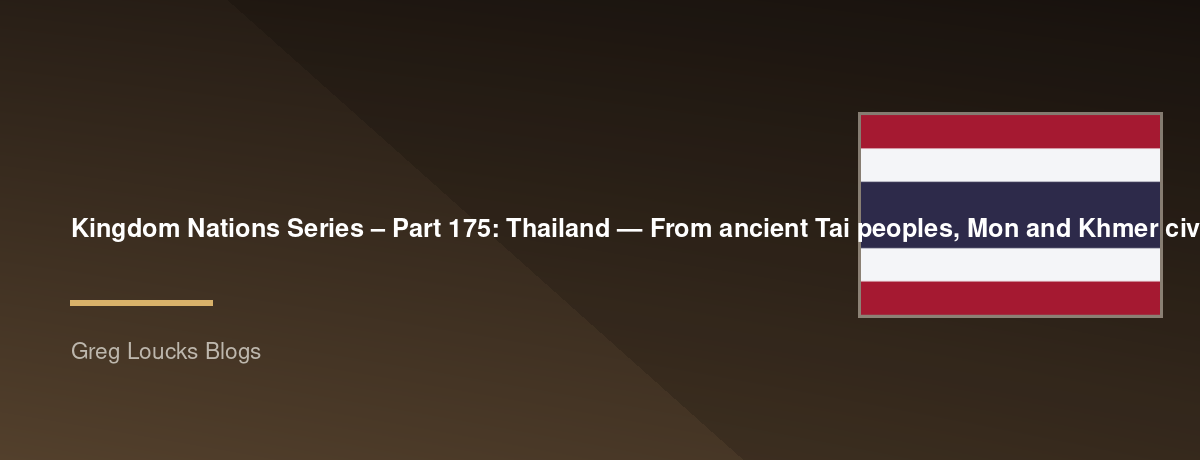
🌎 Kingdom Nations Series – Part 175: 🇹🇭 Thailand — From ancient Tai peoples, Mon and Khmer civilizations, Dvaravati, Srivijaya connections, Sukhothai, Ayutthaya, Lanna, Bangkok, the Chakri dynasty, King Rama I, King Rama V, Buddhism, Theravada

🌎 Kingdom Nations Series – Part 174 🇹🇭 Chapter 1 – Part 1 Thailand: The Kingdom at the Crossroads of Southeast Asia Ancient Peoples, Mon and Khmer Civilizations, Dvaravati, Srivijaya Connections, Sukhothai, Ayutthaya, Lanna, Bangkok, the Chakri Dynasty, Rama I, Rama V, Buddhism, Theravada Tradition, Temples, Thai Language, Siam, European Diplomacy, Modernization, World War II, Constitutional Monarchy, Bangkok, Chiang Mai, Phuket, the Chao Phraya River, Rice Agriculture, Elephants, Tropical Forests, Islands, Tourism, Manufacturing, Food Culture, Muay Thai, and Thailand's Kingdom Calling "Righteousness exalteth a nation: but sin is a reproach to any people." — Proverbs 14:34 Introduction Thailand is: A kingdom of rivers, mountains, temples, forests, islands, agriculture, commerce, and ancient Southeast Asian civilization. It occupies: The heart of: Mainland Southeast Asia. Thailand borders: Myanmar. Laos. Cambodia. And: Malaysia. It faces: The: Andaman Sea to the west. And: The: Gulf of Thailand to the east and south. Its geography includes: Mountains. Forests. River valleys. Rice plains. Tropical islands. Coastal regions. And: The: Chao Phraya River basin. Thailand's capital is: Bangkok. Its northern cultural capital is: Chiang Mai. Its southern regions contain: Phuket. Krabi. Ko Samui. And: Many other: Island and coastal communities. The Chao Phraya The: Chao Phraya River is: One of: Thailand's most important: Geographical features. River Civilization The Chao Phraya basin provided: Water. Transportation. Agriculture. Trade. And: Settlement. Bangkok Bangkok developed: Along: The: Chao Phraya. Rice The river plains became: Some of: Southeast Asia's most productive: Rice-growing regions. Rice Civilization Rice became: Central to: Thai agriculture. Culture. Cuisine. And: Economy. Mainland Southeast Asia Thailand sits: At a crossroads between: South Asia. China. The Mekong region. And: The Malay Peninsula. Ancient Peoples Long before: The modern Thai state: The region contained: Many: Different: Peoples. Languages. And: Kingdoms. Mon Peoples The: Mon were among: The ancient peoples who: Established: Major civilizations in: Mainland Southeast Asia. Dvaravati The: Dvaravati culture flourished: Across: Central Thailand and: Neighboring regions. Buddhism Dvaravati became: Closely associated with: Theravada Buddhism. Buddhist Art Dvaravati produced: Distinctive: Buddhist sculpture. Architecture. And: Religious art. Nakhon Pathom Nakhon Pathom became: An important: Center of: Early Buddhist civilization. Phra Pathom Chedi The: Phra Pathom Chedi is: One of: Thailand's most famous: Buddhist monuments. Khmer Civilization The: Khmer Empire also exercised: Significant influence over: Parts of: Modern Thailand. Angkor The: Angkor civilization developed: One of: Southeast Asia's: Greatest: Architectural traditions. Khmer Temples Khmer temples were: Built: Across: Northeastern and: Central parts of: Thailand. Phanom Rung Phanom Rung is: One of: Thailand's most impressive: Khmer: Temple complexes. Phimai Phimai contains: Another: Major Khmer: Temple. Indian Influence Indian civilization influenced: Southeast Asia through: Trade. Religion. Writing. Political ideas. And: Culture. Hinduism Hindu traditions influenced: Early: Southeast Asian: Kingdoms. Buddhism Buddhism eventually became: One of: The dominant: Religious traditions. Srivijaya Southern Thailand maintained: Connections with: The: Srivijaya maritime world. Maritime Trade The Malay Peninsula connected: The: Indian Ocean with: The: South China Sea. Trade Routes Merchants traveled: Between: India. Sri Lanka. Arabia. China. And: Southeast Asia. Tai Peoples Tai-speaking peoples: Moved: Southward over: Centuries. Tai Languages Tai languages became: Increasingly: Important across: Mainland Southeast Asia. Thai Language Modern Thai developed: Within: The wider: Tai linguistic family. Sukhothai One of: Thailand's most important: Early Thai kingdoms was: Sukhothai. Sukhothai Kingdom The: Kingdom of Sukhothai rose: In: The thirteenth century. Ramkhamhaeng King Ramkhamhaeng became: One of: Sukhothai's most famous: Rulers. Thai Script Tradition associates: Ramkhamhaeng with: The development of: Thai writing. Thai Alphabet The Thai script developed: From: Earlier: Indic-derived: Writing traditions. Theravada Buddhism Sukhothai embraced: Theravada Buddhism as: A central: Cultural tradition. Sukhothai Art Sukhothai art became: Known for: Graceful: Buddha images. Walking Buddha The: Walking Buddha became: An iconic: Sukhothai artistic form. Sukhothai Historical Park The: Sukhothai Historical Park preserves: The ruins of: The ancient: Kingdom. Ayutthaya After Sukhothai: Another kingdom became: Dominant. Ayutthaya Kingdom The: Ayutthaya Kingdom was founded: In: 1351. Ayutthaya Ayutthaya became: One of: Southeast Asia's greatest: Cities. Chao Phraya Ayutthaya was located: At: A strategic: River: Junction. International Trade Ayutthaya traded: With: China. Japan. India. Persia. Arabia. And: European powers. Portuguese The: Portuguese were among: The first: European powers to: Establish: Relations with: Ayutthaya. Dutch The: Dutch also: Established: Trading: Connections. French France developed: Diplomatic: Relations with: Ayutthaya. Persian Influence Persian merchants: Played: An important role in: Ayutthaya's: International trade. Japanese Community A Japanese: Trading community also: Established: Itself: At: Ayutthaya. Cosmopolitan City Ayutthaya became: A: Cosmopolitan: International: Capital. Destruction Ayutthaya was: Destroyed: By: Burmese forces in: 1767. Thonburi After Ayutthaya's: Fall: Taksin established: The: Kingdom of: Thonburi. King Taksin King Taksin reunified: Much of: The Thai: Kingdom. Bangkok After Taksin: A new: Dynasty rose: To: Power. Chakri Dynasty The: Chakri dynasty was founded: In: 1782. Rama I King Rama I became: The founder of: The: Chakri: Dynasty. Bangkok Capital Rama I established: Bangkok as: The: Capital. Rattanakosin The new royal center became: Known as: The: Rattanakosin kingdom. Grand Palace The: Grand Palace became: The: Royal: Center. Wat Phra Kaew The: Temple of the Emerald Buddha became: One of: Thailand's most sacred: Temples. Emerald Buddha The: Emerald Buddha became: A central: Symbol of: Thai: Monarchy and: Buddhism. Bangkok Bangkok grew: Into: A major: Regional: Capital. Rama II Rama II supported: Literature. Art. And: Culture. Thai Literature The royal court became: A center of: Thai: Literature. Sunthorn Phu Sunthorn Phu became: One of: Thailand's greatest: Poets. Rama III Rama III expanded: Trade. Especially: With: China. Chinese Influence Chinese merchants became: Important: Participants in: Thailand's: Economy. Rama IV King Mongkut, or: Rama IV, became: One of: Thailand's most famous: Kings. King Mongkut Rama IV promoted: Science. Education. And: International diplomacy. Anna Leonowens Rama IV became: Famous in: Western popular culture through: Stories associated with: Anna Leonowens. Historical Reality Popular Western portrayals: Often: Dramatize: The historical: Relationship. European Powers By the nineteenth century: European colonial: Expansion threatened: Southeast Asia. Burma British rule: Expanded: Across: Burma. French Indochina France established: Colonial control over: Vietnam. Cambodia. And: Laos. Siam Thailand was then: Known internationally as: Siam. Buffer State Siam became: A strategic: Buffer between: British and: French: Colonial: Territories. Rama V King Chulalongkorn, or: Rama V, became: One of: Thailand's most important: Modernizing: Kings. Modernization Rama V introduced: Major: Administrative: Reforms. Slavery Thailand: Gradually: Abolished: Slavery. Education Modern: Education: Expanded. Railways Railways: Were: Developed. Administration The state became: More: Centralized. Military The military was: Modernized. Diplomacy Diplomacy helped: Preserve: Siamese: Independence. Territorial Concessions Siam nevertheless: Lost: Territories to: European colonial: Powers. Independence Despite: These: Concessions: Siam remained: Independent. Rama VI Rama VI promoted: Thai: National identity. National Symbols Thailand developed: Modern: National symbols. Flag The modern: Thai flag became: A major: National: Symbol. Rama VII Rama VII reigned: During: A period of: Political transformation. 1932 Revolution In: 1932, Thailand's: Absolute monarchy was: Replaced: By: A: Constitutional: Monarchy. Constitutional Monarchy The king remained: Head of: State. But: Political power became: Shared with: Constitutional: Institutions. Siam to Thailand The country adopted: The name: Thailand in: The twentieth: Century. World War II Thailand became: Entangled: In: World War II. Japanese Occupation Japan: Occupied: Thailand. Allied Relationship Thailand's wartime: Position was: Complex. Free Thai Movement The: Free Thai Movement resisted: Japanese: Control. Postwar Thailand After: World War II: Thailand entered: A new: Political era. Cold War Thailand became: An important: U.S. ally during: The: Cold War. Military Politics Military coups: Played: A recurring: Role in: Modern Thai: Political history. Democracy Thailand has: Alternated: Between: Military: Governments. And: Democratic: Periods. Constitutional Monarchy The monarchy remains: A central: Institution of: Thai: National identity. Buddhism Theravada Buddhism is: Deeply embedded in: Thai: Culture. Theravada Thai Buddhism belongs: Primarily: To: The: Theravada tradition. Monks Monks play: Important: Roles in: Thai: Religious life. Temples Thailand contains: Thousands of: Buddhist: Temples. Wat Arun Wat Arun is: One of: Bangkok's most: Recognizable: Temples. Wat Pho Wat Pho is: Famous for: Its: Reclining Buddha. Reclining Buddha The: Reclining Buddha is: One of: Bangkok's most: Famous: Religious: Images. Wat Phra Kaew The: Temple of the Emerald Buddha is: Among: Thailand's: Most sacred: Temples. Chiang Mai Chiang Mai was: The historic: Center of: The: Lanna Kingdom. Lanna The: Lanna Kingdom developed: A distinctive: Northern Thai: Culture. Northern Thai Lanna culture includes: Distinctive: Architecture. Cuisine. Music. And: Religious: Traditions. Doi Suthep Wat Phra That Doi Suthep is: One of: Northern Thailand's: Most famous: Temples. Phuket Phuket is: One of: Thailand's most: Famous: Islands. Tourism Phuket became: A major: International: Tourism: Destination. Krabi Krabi is: Known for: Dramatic: Limestone: Cliffs. Islands. And: Beaches. Ko Samui Ko Samui became: Another: Major: Island: Destination. Southern Thailand Southern Thailand combines: Malay. Thai. Buddhist. And: Muslim: Cultural: Traditions. Islam Islam is: Especially: Important in: Southern Thailand. Malay Muslims Malay Muslim communities: Have: Deep: Historical: Roots in: The: South. Thai Muslims Thailand's: Muslim population includes: Malay. Thai. And: Other: Communities. Christianity Christianity is: A minority: Religion in: Thailand. Catholicism Catholic communities: Have: Historical: Roots in: The: Country. Protestantism Protestant churches: Also: Exist across: Thailand. Indigenous and Folk Traditions Thai Buddhism often: Interacts with: Traditional: Spirit beliefs. Spirit Houses Spirit houses are: Common throughout: Thailand. Brahmanism Hindu and: Brahmanical traditions: Continue: To: Influence: Royal: Ceremonies. Thai Culture Thai culture emphasizes: Hospitality. Respect. Family. Community. Religion. And: Tradition. Wai The: wai is: A traditional: Thai greeting. Respect Respect for: Elders. Teachers. Monks. And: The: Royal institution has: Historically been: Important. Thai Cuisine Thai cuisine is: One of: The world's most: Recognizable: Culinary: Traditions. Pad Thai Pad Thai became: An internationally: Famous: Thai: Dish. Tom Yum Tom Yum is: A famous: Spicy and: Sour: Soup. Green Curry Green curry is: Another: Iconic: Thai: Dish. Massaman Curry Massaman curry reflects: Historical: Muslim. Persian. Indian. And: Southeast Asian: Influences. Coconut Coconut is: Widely: Used in: Thai: Cuisine. Rice Rice is: The: Foundation of: Thai: Meals. Jasmine Rice Jasmine rice became: One of: Thailand's most: Famous: Agricultural: Products. Agriculture Thailand remains: A major: Agricultural: Producer. Rice Rice is: One of: Thailand's most: Important: Crops. Rubber Thailand is: A major: Natural: Rubber: Producer. Cassava Cassava is: An important: Crop. Sugar Sugarcane is: Also: Important. Fruits Thailand produces: Mangoes. Durian. Pineapple. Coconut. Bananas. And: Many: Other: Tropical: Fruits. Durian The: Durian is: One of: Southeast Asia's most: Famous: Fruits. Thai Seafood Thailand's: Coastal: Geography supports: A major: Seafood: Industry. Fishing Fishing has: Long been: Important to: Coastal: Communities. Manufacturing Thailand became: A major: Manufacturing: Economy. Automobiles Thailand developed: A major: Automotive: Industry. Electronics Electronics manufacturing: Became: Important. Tourism Tourism became: One of: Thailand's most: Important: Economic: Sectors. Bangkok Bangkok became: A major: Global: City. Thai Airways Thailand developed: A major: International: Aviation: Industry. Muay Thai Muay Thai is: Thailand's: National: Martial art. Eight Limbs Muay Thai is: Known as: The: "Art of Eight Limbs." Boxing It uses: Fists. Elbows. Knees. And: Shins. Global Sport Muay Thai became: A: Global: Combat: Sport. Elephants The: Asian elephant is: One of: Thailand's most: Important: Animals. Elephant Heritage Elephants have: Played: Important: Roles in: Thai: History. Elephant Conservation Wild elephant populations: Face: Habitat: Loss. And: Human-wildlife: Conflict. National Parks Thailand contains: Many: National: Parks. Khao Yai Khao Yai National Park is: One of: Thailand's most: Important: Protected: Areas. Tropical Forests Thailand's forests contain: Rich: Biodiversity. Wildlife Wildlife includes: Elephants. Tigers. Gibbons. Hornbills. Bears. And: Many: Other: Species. Tigers Wild tigers remain: Threatened. Marine Life Thailand's: Coasts contain: Coral reefs. Mangroves. Seagrass. And: Marine: Wildlife. Environmental Challenges Thailand faces: Deforestation. Air pollution. Water pollution. Plastic waste. Coral reef degradation. And: Climate: Change. Bangkok Bangkok faces: Flooding: Risks because of: Its: Low-lying: Geography. Chao Phraya The: Chao Phraya is: Essential to: Bangkok's: Future. Climate Change Rising: Sea levels pose: Long-term: Challenges for: Coastal: Thailand. Thailand's Identity Thailand combines: Theravada Buddhism. Mon heritage. Khmer heritage. Tai traditions. Lanna culture. Malay culture. Chinese heritage. Indian Ocean connections. And: Modern: Global: Culture. Kingdom Assignment Thailand's Kingdom assignment can be summarized as: Southeast Asian nation. Kingdom nation. Theravada Buddhist nation. Chao Phraya nation. Rice nation. Siam nation. Sukhothai nation. Ayutthaya nation. Lanna nation. Bangkok nation. Zanzibar? No — Thailand is: Gulf of Thailand nation. Andaman Sea nation. Mekong region nation. Island nation. Mountain nation. Tropical forest nation. Elephant nation. Muay Thai nation. Tourism nation. Manufacturing nation. Agricultural nation. Culinary nation. Maritime nation. Cultural crossroads nation. Prayer for Thailand Pray: For Thailand. For Bangkok. For Chiang Mai. For Phuket. For Krabi. For Pattaya. For Ayutthaya. For Sukhothai. For Nakhon Pathom. For every province. For every city. For every village. For the Thai people. For Tai-speaking communities. For Northern Thai communities. For Malay communities. For Chinese Thai communities. For Mon communities. For every ethnic community. For children. For youth. For women. For men. For elders. For farmers. For fishermen. For merchants. For teachers. For students. For doctors. For nurses. For engineers. For scientists. For entrepreneurs. For artists. For musicians. For writers. For monks. For temples. For Buddhist communities. For Muslim communities. For Christians. For churches. For every religious community. For religious freedom. For Thai. For local languages. For Indigenous and regional languages. For schools. For universities. For libraries. For historians. For archaeologists. For Sukhothai. For Ayutthaya. For Dvaravati heritage. For Khmer heritage. For Lanna heritage. For ancient temples. For the Grand Palace. For Wat Phra Kaew. For Wat Arun. For Wat Pho. For Doi Suthep. For Phanom Rung. For Phimai. For Nakhon Pathom. For the Chao Phraya. For the Mekong region. For the Gulf of Thailand. For the Andaman Sea. For the forests. For the mountains. For the islands. For coral reefs. For mangroves. For marine ecosystems. For elephants. For tigers. For gibbons. For hornbills. For wildlife. For conservationists. For wildlife rangers. For national parks. For Khao Yai. For agriculture. For rice farmers. For jasmine rice. For rubber farmers. For cassava growers. For sugarcane farmers. For fruit growers. For fisheries. For responsible tourism. For sustainable development. For manufacturing. For automobile workers. For electronics workers. For technology. For entrepreneurs. For Muay Thai athletes. For artists. For chefs. For Thai cuisine. For Bangkok's future. For flood protection. For climate resilience. For clean water. For clean air. For forests. For coastal protection. For coral reefs. For economic development. For education. For healthcare. For infrastructure. For honest government. For justice. For peace. For the constitutional monarchy. For responsible leadership. For national unity. For Thailand to become: A leader in Buddhist scholarship. A leader in Southeast Asian archaeology. A leader in tropical conservation. A leader in sustainable tourism. A leader in rice agriculture. A leader in responsible manufacturing. A leader in marine conservation. A leader in cultural diplomacy. For the nations. Thailand Before the Throne Thailand has experienced: Ancient Southeast Asian cultures. Mon civilization. Dvaravati. Khmer influence. Srivijaya connections. Tai migrations. Sukhothai. Ramkhamhaeng. Ayutthaya. International trade. Portuguese merchants. Dutch merchants. Persian merchants. Japanese merchants. French diplomacy. Burmese wars. Taksin. Thonburi. Rama I. Bangkok. The Chakri dynasty. Rama IV. Rama V. Modernization. Abolition of slavery. Railways. Constitutional government. World War II. Military rule. Democratic movements. Modern industry. Tourism. And: A continuing: Kingdom. From Dvaravati to Buddhism Thailand demonstrates: The power of: Religious: Civilization. From Khmer Temples to Thai Kingdoms Thailand demonstrates: The cultural: Interconnection of: Southeast Asia. From Sukhothai to Thai Identity Thailand demonstrates: The importance of: Language. Writing. Art. And: Religion. From Ayutthaya to Global Trade Thailand demonstrates: The power of: International: Commerce. From Ayutthaya to Bangkok Thailand demonstrates: The ability of: A civilization to: Rebuild: After: Catastrophe. From Rama I to Rama V Thailand demonstrates: The importance of: Institutional: Adaptation. From Siam to Thailand Thailand demonstrates: The evolution of: National: Identity. From Rama V to Modernization Thailand demonstrates: How: Diplomacy and: Reform can: Preserve: National: Independence. From 1932 to Constitutional Monarchy Thailand demonstrates: The transformation of: Political: Institutions. From Chao Phraya to Bangkok Thailand demonstrates: The power of: Rivers to: Build: Cities. From rice fields to manufacturing Thailand demonstrates: Economic: Transformation. From temples to tourism Thailand demonstrates: How: Cultural: Heritage can: Become: A bridge between: Nations. From Muay Thai to the World Thailand demonstrates: How: Traditional: Culture can: Become: Global. Kingdom Perspective Thailand teaches: A kingdom can preserve ancient traditions while adapting to modern political, economic, and technological realities. Sukhothai Teaches: Cultural: Formation. Ayutthaya Teaches: International: Commerce. Bangkok Teaches: Adaptation. Buddhism Teaches: Discipline. Temples Teach: Continuity. Rice Teaches: Provision. Chao Phraya Teaches: Connection. Elephants Teach: Stewardship. Muay Thai Teaches: Discipline. Rama V Teaches: Reform. Kingdom Calling Thailand's calling can be understood as: To serve as a bridge between South Asia, China, the Mekong region, and the maritime world, preserving its Buddhist and cultural heritage while advancing education, agriculture, environmental stewardship, diplomacy, technology, and peaceful prosperity. Thailand's Future Thailand can continue to lead in: Sustainable tourism. Rice agriculture. Food production. Automotive manufacturing. Electronics. Medical tourism. Marine conservation. Tropical forestry. Cultural preservation. Buddhist scholarship. Southeast Asian archaeology. Bangkok Bangkok can remain: A major: Asian: Global: City. Chiang Mai Chiang Mai can remain: A center of: Lanna: Culture. Ayutthaya Ayutthaya can become: An even greater: Center of: Historical: Preservation. Sukhothai Sukhothai can remain: A guardian of: Thai: Civilizational: Heritage. Phuket Phuket can become: A model of: Sustainable: Island: Tourism. Chao Phraya The Chao Phraya can remain: The: Lifeline of: Central: Thailand. Agriculture Thailand can continue: Producing: Food for: Its: People and: The: World. Forests Thailand can protect: Its: Tropical: Forests. Oceans Thailand can protect: Its: Coral reefs. Mangroves. And: Marine: Ecosystems. Elephants Thailand can lead: In: Responsible: Elephant: Conservation. Final Commission May Thailand become a nation of: Wisdom. Peace. Hospitality. Discipline. Stewardship. Prosperity. Justice. May Bangkok flourish. May Chiang Mai flourish. May Phuket flourish. May Krabi flourish. May Pattaya flourish. May Ayutthaya flourish. May Sukhothai flourish. May Nakhon Pathom flourish. May every province flourish. May every city flourish. May every village flourish. May Thai communities flourish. May Tai-speaking communities flourish. May Northern Thai communities flourish. May Malay communities flourish. May Chinese Thai communities flourish. May Mon communities flourish. May every ethnic community flourish. May children flourish. May youth flourish. May women flourish. May men flourish. May elders receive: Honor. May farmers prosper. May fishermen prosper. May merchants prosper. May teachers prosper. May students prosper. May doctors prosper. May nurses prosper. May engineers prosper. May scientists prosper. May entrepreneurs prosper. May artists prosper. May musicians prosper. May writers prosper. May monks flourish in: Wisdom. May temples remain: Protected. May Buddhist communities flourish. May Muslim communities flourish. May Christian communities flourish. May every religious community flourish. May religious freedom flourish. May Thai flourish. May local languages flourish. May schools flourish. May universities flourish. May libraries flourish. May historians flourish. May archaeologists flourish. May Sukhothai remain: Protected. May Ayutthaya remain: Protected. May Dvaravati heritage remain: Protected. May Khmer heritage remain: Protected. May Lanna heritage remain: Protected. May ancient temples remain: Protected. May the Grand Palace remain: Protected. May Wat Phra Kaew remain: Protected. May Wat Arun remain: Protected. May Wat Pho remain: Protected. May Doi Suthep remain: Protected. May Phanom Rung remain: Protected. May Phimai remain: Protected. May the Chao Phraya remain: Healthy. May the Mekong region flourish. May the Gulf of Thailand remain: Healthy. May the Andaman Sea remain: Healthy. May forests flourish. May mountains flourish. May islands flourish. May coral reefs flourish. May mangroves flourish. May marine ecosystems flourish. May elephants flourish. May tigers flourish. May gibbons flourish. May hornbills flourish. May wildlife flourish. May wildlife rangers be: Protected. May conservationists be: Strengthened. May national parks flourish. May Khao Yai remain: Protected. May agriculture flourish. May rice farmers prosper. May jasmine rice production flourish. May rubber farmers prosper. May cassava growers prosper. May sugarcane farmers prosper. May fruit growers prosper. May fisheries flourish. May responsible tourism flourish. May sustainable development flourish. May manufacturing flourish. May automobile workers prosper. May electronics workers prosper. May technology flourish. May entrepreneurs prosper. May Muay Thai flourish. May Thai arts flourish. May Thai cuisine flourish. May Bangkok's future be: Secure. May flood protection improve. May climate resilience improve. May clean water reach: Every community. May clean air become: A reality. May coastal protection improve. May coral reef protection improve. May economic development flourish. May education flourish. May healthcare flourish. May infrastructure flourish. May honest government flourish. May justice flourish. May peace flourish. May constitutional institutions flourish. May responsible leadership flourish. May national unity flourish. May Thailand become: A leader in Buddhist scholarship. May Thailand become: A leader in Southeast Asian archaeology. May Thailand become: A leader in tropical conservation. May Thailand become: A leader in sustainable tourism. May Thailand become: A leader in rice agriculture. May Thailand become: A leader in responsible manufacturing. May Thailand become: A leader in marine conservation. May Thailand become: A leader in cultural diplomacy. May Thailand contribute: To peace in Southeast Asia. May Thailand contribute: To cultural understanding. May Thailand contribute: To environmental stewardship. May Thailand contribute: To the flourishing of the nations. May its rivers provide: Life. May its rice fields provide: Food. May its forests provide: Shelter. May its mountains provide: Water. May its oceans provide: Connection. May its temples provide: Wisdom. May its people provide: Hospitality. And may the people of Thailand, together with every nation, tribe, people, and language, remember: "Righteousness exalteth a nation: but sin is a reproach to any people." (Proverbs 14:34) Amen. 🇹🇭 Kingdom Nations Series – Part 174 Thailand From ancient peoples to Dvaravati. From Dvaravati to Theravada Buddhism. From Mon civilization to Thai civilization. From Khmer temples to Southeast Asian cultural exchange. From Srivijaya to maritime connections. From Tai migrations to Sukhothai. From Sukhothai to Ramkhamhaeng. From Ramkhamhaeng to Thai writing. From Thai writing to Thai identity. From Sukhothai to Ayutthaya. From Ayutthaya to international trade. From China to Persia. From India to Japan. From Portugal to the Netherlands. From France to Siamese diplomacy. From Ayutthaya to destruction. From Taksin to Thonburi. From Thonburi to Bangkok. From Rama I to the Chakri dynasty. From the Grand Palace to Rattanakosin. From Wat Phra Kaew to the Emerald Buddha. From Rama II to literature. From Sunthorn Phu to Thai poetry. From Rama III to Chinese trade. From Rama IV to science and diplomacy. From Rama V to modernization. From abolition to reform. From railways to national integration. From Siam to Thailand. From 1932 to constitutional monarchy. From World War II to modern Thailand. From military rule to democratic movements. From Chiang Mai to Lanna. From Doi Suthep to northern Buddhist culture. From Phuket to island tourism. From Krabi to limestone landscapes. From the Chao Phraya to Bangkok. From rice fields to national prosperity. From jasmine rice to global agriculture. From rubber to export markets. From manufacturing to industry. From electronics to technology. From tourism to global connection. From Muay Thai to the world. From elephants to conservation. From Khao Yai to tropical forests. From coral reefs to marine stewardship. From Buddhism to spiritual heritage. From Islam to southern Thailand. From Christianity to minority communities. From temples to cultural continuity. From food to hospitality. From Thailand to Southeast Asia. From Thailand to the Mekong region. From Thailand to the Indian Ocean. From Thailand to the nations. From Thailand to the Kingdom. From the Kingdom at the Crossroads of Southeast Asia to the throne. End of Kingdom Nations Series – Part 174: 🇹🇭 Thailand Coming Next: 🌎 Kingdom Nations Series – Part 175: 🇹🇱 Timor-Leste — From ancient Austronesian and Papuan peoples, Timorese kingdoms, animist traditions, Portuguese Timor, Dominican missions, sandalwood trade, Dutch and Portuguese rivalry, the Timorese resistance, World War II, Japanese occupation, Indonesian occupation, independence, Xanana Gusmão, Dili, the Timor Sea, mountains, coral reefs, coffee, agriculture, Tetum, Portuguese, Indigenous languages, Catholic Christianity, traditional houses, tais, maritime culture, oil and gas, reconciliation, and Timor-Leste's Kingdom calling.    
Read more 🌎 Kingdom Nations Series – Part 175: 🇹🇭 Thailand — From ancient Tai peoples, Mon and Khmer civilizations, Dvaravati, Srivijaya connections, Sukhothai, Ayutthaya, Lanna, Bangkok, the Chakri dynasty, King Rama I, King Rama V, Buddhism, Theravada

🌎 Kingdom Nations Series – Part 173: 🇹🇿 Tanzania — From ancient East African civilizations, Bantu migrations, Swahili coast, Kilwa, Zanzibar, Great Lakes cultures, Arab and Persian trade, Portuguese exploration, Omani Zanzibar

🌎 Kingdom Nations Series – Part 173 🇹🇿 Chapter 1 – Part 1 Tanzania: The Cradle of East African Heritage Ancient East Africa, Bantu Migrations, Swahili Civilization, Kilwa, Zanzibar, Arab and Persian Trade, Portuguese Exploration, Omani Zanzibar, the Slave Trade and Its Abolition, German East Africa, Tanganyika, British Rule, Independence, Julius Nyerere, Ujamaa, Zanzibar, the Union, Dar es Salaam, Dodoma, Mount Kilimanjaro, Serengeti, Ngorongoro, Lake Victoria, Lake Tanganyika, the Indian Ocean, Maasai Culture, Swahili, Wildlife Conservation, Agriculture, Tourism, and Tanzania's Kingdom Calling "Let the heavens be glad, and let the earth rejoice: and let men say among the nations, The LORD reigneth." — 1 Chronicles 16:31 Introduction Tanzania is: One of Africa's great nations of mountains, wildlife, lakes, islands, ancient cultures, and Indian Ocean civilization. It occupies: A vast portion of: East Africa. It borders: Kenya. Uganda. Rwanda. Burundi. Democratic Republic of the Congo. Zambia. Malawi. And: Mozambique. To the east lies: The: Indian Ocean. Tanzania also contains: Some of: Africa's most famous: Natural landmarks. Mount Kilimanjaro. Serengeti National Park. Ngorongoro Crater. Lake Victoria. Lake Tanganyika. Lake Nyasa/Malawi. And: The islands of: Zanzibar. Pemba. And: Mafia. Tanzania is therefore: A nation of: Mountains. Savannas. Lakes. Forests. Islands. Coral reefs. Rivers. Wildlife. And: Ancient human history. The Great Lakes Tanzania is connected to: The: African Great Lakes system. Lake Victoria Lake Victoria lies: Along: Tanzania's northern frontier. It is: Africa's largest: Lake by: Surface area. Lake Tanganyika Lake Tanganyika lies: Along: Tanzania's western frontier. It is: One of: The world's deepest: Lakes. Lake Malawi Lake Malawi lies: Along: Tanzania's southwestern: Border. Great Lakes Civilization The Great Lakes region has: Supported: Human communities for: Thousands of: Years. Indian Ocean Tanzania's eastern coast opens: Into: The: Indian Ocean. Swahili Coast The: Swahili Coast extends: Along: East Africa. Swahili Civilization Swahili civilization developed: Through: The interaction of: African. Arab. Persian. Indian. And: Other: Maritime cultures. Swahili Language Swahili, or: Kiswahili, became: One of: Africa's most important: Languages. Bantu Language Swahili belongs: To: The: Bantu branch of: The: Niger-Congo language family. Arabic Influence Swahili contains: A substantial: Arabic-derived: Vocabulary. Indian Ocean The Indian Ocean connected: East Africa with: Arabia. Persia. India. And: Southeast Asia. Ancient East Africa Tanzania's human history: Reaches: Deep into: Prehistory. Olduvai Gorge Olduvai Gorge is: One of: The world's most important: Paleoanthropological: Sites. Human Origins Fossils discovered in: The: Olduvai region have: Provided important: Evidence for: Human evolution. Laetoli Laetoli is famous for: Ancient: Hominin footprints. Footprints The: Laetoli footprints preserve: Evidence of: Early: Bipedal walking. Human Heritage Northern Tanzania therefore holds: A remarkable place in: The study of: Human origins. Bantu Expansion Later: Bantu-speaking peoples migrated: Across: Large areas of: Sub-Saharan Africa. Bantu Languages Bantu languages became: Dominant across: Much of: Eastern and: Central Africa. Agriculture Bantu communities brought: Agriculture. Ironworking. Livestock. And: New settlement patterns. Ironworking Iron technology transformed: East African: Communities. Farming Crops included: Millet. Sorghum. Bananas. And: Other: Staples. Pastoralism Pastoral societies also: Developed: Across: Northern Tanzania. Maasai The: Maasai are: One of: Tanzania's best-known: Pastoral peoples. Maasai Culture Maasai society traditionally emphasizes: Cattle. Community. Age-set systems. Warrior traditions. And: Pastoral life. Cattle Cattle remain: Central to: Maasai cultural identity. Pastoral Landscapes Maasai communities traditionally: Moved: With: Their herds across: Grasslands. Other Peoples Tanzania contains: More than: One hundred: Ethnic communities. Chagga The: Chagga live: Around: Mount Kilimanjaro. Sukuma The: Sukuma are: Tanzania's largest: Ethnic group. Hehe The: Hehe have: A significant: Historical tradition in: Central Tanzania. Nyamwezi The: Nyamwezi played: An important role in: Long-distance: Trade. Zaramo The: Zaramo are: Historically associated with: The: Dar es Salaam: Region. Swahili People Swahili communities: Developed: Along: The: Indian Ocean coast. Kilwa Kilwa Kisiwani became: One of: East Africa's greatest: Medieval: Trading cities. Kilwa Sultanate Kilwa became: A major: Swahili: Sultanate. Gold Trade Kilwa's prosperity was: Closely connected with: The: Gold trade from: Southern Africa. Ivory Ivory also: Moved: Through: Swahili ports. Spices Spices and: Other: Luxury goods were: Traded across: The: Indian Ocean. Kilwa Coins Kilwa produced: Its own: Coinage. Great Mosque of Kilwa The: Great Mosque of Kilwa is: One of: The most important: Historic: Islamic buildings on: The East African coast. Persian Connections Swahili traditions preserve: Historical: Connections with: Persian merchants. Shirazi Tradition Swahili historical traditions include: Stories of: Persian: Shirazi origins. African Foundation Modern scholarship emphasizes: The: Deeply: African foundation of: Swahili civilization. Islam Islam became: Deeply established along: The: Swahili Coast. Mosques Coastal towns developed: Mosques. Markets. Stone houses. And: Merchant communities. Zanzibar Zanzibar became: One of: The most important: Islands in: The: Western Indian Ocean. Stone Town Stone Town is: The historic heart of: Zanzibar City. Zanzibar Architecture Stone Town contains: African. Arab. Indian. Persian. And: European: Architectural influences. Zanzibar Sultanate Zanzibar became: The center of: An: Omani: Sultanate. Oman The: Omani Sultanate expanded: Its influence across: The: Swahili Coast. Sultan Said bin Sultan Said bin Sultan moved: His capital to: Zanzibar in: The nineteenth century. Clove Trade Zanzibar became: A major producer of: Cloves. Spices Other: Spices also became: Important. Ivory Zanzibar became: A major: Commercial center for: Ivory. Slave Trade Zanzibar also became: A major center of: The: East African slave trade. Human Cost The slave trade caused: Enormous: Human suffering. David Livingstone David Livingstone became: One of: The most famous: Opponents of: The East African: Slave trade. Missionaries Christian missionaries: Established: Communities across: East Africa. Anti-Slavery British pressure: Eventually contributed to: The suppression and: Abolition of: The slave trade. Christianity Christianity expanded: Across: The interior. Catholic Missions Catholic missionaries: Established: Schools. Hospitals. And: Churches. Protestant Missions Protestant missions: Also: Expanded. Education Mission schools became: Important centers of: Education. German East Africa European colonial competition: Eventually transformed: Tanzania. Berlin Conference European powers: Partitioned: Large areas of: Africa. German Rule Germany established: Control over: Much of: Modern Tanzania. German East Africa The territory became: Known as: German East Africa. Maji Maji Rebellion The: Maji Maji Rebellion began: In:   Resistance African communities: Resisted: German colonial: Rule. Maji Maji The rebellion became: One of: The most significant: Anti-colonial uprisings in: German Africa. Colonial Violence German repression caused: Massive: Loss of life. World War I World War I: Transformed: German East Africa. British Rule After the war: The League of Nations: Placed: Tanganyika under: British: Administration. Tanganyika The mainland territory became: Known as: Tanganyika. Zanzibar Zanzibar remained: A separate: British: Protectorate. Independence Tanganyika gained: Independence in: 1961. Julius Nyerere Julius Nyerere became: The country's: Founding: President. Nyerere Nyerere became: One of: Africa's most influential: Post-independence: Leaders. Ujamaa Nyerere promoted: Ujamaa, often translated as: African socialism or: familyhood. Rural Development Ujamaa emphasized: Collective: Community life. Rural: Development. And: Self-reliance. Education Nyerere strongly promoted: Universal: Education. Adult Literacy Tanzania made: Major: Progress in: Literacy. National Identity Nyerere promoted: Tanzanian: National unity. Swahili Swahili became: A major: National: Language. Ethnic Unity Swahili helped: Create: A common: National identity across: Many: Ethnic groups. Zanzibar Revolution In: 1964, a revolution occurred: In: Zanzibar. Union Tanganyika and: Zanzibar united: Later in: 1964. Tanzania The: United Republic of Tanzania was: Created. Tanzania The name: "Tanzania" combines: Tanganyika and: Zanzibar. Dar es Salaam Dar es Salaam became: The country's: Major: Commercial and: Political center. Dodoma Dodoma was designated: As: The: National capital. Dar es Salaam Dar es Salaam remains: Tanzania's: Largest: City. Dodoma Dodoma serves: As: The: Political: Capital. Tanzania's Geography Tanzania is: One of: Africa's: Largest countries. Mount Kilimanjaro Mount Kilimanjaro is: Africa's: Highest: Mountain. Uhuru Peak Its highest summit is: Uhuru Peak. Kilimanjaro Kilimanjaro is: A: Stratovolcano: Massif. Snow Its glaciers and: Ice fields have: Declined dramatically: Over: Recent decades. Climate Change Kilimanjaro demonstrates: The effects of: Climate: Change. Serengeti The: Serengeti is: One of: Africa's greatest: Wildlife: Ecosystems. Serengeti National Park The: Serengeti National Park is: World-famous for: Its: Wildlife. Great Migration The: Great Migration involves: Millions of: Wildebeest. Zebra. And: Other: Animals. Wildebeest Wildebeest move: Across: The: Serengeti ecosystem in: Search of: Fresh: Grass. And: Water. Predators The Serengeti supports: Lions. Leopards. Cheetahs. Hyenas. And: Other: Predators. Elephants Elephants: Roam: Across: Tanzania's: Savannas. Giraffes The: Giraffe is: One of: Tanzania's iconic: Animals. Rhinos Black rhinos: Remain: Critically: Threatened. Conservation Tanzania has: Large areas dedicated to: Wildlife: Conservation. Ngorongoro The: Ngorongoro Conservation Area is: One of: Africa's most: Remarkable: Protected landscapes. Ngorongoro Crater The: Ngorongoro Crater is: A massive: Volcanic: Caldera. Wildlife The crater contains: Large populations of: Wildlife. Olduvai Olduvai Gorge lies: Within: The: Ngorongoro region. Archaeology The landscape therefore combines: Wildlife. Geology. And: Human: Prehistory. Tarangire Tarangire National Park is: Known for: Elephants. Baobabs. And: Seasonal: Wildlife concentrations. Ruaha Ruaha National Park is: One of: Tanzania's: Largest: Protected areas. Selous The: Selous Game Reserve has: Historically been: One of: Africa's largest: Protected areas. Nyerere National Park The Selous ecosystem is now: Largely incorporated into: Nyerere National Park. Marine Conservation Tanzania also possesses: Important: Marine: Ecosystems. Mafia Island Mafia Island contains: Coral reefs. Mangroves. And: Marine habitats. Mafia Island Marine Park The: Mafia Island Marine Park protects: Important: Marine: Ecosystems. Pemba Pemba Island is: Known for: Cloves. Coral reefs. And: Diving. Zanzibar Zanzibar is: Known for: Beaches. Spices. History. And: Stone Town. Indian Ocean Trade Zanzibar demonstrates: The long: Historical connection between: Africa. Arabia. Persia. India. And: The wider: Indian Ocean. Swahili Swahili is: One of: The most important: African languages. Regional Language It is: Widely spoken across: East Africa. Tanzania Swahili serves as: A central: National language. Kenya Swahili is: Also: A major: National language. Uganda Swahili is: Also: Used in: Uganda. Democratic Republic of Congo Swahili is: Widely spoken: In: Eastern: DR Congo. Great Lakes Swahili connects: Communities across: The: Great Lakes region. Literature Swahili has: A rich: Literary: Tradition. Poetry Swahili poetry: Developed: Along: The: Swahili Coast. Music Tanzania has: Produced: Major: Musical traditions. Taarab Taarab developed: On: The: Swahili Coast. Bongo Flava Bongo Flava became: A major: Contemporary: Tanzanian music genre. Music Industry Dar es Salaam became: A major: East African: Music center. Culture Tanzanian culture combines: African. Swahili. Islamic. Christian. Indigenous. Indian. And: Arab: Influences. Food Tanzanian cuisine reflects: Its: Agricultural and: Coastal: Heritage. Ugali Ugali is: One of: East Africa's: Staple: Foods. Pilau Pilau reflects: Swahili and: Indian Ocean: Influences. Chapati Chapati is: Widely eaten: Across: Tanzania. Zanzibar Spice Zanzibar became: Famous as: The: Spice Island. Cloves Cloves remain: An important: Part of: Zanzibar's: Agricultural identity. Coffee Coffee production is: Important in: Northern Tanzania. Kilimanjaro Coffee Coffee grown around: Mount Kilimanjaro is: Internationally: Recognized. Tea Tea is: Cultivated in: Several regions. Cashews Cashews are: An important: Export crop. Sisal Sisal became: Historically important: To: Tanzania's: Agricultural economy. Agriculture Agriculture remains: Central to: Tanzania's: Economy. Livestock Livestock production: Is: Important across: The: Country. Fisheries Lake and: Ocean: Fisheries support: Coastal and: Lakeside: Communities. Natural Resources Tanzania possesses: Significant: Natural resources. Gold Gold mining is: Important. Diamonds Tanzania has: Diamond: Resources. Tanzanite Tanzanite is: A gemstone found: Near: Mount Kilimanjaro. Tanzanite The gemstone became: One of: Tanzania's most famous: Natural: Products. Gas Natural gas resources: Have: Also: Been: Developed. Tourism Tourism is: One of: Tanzania's most important: Industries. Safari Tanzania is: One of: The world's most famous: Safari: Destinations. Kilimanjaro Climbing Kilimanjaro: Attracts: Visitors from: Around: The world. Serengeti The Serengeti attracts: Millions of: Wildlife: Travelers. Zanzibar Zanzibar attracts: Beach. Cultural. And: Historical: Tourism. Ngorongoro Ngorongoro attracts: Visitors interested in: Wildlife. Geology. And: Human: Origins. Conservation Challenges Tanzania faces: Poaching. Habitat: Loss. Human-wildlife: Conflict. And: Climate: Change. Wildlife Corridors Protecting: Wildlife: Migration routes is: Essential. Serengeti Migration The Great Migration depends: Upon: Large connected: Ecosystems. Maasai and Conservation Conservation policy must: Consider: The: Rights and: Livelihoods of: Local communities. Indigenous and Local Communities Traditional: Knowledge can: Contribute to: Environmental stewardship. Tanzania's National Identity Tanzania's identity is: Deeply connected to: Swahili. Kiswahili. Ujamaa. Wildlife. Kilimanjaro. Zanzibar. Serengeti. And: The Indian Ocean. Kingdom Assignment Tanzania's Kingdom assignment can be summarized as: East African nation. Swahili nation. Indian Ocean nation. Great Lakes nation. Mountain nation. Kilimanjaro nation. Serengeti nation. Wildlife nation. Safari nation. Zanzibar nation. Spice nation. Swahili Coast nation. Kilwa nation. Maasai cultural nation. Agricultural nation. Lake nation. Conservation nation. Tourism nation. Ujamaa nation. Unity nation. Pan-African nation. Prayer for Tanzania Pray: For Tanzania. For Dodoma. For Dar es Salaam. For Zanzibar. For Stone Town. For Arusha. For Mwanza. For Mbeya. For Moshi. For Tanga. For Kigoma. For every region. For every city. For every village. For the Maasai. For the Sukuma. For the Chagga. For the Nyamwezi. For the Hehe. For the Zaramo. For Swahili communities. For every ethnic community. For Indigenous and local communities. For children. For youth. For women. For men. For elders. For farmers. For fishermen. For pastoralists. For teachers. For students. For doctors. For nurses. For scientists. For engineers. For entrepreneurs. For artists. For musicians. For writers. For churches. For pastors. For Christian communities. For Muslim communities. For coastal Islamic communities. For every religious community. For religious freedom. For Swahili. For local languages. For Indigenous languages. For schools. For universities. For researchers. For archaeologists. For Olduvai Gorge. For Laetoli. For Kilwa Kisiwani. For Stone Town. For Zanzibar. For Pemba. For Mafia Island. For the Swahili Coast. For the Indian Ocean. For Lake Victoria. For Lake Tanganyika. For Lake Malawi. For the Great Lakes. For Mount Kilimanjaro. For Uhuru Peak. For Mount Meru. For the Serengeti. For Ngorongoro. For Tarangire. For Ruaha. For Nyerere National Park. For every national park. For wildlife. For elephants. For lions. For cheetahs. For leopards. For giraffes. For rhinos. For wildebeest. For zebras. For African wild dogs. For conservationists. For wildlife rangers. For wildlife corridors. For marine ecosystems. For coral reefs. For mangroves. For sea turtles. For fisheries. For Zanzibar. For Pemba. For Mafia Island. For agriculture. For coffee farmers. For tea growers. For cashew farmers. For spice growers. For clove farmers. For livestock keepers. For sustainable agriculture. For responsible mining. For Tanzanite. For gold mining. For natural gas development. For tourism. For safari operators. For local guides. For hospitality workers. For responsible tourism. For environmental protection. For climate resilience. For drought protection. For water management. For coastal protection. For economic development. For education. For healthcare. For infrastructure. For honest government. For justice. For peace. For national unity. For Tanzania to become: A leader in wildlife conservation. A leader in sustainable tourism. A leader in Swahili scholarship. A leader in Indian Ocean studies. A leader in Great Lakes research. A leader in biodiversity protection. A leader in sustainable agriculture. A leader in marine conservation. For the nations. Tanzania Before the Throne Tanzania has experienced: Ancient human communities. Olduvai. Laetoli. Bantu migrations. Ironworking. Agriculture. Pastoralism. Maasai culture. Swahili civilization. Kilwa. Indian Ocean trade. Arab trade. Persian connections. Indian merchants. Islam. Christian missions. Zanzibar. Omani rule. The slave trade. Anti-slavery campaigns. German East Africa. The Maji Maji Rebellion. British rule. Tanganyika. Independence. Julius Nyerere. Ujamaa. The Zanzibar Revolution. Union. Tanzania. And: Modern: African nationhood. From Olduvai to Humanity Tanzania demonstrates: The profound: Depth of: Human history. From Laetoli to Walking Tanzania demonstrates: The extraordinary: Story of: Human development. From Bantu Expansion to Tanzania Tanzania demonstrates: The importance of: Migration. From Kilwa to the Indian Ocean Tanzania demonstrates: The power of: Maritime: Civilization. From Zanzibar to the Spice Islands Tanzania demonstrates: The connection between: Africa. Arabia. Persia. India. And: The: Ocean. From the Slave Trade to Abolition Tanzania demonstrates: The devastating: Human cost of: Exploitation. From Maji Maji to Independence Tanzania demonstrates: The determination of: African communities to: Resist: Colonial rule. From Nyerere to Ujamaa Tanzania demonstrates: The search for: African: Self-determination. From Tanganyika and Zanzibar to Tanzania Tanzania demonstrates: The possibility of: Political: Union. From Kilimanjaro to the Serengeti Tanzania demonstrates: The extraordinary: Diversity of: Creation. From Swahili to Unity Tanzania demonstrates: How: A shared language can: Help unite: A diverse: Nation. Kingdom Perspective Tanzania teaches: A nation can preserve extraordinary ancient heritage while using language, unity, conservation, and hospitality to build a shared future. Kilimanjaro Teaches: Greatness. Serengeti Teaches: Movement. Ngorongoro Teaches: Creation's: Complexity. Zanzibar Teaches: Connection. Kilwa Teaches: Trade. Olduvai Teaches: Memory. Laetoli Teaches: Origins. Swahili Teaches: Unity. Ujamaa Teaches: Community. Wildlife Teaches: Stewardship. Indian Ocean Teaches: Connection between: Peoples. Kingdom Calling Tanzania's calling can be understood as: To serve as a bridge between the African interior and the Indian Ocean, protecting its extraordinary wildlife and landscapes while preserving Swahili civilization, strengthening national unity, advancing education and sustainable development, and becoming a center of African hospitality and conservation. Tanzania's Future Tanzania can continue to develop: Wildlife conservation. Sustainable tourism. Swahili scholarship. Marine conservation. Agriculture. Renewable energy. Mountain research. Great Lakes science. Archaeology. Cultural tourism. Indian Ocean trade. Dodoma Dodoma can remain: The: Political heart of: Tanzania. Dar es Salaam Dar es Salaam can remain: The: Commercial gateway to: The: Indian Ocean. Zanzibar Zanzibar can become: An even greater: Center of: Swahili heritage. Marine conservation. And: Responsible tourism. Kilwa Kilwa can become: A major: Center of: Swahili archaeological research. Kilimanjaro Kilimanjaro can remain: A global: Symbol of: Africa. Serengeti The Serengeti can remain: A global: Model of: Wildlife conservation. Ngorongoro Ngorongoro can remain: A center of: Conservation. Archaeology. And: Cultural heritage. Swahili Swahili can continue: Serving as: A bridge between: East African: Nations. Conservation Tanzania can demonstrate: That: Economic development and: Wildlife protection can: Work together. Indian Ocean Tanzania can become: A major: Center of: Indian Ocean cooperation. Final Commission May Tanzania become a nation of: Peace. Unity. Hospitality. Wisdom. Stewardship. Conservation. Prosperity. May Dodoma flourish. May Dar es Salaam flourish. May Zanzibar flourish. May Stone Town flourish. May Arusha flourish. May Mwanza flourish. May Mbeya flourish. May Moshi flourish. May Tanga flourish. May Kigoma flourish. May every region flourish. May every city flourish. May every village flourish. May the Maasai flourish. May the Sukuma flourish. May the Chagga flourish. May the Nyamwezi flourish. May the Hehe flourish. May the Zaramo flourish. May Swahili communities flourish. May every ethnic community flourish. May Indigenous and local communities flourish. May children flourish. May youth flourish. May women flourish. May men flourish. May elders receive: Honor. May farmers prosper. May fishermen prosper. May pastoralists prosper. May teachers prosper. May students prosper. May doctors prosper. May nurses prosper. May scientists prosper. May engineers prosper. May entrepreneurs prosper. May artists prosper. May musicians prosper. May writers prosper. May churches flourish. May Christian communities flourish. May Muslim communities flourish. May every religious community flourish. May religious freedom flourish. May Swahili flourish. May local languages flourish. May Indigenous languages flourish. May schools flourish. May universities flourish. May researchers flourish. May archaeologists flourish. May Olduvai remain: Protected. May Laetoli remain: Protected. May Kilwa remain: Protected. May Stone Town remain: Protected. May Zanzibar's heritage remain: Protected. May Pemba flourish. May Mafia Island flourish. May the Swahili Coast flourish. May the Indian Ocean remain: Healthy. May Lake Victoria remain: Healthy. May Lake Tanganyika remain: Healthy. May Lake Malawi remain: Healthy. May the Great Lakes remain: Protected. May Mount Kilimanjaro remain: Protected. May Uhuru Peak remain: Protected. May Mount Meru remain: Protected. May Serengeti remain: Protected. May Ngorongoro remain: Protected. May Tarangire remain: Protected. May Ruaha remain: Protected. May Nyerere National Park remain: Protected. May every national park flourish. May elephants flourish. May lions flourish. May cheetahs flourish. May leopards flourish. May giraffes flourish. May rhinos flourish. May wildebeest flourish. May zebras flourish. May African wild dogs flourish. May wildlife rangers be: Protected. May conservationists be: Strengthened. May wildlife corridors remain: Open. May coral reefs flourish. May mangroves flourish. May sea turtles flourish. May fisheries flourish. May agriculture flourish. May coffee farmers prosper. May tea growers prosper. May cashew farmers prosper. May spice growers prosper. May clove farmers prosper. May livestock keepers prosper. May sustainable agriculture flourish. May responsible mining flourish. May Tanzanite benefit: Local communities. May gold mining be: Responsible. May natural gas development benefit: The people. May tourism flourish. May safari operators prosper. May local guides prosper. May hospitality workers prosper. May responsible tourism flourish. May environmental protection flourish. May climate resilience flourish. May drought resilience improve. May water management improve. May coastal protection improve. May economic development flourish. May education flourish. May healthcare flourish. May infrastructure improve. May honest government flourish. May justice flourish. May national unity flourish. May peace flourish. May Tanzania become: A leader in wildlife conservation. May Tanzania become: A leader in sustainable tourism. May Tanzania become: A leader in Swahili scholarship. May Tanzania become: A leader in Indian Ocean studies. May Tanzania become: A leader in Great Lakes research. May Tanzania become: A leader in biodiversity protection. May Tanzania become: A leader in sustainable agriculture. May Tanzania become: A leader in marine conservation. May Tanzania contribute: To peace in East Africa. May Tanzania contribute: To unity among African nations. May Tanzania contribute: To conservation across the continent. May Tanzania contribute: To the flourishing of the nations. May its mountains inspire: Greatness. May its savannas inspire: Wonder. May its lakes provide: Life. May its rivers provide: Provision. May its farms provide: Food. May its oceans provide: Connection. May its wildlife provide: A testimony to stewardship. May its language provide: Unity. May its people provide: Hospitality. And may the people of Tanzania, together with every nation, tribe, people, and language, remember: "Let the heavens be glad, and let the earth rejoice: and let men say among the nations, The LORD reigneth." (1 Chronicles 16:31) Amen. 🇹🇿 Kingdom Nations Series – Part 173 Tanzania From Olduvai to humanity. From Laetoli to human origins. From Bantu migrations to East African civilization. From ironworking to agriculture. From pastoralism to the Maasai. From Lake Victoria to the Great Lakes. From Lake Tanganyika to the western frontier. From Lake Malawi to the south. From the Great Lakes to the Indian Ocean. From the Indian Ocean to the Swahili Coast. From Swahili civilization to Kilwa. From Kilwa to gold and ivory trade. From Kilwa to Indian Ocean commerce. From Persian connections to African foundations. From Arabia to Zanzibar. From Oman to the Zanzibar Sultanate. From cloves to the Spice Islands. From ivory to global trade. From the slave trade to abolition. From David Livingstone to the anti-slavery movement. From Christianity to mission schools. From German East Africa to resistance. From Maji Maji to African resilience. From World War I to British Tanganyika. From Tanganyika to independence. From Julius Nyerere to national unity. From Ujamaa to African self-reliance. From Zanzibar Revolution to union. From Tanganyika and Zanzibar to Tanzania. From Dar es Salaam to the Indian Ocean. From Dodoma to national government. From Kilimanjaro to Africa's highest mountain. From Uhuru Peak to freedom. From Serengeti to the Great Migration. From wildebeest to ecological movement. From Ngorongoro to volcanic landscapes. From Olduvai to archaeology. From Tarangire to elephants. From Ruaha to wilderness. From Nyerere National Park to conservation. From Mafia to coral reefs. From Pemba to spices. From Zanzibar to Stone Town. From Swahili to East African unity. From Bongo Flava to modern African culture. From coffee to Kilimanjaro agriculture. From cashews to coastal agriculture. From Tanzanite to natural resources. From safari to global tourism. From wildlife to stewardship. From conservation to future generations. From Tanzania to East Africa. From Tanzania to the Indian Ocean. From Tanzania to the Great Lakes. From Tanzania to Africa. From Tanzania to the nations. From Tanzania to the Kingdom. From the Cradle of East African Heritage to the throne. End of Kingdom Nations Series – Part 173: 🇹🇿 Tanzania Coming Next: 🌎 Kingdom Nations Series – Part 174: 🇹🇭 Thailand — From ancient Tai peoples, Mon and Khmer civilizations, Dvaravati, Srivijaya connections, Sukhothai, Ayutthaya, Lanna, Bangkok, the Chakri dynasty, King Rama I, King Rama V, Buddhism, Theravada tradition, temples, Thai language, Siam, European diplomacy, modernization, World War II, constitutional monarchy, Bangkok, Chiang Mai, Phuket, the Chao Phraya River, rice agriculture, elephants, tropical forests, islands, tourism, manufacturing, food culture, Muay Thai, and Thailand's Kingdom calling.

Read more 🌎 Kingdom Nations Series – Part 173: 🇹🇿 Tanzania — From ancient East African civilizations, Bantu migrations, Swahili coast, Kilwa, Zanzibar, Great Lakes cultures, Arab and Persian trade, Portuguese exploration, Omani Zanzibar

🌎 Kingdom Nations Series – Part 173: 🇹🇯 Tajikistan — From ancient Central Asia, Sogdiana, Bactria, Persian civilizations, Alexander the Great, the Silk Road, Buddhism, Zoroastrianism, Islam, Samanids, Persian culture, the Pamir Mountains

🌎 Kingdom Nations Series – Part 172 🇹🇯 Chapter 1 – Part 1 Tajikistan: The Roof of the World Ancient Central Asia, Bactria, Sogdiana, Persia, Alexander the Great, the Silk Road, Zoroastrianism, Buddhism, Islam, the Samanids, Persian Civilization, the Pamir Mountains, the Amu Darya, Dushanbe, Khujand, the Tajik Language, Persian Literature, Ismail Samani, Soviet Tajikistan, Independence, the Civil War, Agriculture, Cotton, Hydropower, Glaciers, the Pamirs, Nowruz, and Tajikistan's Kingdom Calling "The mountains shall bring peace to the people, and the little hills, by righteousness." — Psalm 72:3 Introduction Tajikistan is: A mountain nation at the heart of Central Asia. It is: One of the world's most mountainous countries. More than: Most of its territory is covered by: Mountains. The country lies between: Uzbekistan. Kyrgyzstan. China. And: Afghanistan. Its southern frontier follows: The: Panj River for significant stretches. The Panj eventually joins: The: Vakhsh to form: The: Amu Darya. Tajikistan is therefore: A nation of: Mountains. Rivers. Glaciers. Valleys. And: Ancient trade routes. Its capital is: Dushanbe. Its second major historic center is: Khujand. Its highest mountains rise within: The: Pamir Mountains. The Pamirs have earned: The title: "Roof of the World." The Land Tajikistan possesses: Some of: The most dramatic: Mountain landscapes in: Central Asia. Pamir Mountains The: Pamir Mountains occupy: Much of: Eastern Tajikistan. Pamir Plateau The eastern Pamirs contain: High: Plateaus. Deep: Valleys. And: Massive: Mountain ranges. Gorno-Badakhshan The: Gorno-Badakhshan Autonomous Region covers: Much of: Eastern Tajikistan. Pamir Highway The: Pamir Highway crosses: Some of: The most remote: Mountain landscapes in: Central Asia. Ismoil Somoni Peak Ismoil Somoni Peak is: Tajikistan's highest: Mountain. It rises to: 7,495 meters. Former Name The mountain was formerly known as: Communism Peak. Korzhenevskaya Peak Korzhenevskaya Peak is another: Major: Pamir summit. Fann Mountains The: Fann Mountains lie: In: Western Tajikistan. Seven Lakes The: Seven Lakes are: A famous: Mountain landscape in: The Fann region. Rivers Tajikistan possesses: Major: Central Asian: River sources. Amu Darya The: Amu Darya is: One of: Central Asia's greatest: Rivers. Panj The: Panj River forms: Much of: The border between: Tajikistan. And: Afghanistan. Vakhsh The: Vakhsh River is: One of: Tajikistan's most important: Rivers. Syr Darya The: Syr Darya also has: Connections to: Northern Tajikistan. Glaciers Tajikistan contains: Thousands of: Glaciers. Fedchenko Glacier The: Fedchenko Glacier is: One of: The world's longest: Mountain glaciers outside: Polar regions. Water Tajikistan possesses: Enormous: Water resources. Hydropower The country's mountains make: Hydroelectric power one of: Its greatest: Natural advantages. Nurek Dam The: Nurek Dam became: One of: The world's great: Hydroelectric projects. Rogun Dam The: Rogun Dam is: One of: The country's most ambitious: Hydroelectric projects. Mountain Nation Tajikistan's geography has: Shaped: Its: History. Economy. Culture. And: Identity. Ancient Central Asia Tajikistan lies within: An ancient: Civilizational crossroads. Bactria Parts of: Modern Tajikistan were connected with: Ancient: Bactria. Sogdiana Northern and western areas were associated with: Sogdiana. Sogdians The: Sogdians were: An ancient Iranian-speaking: People. Sogdian Traders Sogdian merchants became: Major: Traders along: The: Silk Road. Silk Road The Silk Road crossed: Central Asia. Trade Merchants transported: Silk. Spices. Metals. Horses. Textiles. Jewels. And: Ideas. Languages The Silk Road carried: Languages. Religions. Writing systems. And: Technologies. Persian Civilization Tajikistan became: Deeply connected with: The: Persian cultural world. Iranian Heritage The ancestors of: Modern Tajiks belonged to: The broader: Iranian-speaking civilization. Persian Language Persian became: A major: Language of: Culture. Government. Literature. And: Scholarship. Zoroastrianism Ancient Iranian religious traditions: Were present: Across: Central Asia. Zoroastrian Heritage Zoroastrianism influenced: The religious: Landscape of: Ancient Central Asia. Buddhism Buddhism also: Reached: Central Asia. Kushan Empire The: Kushan Empire helped connect: Central Asia. India. And: China. Buddhist Networks Buddhist communities existed: Along: Silk Road routes. Alexander the Great Alexander the Great invaded: Central Asia in: The fourth century BC. Alexander His armies encountered: Bactrian. Sogdian. And: Other: Central Asian peoples. Greek Influence Hellenistic culture became: Part of: The region's: Complex cultural history. Seleucid Empire After Alexander: The region became: Connected with: The: Seleucid world. Greco-Bactrian Kingdom The: Greco-Bactrian Kingdom emerged: In: Central Asia. Kushans The: Kushans later: Created: A major: Central Asian empire. Silk Road Civilization Central Asia became: A meeting place for: Persian. Greek. Indian. Chinese. Turkic. And: Later: Islamic cultures. Arab Conquests Islamic armies: Entered: Central Asia during: The seventh and: Eighth centuries. Islam Islam eventually became: The dominant: Religion of: The region. Persian-Islamic Civilization Persian culture and: Islamic civilization became: Deeply intertwined. Samanids One of: The most important dynasties in: Tajik cultural memory is: The: Samanid dynasty. Samanid Empire The Samanids ruled: Much of: Central Asia during: The ninth and: Tenth centuries. Bukhara Bukhara became: A major: Samanid center. Samarkand Samarkand also became: A major: Cultural center. Persian Renaissance The Samanid era is often remembered as: A major: Revival of: Persian language. Literature. And: Culture. Ismail Samani Ismail Samani became: The most famous: Samanid ruler. Dushanbe Monument A major: Monument to: Ismail Samani stands in: Dushanbe. Tajik Identity The Samanids became: An important: Symbol of: Modern Tajik national identity. Rudaki Rudaki is traditionally regarded as: One of: The founders of: Classical Persian poetry. Persian Literature Persian literature became: One of: The great intellectual traditions of: Central Asia. Ferdowsi Ferdowsi created: The: Shahnameh one of: The world's great: Epic poems. Persian Cultural World Tajikistan belongs to: A vast: Persianate cultural world that historically included: Central Asia. Iran. Afghanistan. And: Parts of: South Asia. Turkic Migrations Over centuries: Turkic peoples: Entered and: Settled across: Central Asia. Cultural Blending Iranian and: Turkic cultures interacted: For: Centuries. Mongol Invasions The: Mongol invasions transformed: Central Asia. Chagatai World Later: Turkic and: Persian traditions continued: Interacting. Timur Timur, also known as: Tamerlane, built: A powerful: Central Asian empire. Samarkand Timur made: Samarkand his: Imperial capital. Tajik Cultural Region The territories of: Modern Tajikistan remained: Connected to: The broader: Persianate world. Russian Expansion The: Russian Empire expanded into: Central Asia during: The nineteenth century. Russian Turkestan Much of: Modern Tajikistan eventually became: Part of: Russian-controlled: Central Asia. Soviet Era After the: Russian Revolution: Central Asia was: Reorganized. Tajik Autonomous Republic A Tajik autonomous republic: Was established: Within: Soviet Central Asia. Tajik Soviet Socialist Republic In: 1929 Tajikistan became: A: Soviet Socialist Republic. Dushanbe Dushanbe developed: As: The capital. Industrialization The Soviet period introduced: Factories. Infrastructure. Schools. Hospitals. And: Modern administration. Collectivization Agriculture was: Restructured under: Soviet collectivization. Cotton Cotton became: A major: Cash crop. Irrigation Large irrigation projects: Expanded: Cotton production. Environmental Costs Soviet agricultural policy: Contributed to: Serious: Water-management problems across: Central Asia. Tajik Language Tajik is: An Iranian language. Persian Connection Tajik is: Closely related to: Persian varieties spoken in: Iran. And: Dari-speaking Afghanistan. Cyrillic During the Soviet period: Tajik was: Written using: The: Cyrillic alphabet. Persian Script Historically: Tajik was: Written using: Perso-Arabic: Scripts. Tajik Identity Modern Tajik identity therefore combines: Persian linguistic heritage. Islamic civilization. Central Asian history. Soviet modernization. And: Independent nationhood. Independence Tajikistan declared: Independence in: 1991. Civil War Independence was followed by: A devastating: Civil war. Tajik Civil War The: Tajik Civil War lasted: From: 1992 to:   Peace Agreement A: General Agreement on the Establishment of Peace and National Accord was signed: In:   Reconstruction The country subsequently: Entered: A period of: Reconstruction. Dushanbe Dushanbe became: The center of: Modern: Tajik statehood. Dushanbe The capital's name: Literally refers to: Monday. Monday Market The name reflects: A historical: Market day. Khujand Khujand is: One of: Central Asia's oldest: Cities. Syr Darya Khujand lies: Along: The: Syr Darya. Alexander The region around: Khujand has: Ancient: Hellenistic connections. Fergana Valley Khujand is: Near: The: Fergana Valley. Fergana The Fergana Valley became: One of: Central Asia's most fertile: Regions. Panjakent Panjakent was: An important: Sogdian city. Ancient Panjakent The archaeological remains: Reveal: Sogdian: Urban culture. Sogdian Art Sogdian murals demonstrate: Remarkable: Artistic: Achievement. Sarazm Sarazm is: One of: Central Asia's most important: Ancient settlements. Sarazm Its history reaches: Back: Thousands of: Years. UNESCO Heritage Sarazm is: Recognized as: A: World Heritage Site. Iskanderkul Iskanderkul is: A famous: Mountain lake. Fann Mountains The Fann Mountains contain: Dramatic: Peaks. Lakes. And: Valleys. Pamir Culture Pamir communities maintain: Distinctive: Languages. Music. Architecture. And: Religious traditions. Pamiri Languages Several: Eastern Iranian languages are spoken: In: The Pamir region. Ismailism Many Pamiri communities: Historically follow: Nizari Ismaili Islam. Aga Khan The: Aga Khan Development Network has played: A significant role in: Development projects in: Tajikistan. Mountain Communities Pamir communities face: Difficult: Transportation. Harsh: Winters. And: Economic challenges. Traditional Houses Traditional Pamiri homes: Contain: Distinctive: Architectural features. Pamiri Music Pamiri musical traditions are: Distinctive: Cultural treasures. Nowruz Nowruz is: One of: Tajikistan's most important: Cultural celebrations. Persian New Year Nowruz marks: The: Spring equinox. Ancient Tradition Nowruz predates: Islam. Islamic Tajikistan Yet: Nowruz became: Part of: Tajik cultural life alongside: Islamic traditions. Islam Most Tajiks are: Muslim. Sunni Islam The majority belong: To: Sunni Islam. Hanafi Tradition The: Hanafi school has: Historically influenced: Tajik religious life. Ismaili Communities Ismaili communities are: Particularly prominent: In: The Pamirs. Religious Heritage Tajikistan's religious history includes: Zoroastrianism. Buddhism. Islam. And: Christian traditions. Christian History Christian communities existed: Along: Central Asian trade routes. Church of the East The: Church of the East reached: Parts of: Central Asia. Silk Road Christianity Christian missionaries: Traveled: Across: The Silk Road. Trade Tajikistan remains: A crossroads between: China. South Asia. Central Asia. And: The Middle East. China Tajikistan shares: A border with: China. Wakhan The: Wakhan Corridor of Afghanistan lies: Near: Tajikistan's southern: Pamir frontier. Afghanistan The: Panj River separates: Much of: Tajikistan from: Afghanistan. Uzbekistan Tajikistan borders: Uzbekistan to: The west. Kyrgyzstan Kyrgyzstan lies: To: The north. Mountain Passes Mountain passes connect: Tajikistan with: Neighboring: Regions. Economy Tajikistan's economy includes: Agriculture. Mining. Hydropower. Construction. Remittances. And: Trade. Aluminum Aluminum production has: Historically been: Important. TALCO The: Tajik Aluminium Company became: A major: Industrial enterprise. Cotton Cotton remains: An important: Agricultural crop. Fruits Tajikistan produces: Apricots. Grapes. Apples. And: Other: Fruit. Apricots Tajikistan is: Especially famous for: Its: Apricots. Agriculture Mountain valleys provide: Fertile: Agricultural land. Livestock Sheep. Goats. Cattle. And: Yaks are: Important in: Mountain communities. Yak Herding High-altitude Pamir communities: Rely on: Yaks for: Milk. Meat. Transport. And: Wool. Hydropower Water is: One of: Tajikistan's greatest: Natural resources. Nurek Nurek remains: A major: Hydroelectric center. Rogun Rogun is intended: To become: One of: The world's largest: Hydropower stations. Electricity Hydropower can: Transform: Tajikistan's: Economy. Regional Power Electricity exports could: Strengthen: Regional: Economic cooperation. Tourism Tajikistan possesses: Enormous: Tourism potential. Pamir Highway The Pamir Highway attracts: Adventure: Travelers. Mountains Mountaineering. Trekking. Climbing. And: Skiing are: Growing: Tourism activities. Iskanderkul Iskanderkul attracts: Visitors seeking: Mountain: Scenery. Fann Mountains The Fann Mountains offer: Some of: Central Asia's: Greatest: Trekking routes. Seven Lakes The Seven Lakes provide: Spectacular: Alpine landscapes. Cultural Tourism Ancient cities and: Archaeological sites can: Support: Cultural tourism. Silk Road Tourism Tajikistan can become: A major: Silk Road: Tourism destination. Environmental Challenges Tajikistan faces: Climate change. Glacier retreat. Water-management pressures. Deforestation. And: Natural disasters. Glacier Retreat Glaciers are: Critical: Sources of: Water. Climate Change Warming temperatures: Threaten: Mountain: Glaciers. Landslides Mountain communities face: Landslides. Floods Spring and: Summer: Flooding can: Damage: Communities. Avalanches High mountain regions face: Avalanche: Risks. Earthquakes Tajikistan is: Seismically: Active. Mountain Resilience Tajik communities have: Developed: Strong: Mountain resilience. Tajik Culture Tajik culture combines: Persian heritage. Central Asian traditions. Islamic civilization. Mountain culture. And: Soviet-era influences. Poetry Poetry is: Central to: Tajik culture. Rudaki Rudaki remains: A foundational: Cultural figure. Ferdowsi Ferdowsi's: Shahnameh remains: Important to: Persian cultural identity. Persian Poetry Tajik literature continues: The: Persian poetic tradition. Music Tajik music includes: Classical. Folk. And: Pamiri traditions. Shashmaqam Shashmaqam is: A major: Central Asian classical: Music tradition. Tajik Cuisine Tajik cuisine reflects: Central Asian: Agriculture. Plov Plov is: One of: Tajikistan's most famous: Foods. Qurutob Qurutob is: A distinctive: Tajik dish. Bread Bread is: Central to: Tajik meals. Tea Tea is: An important: Part of: Daily life. Hospitality Tajik culture places: Strong emphasis on: Hospitality. Mountains and Community Mountain life emphasizes: Family. Community. Hospitality. And: Mutual support. Tajik Identity Tajik identity is: Deeply connected to: Persian language. Nowruz. Poetry. Islam. Central Asia. And: The mountains. Kingdom Assignment Tajikistan's Kingdom assignment can be summarized as: Roof of the World nation. Pamir nation. Mountain nation. River nation. Glacier nation. Silk Road nation. Sogdian nation. Bactrian nation. Persian heritage nation. Tajik Persian-speaking nation. Samanid nation. Ismail Samani nation. Rudaki nation. Nowruz nation. Islamic nation. Ismaili Pamir nation. Hydropower nation. Agricultural nation. Cotton nation. Apricot nation. Silk Road crossroads nation. Central Asian nation. Mountain-resilience nation. Prayer for Tajikistan Pray: For Tajikistan. For Dushanbe. For Khujand. For Kulob. For Qurghonteppa. For Panjakent. For Khorugh. For every city. For every village. For every mountain community. For the Tajik people. For Pamiri peoples. For Tajik-speaking communities. For Eastern Iranian language communities. For children. For youth. For women. For men. For elders. For families. For farmers. For shepherds. For yak herders. For merchants. For teachers. For students. For doctors. For nurses. For engineers. For scientists. For entrepreneurs. For artists. For poets. For musicians. For writers. For religious communities. For Sunni Muslims. For Ismaili Muslims. For Christians. For every religious community. For religious freedom. For Tajik. For Pamiri languages. For Persian literature. For ancient languages. For schools. For universities. For libraries. For historians. For archaeologists. For cultural preservation. For Sarazm. For Panjakent. For the Sogdian heritage. For the Bactrian heritage. For the Samanid heritage. For Rudaki. For Ismail Samani. For Persian literature. For Nowruz. For the Pamir Mountains. For Gorno-Badakhshan. For the Fann Mountains. For Yaghnob Valley. For the Panj River. For the Vakhsh River. For the Amu Darya. For the Syr Darya. For the Fedchenko Glacier. For every glacier. For every mountain ecosystem. For forests. For wildlife. For snow leopards. For mountain communities. For agriculture. For cotton farmers. For fruit growers. For apricot farmers. For livestock herders. For yak herders. For hydropower. For Nurek. For Rogun. For responsible water management. For regional cooperation. For electricity development. For roads. For bridges. For the Pamir Highway. For mountain transportation. For tourism. For trekking. For mountaineering. For cultural tourism. For Silk Road tourism. For disaster preparedness. For earthquakes. For landslides. For floods. For avalanches. For glacier preservation. For climate resilience. For economic development. For honest government. For justice. For peace. For reconciliation. For Tajikistan's future generations. For Tajikistan to become: A center of Persian cultural scholarship. A center of Silk Road research. A center of mountain science. A center of hydropower. A center of sustainable agriculture. A center of ecotourism. A center of cultural preservation. A center of Central Asian cooperation. For the nations. Tajikistan Before the Throne Tajikistan has experienced: Bactria. Sogdiana. Sogdian merchants. Alexander the Great. Hellenistic kingdoms. The Kushans. Zoroastrianism. Buddhism. The Silk Road. Arab conquest. Islam. Persian civilization. The Samanids. Ismail Samani. Rudaki. Persian poetry. Turkic migrations. Mongol invasions. Timur. Russian expansion. Soviet rule. Cotton agriculture. Industrialization. Independence. Civil war. Peace. Reconstruction. And: Modern nationhood. From Bactria to Sogdiana Tajikistan demonstrates: The ancient: Complexity of: Central Asia. From Sogdians to the Silk Road Tajikistan demonstrates: The power of: Trade to move: Goods. Ideas. Languages. And: Religions. From Alexander to the Kushans Tajikistan demonstrates: How: Greek. Iranian. Indian. And: Central Asian cultures interacted. From Zoroastrianism to Islam Tajikistan demonstrates: Religious transformation over: Centuries. From the Samanids to Tajik Identity Tajikistan demonstrates: The enduring power of: Language. Literature. And: Memory. From Rudaki to Persian Poetry Tajikistan demonstrates: The importance of: Words. From the Pamirs to the Roof of the World Tajikistan demonstrates: The majesty of: Creation. From Glaciers to Rivers Tajikistan demonstrates: The connection between: Mountains. Water. And: Life. From Soviet Cotton to Hydropower Tajikistan demonstrates: The transformation of: Natural resources. From Civil War to Peace Tajikistan demonstrates: The possibility of: Reconciliation. Kingdom Perspective Tajikistan teaches: A mountain nation can carry the memory of an entire civilization through its language, poetry, rivers, trade routes, and people. Mountains Teach: Perseverance. Glaciers Teach: Provision. Rivers Teach: Connection. Silk Roads Teach: Exchange. Sogdians Teach: Commerce. Samanids Teach: Cultural renewal. Rudaki Teaches: The power of: Poetry. Nowruz Teaches: Renewal. Pamiri Communities Teach: Mountain resilience. Civil War Teaches: The cost of: Division. Peace Teaches: The possibility of: Restoration. Kingdom Calling Tajikistan's calling can be understood as: To serve as a mountain gateway between civilizations, preserving the Persian and Central Asian heritage of its people while stewarding the waters of the Pamirs, advancing peaceful regional cooperation, and becoming a center of cultural, scientific, agricultural, and ecological renewal. Tajikistan's Future Tajikistan can continue to develop: Hydropower. Agriculture. Mountain tourism. Silk Road tourism. Archaeology. Persian studies. Mountain science. Glacier research. Water management. Renewable energy. Sustainable development. Dushanbe Dushanbe can remain: The political and: Cultural heart of: Tajikistan. Khujand Khujand can remain: A gateway to: The Fergana Valley. Panjakent Panjakent can become: A major center of: Sogdian heritage. Khorugh Khorugh can remain: A center of: Pamir culture. Pamirs The Pamirs can become: A global center of: Mountain science. Water Tajikistan can become: A leader in: Responsible: Water management. Hydropower Tajikistan can become: A major: Clean-energy producer. Agriculture Tajikistan can expand: High-value: Agriculture. Tourism Tajikistan can become: A premier: Mountain destination. Culture Tajikistan can become: A major: Center of: Persian cultural scholarship. Silk Road Tajikistan can become: A bridge between: China. Central Asia. Afghanistan. And: The wider: Persian world. Final Commission May Tajikistan become a nation of: Peace. Wisdom. Strength. Hospitality. Scholarship. Stewardship. Resilience. Prosperity. May Dushanbe flourish. May Khujand flourish. May Kulob flourish. May Qurghonteppa flourish. May Panjakent flourish. May Khorugh flourish. May every city flourish. May every village flourish. May every mountain community flourish. May Tajik families flourish. May Pamiri communities flourish. May children flourish. May youth flourish. May women flourish. May men flourish. May elders receive: Honor. May farmers prosper. May shepherds prosper. May yak herders prosper. May merchants prosper. May teachers prosper. May students prosper. May doctors prosper. May nurses prosper. May engineers prosper. May scientists prosper. May entrepreneurs prosper. May artists prosper. May poets prosper. May musicians prosper. May writers prosper. May religious communities flourish. May Sunni communities flourish. May Ismaili communities flourish. May Christian communities flourish. May every religious community flourish. May religious freedom flourish. May Tajik flourish. May Pamiri languages flourish. May Persian literature flourish. May ancient-language scholarship flourish. May schools flourish. May universities flourish. May libraries flourish. May historians flourish. May archaeologists flourish. May Sarazm remain: Protected. May ancient Panjakent remain: Protected. May Sogdian heritage remain: Protected. May Bactrian heritage remain: Protected. May Samanid heritage remain: Protected. May the legacy of Ismail Samani remain: Remembered. May the poetry of Rudaki remain: Remembered. May Nowruz flourish. May the Pamirs remain: Protected. May Gorno-Badakhshan flourish. May the Fann Mountains remain: Protected. May the Yaghnob Valley remain: Protected. May the Panj remain: Healthy. May the Vakhsh remain: Healthy. May the Amu Darya remain: Healthy. May the Syr Darya remain: Healthy. May Fedchenko Glacier remain: Protected. May Tajikistan's glaciers remain: Protected. May snow leopard populations flourish. May mountain ecosystems flourish. May forests flourish. May agriculture flourish. May cotton farmers prosper. May fruit growers prosper. May apricot orchards flourish. May livestock herds flourish. May yak herders prosper. May Nurek flourish. May Rogun develop: Responsibly. May water management be: Wise. May regional electricity cooperation flourish. May roads improve. May bridges improve. May the Pamir Highway remain: A bridge between: Communities. May mountain transportation improve. May tourism flourish. May trekking flourish. May mountaineering flourish. May cultural tourism flourish. May Silk Road tourism flourish. May disaster preparedness improve. May earthquake resilience improve. May landslide protection improve. May flood protection improve. May avalanche protection improve. May glacier research flourish. May climate resilience flourish. May economic development flourish. May honest government flourish. May justice flourish. May peace flourish. May reconciliation flourish. May Tajikistan's future generations inherit: A stable nation. May Tajikistan become: A leader in Persian cultural scholarship. May Tajikistan become: A leader in Silk Road research. May Tajikistan become: A leader in mountain science. May Tajikistan become: A leader in hydropower. May Tajikistan become: A leader in sustainable agriculture. May Tajikistan become: A leader in ecotourism. May Tajikistan become: A leader in cultural preservation. May Tajikistan become: A leader in Central Asian cooperation. May Tajikistan contribute: To peace in Central Asia. May Tajikistan contribute: To responsible water sharing. May Tajikistan contribute: To the preservation of Persian culture. May Tajikistan contribute: To the flourishing of the nations. May its mountains provide: Water. May its glaciers provide: Life. May its valleys provide: Food. May its rivers provide: Energy. May its ancient cities provide: Knowledge. May its poets provide: Wisdom. May its people provide: Hospitality. And may the people of Tajikistan, together with every nation, tribe, people, and language, remember: "The mountains shall bring peace to the people, and the little hills, by righteousness." (Psalm 72:3) Amen. 🇹🇯 Kingdom Nations Series – Part 172 Tajikistan From Bactria to Sogdiana. From Sogdiana to the Silk Road. From Sogdian merchants to Central Asian trade. From Alexander the Great to Hellenistic Central Asia. From the Seleucids to the Greco-Bactrian world. From the Kushans to Buddhist Central Asia. From Zoroastrianism to Islam. From ancient Persia to Persian civilization. From Arabic conquest to Islamic Central Asia. From the Samanids to Persian cultural renewal. From Ismail Samani to Tajik identity. From Rudaki to Persian poetry. From Bukhara to Samarkand. From Persian literature to Central Asian civilization. From Turkic migrations to cultural blending. From the Mongols to Timur. From Russian expansion to Soviet Central Asia. From Soviet rule to Tajikistan. From cotton to irrigation. From irrigation to water challenges. From 1929 to the Tajik Soviet Socialist Republic. From Dushanbe to modern statehood. From 1991 to independence. From civil war to peace. From reconstruction to renewal. From Tajik Persian to modern identity. From Cyrillic to the preservation of Persian heritage. From Nowruz to spring renewal. From the Pamirs to the Roof of the World. From Ismoil Somoni Peak to mountain greatness. From the Fann Mountains to Seven Lakes. From the Panj to Afghanistan. From the Vakhsh to the Amu Darya. From the Syr Darya to the Fergana Valley. From Fedchenko Glacier to Central Asian water. From Nurek to hydropower. From Rogun to energy development. From cotton to apricots. From agriculture to mountain livelihoods. From yak herders to Pamiri communities. From Khorugh to the Pamirs. From Panjakent to Sogdian heritage. From Sarazm to ancient civilization. From Silk Road caravans to modern trade. From Persian poetry to cultural memory. From Islam to Tajik religious life. From Sunni traditions to Pamiri Ismailism. From ancient Christianity to the Silk Road. From mountain villages to regional cooperation. From glaciers to rivers. From rivers to agriculture. From rivers to electricity. From mountains to resilience. From Tajikistan to Central Asia. From Tajikistan to the Persian world. From Tajikistan to the Silk Road. From Tajikistan to the nations. From Tajikistan to the Kingdom. From the Roof of the World to the throne. End of Kingdom Nations Series – Part 172: 🇹🇯 Tajikistan Coming Next: 🌎 Kingdom Nations Series – Part 173: 🇹🇿 Tanzania — From ancient East African civilizations, Bantu migrations, Swahili coast, Kilwa, Zanzibar, Great Lakes cultures, Arab and Persian trade, Portuguese exploration, Omani Zanzibar, the slave trade and its abolition, German East Africa, Tanganyika, British rule, independence, Julius Nyerere, Ujamaa, Zanzibar, the Union of Tanganyika and Zanzibar, Dar es Salaam, Dodoma, Mount Kilimanjaro, Serengeti, Ngorongoro, Lake Victoria, Lake Tanganyika, the Indian Ocean, Maasai culture, Swahili, wildlife conservation, agriculture, tourism, and Tanzania's Kingdom calling.    

Read more 🌎 Kingdom Nations Series – Part 173: 🇹🇯 Tajikistan — From ancient Central Asia, Sogdiana, Bactria, Persian civilizations, Alexander the Great, the Silk Road, Buddhism, Zoroastrianism, Islam, Samanids, Persian culture, the Pamir Mountains

🌎 Kingdom Nations Series – Part 172: 🇹🇼 Taiwan — From Austronesian Indigenous peoples, ancient maritime cultures, the Dutch and Spanish presence, the Kingdom of Tungning, Qing rule, Japanese Taiwan, modernization, the Republic of China, Taipei

🌎 Kingdom Nations Series – Part 171 🇹🇼 Chapter 1 – Part 1 Taiwan: The Island of Mountains and the Pacific Austronesian Indigenous Peoples, Formosa, Maritime Cultures, Dutch and Spanish Colonies, the Kingdom of Tungning, Qing Rule, Japanese Taiwan, Modernization, the Republic of China, Taipei, Tainan, Kaohsiung, Hualien, Taroko, the Central Mountain Range, the Pacific, Semiconductor Technology, TSMC, Electronics, Trade, Chinese and Indigenous Cultures, Temples, Buddhism, Taoism, Christianity, Democracy, Earthquakes, Typhoons, the Taiwan Strait, and Taiwan's Kingdom Calling "The earth is the LORD's, and the fulness thereof; the world, and they that dwell therein." — Psalm 24:1 Introduction Taiwan is: An island civilization at the crossroads of East Asia and the Pacific. It lies: Between: The: Taiwan Strait. The: East China Sea. And: The: Pacific Ocean. Taiwan is separated from: China's mainland by: The: Taiwan Strait. To the northeast lies: Japan. To the south lies: The Philippines. Taiwan's geography is extraordinary. Its eastern and central regions contain: High mountains. Deep valleys. Dense forests. Rivers. And: Dramatic Pacific coastlines. Its western plains contain: The majority of: Its population. Its capital is: Taipei. Other major cities include: New Taipei. Taoyuan. Taichung. Tainan. And: Kaohsiung. Taiwan's history reaches: Far beyond: Modern political boundaries. Its oldest human traditions belong to: The: Austronesian Indigenous peoples. Taiwan is especially important to world history because: The island is considered one of the major ancestral homelands associated with: The: Austronesian language family. From Taiwan: Austronesian-speaking peoples eventually spread: Across: The Philippines. Indonesia. Melanesia. Micronesia. Polynesia. And: Much of: The Pacific. The First Peoples Long before: European colonization. Chinese imperial administration. Or: Japanese rule: Taiwan was home to: Numerous: Indigenous nations. Austronesian Peoples Taiwan's Indigenous peoples belong: Linguistically and culturally: To the wider: Austronesian world. Indigenous Nations Taiwan officially recognizes: Multiple: Indigenous peoples. Among them are: Amis. Atayal. Paiwan. Bunun. Rukai. Puyuma. Tsou. Saisiyat. Tao. Kavalan. Truku. Sakizaya. Seediq. Thao. And: Others. Indigenous Languages Taiwan's Indigenous languages represent: Some of: The world's most important: Austronesian linguistic traditions. Austronesian Expansion The wider Austronesian family eventually spread: Across: The Pacific. And: Indian Ocean regions. Madagascar Austronesian languages eventually reached: Madagascar far to the west. Polynesia Austronesian peoples eventually settled: Hawaii. Tahiti. Samoa. Tonga. New Zealand. And: Other Pacific islands. Taiwan's Global Linguistic Importance Taiwan therefore holds: A remarkable position in: Human migration history. Mountains Taiwan is: A mountainous island. Central Mountain Range The: Central Mountain Range runs: Along: Much of: The island. Yushan Yushan, or: Jade Mountain is: Taiwan's highest mountain. Elevation Yushan rises: Nearly: 4,000 meters above: Sea level. Taroko Taroko is famous for: Its: Deep marble gorge. Taroko Gorge Taroko Gorge is one of: Taiwan's most spectacular: Natural landscapes. Indigenous Territory The mountains have long been: Home to: Indigenous peoples. Forests Taiwan's mountains contain: Subtropical. Temperate. And: High-altitude: Forests. Biodiversity Taiwan possesses: Remarkable: Biological diversity. Taiwan Black Bear The: Formosan black bear is: Taiwan's most famous: Native mammal. Formosan Serow The: Formosan serow is: An endemic: Mountain animal. Formosan Rock Macaque The: Formosan rock macaque is: A native: Primate. Pacific Ocean Taiwan faces: The: Pacific Ocean to: The east. East Coast Taiwan's eastern coast is: Characterized by: Mountains. Cliffs. Valleys. And: Pacific beaches. West Coast The western side contains: Broad: Plains. Western Plain The: Chianan Plain became: One of: Taiwan's major: Agricultural regions. Rivers Taiwan contains: Many: Mountain rivers. Typhoons Taiwan is: Frequently affected by: Pacific: Typhoons. Earthquakes Taiwan is also: Highly: Seismically active. Tectonic Plates The island lies near: The collision zone between: The: Eurasian Plate. And: The: Philippine Sea Plate. Earthquakes Earthquakes have: Repeatedly shaped: Taiwan's: History. Formosa European sailors eventually: Encountered: The island. Portuguese Name Portuguese sailors referred to: Taiwan as: Ilha Formosa meaning: Beautiful Island. Dutch Taiwan The: Dutch East India Company established: A colony in: Southern Taiwan. Fort Zeelandia The Dutch built: Fort Zeelandia at: Tayouan, near modern: Tainan. Tainan Tainan became: One of: Taiwan's earliest: Major urban centers. Dutch Trade The Dutch used Taiwan: As a base for: Regional trade. Chinese Migration Chinese settlers increasingly: Moved: To: Taiwan. Agriculture Agriculture expanded: Across: The western plains. Sugar Sugar became: An important: Crop. Rice Rice became: Another: Major crop. Deer The Dutch also participated in: The trade of: Deerskins. Spanish Taiwan Spain established: A colony in: Northern Taiwan. Keelung Spanish forces established: A base around: Keelung. Fort San Salvador The Spanish built: Fortifications around: Northern Taiwan. Dutch-Spanish Competition The Dutch and Spanish: Competed: For influence on: The island. Dutch Victory The Dutch eventually: Drove: The Spanish from: Northern Taiwan. Koxinga Taiwan's history changed dramatically: In: 1662. Zheng Chenggong Zheng Chenggong, known in the West as: Koxinga, defeated: The Dutch. Kingdom of Tungning Koxinga established: The: Kingdom of Tungning. First Han Chinese Political State Tungning became: A significant: Political state centered on: Taiwan. Tainan Tainan became: The political center of: Tungning. Zheng Dynasty Koxinga's descendants: Continued: The regime. Qing Conquest The: Qing dynasty eventually: Conquered: Taiwan. Qing Taiwan Taiwan became: Part of: The: Qing Empire. Migration Large numbers of: Chinese settlers continued: Moving to: Taiwan. Hoklo Many settlers came from: Fujian. Hakka Hakka communities also: Established themselves: Across: Taiwan. Indigenous Peoples Indigenous peoples: Continued living: Throughout: The island. Han-Indigenous Relations Taiwan's history includes: Trade. Intermarriage. Conflict. Migration. And: Displacement. Hakka Culture Hakka communities developed: Distinctive: Language. Food. Architecture. And: Agricultural traditions. Taiwanese Hoklo Culture Hoklo communities developed: Distinctive: Taiwanese cultural traditions. Taiwan's Languages Modern Taiwan contains: Mandarin. Taiwanese Hokkien. Hakka. Indigenous languages. And: Other languages. Japanese Taiwan Taiwan was: Ceded to: Japan after: The: First Sino-Japanese War. Treaty of Shimonoseki The treaty was signed: In: 1895. Japanese Rule Japanese colonial rule lasted: From: 1895 to:   Modernization Japan introduced: Modern infrastructure. Railways. Schools. Public health systems. Industry. And: Urban planning. Railway Taiwan's railway system was: Greatly: Expanded. Taipei Taipei developed: As: A major: Administrative center. Tainan Tainan remained: An important: Historic city. Kaohsiung Kaohsiung developed: As: A major: Port. Sugar Industry Japan expanded: Taiwan's: Sugar industry. Rice Rice production: Expanded. Infrastructure Roads. Railways. Ports. Irrigation systems. And: Electricity expanded. Education Modern schools: Were established: Across: Taiwan. Indigenous Resistance Japanese rule also produced: Resistance from: Indigenous communities. Wushe Incident The: Wushe Incident of: 1930 became: One of: The most famous: Indigenous uprisings. Seediq The uprising involved: The: Seediq people. Indigenous History Taiwan's Indigenous history therefore includes: Resistance. Adaptation. Cultural survival. And: Revival. World War II Taiwan remained: Under: Japanese rule throughout: World War II. 1945 Japan surrendered: In:   Republic of China Taiwan came under: The administration of: The: Republic of China. Chinese Civil War The: Chinese Civil War resumed: On: Mainland China. 1949 The: Chinese Communist Party established: The: People's Republic of China on: The mainland. Republic of China Government The: Republic of China government relocated: To: Taiwan. Taipei Taipei became: The principal: Political center. Martial Law Taiwan entered: A period of: Martial law. White Terror The period became associated with: The: White Terror. Political Repression Thousands of people were: Imprisoned. Persecuted. Or: Killed. Economic Development Taiwan subsequently underwent: Rapid: Economic growth. Taiwan Miracle The: Taiwan Miracle describes: Taiwan's rapid: Industrialization. Land Reform Land reform helped: Transform: Taiwan's: Agricultural economy. Manufacturing Taiwan developed: Strong: Manufacturing industries. Electronics Electronics became: A major: Industry. Semiconductors Taiwan eventually became: One of: The world's most important: Semiconductor manufacturing: Centers. TSMC The: Taiwan Semiconductor Manufacturing Company or: TSMC was founded: In:   Semiconductor Foundry TSMC pioneered: The large-scale: Dedicated: Semiconductor foundry model. Global Technology Modern electronics around: The world depend heavily on: Taiwanese semiconductor: Manufacturing. Computers Taiwan became: A major: Computer hardware: Manufacturer. Smartphones Taiwanese companies contribute: To: Global smartphone: Supply chains. Artificial Intelligence Taiwan's semiconductor industry is: Increasingly important to: Artificial intelligence: Infrastructure. Innovation Taiwan became: Known for: Engineering. Manufacturing. Research. And: Technology. Democracy Taiwan underwent: A major: Democratic transformation. Martial Law Ends Martial law ended: In: 1987. Political Reform Democratic reforms: Expanded: Civil liberties. Elections Competitive elections: Became: Central to: Political life. First Direct Presidential Election Taiwan held: Its first direct: Presidential election in: 1996. Democracy Taiwan became: A vibrant: Democracy. Taipei Taipei is: Taiwan's: Capital. Taipei 101 Taipei 101 became: One of: The world's most recognizable: Skyscrapers. Taipei The city combines: Traditional temples. Night markets. Modern technology. Museums. Universities. And: Financial districts. Tainan Tainan is: Taiwan's: Historic capital. Temples Tainan contains: Hundreds of: Temples. Confucian Temple The: Tainan Confucian Temple is: One of: Taiwan's most important: Historic institutions. Kaohsiung Kaohsiung is: Taiwan's: Major southern: Port city. Port Kaohsiung became: A major: International shipping: Center. Taichung Taichung became: A major: Central Taiwanese city. Hualien Hualien is: A gateway to: Taiwan's: Mountainous east. Taroko Taroko remains: One of: Taiwan's most famous: Natural regions. Religion Taiwan contains: A remarkably: Diverse religious landscape. Buddhism Buddhism is: Widely practiced. Taoism Taoism is: Deeply embedded in: Taiwanese religious life. Folk Religion Traditional: Chinese folk religion is: Extremely important. Ancestor Veneration Ancestor remembrance remains: A major: Cultural practice. Confucianism Confucian traditions influence: Education. Family life. And: Social ethics. Christianity Christianity is: Also present. Presbyterianism The: Presbyterian Church in Taiwan played: An important role in: Modern Taiwanese history. George Leslie Mackay George Leslie Mackay was: A Canadian missionary who: Served in: Taiwan. Indigenous Christianity Christianity became: Especially influential among: Some Indigenous communities. Temples Taiwan's temples are: Among: Its most distinctive: Cultural landmarks. Mazu Mazu is: One of: Taiwan's most widely venerated: Deities. Mazu Pilgrimage The: Dajia Mazu Pilgrimage became: One of: The world's largest: Religious pilgrimages. Guanyin Guanyin is: Widely venerated. Guan Gong Guan Gong is: Another: Major figure in: Taiwanese temple culture. Festivals Taiwan's religious festivals include: Lantern festivals. Dragon boat festivals. Temple processions. And: Ancestor celebrations. Lantern Festival The: Taiwan Lantern Festival is: A major: Annual celebration. Dragon Boat Festival The: Dragon Boat Festival is: Widely celebrated. Mid-Autumn Festival The: Mid-Autumn Festival is: Another major: Cultural celebration. Indigenous Culture Taiwan's Indigenous cultures remain: A vital part of: National identity. Amis The: Amis are: Taiwan's largest: Indigenous group. Atayal The: Atayal are known for: Rich: Cultural traditions. Paiwan The: Paiwan maintain: Distinctive: Art. Music. And: Social traditions. Bunun The: Bunun are: Known for: Traditional mountain culture. Rukai The: Rukai maintain: Distinctive: Ceremonial traditions. Tao The: Tao live on: Orchid Island. Orchid Island Orchid Island is: Famous for: Tao culture. Traditional boats. And: Ocean traditions. Indigenous Languages Many Indigenous languages are: Endangered. Cultural Revival Indigenous communities are: Working to: Revitalize: Languages. Traditions. And: Land connections. Taiwan's Mountains The mountains provide: Water. Forests. Hydropower. Biodiversity. Tourism. And: Cultural identity. National Parks Taiwan contains: Numerous: National parks. Taroko National Park Taroko National Park protects: The: Taroko Gorge. Yushan National Park Yushan National Park protects: Taiwan's: Highest mountain. Shei-Pa Shei-Pa National Park protects: Mountain ecosystems. Yangmingshan Yangmingshan National Park lies: Near: Taipei. Kenting Kenting National Park protects: Taiwan's: Southern coast. Marine Environment Taiwan's waters contain: Coral reefs. Fish. Sea turtles. And: Other: Marine ecosystems. Fishing Fishing has: Long been: Important to: Coastal communities. Agriculture Taiwan's agriculture includes: Rice. Tea. Fruit. Vegetables. And: Tropical crops. Tea Taiwan became: Famous for: High-quality: Tea. Oolong Taiwanese: Oolong tea became: Internationally: Renowned. Alishan Alishan is famous for: Tea. Mountains. Forests. And: Sunrise views. Rice Rice remains: A major: Staple. Pineapple Taiwan produces: Pineapples. Tropical Fruit Taiwan is known for: Mangoes. Bananas. Guavas. And: Other: Fruit. Night Markets Taiwanese night markets became: Famous for: Street food. Shilin Shilin Night Market is: One of: Taipei's most famous: Markets. Food Taiwanese cuisine combines: Indigenous. Chinese. Japanese. And: Local: Taiwanese influences. Beef Noodle Soup Taiwanese beef noodle soup is: One of: The island's iconic: Dishes. Bubble Tea Bubble tea originated in: Taiwan. Oyster Omelet Oyster omelet is: A famous: Taiwanese street food. Stinky Tofu Stinky tofu is: Another: Iconic: Taiwanese food. Seafood Taiwan's island geography produces: A rich: Seafood tradition. Technology Taiwan's economy is: Heavily: Technology-oriented. Semiconductors Semiconductors are: Among: Taiwan's most important: Industries. TSMC TSMC has become: A critical: Global semiconductor: Manufacturer. Research Taiwan possesses: Strong: Research institutions. Academia Sinica Academia Sinica is: Taiwan's leading: Research institution. Universities Taiwan has: Major: Universities in: Taipei. Hsinchu. Taichung. Tainan. And: Other cities. Hsinchu Hsinchu became: A major: Technology center. Hsinchu Science Park The: Hsinchu Science Park became: A major: High-tech cluster. Innovation Taiwan's technology sector demonstrates: The importance of: Education. Engineering. Research. And: Manufacturing. Earthquakes Taiwan's location creates: Significant: Earthquake risk. 1999 Earthquake The: 921 Earthquake of: 1999 caused: Massive: Damage. Disaster Preparedness Taiwan developed: Advanced: Earthquake preparedness. Typhoons Taiwan regularly: Experiences: Typhoons. Disaster Response Taiwan has developed: Strong: Disaster-response capabilities. Tsunami Risk Taiwan also: Faces: Tsunami risk. Environmental Stewardship Taiwan faces: Challenges involving: Air pollution. Water management. Waste. And: Coastal development. Renewable Energy Taiwan is expanding: Renewable: Energy. Offshore Wind Offshore wind became: An important: Emerging sector. Solar Energy Solar energy has: Also: Expanded. Democracy and Society Taiwan's democratic development: Is: One of: Its defining: Modern achievements. Civil Society Taiwan possesses: A vibrant: Civil society. Freedom of Religion Religious freedom is: Protected. Freedom of Speech Freedom of expression is: A major: Feature of: Modern Taiwan. Elections Taiwan's elections are: Highly: Competitive. Women Women have: Played: Important roles in: Taiwanese public life. Tsai Ing-wen Tsai Ing-wen became: Taiwan's first: Female president. Indigenous Representation Indigenous peoples have: Increasing: Political representation. Taiwan Strait The: Taiwan Strait is: One of: East Asia's most strategically: Important waterways. Maritime Trade Taiwan's position makes: It: A major: Trading center. Global Supply Chains Taiwan plays: A crucial role in: Global: Technology supply chains. Ports Major ports include: Kaohsiung. Keelung. Taichung. And: Hualien. Kaohsiung Port Kaohsiung is: One of: The world's major: Container ports. Hualien Hualien connects: Taiwan's: Pacific coast with: The mountains. Cultural Identity Taiwanese identity combines: Indigenous heritage. Hoklo heritage. Hakka heritage. Chinese traditions. Japanese influences. Modern democracy. And: Global technology. Taiwan's Kingdom Assignment Taiwan's Kingdom assignment can be summarized as: Pacific island nation. Austronesian homeland nation. Indigenous nation. Mountain nation. Ocean nation. Taiwan Strait nation. Maritime nation. Agricultural nation. Tea nation. Technology nation. Semiconductor nation. Innovation nation. Democratic nation. Temple nation. Buddhist nation. Taoist nation. Christian nation. Hakka nation. Hoklo nation. Indigenous cultural nation. Pacific crossroads nation. Disaster-resilience nation. Prayer for Taiwan Pray: For Taiwan. For Taipei. For New Taipei. For Taoyuan. For Taichung. For Tainan. For Kaohsiung. For Hualien. For Hsinchu. For every city. For every county. For every village. For Indigenous peoples. For the Amis. For the Atayal. For the Paiwan. For the Bunun. For the Rukai. For the Puyuma. For the Tsou. For the Saisiyat. For the Tao. For the Kavalan. For the Truku. For the Sakizaya. For the Seediq. For the Thao. For every Indigenous nation. For Indigenous languages. For cultural revitalization. For Indigenous rights. For Hakka communities. For Hoklo communities. For every Taiwanese family. For children. For youth. For women. For men. For elders. For farmers. For fishermen. For engineers. For scientists. For teachers. For students. For doctors. For nurses. For entrepreneurs. For technology workers. For factory workers. For artists. For musicians. For writers. For churches. For pastors. For Christian communities. For Buddhist communities. For Taoist communities. For temple communities. For religious freedom. For Mandarin. For Taiwanese Hokkien. For Hakka. For Indigenous languages. For schools. For universities. For Academia Sinica. For Hsinchu Science Park. For scientific research. For semiconductor research. For TSMC. For responsible technology. For artificial intelligence. For electronics. For manufacturing. For innovation. For the Central Mountain Range. For Yushan. For Taroko. For Alishan. For Yangmingshan. For Kenting. For forests. For rivers. For coral reefs. For marine ecosystems. For sea turtles. For Taiwan's wildlife. For the Formosan black bear. For the Formosan serow. For the Formosan rock macaque. For agriculture. For rice farmers. For tea growers. For fruit farmers. For fishermen. For ports. For Kaohsiung Port. For Keelung. For Taichung Port. For Hualien. For the Taiwan Strait. For the Pacific. For maritime trade. For supply chains. For economic stability. For earthquake preparedness. For typhoon preparedness. For disaster response. For environmental stewardship. For renewable energy. For offshore wind. For solar energy. For democracy. For civil society. For freedom. For justice. For peaceful elections. For responsible leadership. For women leaders. For Indigenous leaders. For young leaders. For Taiwan's international relationships. For peace across the Taiwan Strait. For stability in East Asia. For peaceful resolution of disputes. For protection of civilians. For Taiwan to become: A center of semiconductor innovation. A center of Pacific Indigenous scholarship. A center of Austronesian studies. A center of democratic innovation. A center of disaster preparedness. A center of environmental stewardship. A center of technology. A center of peaceful maritime cooperation. For the nations. Taiwan Before the Throne Taiwan has experienced: Austronesian Indigenous cultures. Ancient maritime societies. European exploration. Portuguese descriptions of Formosa. Dutch colonization. Spanish colonization. Fort Zeelandia. Koxinga. The Kingdom of Tungning. Qing administration. Hoklo migration. Hakka migration. Japanese colonial rule. Modernization. Railways. Industrialization. The Republic of China. Martial law. The White Terror. Economic development. The Taiwan Miracle. Semiconductor manufacturing. TSMC. Democratization. Direct presidential elections. Modern technological innovation. And: A continuing search for: Peace. From Austronesia to the Pacific Taiwan demonstrates: The extraordinary: Reach of: Human migration. From Indigenous Peoples to Modern Society Taiwan demonstrates: How ancient cultures can: Survive alongside: Modern technology. From Formosa to Taiwan Taiwan demonstrates: How different: Empires and: Peoples have shaped: One island. From Dutch Fort Zeelandia to Tainan Taiwan demonstrates: The strategic importance of: Maritime trade. From Koxinga to Tungning Taiwan demonstrates: The political importance of: The island. From Qing Rule to Japan Taiwan demonstrates: How imperial transitions: Can reshape: Society. From Japanese Modernization to the Republic of China Taiwan demonstrates: How infrastructure can: Transform: An economy. From Martial Law to Democracy Taiwan demonstrates: That political systems can: Change. From Agriculture to Semiconductors Taiwan demonstrates: The power of: Education. Manufacturing. Engineering. And: Industrial strategy. From Hsinchu to the World Taiwan demonstrates: How a small island can: Influence: Global technology. Kingdom Perspective Taiwan teaches: A relatively small island can have an enormous influence on human history when its people combine cultural memory, education, technological skill, resilience, and maritime connection. Indigenous Peoples Teach: The importance of: Remembering origins. Austronesian Languages Teach: The power of: Human migration. Mountains Teach: Resilience. Ocean Teaches: Connection. Temples Teach: Cultural continuity. Democracy Teaches: The importance of: Civic participation. Semiconductors Teach: The power of: Precision. Earthquakes Teach: Preparedness. Typhoons Teach: Resilience. Kingdom Calling Taiwan's calling can be understood as: To serve as a bridge between East Asia and the Pacific, preserving its Indigenous Austronesian heritage while advancing technology, democratic governance, scientific discovery, environmental stewardship, and peaceful cooperation among the nations. Taiwan's Future Taiwan can continue to lead in: Semiconductors. Artificial intelligence. Electronics. Robotics. Biotechnology. Green energy. Disaster preparedness. Marine science. Mountain conservation. Austronesian studies. Indigenous cultural preservation. Democratic innovation. Taipei Taipei can remain: A center of: Democracy. Technology. And: Culture. Hsinchu Hsinchu can remain: A global center of: Semiconductor innovation. Tainan Tainan can remain: A guardian of: Taiwan's historical heritage. Kaohsiung Kaohsiung can remain: A major: Pacific trading center. Hualien Hualien can remain: A gateway to: Taiwan's mountains. Taroko Taroko can remain: A symbol of: Natural beauty. Yushan Yushan can remain: A symbol of: Taiwan's mountain identity. Indigenous Heritage Taiwan can continue: Restoring: Indigenous languages. Culture. Land connections. And: Historical memory. Technology Taiwan can continue: Leading: Global semiconductor: Innovation. Democracy Taiwan can continue: Demonstrating: Democratic resilience. Peace Taiwan can contribute: To: Peace across: The Taiwan Strait. Pacific Taiwan can contribute: To: Pacific environmental: Protection. Final Commission May Taiwan become a nation of: Wisdom. Peace. Innovation. Resilience. Freedom. Stewardship. Creativity. Prosperity. May Taipei flourish. May New Taipei flourish. May Taoyuan flourish. May Taichung flourish. May Tainan flourish. May Kaohsiung flourish. May Hualien flourish. May Hsinchu flourish. May every county flourish. May every village flourish. May the Amis flourish. May the Atayal flourish. May the Paiwan flourish. May the Bunun flourish. May the Rukai flourish. May the Puyuma flourish. May the Tsou flourish. May the Saisiyat flourish. May the Tao flourish. May the Kavalan flourish. May the Truku flourish. May the Sakizaya flourish. May the Seediq flourish. May the Thao flourish. May every Indigenous nation flourish. May Indigenous languages flourish. May Indigenous cultures flourish. May Indigenous rights flourish. May Hakka communities flourish. May Hoklo communities flourish. May every Taiwanese family flourish. May children flourish. May youth flourish. May women flourish. May men flourish. May elders receive: Honor. May farmers prosper. May fishermen prosper. May engineers prosper. May scientists prosper. May teachers prosper. May students prosper. May doctors prosper. May nurses prosper. May entrepreneurs prosper. May technology workers prosper. May factory workers prosper. May artists prosper. May musicians prosper. May writers prosper. May churches flourish. May Christian communities flourish. May Buddhist communities flourish. May Taoist communities flourish. May temple communities flourish. May religious freedom flourish. May Mandarin flourish. May Taiwanese Hokkien flourish. May Hakka flourish. May Indigenous languages flourish. May schools flourish. May universities flourish. May Academia Sinica flourish. May Hsinchu Science Park flourish. May scientific research flourish. May semiconductor research flourish. May TSMC flourish responsibly. May artificial intelligence research flourish. May electronics innovation flourish. May responsible manufacturing flourish. May the Central Mountain Range remain: Protected. May Yushan remain: Protected. May Taroko remain: Protected. May Alishan remain: Protected. May Yangmingshan remain: Protected. May Kenting remain: Protected. May forests flourish. May rivers remain: Healthy. May coral reefs flourish. May marine ecosystems flourish. May sea turtles flourish. May the Formosan black bear flourish. May the Formosan serow flourish. May the Formosan rock macaque flourish. May rice production flourish. May tea production flourish. May farmers prosper. May ports flourish. May Kaohsiung Port flourish. May Keelung flourish. May Taichung Port flourish. May Hualien flourish. May the Taiwan Strait remain: Peaceful. May the Pacific remain: Healthy. May maritime trade flourish. May global supply chains become: More resilient. May economic stability flourish. May earthquake preparedness improve. May typhoon preparedness improve. May disaster response remain: Strong. May environmental stewardship flourish. May renewable energy flourish. May offshore wind flourish. May solar energy flourish. May democracy flourish. May civil society flourish. May freedom flourish. May justice flourish. May elections remain: Peaceful. May responsible leadership flourish. May women leaders flourish. May Indigenous leaders flourish. May young leaders flourish. May Taiwan's international relationships promote: Peace. May peace flourish: Across the Taiwan Strait. May stability flourish: Across East Asia. May disputes be resolved: Peacefully. May civilians remain: Protected. May Taiwan become: A leader in semiconductor innovation. May Taiwan become: A leader in Pacific Indigenous scholarship. May Taiwan become: A leader in Austronesian studies. May Taiwan become: A leader in democratic innovation. May Taiwan become: A leader in disaster preparedness. May Taiwan become: A leader in environmental stewardship. May Taiwan become: A leader in technology. May Taiwan become: A leader in peaceful maritime cooperation. May Taiwan contribute: To peace in East Asia. May Taiwan contribute: To peace across the Pacific. May Taiwan contribute: To Indigenous cultural preservation. May Taiwan contribute: To technological advancement. May Taiwan contribute: To the flourishing of the nations. May its mountains produce: Water. May its forests produce: Life. May its farms produce: Food. May its seas produce: Provision. May its scientists produce: Knowledge. May its engineers produce: Innovation. May its temples preserve: Culture. May its churches produce: Service. May its democratic institutions produce: Justice. May its people produce: Peace. And may the people of Taiwan, together with every nation, tribe, people, and language, remember: "Blessed are the peacemakers: for they shall be called the children of God." (Matthew 5:9) Amen. 🇹🇼 Kingdom Nations Series – Part 171 Taiwan From Austronesian peoples to the Pacific. From Indigenous nations to ancient maritime cultures. From Taiwan to the Austronesian world. From the Philippines to Polynesia. From Madagascar to the Pacific islands. From Formosa to European exploration. From the Dutch to Fort Zeelandia. From Spanish Taiwan to northern fortifications. From Tainan to colonial history. From Koxinga to the Kingdom of Tungning. From Tungning to Qing Taiwan. From Fujian migration to Hoklo culture. From Hakka migration to Hakka culture. From Indigenous communities to cultural survival. From Qing rule to Japan. From 1895 to Japanese Taiwan. From railways to modernization. From schools to education. From Kaohsiung to industrial development. From Wushe to Indigenous resistance. From 1945 to the Republic of China. From 1949 to Taipei. From martial law to the White Terror. From repression to reform. From agriculture to industry. From the Taiwan Miracle to economic transformation. From manufacturing to electronics. From Hsinchu to semiconductors. From TSMC to global technology. From semiconductors to artificial intelligence. From martial law ending in 1987 to democratization. From democratic reform to direct presidential elections. From Taipei to modern democracy. From Tainan to historic temples. From Kaohsiung to Pacific trade. From Hualien to the mountains. From Taroko to marble gorges. From Yushan to Taiwan's highest summit. From Alishan to mountain tea. From Kenting to coral seas. From Amis to Atayal. From Paiwan to Bunun. From Rukai to Puyuma. From Tsou to Saisiyat. From Tao to Orchid Island. From Indigenous languages to Austronesian history. From Buddhism to Taoism. From Christianity to Indigenous churches. From temples to Mazu. From Guanyin to Guan Gong. From Confucian traditions to education. From tea to oolong. From rice to agriculture. From night markets to Taiwanese cuisine. From bubble tea to global culture. From earthquakes to resilience. From typhoons to preparedness. From mountains to forests. From forests to biodiversity. From the Taiwan Strait to maritime trade. From the Pacific to global connection. From Taiwan to East Asia. From Taiwan to the Austronesian world. From Taiwan to the nations. From Taiwan to the Kingdom. From the Island of Mountains and the Pacific to the throne. End of Kingdom Nations Series – Part 171: 🇹🇼 Taiwan Coming Next: 🌎 Kingdom Nations Series – Part 172: 🇹🇯 Tajikistan — From ancient Central Asia, Sogdiana, Bactria, Persian civilizations, Alexander the Great, the Silk Road, Buddhism, Zoroastrianism, Islam, Samanids, Persian culture, the Pamir Mountains, the Amu Darya, Dushanbe, Khujand, the Tajik language, Persian literature, Ismail Samani, Soviet Tajikistan, independence in 1991, the civil war, agriculture, cotton, hydropower, glaciers, mountain ecosystems, the Pamirs, traditional culture, Nowruz, and Tajikistan's Kingdom calling.    

Read more 🌎 Kingdom Nations Series – Part 172: 🇹🇼 Taiwan — From Austronesian Indigenous peoples, ancient maritime cultures, the Dutch and Spanish presence, the Kingdom of Tungning, Qing rule, Japanese Taiwan, modernization, the Republic of China, Taipei

🌎 Kingdom Nations Series – Part 171: 🇸🇾 Syria — From ancient Mesopotamia and the Levant, Ebla, Mari, Ugarit, Aramaeans, Phoenician connections, Assyria, Babylon, Persia, Alexander the Great, Antioch, the Roman and Byzantine eras, early Christianity

🌎 Kingdom Nations Series – Part 170 🇸🇾 Chapter 1 – Part 1 Syria: The Ancient Crossroads of Civilization Mesopotamia and the Levant, Ebla, Mari, Ugarit, Aramaeans, Phoenician Connections, Assyria, Babylon, Persia, Alexander the Great, Antioch, Palmyra, Rome, Byzantium, Early Christianity, Damascus, Islam, Umayyad Damascus, the Crusades, Saladin, the Mamluks, Ottoman Syria, World War I, the French Mandate, Independence, Damascus, Aleppo, Homs, Hama, the Syrian Civil War, Ancient Archaeological Heritage, the Euphrates, Agriculture, Religious Communities, Arabic, Aramaic, Kurdish Culture, Christian Heritage, Islamic Scholarship, and Syria's Kingdom Calling "For out of Zion shall go forth the law, and the word of the LORD from Jerusalem." — Isaiah 2:3 Introduction Syria is: One of the oldest crossroads of civilization on Earth. It occupies: A strategic position between: The Mediterranean. Mesopotamia. Anatolia. Arabia. And: The eastern Mediterranean world. For thousands of years: Armies. Merchants. Prophets. Missionaries. Scholars. Kings. And: Empires have passed through: This land. The region contains: Some of humanity's oldest: Cities. Writing traditions. Trade networks. Religious communities. And: Urban civilizations. Modern Syria is: A relatively young political state. But the land itself possesses: An extraordinarily ancient history. Its heritage includes: Ebla. Mari. Ugarit. Palmyra. Damascus. Aleppo. Antioch. Apamea. And: Hundreds of other: Archaeological sites. Damascus Damascus is: The capital of: Syria. It is traditionally regarded as: One of: The world's oldest continuously inhabited: Cities. Damascus and the Bible Damascus appears repeatedly: In: The biblical record. Abraham's Servant The patriarchal narratives mention: Eliezer of Damascus. Naaman The Syrian commander: Naaman was healed: Through: The ministry of: Elisha. Ben-Hadad The kings of: Aram-Damascus frequently interacted with: The kingdoms of: Israel. And: Judah. Aram Ancient Syria was frequently associated with: The: Aramaeans. Aramaic Aramaic became: One of: The ancient Near East's most important: Languages. Imperial Aramaic Aramaic became: An administrative language across: Large empires. Jesus and Aramaic Jesus lived in: A world where: Aramaic was: Widely spoken. Early Christianity Syria became: One of: The most important centers of: Early Christianity. Antioch Antioch became: One of: The most important cities of: Early Christianity. Christians The followers of Jesus were first called: Christians in: Antioch. Paul Paul the Apostle was associated with: The Christian community of: Antioch. Damascus Road According to: The New Testament: Paul encountered: Jesus on: The road to: Damascus. Conversion of Paul Paul's conversion became: One of: The defining events in: Christian history. Syria and Christianity Syria produced: Major: Christian theologians. Monastics. Missionaries. And: Church traditions. Syriac Christianity Syriac Christianity developed: A major: Christian intellectual tradition. Syriac Language Syriac became: A major language of: Christian worship. Literature. Theology. And: Scholarship. Edessa The city of: Edessa was a major center of: Syriac Christianity. Modern Connection Edessa lies: In modern: Southeastern Turkey. But its historical Christian world was: Closely connected to: Syria. Ancient Syria The ancient Syrian region was: Never: Politically uniform. Ebla Ebla was one of: The ancient world's important: Urban kingdoms. Ebla Tablets The: Ebla tablets contain: Thousands of: Cuneiform texts. Writing Ebla demonstrates: The antiquity of: Writing. Administration. Trade. And: Diplomacy. Mari Mari was another: Major ancient city. Euphrates Mari was located: Along: The: Euphrates River. Mari Archives Mari's archives provide: Extraordinary information about: Ancient Near Eastern: Politics. Trade. Religion. And: Daily life. Ugarit Ugarit was: A major Bronze Age: Port city. Ugaritic The: Ugaritic language is especially important because: Its alphabetic writing system: Helped illuminate: Ancient Semitic languages. Alphabet Ugarit's writing represents: An important stage in: The history of: Alphabetic writing. Canaanite World Ugarit was connected to: The broader: Canaanite cultural world. Phoenicians Phoenician cities to the west: Maintained: Major maritime: Trade networks. Aramaeans Aramaean kingdoms emerged: Across: The interior. Aram-Damascus Aram-Damascus became: A powerful regional: Kingdom. Assyria The: Assyrian Empire eventually conquered: Aramaean territories. Neo-Assyrian Empire Assyria became: One of: The ancient Near East's most powerful: Empires. Babylon After Assyria: Babylonian power expanded. Nebuchadnezzar II Nebuchadnezzar II became: One of: Babylon's greatest: Kings. Babylonian Empire The region became: Part of: The: Neo-Babylonian Empire. Persia Persia later: Conquered: The Babylonian Empire. Achaemenid Empire Syria became: Part of: The: Achaemenid Persian Empire. Alexander the Great Alexander the Great conquered: The region in: The fourth century BC. Hellenistic Syria Greek culture became: Deeply influential. Seleucid Empire Syria became: A central territory of: The: Seleucid Empire. Antioch Antioch was founded: As a major: Hellenistic city. Antioch It became: One of: The ancient Mediterranean world's: Greatest cities. Mediterranean Antioch connected: The Mediterranean. Mesopotamia. And: The interior of: Asia. Roman Syria Rome eventually: Conquered: Syria. Roman Province Syria became: A major: Roman province. Palmyra Palmyra became: One of: The most famous cities in: The ancient Near East. Palmyrene Trade Palmyra's wealth came: From: Long-distance trade. Silk Road Connections Palmyra connected: The Roman world with: Trade routes leading: Eastward. Caravan City Palmyra became: A major: Caravan center. Queen Zenobia Zenobia became: The famous queen of: Palmyra. Palmyrene Empire Zenobia challenged: Roman authority. Aurelian Roman Emperor: Aurelian defeated: Palmyrene forces. Palmyra's Decline Palmyra's political power: Declined. Roman Christianity Christianity expanded: Throughout: Syria. Antiochian Christianity Antioch became: A major center of: Christian theology. Byzantine Syria After the Roman Empire divided: Syria became: Part of: The: Byzantine Empire. Byzantine Christianity Syria became: A major center of: Christian monasticism. Monasticism Desert and mountain regions became: Homes to: Monks. Hermits. And: Ascetics. Simeon Stylites Simeon Stylites became famous for: His ascetic life atop: A pillar. Monastery Traditions Syrian monasteries became: Centers of: Prayer. Scholarship. Manuscript production. And: Mission. Persian Wars Byzantium repeatedly fought: The: Sasanian Persian Empire. Arab Conquest In the seventh century: Arab Muslim armies: Entered: Syria. Byzantine Defeat Byzantine forces were: Defeated in: Major battles. Battle of Yarmouk The: Battle of Yarmouk in: 636 was: A decisive victory for: The early Muslim armies. Damascus Damascus came under: Muslim rule. Umayyad Dynasty Syria became: The political center of: The: Umayyad Caliphate. Damascus Damascus became: The capital of: The Umayyad Empire. Umayyad Caliphate The Umayyads ruled: A vast territory extending: Across: The Middle East. North Africa. And: Much of: The Iberian Peninsula. Abd al-Malik Abd al-Malik ibn Marwan was: One of: The most important Umayyad rulers. Al-Walid I Al-Walid I oversaw: Major: Architectural projects. Umayyad Mosque The: Umayyad Mosque in Damascus became: One of: The world's most important: Islamic monuments. Great Mosque The mosque was built: On a site with: Long religious history. John the Baptist Tradition associates: A shrine within the mosque with: John the Baptist. Damascus Under the Umayyads: Damascus became: A major center of: Politics. Architecture. Scholarship. And: Trade. Abbasids The: Abbasid Revolution ended: Umayyad political dominance. Baghdad The Abbasid capital moved: To: Baghdad. Damascus Damascus remained: An important city. Islamic Scholarship Syria remained: A major center of: Islamic scholarship. Hadith Scholars in: Damascus. Aleppo. And: Other Syrian cities contributed: To: Hadith scholarship. Islamic Law Syrian scholars contributed: To: Islamic jurisprudence. Arabic Arabic became: The dominant: Language. Aleppo Aleppo became: One of: The region's great: Trade cities. Aleppo Citadel The: Citadel of Aleppo is: One of: The city's greatest: Historic monuments. Silk Road Aleppo became: A major: Trade center. Crusades The Crusades transformed: The Levant. Crusader States European crusaders established: States along: The eastern Mediterranean. Antioch Antioch became: A major: Crusader center. Edessa Edessa became: The center of: One of: The Crusader states. Saladin Saladin became: One of: The most famous Muslim leaders of: The medieval world. Ayyubid Dynasty Saladin established: The: Ayyubid dynasty. Battle of Hattin Saladin defeated: Crusader forces at: The: Battle of Hattin in:   Jerusalem Saladin subsequently: Recaptured: Jerusalem. Damascus Damascus became: A major center of: Ayyubid power. Mamluks The: Mamluk Sultanate later controlled: Syria. Mamluk Damascus Damascus became: A major: Regional capital. Caravan Trade Damascus connected: Arabia. Mesopotamia. Anatolia. And: The Mediterranean. Ottoman Syria In: 1516 the Ottomans conquered: Syria. Ottoman Empire Syria remained: Part of: The: Ottoman Empire for roughly: Four centuries. Damascus Damascus became: An important Ottoman: Provincial center. Aleppo Aleppo became: A major: International trading city. Hajj Damascus became: An important: Starting point for: Pilgrims traveling: To: Mecca. Damascus Caravan The: Damascus Hajj caravan became: A major Ottoman institution. Ottoman Architecture Ottoman Syria contains: Mosques. Markets. Caravanserais. Houses. And: Public buildings. Souqs Traditional markets became: Important centers of: Commerce. Damascus Souq The old markets of: Damascus remain: Major cultural landmarks. Al-Hamidiyah Souq Al-Hamidiyah Souq is: One of: Damascus's most famous: Markets. Aleppo Souqs Aleppo historically possessed: One of: The world's great: Covered market complexes. French Mandate World War I transformed: Syria. Ottoman Collapse The Ottoman Empire: Collapsed. Arab Revolt Arab forces: Revolted against: Ottoman rule. Faisal Faisal ibn Hussein became: A central figure in: The Arab nationalist movement. Kingdom of Syria A short-lived: Kingdom of Syria was established: In:   French Rule France subsequently: Established: The: French Mandate for Syria and Lebanon. Battle of Maysalun French forces defeated: Syrian forces at: Maysalun in:   Mandate French rule lasted: Until: Independence. Nationalism Syrian nationalism developed: During: The mandate period. Independence Syria became: Independent in: 1946. Syrian Republic Syria became: A: Republic. Political Instability The early republic experienced: Repeated: Political crises. Ba'ath Party The: Ba'ath Party became: A major force in: Syrian politics. United Arab Republic Syria united with: Egypt to form: The: United Arab Republic in:   Separation The union ended: In:   Hafez al-Assad Hafez al-Assad came to power: In:   Assad Government The Assad family became: Central to: Modern Syrian politics. Damascus Damascus remained: The country's: Political center. Aleppo Aleppo remained: An important: Economic center. Homs Homs became: A major: Industrial and: Transportation center. Hama Hama became: Known for: Its historic: Waterwheels. Norias The: Norias of Hama are: Large traditional: Waterwheels. Euphrates The: Euphrates River flows through: Eastern Syria. Agriculture The Euphrates supports: Agriculture. Irrigation Irrigation transformed: Parts of: The Syrian interior. Tabqa Dam The: Tabqa Dam was constructed: On: The Euphrates. Lake Assad The dam created: Lake Assad. Wheat Wheat became: An important: Agricultural crop. Barley Barley became: Another important: Crop. Cotton Cotton was: Historically significant. Olive Trees Olive cultivation is: Important in: Western Syria. Grapes Grapes are: Cultivated in: Several regions. Livestock Sheep and: Other livestock remain: Important. Desert Eastern Syria contains: Large: Arid regions. Syrian Steppe The: Syrian Desert forms: A major part of: The eastern landscape. Palmira The: Palmyra oasis was: A critical ancient: Water and: Trade center. Ancient Heritage Syria possesses: Extraordinary: Archaeological heritage. Damascus Old City The old city of: Damascus contains: Historic: Mosques. Churches. Markets. Houses. And: Public buildings. Aleppo Old City Aleppo's old city contains: Historic: Markets. Mosques. Churches. Citadel. And: Caravanserais. Bosra Bosra contains: A remarkable: Roman theater. Apamea Apamea contains: Ruins of: A major: Hellenistic and Roman city. Palmyra Palmyra contains: Monumental: Roman-era ruins. Crac des Chevaliers The: Crac des Chevaliers is: One of: The world's best-preserved: Crusader castles. Archaeological Heritage Syria's archaeological heritage represents: Thousands of: Years of: Human civilization. War The: Syrian civil war began: In: 2011. Arab Spring Protests emerged: During: The wider: Arab Spring. Government Response The Syrian government responded: With: Force. Civil War The conflict expanded: Into: A complex: Multi-sided war. Opposition Various opposition groups: Fought: The government. ISIS The: Islamic State captured: Large areas of: Syria. Kurdish Forces Kurdish-led forces became: A major: Military actor in: Northeastern Syria. Foreign Powers Multiple foreign powers: Became involved. Russia Russia supported: The Syrian government. Iran Iran supported: The Syrian government. Turkey Turkey became: A major actor in: Northern Syria. United States The United States: Supported: Certain anti-ISIS and: Kurdish-led forces. Humanitarian Crisis The war produced: One of: The world's largest: Humanitarian crises. Refugees Millions of Syrians: Fled: Their homes. Displacement Millions more: Were internally: Displaced. Cities Major cities suffered: Extensive: Damage. Aleppo Aleppo experienced: Severe: Destruction. Homs Homs experienced: Major: Fighting. Damascus Damascus experienced: Conflict in: Its surrounding: Areas. Palmyra Palmyra was: Captured and: Damaged by: ISIS. Cultural Heritage The war damaged: Ancient: Archaeological sites. Human Cost The conflict caused: Massive: Loss of life. Reconstruction Syria faces: A monumental: Reconstruction challenge. Religious Communities Syria historically contained: Many: Religious communities. Sunni Muslims Sunni Islam is: The largest: Religious tradition. Alawites The: Alawite community has: Played an important role in: Modern Syrian history. Christians Syria contains: Ancient: Christian communities. Syriac Christians Syriac Christian traditions remain: Important. Eastern Orthodox Eastern Orthodox communities: Have: Deep historical roots. Armenian Christians Armenian communities became: Established in: Syrian cities. Druze The: Druze have: Communities in: Southern Syria. Ismailis Ismaili Muslims have: Historical communities in: Syria. Yazidis Yazidi communities have: Also existed: Within the broader: Syrian region. Jews Syria once possessed: Ancient: Jewish communities. Jewish Damascus A historic Jewish community: Lived in: Damascus for: Centuries. Aleppo Jews Aleppo had: A historic: Jewish community. Aleppo Codex The: Aleppo Codex is: One of: The most important medieval: Hebrew manuscripts. Hebrew Bible The codex became: A major: Textual witness to: The Hebrew Bible. Modern Diaspora Most Syrian Jewish communities: Later: Moved abroad. Arabic Arabic became: The primary: Official language. Aramaic Aramaic survives: In: Some communities. Maaloula Maaloula is famous for: Aramaic-speaking: Christian communities. Western Neo-Aramaic Maaloula is: One of: The few places where: Western Neo-Aramaic survives. Kurdish Kurdish communities are: Especially important in: Northern and: Northeastern Syria. Kurdish Language Kurdish is widely spoken: Among: Syrian Kurds. Cultural Diversity Syria's history is: Far more: Diverse than: A single ethnic or: Religious identity. Syrian Cuisine Syrian cuisine is: One of: The Levant's great: Culinary traditions. Kibbeh Kibbeh is: One of: Syria's best-known: Foods. Hummus Hummus is: A major: Levantine staple. Fattoush Fattoush is: A traditional: Levantine salad. Baklava Baklava is: A famous: Regional dessert. Aleppo Cuisine Aleppo developed: A particularly: Rich culinary tradition. Aleppo Pepper Aleppo pepper became: An internationally known: Spice. Damascus Cuisine Damascus developed: Its own: Distinctive culinary traditions. Music Syrian music includes: Arabic classical traditions. Folk music. Christian liturgical music. Kurdish music. And: Aramaic traditions. Poetry Syria has: A long tradition of: Arabic poetry. Literature Syrian writers have: Contributed: To modern: Arabic literature. Nizar Qabbani Nizar Qabbani was: One of: The most famous modern: Syrian poets. Fadwa Tuqan The broader Levantine literary world includes: Major: Poetic traditions. Damascus Damascus has inspired: Poetry. Music. Art. And: Literature for: Centuries. Islamic Scholarship Damascus became: A major center of: Islamic scholarship. Ibn Kathir Ibn Kathir was: A famous: Islamic scholar associated with: Damascus. Ibn Taymiyyah Ibn Taymiyyah spent significant time: In: Damascus. Al-Nawawi Al-Nawawi was: A major: Islamic scholar associated with: The region. Hadith Syrian scholars contributed: To: The preservation and: Study of: Hadith. Christian Scholarship Syrian Christians contributed: To: The preservation of: Ancient texts. Syriac Syriac scholars transmitted: Greek philosophical and: Theological works. Translation Syriac and Arabic scholars helped: Preserve and transmit: Ancient: Knowledge. Crossroads of Knowledge Syria became: A bridge between: Civilizations. Mesopotamia Syria connected: To: Mesopotamia. Anatolia Syria connected: To: Anatolia. Arabia Syria connected: To: Arabia. Mediterranean Syria connected: To: The Mediterranean. Egypt Syria connected: To: Egypt. Silk Roads Syria connected: Westward: To: The Mediterranean. And: Eastward: Toward: Mesopotamia and: Central Asia. Kingdom Assignment Syria's Kingdom assignment can be summarized as: Ancient civilization nation. Levantine nation. Mesopotamian crossroads nation. Mediterranean nation. Euphrates nation. Aramaic heritage nation. Arabic nation. Kurdish cultural nation. Christian heritage nation. Syriac Christian nation. Islamic scholarship nation. Ancient city nation. Damascus nation. Aleppo nation. Palmyra nation. Ebla nation. Mari nation. Ugarit nation. Antioch nation. Trade nation. Agricultural nation. River nation. Archaeological nation. Cultural crossroads nation. Reconciliation nation. Peacebuilding nation. Prayer for Syria Pray: For Syria. For Damascus. For Aleppo. For Homs. For Hama. For Latakia. For Tartus. For Deir ez-Zor. For Raqqa. For Idlib. For Daraa. For Hasakah. For every governorate. For every city. For every village. For every displaced family. For refugees. For children. For youth. For women. For men. For elders. For farmers. For merchants. For teachers. For students. For doctors. For nurses. For engineers. For scientists. For entrepreneurs. For artists. For writers. For journalists. For churches. For priests. For pastors. For Christian communities. For Muslims. For Sunni communities. For Alawites. For Druze. For Ismailis. For Syriac Christians. For Armenian Christians. For Orthodox Christians. For every religious community. For religious freedom. For Indigenous and local cultural traditions. For Syrian Arabic. For Aramaic. For Syriac. For Kurdish. For every language. For schools. For universities. For Islamic scholarship. For Christian scholarship. For Syriac scholarship. For libraries. For historians. For archaeologists. For museums. For ancient cities. For Damascus. For Aleppo. For Palmyra. For Ebla. For Mari. For Ugarit. For Antioch. For Bosra. For Apamea. For Crac des Chevaliers. For Maaloula. For the Aleppo Codex. For ancient manuscripts. For archaeological preservation. For the Euphrates. For the Orontes. For irrigation. For agriculture. For wheat. For barley. For cotton. For olives. For grapes. For livestock. For fisheries. For forests. For the Mediterranean coast. For the Syrian steppe. For responsible resource management. For economic recovery. For rebuilding. For infrastructure. For electricity. For clean water. For hospitals. For schools. For homes. For businesses. For roads. For bridges. For peace negotiations. For reconciliation. For justice. For protection of civilians. For the return of refugees. For internally displaced people. For the preservation of cultural heritage. For the protection of ancient sites. For the restoration of Damascus. For the restoration of Aleppo. For the restoration of Homs. For the restoration of Hama. For the restoration of Palmyra. For the restoration of Syria's churches. For the restoration of Syria's mosques. For Syria's Jewish heritage. For Syria's Christian heritage. For Syria's Islamic heritage. For Syria's Aramaic heritage. For Syria's Kurdish heritage. For Syria's Arab heritage. For Syria's ancient civilizations. For Syria's future generations. For Syria to become: A center of archaeological preservation. A center of ancient-language scholarship. A center of Christian heritage. A center of Islamic scholarship. A center of cultural reconciliation. A center of agriculture. A center of Euphrates development. A center of Mediterranean trade. A center of peacebuilding. For the nations. Syria Before the Throne Syria has experienced: Ebla. Mari. Ugarit. Aramaean kingdoms. Aram-Damascus. Phoenician trade. Assyria. Babylon. Persia. Alexander the Great. The Seleucid Empire. Antioch. Rome. Palmyra. Zenobia. Byzantium. Early Christianity. Syriac Christianity. The Arab conquest. The Umayyad Caliphate. Damascus. The Abbasids. Islamic scholarship. The Crusades. Saladin. The Ayyubids. The Mamluks. The Ottoman Empire. The First World War. The Arab Revolt. The short-lived Kingdom of Syria. The French Mandate. Independence. The Syrian Republic. Ba'athism. The Assad era. The Arab Spring. The Syrian civil war. Mass displacement. And: The continuing hope for: Peace. From Ebla to Damascus Syria demonstrates: The extraordinary: Continuity of: Urban civilization. From Mari to the Euphrates Syria demonstrates: The importance of: Rivers. Trade. And: Agriculture. From Ugarit to Alphabetic Writing Syria demonstrates: The importance of: Language. Writing. And: Communication. From Aram-Damascus to the Levant Syria demonstrates: The endurance of: Semitic cultures. From Assyria to Rome Syria demonstrates: How great empires: Competed for: The Levant. From Palmyra to Zenobia Syria demonstrates: The power of: Trade. From Rome to Christianity Syria demonstrates: How a province became: A center of: Christian civilization. From Antioch to the Church Syria demonstrates: The importance of: Early Christianity. From Damascus to the Umayyads Syria demonstrates: The transformation of: The ancient world into: The Islamic world. From Saladin to the Mamluks Syria demonstrates: The strategic importance of: The Levant. From Ottoman Syria to Independence Syria demonstrates: The complexity of: Modern state formation. From 2011 to the Present Syria demonstrates: The terrible cost of: Political breakdown. Kingdom Perspective Syria teaches: A land can carry thousands of years of memory within its cities, languages, ruins, rivers, churches, mosques, markets, and people. Damascus Teaches: Continuity. Aleppo Teaches: Trade. Euphrates Teaches: Provision. Palmyra Teaches: Connection. Ebla Teaches: Writing. Mari Teaches: Administration. Ugarit Teaches: Language. Antioch Teaches: Mission. Syriac Christianity Teaches: Scholarship. Umayyad Damascus Teaches: The power of: A capital city. Saladin Teaches: Leadership. War Teaches: The devastating cost of: Division. Reconciliation Teaches: The possibility of: Restoration. Kingdom Calling Syria's calling can be understood as: To become a bridge between the civilizations of the Mediterranean, Mesopotamia, Anatolia, and Arabia, preserving its extraordinary ancient heritage while becoming a nation of peace, reconciliation, scholarship, agriculture, cultural preservation, and restored human dignity. Syria's Future Syria can become a leader in: Archaeology. Ancient-language scholarship. Cultural preservation. Islamic scholarship. Christian heritage. Syriac studies. Agriculture. Euphrates development. Mediterranean trade. Cultural tourism. Peacebuilding. Reconstruction. Damascus Damascus can become: A restored: Cultural capital. Aleppo Aleppo can become: A restored: Trade and cultural center. Homs Homs can become: A center of: Industry. Hama Hama can preserve: Its: Historic norias. Palmyra Palmyra can become: A global center of: Ancient civilization. Euphrates The Euphrates can support: Agriculture. Energy. Trade. And: Regional cooperation. Maaloula Maaloula can preserve: One of: The world's surviving: Western Aramaic traditions. Ancient Heritage Syria can restore: Its: Archaeological treasures. Religious Heritage Syria can protect: Mosques. Churches. Synagogues. Monasteries. And: Shrines. Languages Syria can preserve: Arabic. Aramaic. Syriac. Kurdish. And: Other local: Languages. Agriculture Syria can rebuild: Its: Agricultural economy. Reconstruction Reconstruction can restore: Homes. Schools. Hospitals. Roads. Bridges. Markets. And: Historic neighborhoods. Peace Peace can unlock: Syria's enormous: Human potential. Reconciliation Reconciliation can heal: Communities divided by: War. Final Commission May Syria become a nation of: Peace. Justice. Wisdom. Reconciliation. Scholarship. Stewardship. Prosperity. May Damascus flourish. May Aleppo flourish. May Homs flourish. May Hama flourish. May Latakia flourish. May Tartus flourish. May Deir ez-Zor flourish. May Raqqa flourish. May Idlib flourish. May Daraa flourish. May Hasakah flourish. May every governorate flourish. May every city flourish. May every village flourish. May every family flourish. May displaced families return: Safely. May refugees receive: Protection. May children flourish. May youth flourish. May women flourish. May men flourish. May elders receive: Honor. May farmers prosper. May merchants prosper. May teachers prosper. May students prosper. May doctors prosper. May nurses prosper. May engineers prosper. May scientists prosper. May entrepreneurs prosper. May artists prosper. May writers prosper. May journalists prosper. May churches flourish. May Christian communities flourish. May Muslims flourish. May Sunni communities flourish. May Alawite communities flourish. May Druze communities flourish. May Ismaili communities flourish. May Syriac Christians flourish. May Armenian Christians flourish. May Orthodox Christians flourish. May every religious community flourish. May religious freedom flourish. May Arabic flourish. May Aramaic flourish. May Syriac flourish. May Kurdish flourish. May every language be: Preserved. May schools flourish. May universities flourish. May Islamic scholarship flourish. May Christian scholarship flourish. May Syriac scholarship flourish. May libraries flourish. May historians flourish. May archaeologists flourish. May museums flourish. May Damascus's ancient heritage remain: Protected. May Aleppo's ancient heritage remain: Protected. May Palmyra remain: Protected. May Ebla remain: Protected. May Mari remain: Protected. May Ugarit remain: Protected. May Antioch's heritage remain: Protected. May Bosra remain: Protected. May Apamea remain: Protected. May Crac des Chevaliers remain: Protected. May Maaloula remain: Protected. May the Aleppo Codex remain: Protected. May ancient manuscripts remain: Protected. May archaeological sites be: Restored. May the Euphrates remain: Healthy. May the Orontes remain: Healthy. May irrigation systems recover. May wheat production recover. May barley production recover. May cotton production recover. May olive groves flourish. May vineyards flourish. May livestock flourish. May fisheries flourish. May forests flourish. May the Mediterranean coast flourish. May the Syrian steppe remain: Protected. May economic recovery begin. May infrastructure be rebuilt. May electricity return. May clean water reach: Every community. May hospitals reopen. May schools reopen. May homes be rebuilt. May businesses reopen. May roads be rebuilt. May bridges be rebuilt. May markets reopen. May peace negotiations succeed. May reconciliation begin. May justice be established. May civilians be protected. May refugees return: When conditions allow. May displaced people find: Homes. May Syria's churches be: Restored. May Syria's mosques be: Restored. May Syria's historic Jewish heritage be: Remembered. May Syria's Christian heritage be: Preserved. May Syria's Islamic heritage be: Preserved. May Syria's Aramaic heritage be: Preserved. May Syria's Kurdish heritage be: Preserved. May Syria's Arab heritage be: Preserved. May Syria's ancient heritage be: Protected. May Syria become: A leader in archaeological preservation. May Syria become: A leader in ancient-language scholarship. May Syria become: A leader in cultural reconciliation. May Syria become: A leader in Euphrates agriculture. May Syria become: A leader in Mediterranean cultural tourism. May Syria become: A leader in peacebuilding. May Syria contribute: To peace in the Levant. May Syria contribute: To peace between cultures. May Syria contribute: To peace between religions. May Syria contribute: To the flourishing of the nations. May the Euphrates bring: Life. May the Mediterranean bring: Connection. May the ancient cities bring: Knowledge. May the churches bring: Hope. May the mosques bring: Service. May the schools bring: Wisdom. May the universities bring: Discovery. May the archaeological sites bring: Memory. May the people bring: Peace. And may the people of Syria, together with every nation, tribe, people, and language, remember: "Blessed are the peacemakers: for they shall be called the children of God." (Matthew 5:9) Amen. 🇸🇾 Kingdom Nations Series – Part 170 Syria From Ebla to Mari. From Mari to Ugarit. From Ugarit to the Aramaeans. From Aram-Damascus to Assyria. From Assyria to Babylon. From Babylon to Persia. From Persia to Alexander. From Alexander to the Seleucids. From Antioch to Rome. From Rome to Palmyra. From Palmyra to Zenobia. From Zenobia to Byzantium. From Byzantium to Christianity. From Antioch to the first Christians. From Paul to the Damascus Road. From Syriac to Christian scholarship. From monasticism to the Syrian desert. From Simeon Stylites to ascetic tradition. From Byzantium to Yarmouk. From Yarmouk to Damascus. From Damascus to the Umayyad Caliphate. From the Umayyad Mosque to Islamic civilization. From Damascus to Baghdad. From Islamic scholarship to Arabic civilization. From Aleppo to the Silk Roads. From the Crusades to Saladin. From Hattin to Jerusalem. From the Ayyubids to the Mamluks. From the Mamluks to the Ottomans. From Damascus to the Hajj caravan. From Ottoman Syria to World War I. From the Arab Revolt to the Kingdom of Syria. From Maysalun to the French Mandate. From the Mandate to independence. From independence to the Syrian Republic. From Ba'athism to the Assad era. From Damascus to modern Syria. From Aleppo to modern trade. From Homs to industry. From Hama to the norias. From the Euphrates to agriculture. From Palmyra to archaeological heritage. From Maaloula to Aramaic. From the Aleppo Codex to Hebrew scholarship. From Arabic to Kurdish. From Christianity to Islam. From religious diversity to cultural coexistence. From 2011 to civil war. From displacement to the hope of return. From destruction to reconstruction. From division to reconciliation. From ancient civilization to modern nation. From Syria to the Levant. From Syria to Mesopotamia. From Syria to the Mediterranean. From Syria to Arabia. From Syria to the nations. From Syria to the Kingdom. From the Ancient Crossroads of Civilization to the throne. End of Kingdom Nations Series – Part 170: 🇸🇾 Syria Coming Next: 🌎 Kingdom Nations Series – Part 171: 🇹🇼 Taiwan — From Austronesian Indigenous peoples, ancient maritime cultures, the Dutch and Spanish presence, the Kingdom of Tungning, Qing rule, Japanese Taiwan, modernization, the Republic of China, Taipei, Hualien, Tainan, Kaohsiung, the Central Mountain Range, Taroko, the Pacific, Formosa, semiconductor technology, TSMC, electronics, trade, Chinese and Indigenous cultures, temples, Buddhism, Taoism, Christianity, democracy, technological innovation, earthquakes, typhoons, the Taiwan Strait, and Taiwan's Kingdom calling.

Read more 🌎 Kingdom Nations Series – Part 171: 🇸🇾 Syria — From ancient Mesopotamia and the Levant, Ebla, Mari, Ugarit, Aramaeans, Phoenician connections, Assyria, Babylon, Persia, Alexander the Great, Antioch, the Roman and Byzantine eras, early Christianity

🌎 Kingdom Nations Series – Part 169: 🇨🇭 Switzerland — From the Alps, Helvetic peoples, Roman Switzerland, Alemanni, medieval cantons, the Swiss Confederation, William Tell, the Old Swiss Confederacy, the Reformation, Zwingli, Geneva, Calvin

🌎 Kingdom Nations Series – Part 169 🇨🇭 Chapter 1 – Part 1 Switzerland: The Confederation of the Alps The Alps, Helvetii, Roman Switzerland, Alemanni, Medieval Cantons, the Swiss Confederation, William Tell, the Old Swiss Confederacy, the Reformation, Zwingli, Geneva, Calvin, Swiss Neutrality, the Napoleonic Era, the Federal State of 1848, Watches, Banking, Pharmaceuticals, Chocolate, Cheese, CERN, the Red Cross, Multilingualism, Zurich, Bern, Geneva, Basel, Lake Geneva, the Matterhorn, the Rhine, the Alps, and Switzerland's Kingdom Calling "As the mountains are round about Jerusalem, so the LORD is round about his people from henceforth even for ever." — Psalm 125:2 Introduction Switzerland is: A mountain nation at the heart of Europe. It lies: Between: France. Germany. Austria. Liechtenstein. Italy. And: The: Alps. Switzerland has no: Ocean coastline. Yet it has: Major rivers. Great lakes. Mountain passes. And: A geographic position that has connected: Northern Europe. Southern Europe. Western Europe. And: Central Europe. For centuries. Switzerland is famous for: The Alps. Its: 26 cantons. Its: Political neutrality. Its: Direct democracy. Its: Federal system. Its: Multilingual population. Its: Watches. Its: Banking sector. Its: Pharmaceutical industry. Its: Chocolate. Its: Cheese. Its: Mountain railways. Its: Scientific institutions. And: Its: Humanitarian traditions. Its history reaches: Back to: The ancient: Helvetii. Roman rule. Germanic migrations. Medieval territories. Mountain communities. And: The formation of: The: Swiss Confederation. The Land Switzerland is: A country dominated by: Mountains. The Alps The: Swiss Alps occupy: Much of: Southern Switzerland. Swiss Plateau Between: The Alps. And: The Jura. lies: The: Swiss Plateau. Jura Mountains The: Jura Mountains extend along: Western Switzerland. Three Geographic Regions Switzerland is traditionally divided into: The: Alps. The: Swiss Plateau. And: The: Jura. Mountains The Swiss landscape contains: Some of: Europe's most famous mountains. Matterhorn The: Matterhorn is one of: The world's most recognizable: Mountain peaks. Zermatt Zermatt became: An internationally famous: Alpine tourism center. Jungfrau The: Jungfrau is one of: The great peaks of: The Bernese Alps. Eiger The: Eiger is famous for: Its: Dramatic north face. Mönch The: Mönch forms part of: The famous: Jungfrau massif. Dufourspitze The: Dufourspitze is: Switzerland's highest: Mountain summit. Glaciers Switzerland contains: Important: Alpine glaciers. Aletsch Glacier The: Great Aletsch Glacier is: The largest glacier in: The Alps. Lakes Switzerland contains: Hundreds of: Lakes. Lake Geneva Lake Geneva is: One of: Europe's largest: Alpine lakes. Lake Zurich Lake Zurich lies beside: The country's largest: City. Lake Lucerne Lake Lucerne is surrounded by: Dramatic: Mountains. Lake Constance Lake Constance is shared by: Switzerland. Germany. And: Austria. Rivers Switzerland contains: The headwaters of: Several major: European rivers. Rhine The: Rhine begins in: The Swiss Alps. Rhône The: Rhône flows from: The Swiss Alps through: Lake Geneva toward: France. Aare The: Aare flows through: Central Switzerland. Ticino The: Ticino River flows southward: Toward: Italy. Alpine Watershed Switzerland's mountains make: The country: A major: European water tower. Ancient Switzerland Before Rome: Several Celtic peoples lived: In: The region. Helvetii The: Helvetii were: A major Celtic people. Julius Caesar The Helvetii became: Involved in: The campaigns of: Julius Caesar. Gallic War Caesar's: Gallic War included: Conflict with: The Helvetii. Roman Switzerland Rome eventually: Controlled: Much of: Modern Switzerland. Helvetia The Roman name: Helvetia became: A lasting symbol of: Switzerland. Swiss Confederation The country's Latin name: Confoederatio Helvetica continues today. CH The international abbreviation: CH comes from: Confoederatio Helvetica. Roman Roads Rome constructed: Roads. Bridges. And: Settlements. Across: The Alps. Augusta Raurica Augusta Raurica became: An important Roman city. Basel Region The ruins of: Augusta Raurica remain: An important: Archaeological site. Romanization Roman rule introduced: Latin. Roman law. Urban institutions. And: Mediterranean cultural connections. Germanic Peoples After Roman power weakened: Germanic peoples entered: The region. Alemanni The: Alemanni settled: Much of: Northern and central Switzerland. Burgundians The: Burgundians settled: Western Switzerland. Romansh The: Romansh languages preserve: A surviving Romance-language tradition. German Swiss German dialects became: Dominant across: Much of: German-speaking Switzerland. Medieval Switzerland Switzerland was not initially: A unified nation. Cantons Communities developed: Local: Political institutions. Uri Uri became: One of: The founding cantons. Schwyz Schwyz became: Another founding: Canton. Unterwalden Unterwalden traditionally referred to: Two communities: Obwalden. And: Nidwalden. 1291 The traditional founding date of: The Swiss Confederation is: 1291. Federal Charter The: Federal Charter of 1291 represented: An alliance among: Uri. Schwyz. And: Unterwalden. Swiss Confederation The early Confederation developed: As: A defensive alliance. Mountain Passes The Alps gave Switzerland: Strategic importance. Gotthard Pass The: Gotthard Pass became: One of: Europe's most important: Mountain routes. Trade Mountain passes connected: Northern and: Southern Europe. William Tell Swiss tradition remembers: William Tell as: A legendary hero. Tell The William Tell story includes: A famous: Apple-shot episode. Legend Whether historical or legendary: Tell became: A symbol of: Swiss freedom. Habsburgs The early Confederation resisted: Growing influence from: The: Habsburg dynasty. Battle of Morgarten The Swiss victory at: Morgarten in: 1315 became: A major symbol of: Confederate resistance. Battle of Sempach Another major Swiss victory occurred: At: Sempach in:   Swiss Military Reputation Swiss soldiers became: Known throughout: Europe. Expansion Additional territories joined: The Confederation. Old Swiss Confederacy The: Old Swiss Confederacy developed: Over: Centuries. Eight Cantons The Confederation eventually expanded: Beyond: The original three cantons. Thirteen Cantons By the sixteenth century: The Confederation had: 13 cantons. Reformation The sixteenth century transformed: Switzerland. Huldrych Zwingli Huldrych Zwingli became: A central figure in: The Swiss Reformation. Zurich Zwingli preached: In: Zurich. Swiss Reformation Zurich adopted: Reformed: Christianity. John Calvin John Calvin became: A major figure in: Geneva. Geneva Geneva became: A major center of: Reformed Protestantism. Calvin Calvin's theology influenced: Churches across: Europe. Calvinism Geneva became: One of: The major centers of: Calvinism. Reformation Division The Reformation divided: Swiss communities. Catholic Cantons Several cantons remained: Roman Catholic. Protestant Cantons Others became: Reformed. Religious Conflict Switzerland experienced: Religious wars. Peace The Confederation eventually: Developed mechanisms for: Religious coexistence. Geneva Geneva also became: A major center of: International diplomacy. International City Modern Geneva hosts: Numerous: International organizations. Red Cross The: International Committee of the Red Cross was founded: In: Geneva. Henry Dunant Henry Dunant was: A Swiss humanitarian. Battle of Solferino Witnessing the suffering of: Wounded soldiers inspired: Dunant's humanitarian work. Red Cross The Red Cross became: One of: The world's most important: Humanitarian movements. Geneva Conventions Geneva became associated with: The: Geneva Conventions. Humanitarian Law International humanitarian law became: A major part of: Geneva's global identity. Neutrality Swiss neutrality became: One of: The country's defining: Political traditions. Swiss Neutrality The principle developed: Over: Centuries. 1648 The: Peace of Westphalia helped establish: Switzerland's recognized: Independence from: The Holy Roman Empire. Napoleonic Era Napoleon transformed: Switzerland. Helvetic Republic Napoleon established: The: Helvetic Republic in:   Centralization The Helvetic Republic attempted: To replace: The cantonal system with: A centralized state. Resistance Swiss communities resisted: Some aspects of: French centralization. Act of Mediation Napoleon later introduced: The: Act of Mediation in:   Cantons Restored Cantonal institutions were: Partially restored. 1815 The: Congress of Vienna recognized: Swiss permanent: Neutrality. Permanent Neutrality Switzerland became: A permanently: Neutral state. Federal State Switzerland developed: A modern: Federal system. 1848 The: Swiss Federal Constitution created: The modern: Federal state. Bern Bern became: The: Federal city. Federal City Bern functions as: Switzerland's: Political capital. Federal Council The: Federal Council serves as: The collective: Executive government. Direct Democracy Switzerland became famous for: Referendums. Initiatives. And: Citizen participation. Cantons The: 26 cantons retain: Significant: Autonomy. Federalism Switzerland demonstrates: A strong model of: Federal government. Multilingualism Switzerland recognizes: Four: National languages. German German is: The most widely spoken: National language. French French is: Dominant in: Western Switzerland. Italian Italian is: Dominant in: Ticino. And: Parts of: Graubünden. Romansh Romansh is: Spoken in: Parts of: Graubünden. Swiss German Swiss German dialects are: Widely spoken: Across: German-speaking Switzerland. Ticino Ticino is: Switzerland's principal: Italian-speaking canton. Graubünden Graubünden is: Switzerland's most: Linguistically diverse canton. Zurich Zurich is: Switzerland's largest: City. Banking Zurich became: A major: Global financial center. Geneva Geneva became: A major: International financial and diplomatic center. Basel Basel became: A major center of: Pharmaceuticals. Chemicals. And: Trade. Basel Rhine Port Basel connects: Switzerland to: The: Rhine River. Lausanne Lausanne became: An important: Cultural and international city. Lucerne Lucerne became: A major: Tourism center. Industry Switzerland became: Highly: Industrialized. Watches Swiss watchmaking became: World-renowned. Geneva Watchmaking Geneva became: A historic center of: Luxury watchmaking. Rolex Rolex became: One of: The world's most famous: Swiss watch brands. Omega Omega became: Another globally recognized: Swiss watchmaker. Patek Philippe Patek Philippe became: A symbol of: Swiss luxury watchmaking. Chocolate Swiss chocolate became: Internationally famous. Milk Chocolate Daniel Peter is associated with: The development of: Milk chocolate. Nestlé Nestlé became: One of: The world's largest: Food companies. Cheese Swiss cheese became: A major: Cultural symbol. Emmental Emmental is famous for: Its: Distinctive holes. Gruyère Gruyère became: One of: Switzerland's most famous: Cheeses. Pharmaceuticals Switzerland became: A major center of: Pharmaceutical research. Novartis Novartis became: A global: Pharmaceutical company. Roche Roche became: A global: Healthcare and: Pharmaceutical company. Science Switzerland developed: World-class: Scientific institutions. CERN The: European Organization for Nuclear Research is located near: Geneva. Large Hadron Collider The: Large Hadron Collider became: One of: Humanity's greatest: Scientific instruments. Physics Swiss institutions became: Important centers of: Particle physics. Albert Einstein Albert Einstein studied and worked: In: Switzerland. Zurich Polytechnic Einstein studied: At: The: Swiss Federal Polytechnic in: Zurich. Einstein Switzerland played: An important role in: His early scientific career. Swiss Education Switzerland developed: Highly regarded: Universities. ETH Zurich ETH Zurich became: One of: Europe's leading: Technical universities. EPFL EPFL in Lausanne became: A major: Science and technology institution. Mountain Engineering Switzerland became famous for: Engineering: Through: The Alps. Gotthard Tunnel The: Gotthard Base Tunnel became: One of: The world's longest: Rail tunnels. Railways Swiss railways became: Famous for: Reliability. Precision. And: Mountain engineering. Tourism The Alps became: A major: Tourism destination. Skiing Switzerland became: A global: Skiing center. St. Moritz St. Moritz became: One of: The world's most famous: Alpine resorts. Davos Davos became: An internationally known: Mountain resort. World Economic Forum Davos hosts: The: World Economic Forum annual meeting. Interlaken Interlaken became: A major: Tourist destination. Zermatt Zermatt became: Famous for: The Matterhorn. Alpine Tourism Tourism contributes: Significantly to: The Swiss economy. Swiss Army Switzerland maintains: An: Army despite: Neutrality. Armed Neutrality Swiss neutrality historically rested: On: The ability to: Defend its territory. World War I Switzerland remained: Neutral. World War II Switzerland again remained: Neutral. Alpine Redoubt Swiss military planning included: The: National Redoubt strategy. Humanitarian Role Switzerland provided: Humanitarian services: During: The wars. Refugees Switzerland accepted: Some refugees while also: Restricting others. Postwar Switzerland After World War II: Switzerland became: A prosperous: European economy. European Integration Switzerland remained: Outside: The European Union. European Economic Area Switzerland rejected: Membership in: The: European Economic Area. Bilateral Agreements Switzerland instead developed: Extensive: Bilateral agreements with: The European Union. Swiss Identity Swiss identity is built around: Federalism. Local government. Direct democracy. Neutrality. Multilingualism. And: Mountain geography. Culture Swiss culture varies: Significantly: By: Canton. German Switzerland German-speaking Switzerland has: Its own: Dialects. Food. Traditions. And: Festivals. French Switzerland Romandy maintains: Distinctive: French cultural traditions. Italian Switzerland Ticino reflects: Strong: Italian cultural influence. Romansh Switzerland Graubünden preserves: Romansh culture. Festivals Swiss festivals include: Carnivals. Alpine celebrations. Music festivals. And: Traditional agricultural events. Basel Carnival Basel Carnival is: One of: Switzerland's most famous: Festivals. Swiss National Day Switzerland celebrates: Its national day: On: August 1. Alps The Alps remain: Central to: Swiss identity. Swiss Cross The: Swiss cross became: A globally recognized symbol. Humanitarian Cross The Red Cross symbol reflects: Swiss humanitarian history. Food Swiss cuisine reflects: Alpine traditions. Fondue Fondue became: One of: Switzerland's most famous: Foods. Raclette Raclette is: Another famous: Swiss dish. Rösti Rösti is: A traditional: Potato dish. Chocolate Swiss chocolate remains: A global: Luxury product. Cheese Cheese remains: Central to: Swiss food culture. Kingdom Assignment Switzerland's Kingdom assignment can be summarized as: Alpine nation. European crossroads nation. Confederation nation. Canton nation. Helvetic nation. Christian heritage nation. Reformation nation. Reformed Protestant heritage nation. Catholic heritage nation. Neutrality nation. Direct democracy nation. Federalism nation. Multilingual nation. German-speaking nation. French-speaking nation. Italian-speaking nation. Romansh-speaking nation. Watchmaking nation. Chocolate nation. Cheese nation. Pharmaceutical nation. Scientific nation. Engineering nation. Humanitarian nation. Alpine tourism nation. International diplomacy nation. Red Cross nation. Prayer for Switzerland Pray: For the Swiss Confederation. For the Federal Council. For the National Council. For the Council of States. For the cantons. For local governments. For Bern. For Zurich. For Geneva. For Basel. For Lausanne. For Lucerne. For Lugano. For St. Moritz. For Zermatt. For Davos. For Interlaken. For every canton. For every municipality. For the Swiss people. For families. For children. For youth. For women. For men. For elders. For farmers. For mountain communities. For fishermen. For watchmakers. For engineers. For scientists. For doctors. For nurses. For teachers. For students. For entrepreneurs. For bankers. For artists. For musicians. For writers. For filmmakers. For churches. For Christian communities. For the Catholic cantons. For Reformed communities. For the Church of Switzerland. For religious freedom. For the Sami? No — for Switzerland's local Indigenous and regional communities. For cultural preservation. For German. For French. For Italian. For Romansh. For Swiss German dialects. For multilingual education. For universities. For ETH Zurich. For EPFL. For CERN. For scientific research. For particle physics. For medicine. For pharmaceuticals. For biotechnology. For innovation. For responsible banking. For ethical finance. For watchmaking. For engineering. For railways. For mountain infrastructure. For the Gotthard. For the Alps. For the Jura. For the Swiss Plateau. For the Matterhorn. For the Jungfrau. For the Eiger. For the Mönch. For Dufourspitze. For glaciers. For the Aletsch Glacier. For Lake Geneva. For Lake Zurich. For Lake Lucerne. For Lake Constance. For the Rhine. For the Rhône. For the Aare. For the Ticino. For forests. For wildlife. For Alpine ecosystems. For climate stewardship. For sustainable tourism. For skiing communities. For St. Moritz. For Davos. For Zermatt. For Interlaken. For mountain villages. For humanitarian organizations. For the Red Cross. For Geneva. For international diplomacy. For international law. For peacebuilding. For neutrality. For responsible defense. For democracy. For direct democracy. For federalism. For justice. For constitutional government. For Switzerland to become: A center of scientific discovery. A center of humanitarian service. A center of international diplomacy. A center of responsible finance. A center of technological innovation. A center of Alpine conservation. A center of multilingual education. A center of peacebuilding. For the nations. Switzerland Before the Throne Switzerland has experienced: Celtic Helvetii. Roman rule. Roman roads. Alemanni. Burgundians. Christianization. Medieval cantons. Uri. Schwyz. Unterwalden. The Federal Charter of 1291. William Tell. Morgarten. Sempach. The Old Swiss Confederacy. The Reformation. Zwingli. Calvin. Geneva. Catholic-Protestant conflict. Swiss neutrality. The Peace of Westphalia. Napoleon. The Helvetic Republic. The Act of Mediation. The Congress of Vienna. Permanent neutrality. The Federal Constitution of 1848. Industrialization. Railways. Watches. Banking. Pharmaceuticals. Chocolate. Cheese. CERN. The Red Cross. Direct democracy. And: Modern Switzerland. From Helvetii to Helvetia Switzerland demonstrates: The persistence of: Historical identity. From Rome to the Cantons Switzerland demonstrates: How local communities can: Preserve autonomy. From Three Cantons to Twenty-Six Switzerland demonstrates: The gradual development of: Confederation. From William Tell to Swiss Identity Switzerland demonstrates: The power of: National legends. From Zwingli to Calvin Switzerland demonstrates: The enormous impact of: The Reformation. From Religious Division to Federalism Switzerland demonstrates: How diverse communities can: Build institutions for: Coexistence. From Napoleon to 1848 Switzerland demonstrates: The tension between: Centralization. And: Local autonomy. From Neutrality to Humanitarianism Switzerland demonstrates: How neutrality can be connected with: International service. From Alps to Engineering Switzerland demonstrates: How geography can produce: Innovation. From Watches to CERN Switzerland demonstrates: The combination of: Precision. Science. And: Technology. Kingdom Perspective Switzerland teaches: Unity does not always require uniformity. The Swiss model demonstrates: Different languages. Different cantons. Different religious traditions. Different cultures. And: Different local identities can exist within: One federal nation. Mountains Teach: Steadfastness. Cantons Teach: Local responsibility. Confederation Teaches: Cooperation. Neutrality Teaches: Restraint. Direct Democracy Teaches: Civic responsibility. Reformation Teaches: The power of ideas. Geneva Teaches: International service. Red Cross Teaches: Compassion. CERN Teaches: The power of: Human curiosity. Watches Teach: Precision. Alps Teach: Stewardship. Kingdom Calling Switzerland's calling can be understood as: To serve as a center of peace, precision, scientific discovery, humanitarian action, responsible finance, democratic innovation, multilingual cooperation, and stewardship of the Alpine heart of Europe. Switzerland's Future Switzerland can continue to lead in: Science. Medicine. Pharmaceuticals. Engineering. Precision manufacturing. Watchmaking. Financial innovation. International diplomacy. Humanitarian law. Climate research. Alpine conservation. Railway engineering. Renewable energy. Education. Bern Bern can remain: The political heart of: The Confederation. Zurich Zurich can remain: A center of: Finance. Technology. And: Innovation. Geneva Geneva can remain: A center of: International diplomacy. Basel Basel can remain: A center of: Science. Pharmaceuticals. And: Trade. Lausanne Lausanne can remain: A center of: Science. Sport. And: International institutions. Lugano Lugano can remain: A bridge between: Switzerland. And: Italy. Alps The Alps can remain: A foundation of: Swiss identity. Rhine The Rhine can continue: Connecting: Switzerland to: Europe. Geneva Lake Geneva can remain: A symbol of: International connection. Matterhorn The Matterhorn can remain: A symbol of: Alpine beauty. Humanitarian Switzerland Switzerland can continue: Serving: The nations. Scientific Switzerland Switzerland can continue: Exploring: The deepest questions of: Matter. Energy. Life. And: Creation. Democratic Switzerland Switzerland can continue: Developing: Participatory government. Final Commission May Switzerland become a nation of: Peace. Precision. Wisdom. Justice. Compassion. Innovation. Stewardship. Prosperity. May Bern flourish. May Zurich flourish. May Geneva flourish. May Basel flourish. May Lausanne flourish. May Lucerne flourish. May Lugano flourish. May St. Moritz flourish. May Zermatt flourish. May Davos flourish. May Interlaken flourish. May every canton flourish. May every municipality flourish. May Swiss families flourish. May children flourish. May youth flourish. May women flourish. May men flourish. May elders receive: Honor. May farmers prosper. May mountain communities prosper. May fishermen prosper. May watchmakers prosper. May engineers prosper. May scientists prosper. May doctors prosper. May nurses prosper. May teachers prosper. May students prosper. May entrepreneurs prosper. May artists prosper. May musicians prosper. May writers prosper. May filmmakers prosper. May churches flourish. May Christian communities flourish. May Catholic communities flourish. May Reformed communities flourish. May religious freedom flourish. May German flourish. May French flourish. May Italian flourish. May Romansh flourish. May Swiss German dialects flourish. May multilingual education flourish. May universities flourish. May ETH Zurich flourish. May EPFL flourish. May CERN flourish. May scientific research flourish. May particle physics flourish. May medicine flourish. May pharmaceuticals flourish. May biotechnology flourish. May responsible finance flourish. May ethical banking flourish. May watchmaking flourish. May engineering flourish. May railway innovation flourish. May the Gotthard remain: Protected. May the Alps remain: Protected. May the Jura remain: Protected. May the Swiss Plateau flourish. May the Matterhorn remain: Protected. May the Jungfrau remain: Protected. May the Eiger remain: Protected. May the Mönch remain: Protected. May Dufourspitze remain: Protected. May glaciers survive. May the Aletsch Glacier remain: Protected. May Lake Geneva remain: Healthy. May Lake Zurich remain: Healthy. May Lake Lucerne remain: Healthy. May Lake Constance remain: Healthy. May the Rhine remain: Clean. May the Rhône remain: Clean. May the Aare remain: Healthy. May the Ticino remain: Healthy. May forests flourish. May Alpine wildlife flourish. May biodiversity flourish. May climate stewardship flourish. May sustainable tourism flourish. May skiing communities prosper. May mountain villages flourish. May the Red Cross continue: Serving humanity. May Geneva continue: Serving international peace. May international law flourish. May humanitarian law flourish. May neutrality be: Wisely maintained. May responsible defense protect: The nation. May democracy flourish. May direct democracy flourish. May federalism flourish. May justice flourish. May constitutional government flourish. May Switzerland become: A leader in scientific discovery. May Switzerland become: A leader in humanitarian service. May Switzerland become: A leader in international diplomacy. May Switzerland become: A leader in responsible finance. May Switzerland become: A leader in technological innovation. May Switzerland become: A leader in Alpine conservation. May Switzerland become: A leader in multilingual cooperation. May Switzerland become: A leader in peacebuilding. May Switzerland contribute: To peace in Europe. May Switzerland contribute: To peace across the Alps. May Switzerland contribute: To peace among the nations. May its mountains produce: Water. May its rivers produce: Life. May its glaciers preserve: The future. May its scientists produce: Knowledge. May its engineers produce: Innovation. May its watchmakers produce: Precision. May its artists produce: Beauty. May its humanitarian workers produce: Compassion. May its people produce: Peace. And may the people of Switzerland, together with every nation, tribe, people, and language, remember: "Blessed are the peacemakers: for they shall be called the children of God." (Matthew 5:9) Amen. 🇨🇭 Kingdom Nations Series – Part 169 Switzerland From the Helvetii to Helvetia. From Rome to the medieval cantons. From Uri to Schwyz. From Unterwalden to the Federal Charter. From 1291 to the Swiss Confederation. From William Tell to the legend of freedom. From Morgarten to Sempach. From the Old Swiss Confederacy to European history. From the Alps to the mountain passes. From the Gotthard to European trade. From Catholic Switzerland to the Reformation. From Zwingli to Zurich. From Calvin to Geneva. From Geneva to Reformed Christianity. From religious division to coexistence. From the Peace of Westphalia to recognized independence. From Napoleon to the Helvetic Republic. From the Act of Mediation to restored cantonal power. From 1815 to permanent neutrality. From 1848 to the federal state. From Bern to the Federal Council. From 26 cantons to federalism. From direct democracy to citizen participation. From German to French. From Italian to Romansh. From Swiss German to multilingual identity. From Zurich to global finance. From Geneva to international diplomacy. From Basel to pharmaceuticals. From Lausanne to science. From Lucerne to tourism. From Lugano to Italian Switzerland. From the Matterhorn to Alpine identity. From Zermatt to mountain tourism. From St. Moritz to winter sports. From Davos to international diplomacy. From the Alps to engineering. From the Rhine to European trade. From Lake Geneva to international connection. From Lake Zurich to urban life. From Lake Lucerne to Alpine beauty. From glaciers to water. From iron to industry. From watches to precision. From chocolate to craftsmanship. From cheese to Alpine tradition. From banking to global finance. From pharmaceuticals to medicine. From CERN to particle physics. From Einstein to modern science. From ETH Zurich to technological education. From the Red Cross to humanitarian service. From Henry Dunant to international humanitarianism. From Geneva to the Geneva Conventions. From neutrality to peacebuilding. From the Alps to Europe. From Switzerland to the nations. From Switzerland to the Kingdom. From the Confederation of the Alps to the throne. End of Kingdom Nations Series – Part 169: 🇨🇭 Switzerland Coming Next: 🌎 Kingdom Nations Series – Part 170: 🇸🇾 Syria — From ancient Mesopotamia and the Levant, Ebla, Mari, Ugarit, Aramaeans, Phoenician connections, Assyria, Babylon, Persia, Alexander the Great, Antioch, the Roman and Byzantine eras, early Christianity, Damascus, Palmyra, Islam, Umayyad Damascus, the Crusades, the Ayyubids, Saladin, the Mamluks, Ottoman Syria, World War I, the French Mandate, independence, Damascus, Aleppo, Homs, Hama, the Syrian civil war, ancient archaeological heritage, the Euphrates, agriculture, religious communities, Arabic, Aramaic, Kurdish culture, Christian heritage, Islamic scholarship, and Syria's Kingdom calling.    

Read more 🌎 Kingdom Nations Series – Part 169: 🇨🇭 Switzerland — From the Alps, Helvetic peoples, Roman Switzerland, Alemanni, medieval cantons, the Swiss Confederation, William Tell, the Old Swiss Confederacy, the Reformation, Zwingli, Geneva, Calvin

🌎 Kingdom Nations Series – Part 169: 🇸🇪 Sweden — From ancient Scandinavia, the Sami, Germanic tribes, the Viking Age, Norse mythology, the formation of the Swedish kingdom, medieval Christianity, Stockholm, Gustav Vasa, the Swedish Empire, Gustavus

🌎 Kingdom Nations Series – Part 168 🇸🇪 Chapter 1 – Part 1 Sweden: The Kingdom of the North Ancient Scandinavia, the Sami, Germanic Peoples, the Viking Age, Norse Mythology, the Formation of the Swedish Kingdom, Medieval Christianity, Stockholm, Gustav Vasa, the Swedish Empire, Gustavus Adolphus, the Thirty Years' War, the Age of Greatness, Finland and Sweden, the Loss of Finland, Industrialization, Neutrality, World War II, the Welfare State, Democracy, Innovation, Forests, Lakes, Iron, Engineering, Music, Literature, Nobel Heritage, IKEA, Volvo, Ericsson, ABBA, Sami Culture, the Arctic, Lapland, the Baltic Sea, and Sweden's Kingdom Calling "He shall have dominion also from sea to sea, and from the river unto the ends of the earth." — Psalm 72:8 Introduction Sweden is: A kingdom of forests, lakes, islands, mountains, innovation, and northern light. It is the largest country in: Scandinavia by area. It stretches: From the: Baltic Sea northward into: The: Arctic. Sweden borders: Norway to the west. And: Finland to the east. Its coastline faces: The: Baltic Sea. The: Gulf of Bothnia. And: The: Gulf of Finland. Its capital is: Stockholm. Stockholm is built across: Islands. Peninsulas. And: Waterways. Sweden's history reaches: Thousands of years into: Prehistory. Its people include: The majority Swedish population. The: Sami of northern Scandinavia. And: Communities whose families have arrived: From around: The world. Sweden became famous for: Viking voyages. Norse culture. Medieval Christianity. Royal dynasties. The Swedish Empire. Military innovation. Mining. Iron. Engineering. Industrialization. Social democracy. Scientific achievement. And: Modern technological innovation. The Land Sweden possesses: Vast forests. Thousands of lakes. Long coastlines. Archipelagos. Mountain ranges. Rivers. Wetlands. And: Arctic tundra. Geography Southern Sweden is: More agricultural. Central Sweden contains: Large forests. Northern Sweden contains: Mountains. Forests. And: Arctic landscapes. Swedish Lapland Northern Sweden is often associated with: Lapland. The region is home to: The: Sami. Sami The Sami are: The indigenous people of: Northern Scandinavia. Their traditional homeland extends across: Sweden. Norway. Finland. And: Russia's Kola Peninsula. Sami Culture Sami culture includes: Reindeer herding. Fishing. Hunting. Handicrafts. Music. Oral traditions. And: Traditional ecological knowledge. Reindeer Reindeer are: Central to: Many Sami traditions. Sámi Joik Joik is a traditional: Sami vocal art. Sápmi The Sami homeland is known as: Sápmi. Indigenous Heritage Sweden's Sami heritage represents: One of: Europe's oldest surviving indigenous cultural traditions. Prehistoric Sweden Human settlement in: Sweden extends back: Thousands of years. Stone Age Hunter-gatherers inhabited: The Scandinavian landscape. Bronze Age Agricultural societies developed: Across: Southern Scandinavia. Rock Carvings Swedish rock art preserves: Images of: Ships. Animals. People. Weapons. And: Ritual scenes. Viking Age Sweden became: A major center of: The Viking world. Swedish Vikings Swedish Vikings traveled: Especially: Eastward. Varangians Scandinavians traveled: Through: Eastern Europe. Rus' Networks Swedish traders and warriors became: Connected with: The river systems of: Eastern Europe. Baltic Sea The Baltic Sea became: A major: Commercial highway. Novgorod Swedish traders interacted with: Novgorod and: Other eastern trading centers. Byzantium Some Scandinavian travelers reached: The: Byzantine Empire. Constantinople Norsemen knew: Constantinople as: Miklagarðr. Varangian Guard Scandinavian warriors served: In: The Byzantine: Varangian Guard. Kiev Swedish-connected traders and warriors: Traveled through: The: Kievan Rus' world. Viking Christianity Christianity gradually: Entered: Sweden. Ansgar Ansgar is traditionally remembered as: An early Christian missionary to: Scandinavia. Medieval Sweden Swedish political organization gradually: Developed into: A unified kingdom. Formation of the Kingdom The medieval Swedish kingdom emerged: Through: The consolidation of: Regional territories. Svealand Svealand became: A central political region. Götaland Götaland became: Another major region. Gotland Gotland became: An important: Baltic trading center. Visby Visby became: One of: The Baltic's great medieval trading cities. Hanseatic League Visby became: Connected with: The: Hanseatic trading world. Christianity Christianity became: Increasingly established. Uppsala Uppsala became: A major center of: Swedish religious and political life. Uppsala Cathedral The: Uppsala Cathedral became: One of: Sweden's great medieval churches. Catholic Sweden Medieval Sweden was: Part of: Western Christianity. Birger Jarl Birger Jarl became: One of: Medieval Sweden's most influential political figures. Stockholm Stockholm was traditionally founded: In: 1252 by: Birger Jarl. Stockholm The city developed: Around: The strategic waterways between: Lake Mälaren. And: The Baltic Sea. Gamla Stan Gamla Stan is: Stockholm's historic old town. Royal Palace Stockholm contains: The: Royal Palace. Swedish Monarchy Sweden remains: A: Constitutional monarchy. Vasa Dynasty One of Sweden's most important royal dynasties was: The: Vasa dynasty. Gustav Vasa Gustav I Vasa became: A foundational figure in: Modern Swedish statehood. 1523 Gustav Vasa became: King of Sweden in: 1523. Reformation Sweden adopted: The: Protestant Reformation. Lutheranism Sweden became: Predominantly: Lutheran. Swedish Church The: Church of Sweden became: A major institution. Swedish State Gustav Vasa strengthened: Central royal government. National Consolidation The Swedish monarchy became: More: Centralized. Gustavus Adolphus Gustavus Adolphus became: One of: Sweden's most famous kings. Thirty Years' War Sweden intervened: In: The: Thirty Years' War. Protestant Powers Sweden became: A major: Protestant military power. Gustavus Adolphus Gustavus Adolphus became: Known for: Military innovation. Battle of Breitenfeld Swedish forces won: A major victory at: Breitenfeld in:   Death Gustavus Adolphus died: At: The: Battle of Lützen in:   Swedish Empire Sweden became: A major: European power. Baltic Empire Swedish territory expanded: Around: The Baltic Sea. Great Power Sweden entered: Its: Age of Greatness. Finland For centuries: Finland was: Part of: The Swedish realm. Swedish-Finnish Kingdom Sweden and Finland were: Politically united: For centuries. Baltic Provinces Sweden controlled: Parts of: The eastern Baltic. Thirty Years' War Sweden became: One of: Europe's most important: Protestant powers. Charles XII Charles XII became: One of: Sweden's most famous kings. Great Northern War Sweden fought: The: Great Northern War. Russia Sweden faced: The growing power of: Russia. Peter the Great Peter the Great transformed: Russia into: A major European power. Poltava Sweden suffered: A decisive defeat at: Poltava in:   Swedish Empire Declines Sweden's great-power position: Declined. Loss of Finland In: 1809 Sweden lost: Finland to: Russia. Grand Duchy of Finland Finland became: A: Russian Grand Duchy. Bernadotte A new royal dynasty emerged: The: House of Bernadotte. Charles XIV John Charles XIV John became: King of Sweden. Norway Sweden entered: A union with: Norway in: 1814. Swedish-Norwegian Union Sweden and Norway remained: United until: 1905. Peace After the Napoleonic era: Sweden entered: A long period of: Peace. Neutrality Sweden developed: A policy of: Military non-alignment. Industrialization Sweden underwent: Rapid: Industrial development. Iron Swedish iron ore became: A major: Industrial resource. Steel Swedish metallurgy became: World-renowned. Timber Forests supported: A major: Timber industry. Hydropower Sweden developed: Extensive: Hydroelectric power. Railways Railways connected: Mining. Forests. Factories. Ports. And: Cities. Mining Sweden became: A major: Mining nation. Kiruna Kiruna became: One of: Europe's most important: Iron-ore mining centers. LKAB The: LKAB mining company became: Central to: Swedish iron production. Engineering Sweden became famous for: Engineering. Alfred Nobel Alfred Nobel was: A Swedish inventor. Engineer. Chemist. And: Industrialist. Nobel Prize His legacy established: The: Nobel Prizes. Stockholm Stockholm hosts: Several: Nobel Prize ceremonies. Nobel Peace Prize The: Nobel Peace Prize is awarded: In: Oslo. Science Sweden became: A major center of: Scientific research. Medicine Swedish scientists contributed: To: Medicine. Carl Linnaeus Carl Linnaeus developed: A foundational system of: Biological classification. Linnaean Taxonomy Modern biological naming owes: Much to: Linnaeus. Anders Celsius Anders Celsius developed: The Celsius temperature scale. Astronomy Sweden developed: Important: Astronomical traditions. Industrial Companies Sweden produced: Globally recognized: Companies. Volvo Volvo became: A famous Swedish: Automotive brand. Saab Saab became: Important in: Automobiles and aerospace. Ericsson Ericsson became: A global: Telecommunications company. IKEA IKEA became: One of: The world's best-known: Furniture brands. Electrolux Electrolux became: A major: Home-appliance company. H&M H&M became: A global: Fashion retailer. Spotify Spotify became: One of: The world's major: Music-streaming platforms. Innovation Sweden became: Known for: Technology. Design. Engineering. And: Entrepreneurship. Telecommunications Swedish companies helped: Transform: Global communications. Information Technology Sweden developed: A strong: Technology sector. Stockholm Tech Stockholm became: One of: Europe's major: Startup centers. Welfare State Sweden developed: An extensive: Social welfare system. Social Democracy Swedish political culture became: Closely associated with: Social democracy. Education Sweden developed: A broad: Public education system. Healthcare Sweden developed: A comprehensive: Healthcare system. Equality Swedish society became known for: High levels of: Social equality. Labor Trade unions became: Important to: Swedish society. Democracy Sweden developed: Stable: Parliamentary democracy. Riksdag The: Riksdag is Sweden's: Parliament. Constitution Sweden's political system rests: On: Constitutional laws. Monarchy The monarch is: Head of: State. Government Political power is exercised: By: Elected institutions. World War I Sweden remained: Neutral. World War II Sweden also remained: Officially: Neutral. Wartime Trade Sweden traded: With: Both sides during: World War II. Humanitarian Efforts Sweden also became: Known for: Humanitarian action. Raoul Wallenberg Raoul Wallenberg became: One of: The most famous Swedish humanitarian figures. Hungary Wallenberg worked: In: Budapest during: The Holocaust. White Buses Swedish humanitarian efforts included: The: White Buses operation. Postwar Sweden After World War II: Sweden experienced: Economic expansion. Welfare Expansion The welfare state: Expanded. Modern Sweden Sweden became: A highly: Developed economy. Nordic Model Sweden became: A leading example of: The: Nordic model. European Union Sweden joined: The: European Union in: 1995. NATO Sweden abandoned: Its long-standing military: Non-alignment and joined: NATO in: 2024. Arctic Sweden Northern Sweden reaches: Into: The Arctic region. Abisko Abisko National Park is famous for: Mountain scenery. Northern Lights Northern Sweden is: A major place to observe: The: Aurora Borealis. Midnight Sun Northern Sweden experiences: The: Midnight Sun during summer. Polar Night Northern areas also experience: Extended: Winter darkness. Mountains Sweden's western mountains form: Part of: The Scandinavian mountain system. Kebnekaise Kebnekaise is: Sweden's highest mountain. Lakes Sweden contains: Thousands of: Lakes. Vänern Lake Vänern is: Sweden's largest lake. Vättern Lake Vättern is: Sweden's second-largest lake. Mälaren Lake Mälaren is closely connected with: Stockholm. Forests Forests cover: A large proportion of: Sweden. Spruce Norway spruce is: Common in: Swedish forests. Pine Scots pine is: Another major: Forest species. Birch Birch trees dominate: Many northern landscapes. Wildlife Sweden contains: Diverse: Wildlife. Moose The: Moose is one of: Sweden's iconic animals. Reindeer Reindeer are: Important to: Sami culture. Brown Bears Brown bears inhabit: Swedish forests. Wolves Wolves remain: Part of: Swedish wildlife. Lynx The: Eurasian lynx lives in: Sweden. Baltic Sea Sweden's eastern coast faces: The: Baltic Sea. Archipelago Stockholm is surrounded by: A vast: Archipelago. Stockholm Archipelago The: Stockholm Archipelago contains: Thousands of: Islands and islets. Gotland Gotland is: Sweden's largest island. Öland Öland is: Sweden's second-largest island. Visby Visby preserves: Medieval: City walls. Church ruins. And: Stone architecture. Cultural Heritage Sweden possesses: A rich cultural tradition. Literature Swedish literature includes: Poetry. Novels. Children's literature. Drama. And: Philosophy. Astrid Lindgren Astrid Lindgren became: One of: The world's most famous children's authors. Pippi Longstocking Her: Pippi Longstocking became: An international: Literary character. August Strindberg August Strindberg became: One of: Sweden's most influential: Writers. Ingmar Bergman Ingmar Bergman became: One of: Cinema's greatest: Directors. Film Swedish cinema became: Internationally influential. Music Sweden became: One of: The world's major: Music-exporting countries. ABBA ABBA became: One of: The world's most successful: Pop groups. Roxette Roxette became: A globally successful: Swedish music group. Avicii Avicii became: A major: Electronic music artist. Swedish Design Swedish design became: Associated with: Simplicity. Function. And: Minimalism. Architecture Swedish architecture combines: Modern design. Historic buildings. And: Nordic traditions. Food Swedish cuisine includes: Fish. Potatoes. Bread. Meat. Berries. And: Dairy products. Swedish Meatballs Swedish meatballs became: Internationally famous. Herring Herring has: Long been: A staple. Lingonberries Lingonberries are: Common in: Swedish cuisine. Fika Fika is a Swedish tradition of: Coffee. Food. And: Social connection. Midsummer Midsummer is one of: Sweden's most important: Cultural celebrations. Christmas Swedish Christmas traditions include: Jul. Lucia Saint Lucia celebrations are: Important throughout: Sweden. Sami Food Traditional Sami cuisine includes: Reindeer. Fish. Berries. And: Wild plants. Religion Sweden was historically: A Lutheran country. Church of Sweden The: Church of Sweden remains: A major national institution. Secularization Modern Sweden has become: Highly: Secular. Religious Freedom Sweden protects: Religious freedom. Christianity Christianity remains: An important part of: Swedish history. Sami Spirituality Traditional Sami spiritual traditions: Were: Historically important. Sami Christianity Many Sami communities later became: Christian. Sweden's Kingdom Assignment Sweden's Kingdom assignment can be summarized as: Nordic nation. Scandinavian nation. Arctic nation. Baltic nation. Sami homeland nation. Viking nation. Norse heritage nation. Christian heritage nation. Lutheran heritage nation. Constitutional monarchy. Democratic nation. Innovation nation. Engineering nation. Forestry nation. Iron nation. Mining nation. Hydropower nation. Technology nation. Design nation. Music nation. Literary nation. Nobel nation. Welfare-state nation. Archipelago nation. Lake nation. Northern Lights nation. Prayer for Sweden Pray: For the King. For the Prime Minister. For the Riksdag. For government leaders. For judges. For local leaders. For Stockholm. For Gothenburg. For Malmö. For Uppsala. For Kiruna. For every municipality. For every village. For the Sami. For Sápmi. For Sami languages. For Sami culture. For reindeer herders. For Indigenous rights. For families. For children. For youth. For women. For men. For elders. For farmers. For fishermen. For miners. For engineers. For scientists. For teachers. For students. For doctors. For nurses. For entrepreneurs. For artists. For musicians. For writers. For filmmakers. For churches. For Christian communities. For the Church of Sweden. For religious freedom. For universities. For scientific research. For innovation. For technology. For Swedish companies. For responsible business. For forests. For lakes. For rivers. For the Baltic Sea. For the Arctic. For Lapland. For Kebnekaise. For Abisko. For the Northern Lights. For the Midnight Sun. For reindeer. For moose. For bears. For wolves. For lynx. For Baltic ecosystems. For Stockholm Archipelago. For Gotland. For Öland. For Visby. For sustainable forestry. For responsible mining. For iron production. For hydropower. For renewable energy. For climate stewardship. For education. For healthcare. For social stability. For democracy. For constitutional government. For justice. For peace. For Sweden's role in Europe. For Sweden's role in the Baltic. For Sweden's role in the Arctic. For Sweden's role in NATO. For Sweden's international humanitarian work. For Swedish culture. For Swedish literature. For Swedish music. For Swedish cinema. For Swedish design. For Swedish innovation. For the Nobel tradition. For Alfred Nobel's legacy. For Swedish humanitarian traditions. For Sweden to become: A center of Arctic research. A center of scientific innovation. A center of responsible technology. A center of environmental stewardship. A center of Sami cultural preservation. A center of peacebuilding. A center of humanitarian service. For the nations. Sweden Before the Throne Sweden has experienced: Stone Age cultures. Bronze Age societies. Norse traditions. The Viking Age. Baltic trade. Christianization. The medieval kingdom. Uppsala. Stockholm. The Vasa dynasty. The Reformation. Gustav Vasa. Gustavus Adolphus. The Thirty Years' War. The Swedish Empire. The Great Northern War. The loss of Finland. The union with Norway. Industrialization. Iron. Timber. Hydropower. Neutrality. World War II. The welfare state. Scientific innovation. The Nobel Prize. Democracy. European integration. And: Modern Nordic society. From the Viking Age to the Kingdom Sweden demonstrates: How maritime societies became: Centralized states. From Uppsala to Christianity Sweden demonstrates: How religious transformation can: Reshape national identity. From Gustav Vasa to the Reformation Sweden demonstrates: The connection between: Religion and: State formation. From Gustavus Adolphus to Empire Sweden demonstrates: How a northern kingdom became: A European great power. From Poltava to Peace Sweden demonstrates: The limits of: Military expansion. From Finland to Modern Sweden Sweden demonstrates: How national identity can: Change after territorial loss. From Iron to Industry Sweden demonstrates: How natural resources can: Fuel innovation. From Nobel to Innovation Sweden demonstrates: The importance of: Scientific achievement. From Neutrality to NATO Sweden demonstrates: How geopolitical realities can: Transform national policy. Kingdom Perspective Sweden teaches: A northern nation can turn forests, water, minerals, knowledge, and innovation into a civilization of remarkable influence. Sami Teach: The importance of: Indigenous cultural preservation. Vikings Teach: The power of: Exploration and trade. Gustav Vasa Teaches: The importance of: Political consolidation. Gustavus Adolphus Teaches: The importance and danger of: Military power. Nobel Teaches: The influence of: Scientific discovery. Linnaeus Teaches: The importance of: Classifying and understanding: Creation. Swedish Forests Teach: Stewardship. Baltic Sea Teaches: Connection. Welfare State Teaches: The importance of: Social responsibility. Innovation Teaches: The power of: Knowledge. Kingdom Calling Sweden's calling can be understood as: To use its northern resources, scientific knowledge, technological creativity, democratic institutions, cultural heritage, and Arctic stewardship to serve Europe and the nations through innovation, peace, humanitarian leadership, and responsible care for creation. Sweden's Future Sweden can continue to lead in: Arctic research. Renewable energy. Engineering. Telecommunications. Biotechnology. Artificial intelligence. Environmental science. Forestry. Sustainable mining. Music. Film. Design. Education. Humanitarian work. Peacebuilding. Stockholm Stockholm can remain: A global center of: Innovation. Gothenburg Gothenburg can remain: A center of: Industry. Shipping. And: Engineering. Malmö Malmö can remain: A bridge between: Sweden. Denmark. And: Continental Europe. Uppsala Uppsala can remain: A center of: Science. Education. And: Christian heritage. Kiruna Kiruna can become: A center of: Arctic research. Space science. And: Sustainable northern development. Lapland Lapland can preserve: Sami heritage. Baltic Sea Sweden can become: A leader in: Baltic conservation. Forests Sweden can continue: Developing: Sustainable forestry. Minerals Swedish mineral resources can support: Responsible: Green industry. Innovation Sweden can continue: Producing: Global technologies. Science Sweden can continue: Supporting: Scientific discovery. Final Commission May Sweden become a nation of: Wisdom. Peace. Justice. Innovation. Stewardship. Creativity. Prosperity. May Stockholm flourish. May Gothenburg flourish. May Malmö flourish. May Uppsala flourish. May Kiruna flourish. May every municipality flourish. May every village flourish. May the Sami flourish. May Sápmi flourish. May Sami languages flourish. May Sami culture flourish. May reindeer herders prosper. May Indigenous rights be: Protected. May families flourish. May children flourish. May youth flourish. May women flourish. May men flourish. May elders receive: Honor. May farmers prosper. May fishermen prosper. May miners prosper. May engineers prosper. May scientists prosper. May teachers prosper. May students prosper. May doctors prosper. May nurses prosper. May entrepreneurs prosper. May artists prosper. May musicians prosper. May writers prosper. May filmmakers prosper. May churches flourish. May Christian communities flourish. May the Church of Sweden flourish. May religious freedom flourish. May universities flourish. May scientific research flourish. May innovation flourish. May technology flourish. May responsible businesses flourish. May forests remain: Protected. May lakes remain: Clean. May rivers remain: Healthy. May the Baltic Sea recover: Its health. May Arctic ecosystems flourish. May Lapland flourish. May Kebnekaise remain: Protected. May Abisko remain: Protected. May the Northern Lights remain: Visible. May the Midnight Sun continue: To illuminate: The north. May reindeer flourish. May moose flourish. May bears flourish. May wolves flourish. May lynx flourish. May Baltic wildlife flourish. May Stockholm Archipelago remain: Protected. May Gotland flourish. May Öland flourish. May Visby remain: Protected. May forestry become: Increasingly sustainable. May mining become: Increasingly responsible. May iron resources support: Prosperity. May hydropower remain: Responsible. May renewable energy flourish. May climate stewardship flourish. May education flourish. May healthcare flourish. May democracy flourish. May constitutional government flourish. May justice flourish. May peace flourish. May Sweden serve: Europe. May Sweden serve: The Baltic region. May Sweden serve: The Arctic. May Sweden serve: The nations. May Swedish literature flourish. May Swedish music flourish. May Swedish cinema flourish. May Swedish design flourish. May the Nobel tradition continue: To honor: Human achievement. May scientific discovery flourish. May humanitarian service flourish. May Sweden become: A leader in Arctic research. May Sweden become: A leader in environmental stewardship. May Sweden become: A leader in responsible technology. May Sweden become: A leader in Sami cultural preservation. May Sweden become: A leader in humanitarian service. May Sweden become: A leader in peacebuilding. May Sweden contribute: To peace in Europe. May Sweden contribute: To peace in the Baltic. May Sweden contribute: To peace in the Arctic. May Sweden contribute: To the flourishing of the nations. May its forests produce: Provision. May its lakes produce: Life. May its rivers produce: Power. May its minerals produce: Responsible prosperity. May its scientists produce: Knowledge. May its engineers produce: Innovation. May its artists produce: Beauty. May its musicians produce: Joy. May its writers produce: Wisdom. May its people produce: Peace. And may the people of Sweden, together with every nation, tribe, people, and language, remember: "Blessed are the peacemakers: for they shall be called the children of God." (Matthew 5:9) Amen. 🇸🇪 Kingdom Nations Series – Part 168 Sweden From ancient Scandinavia to the Viking Age. From Norse traditions to Christianity. From Uppsala to the medieval kingdom. From Svealand to Götaland. From Gotland to Baltic trade. From Visby to the Hanseatic world. From Birger Jarl to Stockholm. From Gamla Stan to royal Sweden. From Gustav Vasa to national consolidation. From the Reformation to Lutheran Sweden. From the Vasa dynasty to the Swedish state. From Gustavus Adolphus to the Thirty Years' War. From Breitenfeld to Lützen. From the Swedish Empire to the Baltic. From Finland to the Swedish realm. From Charles XII to the Great Northern War. From Poltava to the decline of Swedish great-power status. From Finland to Russia in 1809. From Bernadotte to a new royal dynasty. From Norway to the union of 1814. From 1905 to separate Swedish and Norwegian kingdoms. From peace to neutrality. From iron to industry. From timber to global commerce. From hydropower to electrification. From Kiruna to iron ore. From Alfred Nobel to the Nobel Prizes. From Linnaeus to modern biological classification. From Celsius to modern temperature measurement. From engineering to Volvo. From telecommunications to Ericsson. From furniture design to IKEA. From appliances to Electrolux. From fashion to H&M. From music streaming to Spotify. From ABBA to global pop culture. From Astrid Lindgren to children's literature. From Strindberg to Swedish literature. From Bergman to world cinema. From Sami traditions to Sápmi. From reindeer herding to Indigenous heritage. From Lapland to the Arctic. From Abisko to the Northern Lights. From Kebnekaise to the Scandinavian mountains. From Vänern to Sweden's great lakes. From Mälaren to Stockholm. From the Baltic Sea to maritime culture. From Gotland to Visby. From forests to sustainable industry. From minerals to engineering. From neutrality to NATO. From welfare institutions to the Nordic model. From democracy to constitutional monarchy. From science to innovation. From Sweden to Scandinavia. From Sweden to Europe. From Sweden to the Arctic. From Sweden to the Baltic. From Sweden to the nations. From Sweden to the Kingdom. From the Kingdom of the North to the throne. End of Kingdom Nations Series – Part 168: 🇸🇪 Sweden Coming Next: 🌎 Kingdom Nations Series – Part 169: 🇨🇭 Switzerland — From the Alps, Helvetic peoples, Roman Switzerland, Alemanni, medieval cantons, the Swiss Confederation, William Tell, the Old Swiss Confederacy, the Reformation, Zwingli, Geneva, Calvin, the Thirty Years' War, Swiss neutrality, the Napoleonic era, the federal state of 1848, the Alps, watches, banking, pharmaceuticals, chocolate, cheese, CERN, the Red Cross, multilingualism, German, French, Italian, Romansh, the Swiss cantons, Zurich, Bern, Geneva, Basel, Lake Geneva, the Matterhorn, the Rhine, the Alps, and Switzerland's Kingdom calling.    

Read more 🌎 Kingdom Nations Series – Part 169: 🇸🇪 Sweden — From ancient Scandinavia, the Sami, Germanic tribes, the Viking Age, Norse mythology, the formation of the Swedish kingdom, medieval Christianity, Stockholm, Gustav Vasa, the Swedish Empire, Gustavus

🌎 Kingdom Nations Series – Part 168: 🇸🇷 Suriname — From Indigenous peoples, the Arawak and Carib, Maroon communities, Dutch Guiana, plantations, slavery, resistance, the Maroons, Paramaribo, independence in 1975, the Surinamese interior, the Amazon

🌎 Kingdom Nations Series – Part 167 🇸🇷 Chapter 1 – Part 1 Suriname: The Green Heart of South America Indigenous Peoples, Arawak and Carib, Maroon Communities, Dutch Guiana, Plantations, Slavery, Resistance, Paramaribo, Independence, the Amazon Rainforest, Rivers, Biodiversity, Gold, Bauxite, Rice, Bananas, Multicultural Society, Dutch, Sranan Tongo, Hindustani, Javanese, Maroon Cultures, Christianity, Hinduism, Islam, Judaism, Indigenous Spirituality, Colonial History, the Suriname River, Brownsberg, Central Suriname Nature Reserve, and Suriname's Kingdom Calling "The earth is the LORD's, and the fulness thereof; the world, and they that dwell therein." — Psalm 24:1 Introduction Suriname is: One of South America's most culturally diverse nations. It lies on: The: Northeastern coast of South America. Its neighbors are: Guyana to the west. French Guiana to the east. And: Brazil to the south. Its northern boundary is: The: Atlantic Ocean. Suriname is: A relatively small country by population. But its cultural diversity is: Extraordinary. Its population includes: Indigenous peoples. Hindustani Surinamese. Maroons. Javanese Surinamese. Creoles. Chinese Surinamese. Dutch descendants. And: People of many mixed backgrounds. Its capital is: Paramaribo. Paramaribo stands: Along the: Suriname River. The city's historic center contains: Dutch colonial architecture. Wooden houses. Canals. Religious buildings. And: Historic commercial districts. Suriname's history cannot be separated from: Plantation agriculture. European colonialism. African slavery. Resistance. Maroon communities. Indentured labor. Migration. And: The development of: A remarkably multicultural society. Indigenous Suriname Long before European colonization: Indigenous peoples lived: Throughout: The region. Arawak Arawak-speaking peoples inhabited: Parts of: The coastal region. Carib Carib-speaking peoples also inhabited: Suriname. Indigenous Communities Indigenous peoples maintained: Their own: Languages. Social systems. Spiritual traditions. Knowledge of: Forests. Rivers. Plants. Animals. And: Seasonal cycles. Rainforest Most of southern Suriname is covered by: Amazonian rainforest. Interior The interior remains: One of: The least densely populated regions of: South America. Rivers Rivers are essential to: Transportation. Fishing. Food. Trade. And: Community life. Suriname River The: Suriname River flows northward: Toward: The Atlantic. Maroni River The: Maroni River forms much of: The border between: Suriname. And: French Guiana. Coppename River The: Coppename River is another: Major river system. Saramacca River The: Saramacca River drains: Western Suriname. Colonial Era European interest in: Suriname grew during: The seventeenth century. English Colonization English settlers established: Early colonies. Dutch The Dutch eventually: Took control of: Suriname. Dutch Guiana Suriname became: Known as: Dutch Guiana. Plantation Economy The Dutch developed: A plantation economy. Sugar Sugar became: A major: Plantation crop. Coffee Coffee plantations also: Expanded. Cocoa Cocoa became: Another important: Plantation crop. Cotton Cotton was: Also cultivated. Slavery The plantation economy depended heavily on: Enslaved Africans. Atlantic Slave Trade Enslaved people were: Transported from: Africa to: Suriname. Plantation Brutality Plantation slavery was: Extremely violent. Resistance Enslaved people: Resisted. Escape Many escaped: Into: The interior rainforest. Maroons These communities became known as: Maroons. Maroon Societies Maroon societies developed: Independent communities in: The interior. Saramaka The: Saramaka became: One of: Suriname's major Maroon peoples. Ndyuka The: Ndyuka also developed: Strong independent communities. Aluku The: Aluku formed: Another major Maroon society. Paramaka The: Paramaka became: Another Maroon community. Matawai The: Matawai also developed: Inland communities. Maroon Culture Maroon societies preserved: African cultural traditions. Music Maroon music contains: Distinctive: Rhythms. Dance Dance remains: Important to: Maroon culture. Oral Tradition Oral history preserves: Stories. Genealogies. Spiritual knowledge. And: Historical memory. Languages Maroon communities developed: Distinctive: Languages. Sranan Tongo Sranan Tongo became: One of: Suriname's most widely understood: Languages. Dutch Dutch is: The official language. Multilingual Society Many Surinamese speak: More than: One language. Hindustani Large numbers of: South Asian descendants speak: Sarnami Hindustani. Javanese Javanese Surinamese communities preserve: The: Javanese language. Chinese Languages Chinese Surinamese communities have also: Maintained: Chinese linguistic traditions. Immigration After slavery was abolished: The plantation economy needed: New labor. Emancipation Slavery was abolished in: Suriname in: 1863. Contract Labor Indentured workers were brought: From: India. Java. And: China. British India Large numbers of: Indian workers arrived: Under: Indentured contracts. Hindustani Community Their descendants became: A major part of: Modern Suriname. Javanese Workers Workers were also brought: From: The Dutch East Indies. Java Many came from: Java. Chinese Migration Chinese migrants also: Settled in: Suriname. Multicultural Suriname The result was: A remarkably: Multicultural society. Religion Suriname contains: Multiple major: Religious traditions. Christianity Christianity is: Widely practiced. Roman Catholicism Catholic communities exist: Across: The country. Protestantism Protestant churches are: Also significant. Moravian Church The: Moravian Church has a: Long history in: Suriname. Hinduism Hinduism is: One of: Suriname's major religions. Hindustani Heritage Hindu temples can be found: Throughout: Suriname. Islam Islam also has: A significant: Surinamese community. Javanese Muslims Many Javanese Surinamese: Are: Muslim. Judaism Suriname has: A remarkable Jewish history. Jodensavanne Jodensavanne was: A historic Jewish settlement. Jewish Suriname Jewish communities became: Important participants in: Colonial Suriname. Indigenous Spirituality Indigenous communities preserve: Traditional: Spiritual practices. Religious Diversity Suriname is notable for: Its: Religious coexistence. Paramaribo Paramaribo is: The political. Economic. And: Cultural center of: Suriname. Historic Inner City The historic center contains: Dutch colonial architecture. Wooden Architecture Many buildings were constructed: With: Wood. Fort Zeelandia Fort Zeelandia is one of: Paramaribo's most important: Historic monuments. Fort The fort reflects: Suriname's: Colonial history. Presidential Palace The: Presidential Palace stands: Near: Independence Square. Independence Square Independence Square is: An important civic space. Saint Peter and Paul Cathedral The: St. Peter and Paul Cathedral is: One of: The world's largest wooden cathedrals. Neveh Shalom Synagogue The: Neveh Shalom Synagogue is part of: Paramaribo's: Historic religious landscape. Mosque Paramaribo also contains: Historic: Muslim institutions. Religious Coexistence The proximity of: Mosque. Synagogue. Churches. And: Temples has become: A symbol of: Suriname's pluralism. UNESCO Historic Paramaribo is: A: UNESCO World Heritage Site. Independence Suriname became: Independent from: The Netherlands on: November 25, 1975. Republic Suriname became: A: Republic. Johan Ferrier Johan Ferrier became: The first: President of independent: Suriname. Independence Independence brought: New political opportunities. Political Instability But the young republic experienced: Political instability. 1980 Coup A military coup occurred: In: 1980. Desi Bouterse Desi Bouterse became: A central figure in: Surinamese politics. December Murders The: December Murders of: 1982 became: One of: The darkest episodes of: Modern Surinamese history. Civil Conflict Suriname also experienced: An internal armed conflict. Jungle Commando The: Jungle Commando fought: The military government. Marowijne Conflict affected: The: Marowijne region. Peace Agreement A peace agreement eventually: Helped end: The conflict. Democracy Suriname returned: Toward: Democratic civilian government. Economy Suriname's economy has historically depended on: Natural resources. Bauxite Bauxite became: One of: Suriname's most important exports. Aluminum Bauxite supported: Aluminum production. Gold Gold became: Increasingly important. Gold Mining Gold mining now represents: A major: Economic sector. Environmental Cost Gold mining can cause: Deforestation. Mercury pollution. And: River contamination. Oil Suriname also possesses: Offshore: Oil resources. Offshore Development Offshore petroleum discoveries have: Created: Major economic expectations. Agriculture Agriculture remains: Important. Rice Rice is: One of: Suriname's major crops. Nickerie Nickerie is famous for: Rice production. Bananas Bananas are: Another important: Agricultural product. Plantations Modern agriculture retains: Connections to: The colonial plantation era. Forestry Forestry is: Important in: The interior. Rainforest The rainforest contains: Enormous: Biological diversity. Biodiversity Suriname is: One of: The most heavily forested countries in: The world. Forest Cover A very large proportion of: Suriname remains: Forest. Amazonian Ecosystem The southern interior forms: Part of: The broader Amazonian: Ecological system. Central Suriname Nature Reserve The: Central Suriname Nature Reserve protects: A vast wilderness. UNESCO The Central Suriname Nature Reserve is: A: UNESCO World Heritage Site. Brownsberg Brownsberg Nature Park contains: Rainforest. Mountains. Waterfalls. And: Wildlife. Raleighvallen Raleighvallen is another: Important natural area. Coppename River The Coppename River flows: Through: Protected rainforest. Wildlife Suriname contains: Remarkable wildlife. Jaguars Jaguars inhabit: The rainforest. Giant River Otters The: Giant river otter is found in: Suriname's waterways. Giant Anteaters Giant anteaters occur: In: Suriname. Sloths Sloths inhabit: The: Rainforest. Monkeys Several monkey species inhabit: Suriname. Harpy Eagle The: Harpy eagle is one of: The region's most impressive birds of prey. Turtles Coastal beaches support: Sea turtles. Leatherback The: Leatherback sea turtle nests along: Suriname's coast. Galibi Galibi Nature Reserve is famous for: Sea turtle nesting. Atlantic Coast Suriname's northern coast is: Mostly: Low-lying. Mangroves Mangrove ecosystems protect: The: Coast. Mudflats Suriname's coast contains: Extensive: Mudflats. Migratory Birds The mudflats support: Large numbers of: Migratory birds. Guiana Shield Southern Suriname lies within: The: Guiana Shield. Ancient Geology The Guiana Shield contains: Some of: South America's oldest: Geological formations. Waterfalls The interior contains: Spectacular: Waterfalls. Brownsberg Brownsberg provides: Panoramic views of: Rainforest landscapes. Rivers Suriname's rivers are: Essential to: Interior communities. River Transportation Many interior communities depend on: Boats. Indigenous Knowledge Indigenous communities possess: Deep knowledge of: Medicinal plants. Forest Medicine Traditional knowledge includes: Plant-based: Medicines. Conservation Indigenous stewardship can: Contribute to: Forest protection. Maroon Forest Knowledge Maroon communities also possess: Extensive knowledge of: The rainforest. Traditional Agriculture Small-scale agriculture includes: Cassava. Rice. Bananas. And: Other crops. Cassava Cassava is: A major staple. Food Surinamese cuisine reflects: The country's: Multicultural history. Pom Pom is one of: Suriname's best-known: Dishes. Roti Roti reflects: South Asian: Culinary influence. Javanese Cuisine Javanese dishes remain: Popular. Chinese Cuisine Chinese culinary traditions are: Also widespread. Creole Cuisine Creole food combines: African. European. And: Indigenous influences. Maroon Cuisine Maroon cuisine uses: Traditional forest and: River ingredients. Music Suriname's music reflects: Its: Multicultural population. Kaseko Kaseko is one of: Suriname's most distinctive: Musical traditions. Kawina Kawina developed within: Afro-Surinamese culture. Maroon Music Maroon music contains: Distinctive: Drumming traditions. Dance Dance is: An important part of: Cultural celebrations. Literature Suriname has produced: Important: Writers. Anton de Kom Anton de Kom became: One of: Suriname's most important: Historical figures and writers. We Slaves of Suriname His book: We Slaves of Suriname became: A landmark work on: Colonialism and slavery. Identity Surinamese identity developed: Through: Multiple cultural traditions. Dutch Language Dutch remains: The official language. Sranan Tongo Sranan Tongo functions: As: A widely understood: Creole language. Sarnami Sarnami reflects: The heritage of: Indian indentured workers. Javanese Javanese reflects: Indonesian heritage. Maroon Languages Maroon communities maintain: Several: Distinct languages. Indigenous Languages Indigenous communities preserve: Their: Own languages. Multilingualism Suriname is: One of: The world's most multilingual: Societies relative to: Its population. Education Education is: Important to: Surinamese society. Anton Resida? Suriname's educational institutions include: Universities. Colleges. And: Professional schools. Anton de Kom University The: Anton de Kom University of Suriname is: The country's major: University. Paramaribo Paramaribo remains: The center of: Higher education. Sport Football is: Widely popular. Football Suriname has: Produced: International footballers. Clarence Seedorf Clarence Seedorf was: Born in: Suriname. Edgar Davids Edgar Davids also has: Surinamese heritage. Ruud Gullit Ruud Gullit has: Surinamese heritage. Dutch Football Surinamese migration has: Had: A significant impact on: Dutch football. Cricket Cricket also has: A strong: Surinamese following. Suriname's Kingdom Assignment Suriname's Kingdom assignment can be summarized as: Amazonian nation. Atlantic nation. Guiana Shield nation. Indigenous nation. Maroon nation. African-diaspora nation. Hindustani nation. Javanese nation. Dutch-speaking nation. Sranan-speaking nation. Multilingual nation. Multireligious nation. Plantation-history nation. Rainforest nation. River nation. Biodiversity nation. Gold nation. Bauxite nation. Rice nation. Agricultural nation. Oil nation. Cultural-diversity nation. Freedom nation. Independence nation. Prayer for Suriname Pray: For the President. For Parliament. For government officials. For judges. For local leaders. For Paramaribo. For Nickerie. For Albina. For Brokopondo. For Marowijne. For every district. For every village. For Indigenous communities. For Arawak communities. For Carib communities. For Maroon communities. For Saramaka communities. For Ndyuka communities. For Aluku communities. For Paramaka communities. For Matawai communities. For Hindustani communities. For Javanese communities. For Creole communities. For Chinese communities. For mixed communities. For every Surinamese family. For children. For youth. For women. For men. For elders. For farmers. For fishermen. For miners. For forestry workers. For entrepreneurs. For teachers. For students. For doctors. For nurses. For scientists. For engineers. For artists. For musicians. For writers. For churches. For pastors. For priests. For Christian communities. For Hindu communities. For Muslims. For Jewish communities. For Indigenous spiritual traditions. For religious freedom. For Dutch. For Sranan Tongo. For Sarnami. For Javanese. For Maroon languages. For Indigenous languages. For language preservation. For schools. For the Anton de Kom University. For libraries. For historians. For archaeologists. For Paramaribo's historic center. For Fort Zeelandia. For Jodensavanne. For historic churches. For historic mosques. For historic synagogues. For cultural preservation. For Indigenous rights. For Maroon rights. For rainforest protection. For the Central Suriname Nature Reserve. For Brownsberg. For Raleighvallen. For Galibi. For the Guiana Shield. For the Suriname River. For the Maroni River. For the Coppename River. For the Saramacca River. For wetlands. For mangroves. For coastal ecosystems. For migratory birds. For sea turtles. For leatherback turtles. For jaguars. For giant river otters. For giant anteaters. For sloths. For monkeys. For harpy eagles. For rainforest biodiversity. For rivers. For clean water. For responsible mining. For gold mining communities. For mercury reduction. For bauxite. For offshore oil. For responsible energy development. For rice farmers. For banana farmers. For cassava production. For forestry. For sustainable forest management. For fisheries. For tourism. For ecotourism. For cultural tourism. For Paramaribo. For independence. For democracy. For good government. For economic stability. For social unity. For Suriname to become: A center of rainforest conservation. A center of Indigenous knowledge. A center of Maroon cultural preservation. A center of religious coexistence. A center of multilingual education. A center of sustainable agriculture. A center of responsible natural-resource development. A center of Guiana Shield research. A center of Atlantic conservation. For the nations. Suriname Before the Throne Suriname has experienced: Indigenous civilizations. Arawak communities. Carib communities. European exploration. English colonization. Dutch colonization. Plantations. Sugar. Coffee. Cocoa. Cotton. African slavery. Resistance. Maroon societies. Emancipation. Indian indentured labor. Javanese migration. Chinese migration. Dutch colonial administration. Paramaribo. Independence. Military rule. Political violence. Civil conflict. Democracy. Mining. Agriculture. Rainforest conservation. And: A continuing search for: National prosperity. From Indigenous Suriname to Dutch Guiana The colonial era transformed: The coastal region. From Plantations to Maroon Communities Slavery produced: Resistance. Escape. And: Independent Maroon societies. From Emancipation to Indentured Labor The end of slavery produced: New migration. From India and Java to Suriname Migration transformed: Suriname's: Demographic identity. From Colony to Republic Independence transformed: Suriname's: Political identity. From Military Rule to Democracy Suriname experienced: A difficult path toward: Democratic government. From Plantation Economy to Resource Economy Bauxite. Gold. Oil. And: Agriculture reshaped: The economy. From Forest to Future The rainforest represents: One of: Suriname's greatest assets. Kingdom Perspective Suriname teaches: A small nation can contain an extraordinary concentration of cultures, languages, religions, ecosystems, and historical experiences. Indigenous Peoples Teach: The importance of: Ancient knowledge. Maroons Teach: The power of: Freedom and resistance. Hindustani Surinamese Teach: The enduring influence of: Migration. Javanese Surinamese Teach: The power of: Cultural preservation across oceans. Paramaribo Teaches: The possibility of: Cultural coexistence. Rainforest Teaches: Stewardship. Rivers Teach: Connection. Slavery Teaches: The necessity of: Remembering historical injustice. Independence Teaches: The importance of: Self-government. Democracy Teaches: The responsibility of: Citizenship. Kingdom Calling Suriname's calling can be understood as: To become a model of cultural coexistence, rainforest stewardship, Indigenous and Maroon preservation, responsible resource development, religious freedom, and peaceful democracy at the gateway between the Caribbean, South America, and the Amazon. Suriname's Future Suriname can become a leader in: Rainforest conservation. Carbon protection. Indigenous stewardship. Maroon cultural preservation. Ecotourism. Marine conservation. Sustainable agriculture. Rice production. Responsible gold mining. Offshore energy. Renewable energy. Multilingual education. Cultural tourism. Religious coexistence. Paramaribo Paramaribo can remain: A cultural crossroads. Marowijne The Marowijne region can preserve: Its: Indigenous and Maroon heritage. Brownsberg Brownsberg can become: A center of: Ecotourism. Central Suriname The Central Suriname Nature Reserve can remain: A global example of: Tropical forest conservation. Galibi Galibi can protect: Sea turtle nesting. Rivers Suriname's rivers can remain: Clean. Healthy. And: Accessible. Rainforest The rainforest can become: A foundation of: Sustainable prosperity. Gold Gold mining can become: More: Responsible. Oil Offshore oil development can: Support: National development while protecting: Marine ecosystems. Agriculture Rice. Bananas. Cassava. And: Other crops can support: Food security. Culture Suriname can continue: Preserving: Dutch. Sranan Tongo. Sarnami. Javanese. Maroon languages. And: Indigenous languages. Religious Coexistence Suriname can continue: Its tradition of: Christian. Hindu. Muslim. Jewish. And: Indigenous coexistence. Final Commission May Suriname become a nation of: Peace. Freedom. Wisdom. Justice. Unity. Diversity. Stewardship. Prosperity. May Paramaribo flourish. May Nickerie flourish. May Albina flourish. May Brokopondo flourish. May Marowijne flourish. May every district flourish. May every village flourish. May Indigenous communities flourish. May Arawak communities flourish. May Carib communities flourish. May Maroon communities flourish. May Saramaka communities flourish. May Ndyuka communities flourish. May Aluku communities flourish. May Paramaka communities flourish. May Matawai communities flourish. May Hindustani communities flourish. May Javanese communities flourish. May Creole communities flourish. May Chinese communities flourish. May mixed communities flourish. May every Surinamese family flourish. May children flourish. May youth flourish. May women flourish. May men flourish. May elders receive: Honor. May farmers prosper. May fishermen prosper. May miners prosper. May forestry workers prosper. May entrepreneurs prosper. May teachers prosper. May students prosper. May doctors prosper. May nurses prosper. May scientists prosper. May engineers prosper. May artists prosper. May musicians prosper. May writers prosper. May churches flourish. May Christian communities flourish. May Hindu communities flourish. May Muslim communities flourish. May Jewish communities flourish. May Indigenous spiritual traditions be: Respected. May religious freedom flourish. May Dutch flourish. May Sranan Tongo flourish. May Sarnami flourish. May Javanese flourish. May Maroon languages flourish. May Indigenous languages flourish. May schools flourish. May the Anton de Kom University flourish. May libraries flourish. May historians flourish. May archaeologists flourish. May Paramaribo's historic center remain: Protected. May Fort Zeelandia remain: Protected. May Jodensavanne remain: Protected. May churches remain: Protected. May mosques remain: Protected. May synagogues remain: Protected. May Indigenous heritage remain: Protected. May Maroon heritage remain: Protected. May the Central Suriname Nature Reserve remain: Protected. May Brownsberg remain: Protected. May Raleighvallen remain: Protected. May Galibi remain: Protected. May the Guiana Shield remain: Protected. May the Suriname River remain: Healthy. May the Maroni remain: Healthy. May the Coppename remain: Healthy. May the Saramacca remain: Healthy. May mangroves flourish. May wetlands flourish. May migratory birds flourish. May sea turtles flourish. May leatherbacks flourish. May jaguars flourish. May giant river otters flourish. May giant anteaters flourish. May sloths flourish. May monkeys flourish. May harpy eagles flourish. May rainforest biodiversity flourish. May responsible mining flourish. May gold resources benefit: The people. May mercury pollution decrease. May bauxite production be: Responsible. May offshore oil development protect: The environment. May rice production flourish. May banana production flourish. May cassava production flourish. May forestry become: Sustainable. May fisheries flourish. May tourism flourish. May ecotourism flourish. May cultural tourism flourish. May democracy flourish. May justice flourish. May good government flourish. May economic stability flourish. May social unity flourish. May Suriname become: A leader in rainforest conservation. May Suriname become: A leader in Indigenous stewardship. May Suriname become: A leader in Maroon cultural preservation. May Suriname become: A leader in religious coexistence. May Suriname become: A leader in multilingual education. May Suriname become: A leader in sustainable agriculture. May Suriname become: A leader in responsible resource development. May Suriname become: A leader in Guiana Shield conservation. May Suriname become: A leader in Atlantic conservation. May Suriname contribute: To peace in South America. May Suriname contribute: To the protection of the Amazon. May Suriname contribute: To the flourishing of Indigenous peoples. May Suriname contribute: To the flourishing of the nations. May its rivers produce: Life. May its forests produce: Wisdom. May its farms produce: Abundance. May its people produce: Peace. May its cultures produce: Beauty. May its languages produce: Understanding. May its churches produce: Service. May its temples produce: Community. May its mosques produce: Service. May its synagogues preserve: Memory. May its Indigenous communities preserve: Ancient knowledge. May its Maroon communities preserve: Freedom's memory. And may the people of Suriname, together with every nation, tribe, people, and language, remember: "Blessed are the peacemakers: for they shall be called the children of God." (Matthew 5:9) Amen. 🇸🇷 Kingdom Nations Series – Part 167 Suriname From Indigenous peoples to ancient forest societies. From Arawak communities to Carib communities. From the first Europeans to Dutch Guiana. From plantations to sugar. From coffee to cocoa. From cotton to colonial commerce. From African slavery to resistance. From resistance to escape. From escape to Maroon societies. From Saramaka to Ndyuka. From Aluku to Paramaka. From Matawai to Maroon cultural survival. From emancipation in 1863 to a new society. From India to Hindustani Suriname. From Java to Javanese Suriname. From China to Chinese Suriname. From migration to multiculturalism. From Dutch to Sranan Tongo. From Sarnami to Javanese. From Indigenous languages to Maroon languages. From Paramaribo to national identity. From Fort Zeelandia to colonial memory. From Jodensavanne to Jewish heritage. From churches to Christian heritage. From temples to Hindu heritage. From mosques to Islamic heritage. From Indigenous spirituality to ancient traditions. From religious diversity to coexistence. From Dutch Guiana to independence. From 1975 to the Republic of Suriname. From Johan Ferrier to the first presidency. From military rule to democracy. From 1980 to political upheaval. From the December Murders to national memory. From the Jungle Commando to civil conflict. From Marowijne to peace. From bauxite to industrial development. From gold to resource wealth. From mining to environmental responsibility. From offshore oil to future opportunity. From rice to Nickerie. From bananas to agriculture. From cassava to traditional food. From plantations to modern farming. From the Suriname River to Paramaribo. From the Maroni to the French Guiana frontier. From the Coppename to the rainforest. From the Saramacca to western Suriname. From the Atlantic coast to mangroves. From Galibi to sea turtles. From Brownsberg to mountain rainforest. From Central Suriname to wilderness. From the Guiana Shield to ancient geology. From jaguars to giant river otters. From sloths to harpy eagles. From rainforest to biodiversity. From rivers to life. From Indigenous knowledge to conservation. From Maroon knowledge to forest stewardship. From Dutch architecture to Paramaribo's historic center. From Kaseko to Surinamese music. From Kawina to Afro-Surinamese culture. From Anton de Kom to historical memory. From Suriname to the Caribbean. From Suriname to South America. From Suriname to the Amazon. From Suriname to the nations. From Suriname to the Kingdom. From the Green Heart of South America to the throne. End of Kingdom Nations Series – Part 167: 🇸🇷 Suriname Coming Next: 🌎 Kingdom Nations Series – Part 168: 🇸🇪 Sweden — From ancient Scandinavia, the Sami, Germanic tribes, the Viking Age, Norse mythology, the formation of the Swedish kingdom, medieval Christianity, Stockholm, Gustav Vasa, the Swedish Empire, Gustavus Adolphus, the Thirty Years' War, the Age of Greatness, Finland and Sweden, the loss of Finland to Russia, industrialization, neutrality, World War II, the welfare state, democracy, Swedish innovation, forests, lakes, iron, engineering, music, literature, IKEA, Volvo, Ericsson, ABBA, Nobel Prize heritage, Sami culture, the Arctic, Lapland, the Baltic Sea, and Sweden's Kingdom calling.    

Read more 🌎 Kingdom Nations Series – Part 168: 🇸🇷 Suriname — From Indigenous peoples, the Arawak and Carib, Maroon communities, Dutch Guiana, plantations, slavery, resistance, the Maroons, Paramaribo, independence in 1975, the Surinamese interior, the Amazon

🌎 Kingdom Nations Series – Part 167: 🇸🇩 Sudan — From ancient Nubia and Kush, Kerma, Napata, Meroë, the pyramids of Sudan, the Nile, Nubian kingdoms, Christianity in Nubia, the rise of Islam, Arab migrations, Sufi traditions, the Funj Sultanate

🌎 Kingdom Nations Series – Part 166 🇸🇩 Chapter 1 – Part 1 Sudan: The Land of Nubia and the Two Niles Ancient Nubia, Kerma, Kush, Napata, Meroë, the Pyramids of Sudan, the Nile, Nubian Kingdoms, Christianity in Nubia, Islam, Arab Migrations, Sufi Traditions, the Funj Sultanate, the Mahdist State, Muhammad Ahmad al-Mahdi, Anglo-Egyptian Sudan, Independence in 1956, Khartoum, Omdurman, Darfur, South Sudan's Separation, Modern Political Upheaval, Agriculture, Gum Arabic, Gold, the Red Sea, Ancient Archaeological Treasures, Nubian Culture, Islamic Scholarship, Christian Heritage, the Blue and White Nile, and Sudan's Kingdom Calling "There is a river, the streams whereof shall make glad the city of God." — Psalm 46:4 Introduction Sudan is: One of Africa's great historical crossroads. It stretches across: The: Nile Valley. The: Sahara. The: Sahel. The: Red Sea coast. And: The: Horn of Africa frontier. Its history reaches: Thousands of years into: Antiquity. Long before the modern Republic of Sudan existed, civilizations flourished along: The: Nile. Among the greatest were: Kerma. Napata. And: Meroë. These civilizations belonged to the wider: Nubian and Kushite world. Sudan possesses: More ancient pyramids than: Egypt. Its pyramids are concentrated especially around: Meroë. The: Kingdom of Kush became one of: Ancient Africa's greatest powers. At one point: Kushite kings ruled: Egypt itself. These rulers are remembered as: The: Twenty-Fifth Dynasty of Egypt. Among them was: Taharqa. Sudan's history also includes: Christian Nubian kingdoms. Islamic sultanates. Arab migrations. African kingdoms. Sufi traditions. Ottoman-Egyptian rule. The Mahdist revolution. British administration. Independence. Civil wars. Political revolutions. And: The continuing struggle for: Peace. Sudan's geography is dominated by: Two great rivers: The: Blue Nile. And: The: White Nile. They meet at: Khartoum. From their union: The: Nile flows northward toward: Egypt. The Two Niles The Blue Nile begins in: The Ethiopian Highlands. The White Nile rises: From the Great Lakes region of: East Africa. They meet at: Khartoum. Khartoum Khartoum is: The capital of: Sudan. It stands at: The meeting point of: The Blue Nile. And: The White Nile. Omdurman Across the Nile from: Khartoum lies: Omdurman. Omdurman became: The political center of: The Mahdist State. Khartoum North Khartoum North, also called: Bahri forms part of: The greater Khartoum metropolitan area. Nile Civilization The Nile created: A corridor of: Agriculture. Transportation. Trade. And: Civilization. Nubia The region south of Egypt became known historically as: Nubia. Nubia extended across: Modern: Southern Egypt. And: Northern Sudan. Ancient Nubia Nubian civilizations developed: Their own: Political systems. Religions. Languages. Art. And: Architecture. Kerma The: Kingdom of Kerma was one of: Africa's earliest major centralized states. Kerma Civilization Kerma flourished: Along: The Upper Nile. Deffufa The: Western Deffufa at Kerma is: One of: Sudan's greatest ancient monuments. Kush Later: The: Kingdom of Kush became: A major Nile civilization. Napata Napata became: A major Kushite capital. Jebel Barkal Jebel Barkal became: A sacred mountain of: Kush. Amun The Kushites worshipped: Amun as: A major deity. Egyptian Influence Kush maintained: Deep religious and cultural connections with: Egypt. Kushite Power But Kush was: Not simply an Egyptian colony. It became: An independent African civilization. Egypt Kush eventually: Conquered Egypt. Twenty-Fifth Dynasty Kushite rulers established: Egypt's: Twenty-Fifth Dynasty. Piye Piye was one of: The most important Kushite kings. Piye's Conquest Piye conquered: Large portions of: Egypt. Taharqa Taharqa became: One of: The most famous Kushite pharaohs. Kushite Pharaohs Kushite rulers governed: Egypt while maintaining: Their African homeland. Assyria Kush eventually confronted: The: Assyrian Empire. Egyptian Withdrawal Kushite power in Egypt eventually: Declined. Meroë The Kushite center later shifted: Southward to: Meroë. Meroë Meroë became: One of: Ancient Africa's greatest cities. Meroitic Civilization Meroë became famous for: Ironworking. Trade. Agriculture. Architecture. And: Royal culture. Meroitic Script The Kushites developed: A distinctive: Meroitic writing system. Meroitic Language The Meroitic language remains: An important subject of: African historical research. Ironworking Meroë became associated with: Large-scale: Iron production. Pyramids The rulers of Meroë constructed: Hundreds of: Small steep-sided pyramids. Pyramids of Sudan Sudan contains: More surviving pyramids than: Egypt. Royal Cemeteries Meroitic royal cemeteries contain: Numerous: Pyramids. Queen Amanirenas Amanirenas was a famous: Kushite queen. Kandakes Kushite royal women were sometimes known as: Kandakes. Royal Women Women held: Significant positions within: Kushite political life. Amanitore Amanitore was another famous: Kushite queen. Naqa Naqa contains: Important Kushite temples. Musawwarat es-Sufra Musawwarat es-Sufra contains: Major Kushite archaeological remains. Temple of Apedemak The: Temple of Apedemak preserves: Kushite religious art. Apedemak Apedemak was a major: Kushite deity. Roman Contact Kush interacted with: The: Roman Empire. Roman-Kushite Conflict Kush and Rome fought: Along: The Egyptian frontier. Trade Sudan's location connected: The Mediterranean. Africa. The Red Sea. And: Arabia. Gold Gold became: A major regional commodity. Ivory Ivory was: Another important trade product. Incense Incense traveled: Through: Red Sea trade networks. Animals Exotic animals also: Moved through: Sudanese trade routes. Slavery Enslavement and slave trading: Also affected: Sudan's history. Christianity Christianity spread: Into: Nubia. Christian Nubia Several Christian kingdoms developed: Along: The Nile. Nobatia Nobatia was one of: The early Christian Nubian kingdoms. Makuria The: Kingdom of Makuria became: A major Christian Nubian state. Alodia The: Kingdom of Alodia flourished: Farther south. Dongola Old Dongola became: A major center of: Makurian civilization. Christian Nubian Architecture Churches were constructed: Along: The Nile. Christianity Nubian Christianity survived: For centuries. Islam Islam gradually expanded: Into: The region. Arab Migration Arab tribes migrated: Into: The Nile Valley. Islamic Sudan Over time: Islam became: The dominant religion. Sufi Orders Sufi traditions became: Extremely influential. Islamic Scholarship Sudan became: A center of: Islamic learning. Qur'anic Schools Traditional: Khalwa schools became: Important centers of: Qur'anic education. Sufism Sufi sheikhs became: Important religious and: Social leaders. Mahdiya Islamic reform movements later: Played a major role in: Sudanese history. Funj Sultanate The: Funj Sultanate emerged: In: The early modern period. Sennar Sennar became: The capital of: The Funj Sultanate. Blue Nile The Funj state was closely connected with: The: Blue Nile. Sultanate The Funj Sultanate controlled: Large portions of: Central Sudan. Trade Sennar became: A major center of: Trade. Islam The Funj period strengthened: Islamic political culture. Darfur To the west: Darfur developed: Its own powerful political traditions. Darfur Sultanate The: Sultanate of Darfur became: An important independent state. Fur People The: Fur became: The dominant population of: Darfur. Darfur Darfur's history included: Agriculture. Pastoralism. Trade. Islamic scholarship. And: Royal government. Kordofan Kordofan became: Another important region. Nuba Mountains The: Nuba Mountains contain: Many distinct communities. Nubian Peoples Modern Sudan contains: Many Nubian communities. Beja The: Beja are an ancient people of: Eastern Sudan. Red Sea Beja communities have: Long connections with: The Red Sea. Hadendowa The: Hadendowa are one of: The major Beja groups. Fur The Fur remain: Central to: Darfur's identity. Zaghawa The: Zaghawa live across: Sudan. And: Chad. Masalit The: Masalit are another: Major people of: Western Sudan. Arab Communities Arab-identifying communities are: Also widespread. Cultural Diversity Sudan therefore contains: Extraordinary: Ethnic. Linguistic. And: Cultural diversity. Languages Arabic is: The most widely used language. Sudanese Arabic Sudanese Arabic has: Distinctive characteristics. Nubian Languages Nubian languages remain: Important in: Northern Sudan. Beja Language Beja is spoken by: Beja communities. Fur Language Fur is spoken in: Darfur. Zaghawa Zaghawa languages remain: Important in: Western Sudan. English English remains: Important in: Education. Business. And: International relations. Ottoman-Egyptian Rule Egyptian-Ottoman expansion transformed: Sudan. Muhammad Ali Muhammad Ali Pasha expanded: Egyptian power southward. Turkiyah The period of: Egyptian-Ottoman rule became known as: The: Turkiyah. Khartoum Khartoum developed: As a major administrative center. Slave Trade The Turkiyah period became associated with: Expansion of: Slave trading. Resistance Local communities resisted: Foreign administration. Mahdi In the nineteenth century: A major Islamic revolutionary movement emerged. Muhammad Ahmad Muhammad Ahmad ibn Abd Allah declared himself: The: Mahdi. Mahdist Movement The Mahdist movement challenged: Egyptian rule. Omdurman The Mahdists captured: Omdurman. Khartoum Mahdist forces eventually: Captured: Khartoum. Charles Gordon Charles Gordon was the British-Egyptian governor: At: Khartoum. Siege of Khartoum Khartoum was besieged: By: Mahdist forces. Gordon Gordon was: Killed during: The fall of Khartoum in: 1885. Mahdist State The Mahdists established: A powerful Islamic state. Khalifa Abdullahi After Muhammad Ahmad's death: Abdallahi ibn Muhammad became: The leading Mahdist ruler. Anglo-Egyptian Reconquest Britain and Egypt eventually: Reconquered: Sudan. Omdurman The: Battle of Omdurman was fought: In: 1898. Kitchener British forces were led by: Herbert Kitchener. Mahdist Defeat The Mahdist state was: Defeated. Anglo-Egyptian Sudan Sudan became: The: Anglo-Egyptian Sudan. British Rule British administration transformed: Education. Infrastructure. Agriculture. And: Government. Cotton Cotton became: A major export. Gezira Scheme The: Gezira Scheme became: One of Africa's largest irrigation projects. Gezira The region between: The Blue Nile and: White Nile became: A major agricultural zone. Irrigation Irrigation enabled: Large-scale: Cotton cultivation. Railways Railways connected: Sudan's: Agricultural and urban centers. Port Sudan Port Sudan became: The country's principal: Red Sea port. Red Sea The Red Sea connected: Sudan to: International maritime trade. Independence Sudan became: Independent: January 1, 1956. Republic Sudan became: One of: Africa's early post-colonial states. Khartoum Khartoum became: The national capital. Parliamentary Politics Sudan initially experienced: Parliamentary government. Military Coups Political instability eventually produced: Military coups. Ibrahim Abboud Ibrahim Abboud seized power: In: 1958. Nimeiry Jaafar Nimeiry came to power: In: 1969. Sudanese Politics Sudan experienced: Repeated political changes. North-South Conflict Tensions between: Northern and southern Sudan produced: Long wars. First Sudanese Civil War The: First Sudanese Civil War lasted: From: 1955 to 1972. Addis Ababa Agreement The war ended with: The: Addis Ababa Agreement in:   Peace The agreement granted: Southern autonomy. Second Sudanese Civil War War resumed: In: 1983. SPLM The: Sudan People's Liberation Movement became: The major southern rebel movement. John Garang John Garang became: Its most famous leader. Comprehensive Peace Agreement The: Comprehensive Peace Agreement was signed: In: 2005. South Sudan The agreement eventually led: To: Southern independence. 2011 South Sudan became: Independent: July 9, 2011. Sudan After Separation Sudan lost: A large portion of: Its oil production. Oil Oil remained: An important part of: Sudan's economy. Gold Gold became: Increasingly important. Gum Arabic Sudan is: One of: The world's most important sources of: Gum arabic. Acacia Gum arabic comes primarily from: Acacia trees. Agriculture Agriculture remains: Central to: Sudan's economy. Sorghum Sorghum is: A major staple. Millet Millet is: Important in: Dry regions. Wheat Wheat is: Produced especially in: Irrigated areas. Sesame Sesame is: A major export crop. Groundnuts Groundnuts are: Important agricultural products. Livestock Sudan possesses: Large livestock populations. Camels Camels remain: Important across: Northern and western regions. Cattle Cattle are: Important to: Pastoral communities. Sheep Sheep are: Important livestock. Red Sea Sudan possesses: A long: Red Sea coastline. Port Sudan Port Sudan is: The country's principal: Maritime gateway. Suakin Suakin was historically: A major Red Sea port. Suakin Island Historic Suakin contains: Ruins of: Ottoman-era and earlier: Port architecture. Red Sea Trade The Red Sea connected: Sudan to: Arabia. Egypt. East Africa. And: India. Desert Northern Sudan contains: Vast: Sahara landscapes. Nubian Desert The: Nubian Desert covers: Much of northeastern Sudan. Sahel Southern and western regions transition: Toward: The Sahel. Savanna Savanna landscapes support: Agriculture. Pastoralism. And: Wildlife. Wildlife Sudan contains: Diverse wildlife. Desert Animals The desert supports: Gazelles. Camels. Foxes. And: Other adapted species. Elephants Elephants survive: In some southern regions. Giraffes Giraffes occur: In suitable: Savanna habitats. Lions Lions historically inhabited: Large areas of: Sudan. Hippopotamus Hippos inhabit: Some river systems. Crocodiles Nile crocodiles inhabit: The: Nile. Birds Sudan lies along: Major migratory: Bird routes. Marine Life The Red Sea contains: Coral reefs. Red Sea Coral Sudan's Red Sea reefs are: Among: The region's important: Marine ecosystems. Conservation Protected areas include: National parks. And: Wildlife reserves. Dinder National Park Dinder National Park is one of: Sudan's best-known: Protected areas. Dinder The park contains: Savanna. Wetlands. And: Wildlife. Radom Radom National Park protects: Important western ecosystems. Sanganeb The: Sanganeb Marine National Park protects: Red Sea coral ecosystems. Dungonab Bay Dungonab Bay is internationally important for: Marine conservation. Red Sea Conservation Sudan possesses: Major potential for: Marine tourism. Archaeology Sudan contains: Extraordinary archaeological treasures. Pyramids of Meroë The pyramids at: Meroë are among: Africa's greatest archaeological monuments. Jebel Barkal Jebel Barkal contains: Temples. Pyramids. And: Royal monuments. Nuri The royal cemetery at: Nuri contains: Kushite pyramids. El-Kurru El-Kurru contains: Early Kushite royal tombs. Kerma Kerma preserves: The remains of: One of: Ancient Africa's earliest states. Naqa Naqa preserves: Kushite temples. Musawwarat Musawwarat preserves: Monumental: Kushite architecture. UNESCO Several Sudanese archaeological sites are: Recognized as: World Heritage Sites. Nubian Heritage Nubian culture remains: A living part of: Sudan. Nubian Architecture Traditional Nubian houses often feature: Distinctive: Decorative designs. Music Sudanese music contains: African. Arab. Islamic. And: Nubian influences. Poetry Poetry remains: Important to: Sudanese culture. Sufi Poetry Sufi traditions have produced: Rich: Poetic traditions. Calligraphy Arabic calligraphy is: An important: Artistic tradition. Hospitality Hospitality is: A highly valued: Social tradition. Food Sudanese cuisine reflects: African. Arab. And: Red Sea influences. Ful Ful medames is: A popular staple. Kisra Kisra is a traditional: Sorghum flatbread. Asida Asida is another: Traditional Sudanese food. Tea Tea is: Deeply embedded in: Sudanese social life. Coffee Jabana is a traditional: Sudanese coffee preparation. Islam Islam remains: The dominant religion. Sufism Sufi orders remain: Important across: Sudan. Mosques Mosques serve as: Centers of: Prayer. Education. Community. And: Social life. Christian Heritage Sudan also possesses: A deep: Christian Nubian heritage. Coptic Christianity Coptic Christianity influenced: Nubian Christianity. Nubian Christianity Christian Nubia survived: For centuries. Ancient Churches Archaeological remains preserve: Evidence of: Christian communities. Religious Freedom Modern Sudan's future requires: Respect for: Religious diversity. Education Sudan possesses: A long tradition of: Scholarship. University of Khartoum The: University of Khartoum is one of: Sudan's most important: Institutions of higher education. Islamic Scholarship Traditional Islamic schools have: Played: A major role in: Education. Modern Education Modern universities expanded: Scientific. Medical. And: Technical education. Literature Sudanese writers have: Contributed: To Arabic literature. Tayeb Salih Tayeb Salih became: One of: Sudan's most internationally recognized: Writers. Season of Migration to the North His novel: Season of Migration to the North became: A major work of: Modern Arabic literature. Poetry Sudanese poetry includes: Strong traditions of: Political. Religious. And: Romantic expression. Modern Political Crisis Sudan experienced: Repeated political instability. Omar al-Bashir Omar al-Bashir came to power: In: 1989. Bashir Government His government lasted: Nearly: Three decades. 2019 Mass protests eventually: Removed: Bashir from: Power. Sudanese Revolution The: 2018–2019 Sudanese Revolution became: A major popular movement. Civilian Rule Protesters demanded: Democratic government. Transitional Government A transitional arrangement was: Established. 2021 Another military takeover: Occurred. Sudan War In: 2023 fighting erupted between: The: Sudanese Armed Forces and: The: Rapid Support Forces. Khartoum Khartoum became: A major battlefield. Humanitarian Crisis The war produced: Mass displacement. Food insecurity. Destruction. And: A severe humanitarian crisis. Darfur Darfur again became: A major center of: Violence and: Humanitarian suffering. Refugees Millions of Sudanese have: Been displaced. Neighboring Countries Refugees have fled: To: Chad. Egypt. South Sudan. Ethiopia. And: Other countries. Peace Sudan's greatest present need is: Peace. Reconciliation Peace requires: Reconciliation. Civil Society Sudanese civil society has: Demonstrated: Remarkable resilience. Women Sudanese women played: A major role in: The 2019 revolution. Youth Sudan's youth represent: A major part of: The country's future. Kingdom Assignment Sudan's Kingdom assignment can be summarized as: Nile nation. Nubian nation. Kushite nation. African civilization nation. Two-Nile nation. Blue Nile nation. White Nile nation. Red Sea nation. Sahara nation. Sahel nation. Islamic nation. Christian heritage nation. Sufi nation. Agricultural nation. Gum-arabic nation. Gold nation. Livestock nation. Pastoral nation. Archaeological nation. Pyramid nation. Cultural crossroads nation. Reconciliation nation. Peacebuilding nation. Prayer for Sudan Pray: For Sudan's people. For the government. For political leaders. For military leaders. For civilian leaders. For judges. For local officials. For traditional leaders. For elders. For wisdom. For justice. For integrity. For peace. For Khartoum. For Omdurman. For Khartoum North. For Port Sudan. For Omdurman's communities. For Darfur. For Kordofan. For the Nuba Mountains. For Blue Nile. For White Nile. For Northern Sudan. For eastern Sudan. For western Sudan. For southern Sudan. For every state. For every city. For every village. For every tribe. For every people. For the Nubian peoples. For the Beja. For the Fur. For the Zaghawa. For the Masalit. For Arab communities. For every ethnic community. For every language. For children. For women. For men. For elders. For youth. For farmers. For pastoralists. For fishermen. For livestock keepers. For merchants. For teachers. For students. For doctors. For nurses. For engineers. For scientists. For entrepreneurs. For artists. For writers. For journalists. For humanitarian workers. For churches. For pastors. For priests. For Christian communities. For Muslims. For Sufi communities. For Christian minorities. For religious freedom. For Islamic scholarship. For Qur'anic schools. For universities. For the University of Khartoum. For schools. For libraries. For historians. For archaeologists. For Kerma. For Napata. For Meroë. For Jebel Barkal. For Nuri. For El-Kurru. For Naqa. For Musawwarat es-Sufra. For the pyramids. For ancient churches. For Nubian heritage. For Sudanese literature. For Tayeb Salih's literary legacy. For Arabic literature. For poetry. For music. For traditional arts. For agriculture. For sorghum. For millet. For wheat. For sesame. For groundnuts. For cotton. For gum arabic. For acacia forests. For livestock. For camels. For cattle. For sheep. For gold miners. For responsible mining. For economic development. For the Gezira Scheme. For irrigation. For the Blue Nile. For the White Nile. For the Nile. For the Red Sea. For Port Sudan. For Suakin. For maritime trade. For fisheries. For coral reefs. For Sanganeb. For Dungonab Bay. For Dinder National Park. For Radom National Park. For wildlife. For elephants. For giraffes. For lions. For crocodiles. For migratory birds. For marine life. For conservation. For environmental protection. For the Sahara. For the Nubian Desert. For the Sahel. For savannas. For forests. For wetlands. For the protection of natural resources. For displaced families. For refugees. For those trapped by war. For those who have lost loved ones. For humanitarian access. For food security. For clean water. For medical care. For schools affected by war. For hospitals. For peace negotiations. For ceasefires. For reconciliation. For justice. For an end to atrocities. For protection of civilians. For democracy. For constitutional government. For civil society. For women leaders. For youth leaders. For Sudan's diaspora. For Sudan's neighbors. For Egypt. For Chad. For South Sudan. For Ethiopia. For Eritrea. For Libya. For the Central African Republic. For regional peace. For Sudan to become: A center of Nile scholarship. A center of African archaeology. A center of Nubian cultural preservation. A center of Islamic scholarship. A center of religious coexistence. A center of agriculture. A center of responsible resource development. A center of Red Sea conservation. A center of peacebuilding. For the nations. Sudan Before the Throne Sudan has experienced: Ancient Nubia. Kerma. Kush. Napata. Meroë. Kushite pharaohs. Taharqa. Kushite queens. Roman contact. Christian Nubia. Nobatia. Makuria. Alodia. The spread of Islam. Arab migrations. Sufi traditions. The Funj Sultanate. Sennar. Darfur. The Beja. The Fur. The Zaghawa. The Masalit. Ottoman-Egyptian rule. The Turkiyah. The Mahdi. Muhammad Ahmad. The Mahdist State. Omdurman. The fall of Khartoum. Anglo-Egyptian Sudan. The Gezira Scheme. Cotton. Independence in 1956. Civil wars. The Addis Ababa Agreement. The Comprehensive Peace Agreement. South Sudan's independence. The 2019 revolution. And: The present struggle for peace. From Kerma to Kush Sudan demonstrates: That some of Africa's oldest states flourished: Along: The Nile. From Napata to Egypt Kushite rulers demonstrate: That African kingdoms could: Project power northward. From Meroë to the Pyramids Meroë demonstrates: The sophistication of: Ancient African civilization. From Christianity to Islam Sudan demonstrates: How religious traditions can: Transform over centuries. From Sennar to Darfur Sudan demonstrates: The diversity of: African Islamic political traditions. From the Mahdi to Independence Sudan demonstrates: The power of: Religious and political resistance. From Empire to Republic Sudan demonstrates: The complexity of: Post-colonial state building. From North-South War to South Sudan Sudan demonstrates: The consequences of: Unresolved political and cultural divisions. From Revolution to War Sudan demonstrates: How fragile: Political transitions can become. From War to Peace Sudan's future depends upon: Turning: Conflict into: Reconciliation. Kingdom Perspective Sudan teaches: The Nile is not merely a river. It is a corridor through which civilizations, peoples, faiths, languages, and ideas have traveled for thousands of years. Kerma Teaches: The antiquity of: African civilization. Kush Teaches: The power of: African statecraft. Meroë Teaches: The importance of: Innovation. The Pyramids Teach: That Africa possesses: Ancient architectural wonders of: Its own. The Two Niles Teach: Connection. Red Sea Teaches: Maritime opportunity. Sufi Tradition Teaches: The importance of: Spiritual scholarship. Darfur Teaches: The importance of: Local identity and: Peace. Agriculture Teaches: The importance of: Water. Gum Arabic Teaches: The economic value of: Sustainable natural resources. Gold Teaches: The importance of: Responsible resource management. Revolution Teaches: The power of: Popular participation. War Teaches: The terrible cost of: Political breakdown. Kingdom Calling Sudan's calling can be understood as: To become a bridge between the civilizations of the Nile, Africa, the Arab world, and the Red Sea, recovering the dignity of its ancient Nubian inheritance while building a peaceful, just, prosperous, and reconciled modern nation. Sudan's Future Sudan can become a leader in: Nile studies. African archaeology. Nubian cultural preservation. Islamic scholarship. Agriculture. Gum arabic. Sustainable livestock. Gold-resource governance. Red Sea conservation. Maritime trade. Renewable energy. Peacebuilding. Humanitarian innovation. Khartoum Khartoum can become: A peaceful capital at: The meeting of: The Two Niles. Omdurman Omdurman can preserve: The memory of: Sudan's Mahdist history. Meroë Meroë can become: A global center of: African archaeology. Jebel Barkal Jebel Barkal can remain: A monument to: Kushite civilization. Port Sudan Port Sudan can become: A major: Red Sea commercial center. Gezira The Gezira can become: A center of: Sustainable agriculture. Gum Arabic Sudan can develop: A sustainable: Gum-arabic industry. Gold Gold resources can be: Managed transparently. Red Sea Sudan can become: A leader in: Red Sea conservation. Wildlife Sudan can protect: Its remaining: Wildlife. Archaeology Sudan can preserve: Its extraordinary: Ancient heritage. Peace Peace can unlock: Sudan's enormous: Economic and cultural potential. Reconciliation Reconciliation can unite: Communities divided by: War. Final Commission May Sudan become a nation of: Peace. Wisdom. Justice. Reconciliation. Faith. Stewardship. Prosperity. May Khartoum flourish. May Omdurman flourish. May Khartoum North flourish. May Port Sudan flourish. May Suakin flourish. May Darfur flourish. May Kordofan flourish. May the Nuba Mountains flourish. May Blue Nile flourish. May White Nile flourish. May Northern Sudan flourish. May eastern Sudan flourish. May western Sudan flourish. May every state flourish. May every city flourish. May every village flourish. May the Nubian peoples flourish. May the Beja flourish. May the Fur flourish. May the Zaghawa flourish. May the Masalit flourish. May every Sudanese community flourish. May every language be: Protected. May children flourish. May young people flourish. May women flourish. May men flourish. May elders receive: Honor. May farmers prosper. May pastoralists prosper. May fishermen prosper. May livestock keepers prosper. May teachers prosper. May students prosper. May doctors prosper. May nurses prosper. May scientists prosper. May engineers prosper. May entrepreneurs prosper. May artists prosper. May writers prosper. May journalists prosper. May churches flourish. May Christian communities flourish. May Muslims flourish. May Sufi communities flourish. May Islamic scholarship flourish. May religious freedom flourish. May universities flourish. May schools flourish. May the University of Khartoum flourish. May libraries flourish. May historians flourish. May archaeologists flourish. May Kerma remain: Protected. May Napata remain: Protected. May Meroë remain: Protected. May Jebel Barkal remain: Protected. May Nuri remain: Protected. May El-Kurru remain: Protected. May Naqa remain: Protected. May Musawwarat remain: Protected. May ancient Christian heritage remain: Protected. May Nubian culture remain: Alive. May Sudanese literature flourish. May poetry flourish. May music flourish. May agriculture flourish. May sorghum flourish. May millet flourish. May wheat flourish. May sesame flourish. May groundnuts flourish. May cotton flourish. May gum arabic flourish. May acacia forests remain: Protected. May livestock flourish. May camels flourish. May cattle flourish. May sheep flourish. May responsible mining flourish. May gold resources benefit: The people. May the Gezira Scheme flourish. May irrigation improve. May the Blue Nile remain: Healthy. May the White Nile remain: Healthy. May the Nile remain: Protected. May Port Sudan flourish. May Suakin flourish. May maritime trade flourish. May Red Sea fisheries flourish. May Sanganeb remain: Protected. May Dungonab Bay remain: Protected. May coral reefs flourish. May Dinder flourish. May Radom flourish. May wildlife flourish. May elephants flourish. May giraffes flourish. May lions flourish. May crocodiles flourish. May migratory birds flourish. May marine ecosystems flourish. May the Sahara remain: Protected. May the Nubian Desert remain: Protected. May the Sahel remain: Healthy. May Sudan's savannas flourish. May forests flourish. May wetlands flourish. May displaced families return: Safely. May refugees find: Protection. May those separated from family: Be reunited. May those who lost loved ones: Receive comfort. May humanitarian workers: Be protected. May food security increase. May clean water reach: Every community. May hospitals reopen. May schools reopen. May roads be rebuilt. May bridges be rebuilt. May electricity expand. May communications expand. May businesses reopen. May agriculture recover. May trade recover. May Sudan's economy recover. May the political transition succeed. May civilian government flourish. May democracy flourish. May justice flourish. May the rule of law flourish. May corruption decrease. May weapons fall silent. May ceasefires hold. May peace negotiations succeed. May reconciliation begin. May communities forgive. May justice be established. May civilians be protected. May Sudan's women continue: Leading. May Sudan's youth continue: Building. May Sudan's civil society continue: Serving. May Sudan's diaspora continue: Helping. May Sudan become: A leader in African archaeology. May Sudan become: A leader in Nubian heritage preservation. May Sudan become: A leader in Nile scholarship. May Sudan become: A leader in Islamic scholarship. May Sudan become: A leader in Red Sea conservation. May Sudan become: A leader in sustainable agriculture. May Sudan become: A leader in responsible resource development. May Sudan become: A leader in reconciliation. May Sudan become: A leader in peacebuilding. May Sudan contribute: To peace in Northeast Africa. May Sudan contribute: To peace along the Nile. May Sudan contribute: To peace across the Red Sea region. May Sudan contribute: To the flourishing of the nations. May the Blue Nile bring: Life. May the White Nile bring: Life. May the Nile unite: Communities. May the Red Sea bring: Connection. May the desert produce: Resilience. May the farms produce: Abundance. May the acacia trees produce: Provision. May the archaeological sites produce: Knowledge. May the mosques produce: Service. May the churches produce: Service. May the schools produce: Wisdom. May the universities produce: Discovery. May the people produce: Peace. And may the people of Sudan, together with every nation, tribe, people, and language, remember: "Blessed are the peacemakers: for they shall be called the children of God." (Matthew 5:9) Amen. 🇸🇩 Kingdom Nations Series – Part 166 Sudan From ancient Nubia to Kush. From Kerma to Napata. From Napata to Meroë. From Meroë to the pyramids. From Kushite kings to Taharqa. From Kushite queens to Amanirenas. From Jebel Barkal to Amun. From Naqa to Apedemak. From Meroitic script to African scholarship. From Roman contact to Nile trade. From Nobatia to Makuria. From Alodia to Christian Nubia. From Dongola to medieval civilization. From Christianity to Islam. From Arab migrations to cultural transformation. From Sufi orders to Islamic scholarship. From Qur'anic schools to the khalwa. From Sennar to the Funj Sultanate. From Darfur to the Fur Sultanate. From the Beja to the Red Sea. From the Zaghawa to the western frontier. From the Masalit to Darfur. From the Turkiyah to Egyptian-Ottoman rule. From Muhammad Ali to Khartoum. From the Mahdi to revolution. From Muhammad Ahmad to the Mahdist State. From Omdurman to the fall of Khartoum. From Gordon to 1885. From Kitchener to Omdurman in 1898. From the Mahdist State to Anglo-Egyptian Sudan. From cotton to the Gezira Scheme. From irrigation to agricultural development. From Port Sudan to the Red Sea. From independence to 1956. From parliamentary government to military rule. From the First Sudanese Civil War to the Addis Ababa Agreement. From 1983 to the Second Sudanese Civil War. From John Garang to the SPLM. From the Comprehensive Peace Agreement to South Sudan. From 2011 to a divided Nile Valley. From oil to economic transformation. From gold to resource opportunity. From gum arabic to global markets. From sorghum to food security. From livestock to pastoral culture. From the Sahara to the Sahel. From the Nile to the Red Sea. From Dinder to wildlife conservation. From Sanganeb to coral reefs. From Dungonab to marine conservation. From Kerma to Meroë. From pyramids to archaeological heritage. From Nubian culture to modern identity. From Islamic scholarship to Sudanese literature. From Tayeb Salih to world literature. From the 2019 revolution to the hope for democracy. From 2021 to renewed political crisis. From 2023 to devastating war. From Khartoum to displacement. From Darfur to humanitarian suffering. From war to the need for reconciliation. From the Two Niles to national unity. From ancient kingdoms to a modern republic. From Nubia to Africa. From Sudan to the nations. From Sudan to the Kingdom. From the land of Kush to the throne. End of Kingdom Nations Series – Part 166: 🇸🇩 Sudan Coming Next: 🌎 Kingdom Nations Series – Part 167: 🇸🇷 Suriname — From Indigenous peoples, the Arawak and Carib, Maroon communities, Dutch Guiana, plantations, slavery, resistance, the Maroons, Paramaribo, independence in 1975, the Surinamese interior, the Amazon rainforest, rivers, biodiversity, gold, bauxite, rice, bananas, multicultural society, Dutch, Sranan Tongo, Hindustani, Javanese, Maroon cultures, Christianity, Hinduism, Islam, Judaism, indigenous spirituality, colonial history, the Suriname River, Brownsberg, Central Suriname Nature Reserve, and Suriname's Kingdom calling.    
Read more 🌎 Kingdom Nations Series – Part 167: 🇸🇩 Sudan — From ancient Nubia and Kush, Kerma, Napata, Meroë, the pyramids of Sudan, the Nile, Nubian kingdoms, Christianity in Nubia, the rise of Islam, Arab migrations, Sufi traditions, the Funj Sultanate

🌎 Kingdom Nations Series – Part 166: 🇱🇰 Sri Lanka — From ancient Sri Lankan civilizations, the indigenous Vedda, Anuradhapura, Buddhism, Hindu traditions, the arrival of Christianity and Islam, Polonnaruwa, Sigiriya, Kandy, the Sinhalese kingdoms

🌎 Kingdom Nations Series – Part 165 🇱🇰 Chapter 1 – Part 1 Sri Lanka: The Pearl of the Indian Ocean Ancient Lanka, the Vedda, Anuradhapura, Buddhism, Hindu Traditions, Polonnaruwa, Sigiriya, Kandy, the Sinhalese Kingdoms, Tamil Kingdoms, Portuguese Ceylon, Dutch Ceylon, British Ceylon, Tea, Cinnamon, Independence, Civil Conflict, Colombo, Sri Jayawardenepura Kotte, Adam's Peak, Buddhist Heritage, Hindu Temples, Tropical Forests, Elephants, Tea Plantations, Spices, Indian Ocean Trade, Languages, Literature, Cricket, Tourism, and Sri Lanka's Kingdom Calling "The earth is the LORD's, and the fulness thereof; the world, and they that dwell therein." — Psalm 24:1 Introduction Sri Lanka is: An island nation in the Indian Ocean. It lies: Just south of: India. For centuries it was known internationally as: Ceylon. But its history reaches: Far beyond the colonial period. Sri Lanka possesses: One of Asia's oldest: Continuous civilizations. Its ancient cities became: Centers of: Government. Agriculture. Religion. Art. Engineering. And: Learning. Among the greatest is: Anuradhapura. Later: Polonnaruwa became another: Great royal capital. Sri Lanka also contains: The extraordinary: Sigiriya Rock Fortress. Its history includes: The: Sinhalese kingdoms. Tamil kingdoms. Buddhist traditions. Hindu traditions. Christianity. Islam. And: Indigenous traditions. The island's location made it: A natural crossroads between: India. Southeast Asia. The Middle East. Africa. And: Europe. Ships traveling through: The Indian Ocean passed near: Sri Lanka. Its ports therefore became: Centers of: Trade. The Island Sri Lanka has: Tropical forests. Mountains. Dry zones. Wet zones. River valleys. Tea country. Coral reefs. Beaches. And: Wildlife reserves. Its biodiversity is: Remarkable. The island is particularly famous for: Asian elephants. Sri Lankan Elephant Sri Lanka's elephant population is: One of: The country's most important wildlife treasures. Buddhism Buddhism became: A central part of: Sri Lankan civilization. Mahinda According to Sri Lankan tradition: Mahinda brought Buddhism: To the island during the reign of: King Devanampiya Tissa. Ashoka The Buddhist mission was associated with: Emperor Ashoka of: Mauryan India. Sanghamitta Tradition also remembers: Sanghamitta who brought: A branch of the: Bodhi tree. Sri Maha Bodhi The: Sri Maha Bodhi at Anuradhapura is traditionally regarded as: A descendant of: The original Bodhi tree at Bodh Gaya. Anuradhapura Anuradhapura became: A major Buddhist center. Stupas The ancient city contains: Enormous stupas. Ruwanwelisaya The: Ruwanwelisaya is one of: Sri Lanka's most sacred Buddhist monuments. Jetavanaramaya The: Jetavanaramaya was once: One of the world's tallest brick structures. Abhayagiri The: Abhayagiri Monastery became: A major center of: Buddhist scholarship. Buddhist Scholarship Sri Lanka became: A major center for: Preserving Buddhist texts. Pali The: Pali Canon became: A central part of: Theravada Buddhist tradition. Theravada Sri Lanka became: One of the world's great centers of: Theravada Buddhism. Hinduism Hindu traditions also have: Ancient roots on: The island. Tamil Communities Tamil communities became: An important part of: Sri Lankan history. Jaffna The northern city of: Jaffna became: A major center of: Tamil culture. Jaffna Kingdom A Tamil kingdom developed: In: Northern Sri Lanka. Nallur Nallur became: An important Tamil cultural center. Hindu Temples Hindu temples remain: Important across: The island. Koneswaram The: Koneswaram Temple at Trincomalee is one of: Sri Lanka's most important Hindu temples. Kataragama Kataragama is a major: Multi-religious pilgrimage center. Religious Diversity Sri Lanka therefore contains: Buddhist. Hindu. Christian. Muslim. And: Indigenous traditions. Vedda The: Vedda are recognized as: An indigenous people of: Sri Lanka. Indigenous Heritage Vedda traditions preserve: Ancient relationships with: Forests. Hunting. Gathering. And: The natural environment. Ancient Agriculture Sri Lanka's ancient civilization became famous for: Water management. Irrigation Kings constructed: Reservoirs. Canals. And: Irrigation systems. Tanks Ancient Sri Lankan: Tank systems supported: Agriculture. Parakrama Samudra The: Parakrama Samudra was constructed during: The reign of: King Parakramabahu I. Water Civilization Sri Lanka demonstrates: How engineering can transform: A tropical landscape. Polonnaruwa Polonnaruwa became: A major medieval capital. Parakramabahu I Parakramabahu I became: One of Sri Lanka's most famous kings. Royal Power Polonnaruwa became: A center of: Political. Religious. And: Economic power. Gal Vihara The: Gal Vihara contains: Magnificent rock-cut Buddha images. Sigiriya Sigiriya is one of: Sri Lanka's most famous landmarks. Rock Fortress Sigiriya rises: Dramatically above: The surrounding plains. King Kashyapa I Kashyapa I built: A royal complex at: Sigiriya. Frescoes Sigiriya contains: Famous ancient: Frescoes. Mirror Wall The: Mirror Wall preserves: Ancient inscriptions and graffiti. Lion Rock Sigiriya is commonly called: Lion Rock. Kandy Kandy became: The final major royal capital of: The Sinhalese kingdoms. Temple of the Tooth Kandy is home to: The: Temple of the Sacred Tooth Relic. Sacred Tooth The relic became: One of: Sri Lanka's most important Buddhist symbols. Esala Perahera The: Kandy Esala Perahera is one of: Sri Lanka's great religious festivals. Kandyan Kingdom The: Kingdom of Kandy survived: European coastal expansion for centuries. Portuguese Portugal established: Colonial footholds in: Sri Lanka. Portuguese Ceylon Portuguese influence expanded: Along: The coast. Cinnamon Cinnamon became: One of: The island's most valuable exports. Dutch The: Dutch East India Company later displaced: Portuguese power in: Much of coastal Sri Lanka. Dutch Ceylon The Dutch established: A colonial administration. Forts Dutch forts remain: Important historical monuments. Galle Galle contains: One of: Sri Lanka's most famous colonial fortifications. Galle Fort Galle Fort reflects: Portuguese. Dutch. And: British influences. British Britain eventually: Took control of: The island. British Ceylon Sri Lanka became: A British colony known as: Ceylon. Kandyan Kingdom The Kandyan Kingdom remained: Independent until: 1815. Kandyan Convention The: Kandyan Convention transferred sovereignty: To: The British. Tea British rule transformed: Sri Lanka's economy. Tea Plantations Tea plantations spread: Across: The central highlands. Ceylon Tea Ceylon Tea became: A world-famous product. Nuwara Eliya Nuwara Eliya became: A major center of: Tea production. Coffee Before tea: Coffee plantations were: Important. Tea Replaces Coffee A coffee disease devastated: The coffee industry. Tea then became: Dominant. Tea Workers Large numbers of: Tamil workers from: Southern India were brought to: The plantations. Indian Tamil Community This community became: An important part of: Modern Sri Lankan society. Railways The British built: Railways. Colombo Colombo became: The island's major: Commercial center. Port of Colombo Colombo became: A major: Indian Ocean port. Education Missionary and colonial institutions expanded: Education. English English became: A major language of: Administration. Commerce. And: Education. Independence Ceylon became: Independent: February 4, 1948. Dominion Initially it became: A: Dominion within: The Commonwealth. Republic In: 1972 the country became: A republic. Sri Lanka The country adopted: The name: Sri Lanka. Executive Presidency A new constitutional system was introduced: In:   Sri Jayawardenepura Kotte Sri Jayawardenepura Kotte became: The official legislative capital. Colombo Colombo remained: The country's principal: Commercial and economic center. Sinhala Sinhala is the language of: The majority community. Tamil Tamil is another: Official language. English English functions as: A link language. Civil Conflict Sri Lanka experienced: A long and devastating: Civil conflict. Tamil Militancy Tamil separatist militancy emerged: During increasing: Ethnic and political tensions. LTTE The: Liberation Tigers of Tamil Eelam became: The dominant Tamil militant organization. Civil War The civil war began: In: The early 1980s. 1983 The year: 1983 marked: A major escalation. Black July The: Black July violence intensified: The conflict. Displacement Large numbers of: Civilians were displaced. Indian Intervention India became: Directly involved during: The late 1980s. Indian Peace Keeping Force The: IPKF was deployed: To Sri Lanka. War Fighting continued: For decades. 2004 Tsunami The: Indian Ocean tsunami of 2004 devastated: Sri Lanka's coastline. Tsunami Tens of thousands of: Sri Lankans died. Humanitarian Response The disaster produced: A massive: International response. 2009 The civil war ended: In: 2009. Postwar Era Sri Lanka entered: A new period of: Reconstruction. Reconciliation Reconciliation remains: An important: National challenge. Economic Development Sri Lanka has: A diversified economy. Tea Tea remains: A major export. Apparel Garments are: A major export industry. Tourism Tourism is: A major economic sector. Remittances Sri Lankans working abroad: Provide: Significant remittances. Agriculture Agriculture remains: Important. Rice Rice is: A central staple crop. Coconut Coconut production is: Important to: The economy. Rubber Rubber is: Another major crop. Cinnamon Sri Lanka is famous for: Ceylon cinnamon. Spices The island produces: Pepper. Cardamom. Cloves. And: Other spices. Gemstones Sri Lanka is famous for: Precious gemstones. Sapphires Sri Lankan: Blue sapphires are internationally renowned. Ratnapura Ratnapura is famous for: Gemstone mining. Indian Ocean Trade Sri Lanka has: A strategic location on: Indian Ocean trade routes. Maritime Civilization Ships connected: Sri Lanka with: India. Arabia. East Africa. Southeast Asia. China. And: Europe. Ports Historic ports included: Trincomalee. Galle. Colombo. And: Jaffna-region ports. Trincomalee Trincomalee possesses: One of: The world's great natural harbors. Maritime Power The island's location gave it: Strategic importance. Wildlife Sri Lanka contains: Exceptional biodiversity. Elephants Asian elephants are: One of: The country's iconic species. Leopards Sri Lanka has: A distinctive population of: Sri Lankan leopards. Yala Yala National Park is famous for: Wildlife. Leopards Yala is particularly famous for: Leopard sightings. Udawalawe Udawalawe National Park is famous for: Elephants. Sinharaja Sinharaja Forest Reserve is a: UNESCO World Heritage Site. Rainforest Sinharaja protects: Rare tropical rainforest. Horton Plains Horton Plains National Park contains: Highland ecosystems. Adam's Peak Sri Pada, commonly called: Adam's Peak is one of: Sri Lanka's most sacred mountains. Multi-Religious Pilgrimage The mountain is sacred: To: Buddhists. Hindus. Muslims. And: Some Christians. Sacred Footprint Traditions associate: A footprint at the summit with: Different religious figures. Mountains Sri Lanka's central highlands contain: Spectacular landscapes. Rivers Rivers flow: From: The central mountains toward: The sea. Forests Tropical forests contain: Hundreds of: Plant species. Endemism Sri Lanka has: High levels of: Endemic species. Birds The island contains: Many endemic birds. Blue Whale Sri Lankan waters are: Famous for: Blue whales. Whale Watching Whale watching has become: A major tourism industry. Mirissa Mirissa is famous for: Whale watching. Beaches Sri Lanka contains: Beautiful tropical beaches. Unawatuna Unawatuna is famous for: Its beaches. Arugam Bay Arugam Bay is internationally famous for: Surfing. Surfing Sri Lanka has: Become a major: Surf destination. Cricket Cricket is: One of: Sri Lanka's most beloved sports. Sri Lanka Cricket Sri Lanka became: A major force in: International cricket. 1996 Sri Lanka won: The: Cricket World Cup in:   Muralitharan Muttiah Muralitharan became: One of: Cricket's greatest bowlers. Kumar Sangakkara Kumar Sangakkara became: One of: Sri Lanka's greatest batsmen. Mahela Jayawardene Mahela Jayawardene became: Another legendary: Sri Lankan cricketer. Sanath Jayasuriya Sanath Jayasuriya helped transform: Modern: One-Day cricket. Literature Sri Lanka possesses: A long literary tradition. Sinhala Literature Sinhala literature developed: Over: Many centuries. Tamil Literature Tamil literature also possesses: Deep roots. Buddhist Literature Buddhist chronicles became: Important historical sources. Mahavamsa The: Mahavamsa is one of: Sri Lanka's most famous chronicles. Dipavamsa The: Dipavamsa is another: Important early chronicle. Chronicles These works preserve: Religious. Political. And: Cultural memory. Architecture Sri Lankan architecture reflects: Many traditions. Stupas Anuradhapura's stupas are: Among: The largest ancient brick structures. Rock Architecture Sigiriya demonstrates: Sophisticated: Engineering and: Art. Temple Architecture Buddhist temples remain: Central to: Sri Lankan landscapes. Hindu Architecture Hindu temples preserve: Tamil and: South Indian traditions. Galle Fort Colonial architecture survives: At: Galle. Kandy Kandy preserves: Kandyan architecture. Food Sri Lankan cuisine reflects: Indian Ocean trade. Rice and Curry Rice and curry is a central: Sri Lankan meal tradition. Coconut Coconut appears: Throughout: Sri Lankan cuisine. Spices Cinnamon. Cardamom. Clove. Pepper. And: Chili shape: Sri Lankan food. Tea Tea remains: Part of: Daily life. Religion Sri Lanka remains: Religiously diverse. Buddhism Buddhism is: The majority religion. Hinduism Hinduism is: Especially important among: Tamil communities. Islam Islam has: Centuries of: Indian Ocean connections. Christianity Christianity has: Portuguese. Dutch. British. And: Local histories. Churches Christian churches exist: Across: The island. Religious Heritage Sri Lanka demonstrates: That multiple religious traditions can: Share one island. Sri Lanka's Kingdom Assignment Sri Lanka's Kingdom assignment can be summarized as: Indian Ocean nation. Island nation. Ancient civilization nation. Buddhist heritage nation. Hindu heritage nation. Christian heritage nation. Muslim heritage nation. Indigenous Vedda nation. Sinhalese nation. Tamil nation. Tea nation. Cinnamon nation. Spice nation. Gemstone nation. Wildlife nation. Elephant nation. Maritime nation. Agricultural nation. Tourism nation. Cricket nation. Literary nation. Pilgrimage nation. Prayer for Sri Lanka Pray: For the President. For Parliament. For government leaders. For provincial governments. For local leaders. For judges. For police. For military personnel. For wisdom. For justice. For integrity. For national reconciliation. For Colombo. For Sri Jayawardenepura Kotte. For Kandy. For Jaffna. For Galle. For Trincomalee. For Anuradhapura. For Polonnaruwa. For Nuwara Eliya. For Ratnapura. For every city. For every village. For families. For children. For young people. For women. For men. For elders. For farmers. For fishermen. For tea workers. For plantation communities. For entrepreneurs. For scientists. For teachers. For students. For doctors. For nurses. For artists. For writers. For musicians. For athletes. For churches. For pastors. For priests. For bishops. For Christian communities. For Buddhists. For Hindus. For Muslims. For Christians. For the Vedda. For religious freedom. For Sinhala. For Tamil. For English. For language preservation. For universities. For schools. For libraries. For historians. For archaeologists. For Anuradhapura. For Polonnaruwa. For Sigiriya. For Kandy. For the Temple of the Tooth. For the Sri Maha Bodhi. For Buddhist heritage. For Hindu temples. For Christian churches. For Islamic heritage. For the Mahavamsa tradition. For historical preservation. For tea. For cinnamon. For spices. For rice. For coconut. For rubber. For gemstones. For sapphires. For Ratnapura. For agriculture. For fisheries. For the Indian Ocean. For Trincomalee. For Colombo Port. For maritime trade. For shipping. For tourism. For sustainable tourism. For Yala. For Udawalawe. For Sinharaja. For Horton Plains. For Adam's Peak. For elephants. For leopards. For blue whales. For endemic species. For forests. For rivers. For coral reefs. For beaches. For marine ecosystems. For whale conservation. For wildlife rangers. For environmental protection. For climate resilience. For coastal communities. For flood protection. For drought resilience. For economic development. For tea workers. For apparel workers. For entrepreneurs. For small businesses. For technology. For education. For healthcare. For infrastructure. For transportation. For railways. For roads. For ports. For electricity. For renewable energy. For reconciliation after civil conflict. For communities affected by war. For displaced families. For those who lost loved ones. For veterans. For peace. For forgiveness. For justice. For national unity. For Sri Lanka to become: A center of Indian Ocean scholarship. A center of Buddhist studies. A center of religious dialogue. A center of wildlife conservation. A center of sustainable tourism. A center of tea and agricultural excellence. A center of maritime trade. A center of Christian service. For the nations. Sri Lanka Before the Throne Sri Lanka has experienced: Ancient indigenous cultures. The Vedda. Early agricultural communities. Anuradhapura. Buddhist civilization. Hindu traditions. Tamil kingdoms. Polonnaruwa. Sigiriya. Kandy. Portuguese rule. Dutch rule. British rule. Ceylon. Tea plantations. Independence. Republican government. Civil conflict. The 2004 tsunami. Peace. Reconstruction. And: National resilience. From Ancient Lanka to Anuradhapura Sri Lanka developed: One of: South Asia's great ancient civilizations. From Anuradhapura to Polonnaruwa Political power shifted: But civilization continued: To flourish. From Polonnaruwa to Kandy The island's kingdoms: Adapted to: Changing political conditions. From Kandy to Colonial Rule European maritime powers gradually: Captured: The coast. From Cinnamon to Tea Colonial trade transformed: The island's economy. From Ceylon to Sri Lanka Independence transformed: The country's: Political identity. From Civil War to Reconciliation Sri Lanka's future requires: Healing. Justice. And: Peace. From Tea to Tourism Sri Lanka's natural and cultural heritage: Provides: Enormous economic potential. From Elephants to Ecosystems Wildlife conservation requires: Protection of: Entire ecosystems. Kingdom Perspective Sri Lanka teaches: An island can become a bridge between civilizations. Anuradhapura Teaches: The power of: Long-term civilization. Irrigation Teaches: The importance of: Wise stewardship of water. Buddhism Demonstrates: The power of: Religious institutions in shaping culture. Hinduism Demonstrates: The continuity of: Ancient traditions. Indian Ocean Demonstrates: The power of: Trade and cultural exchange. Colonialism Demonstrates: The transformative consequences of: Global empires. Civil War Demonstrates: The cost of: Division. Tsunami Demonstrates: Human vulnerability to: Natural disasters. Wildlife Demonstrates: The importance of: Stewardship. Kingdom Calling Sri Lanka's calling can be understood as: To serve as a peaceful bridge between South Asia and the wider Indian Ocean world, preserving its ancient civilizations, religious heritage, languages, forests, wildlife, maritime traditions, and agricultural resources while becoming a model of reconciliation and sustainable island development. Sri Lanka's Future Sri Lanka can become a leader in: Indian Ocean trade. Maritime research. Tea production. Cinnamon. Sustainable agriculture. Wildlife conservation. Ecotourism. Renewable energy. Marine science. Religious dialogue. Cultural preservation. Education. Technology. Colombo Colombo can remain: A major Indian Ocean commercial center. Kotte Sri Jayawardenepura Kotte can remain: A center of: Government. Kandy Kandy can remain: A center of: Buddhist heritage. Jaffna Jaffna can remain: A center of: Tamil culture. Anuradhapura Anuradhapura can remain: A center of: Ancient Buddhist heritage. Polonnaruwa Polonnaruwa can remain: A monument to: Medieval Sri Lankan civilization. Sigiriya Sigiriya can remain: A symbol of: Sri Lankan ingenuity. Adam's Peak Sri Pada can remain: A mountain of: Pilgrimage. Tea Country The central highlands can remain: A center of: Agricultural excellence. Wildlife Sri Lanka can protect: Its elephants. Leopards. Whales. Birds. And: Endemic species. Ocean Sri Lanka can become: A leader in: Indian Ocean conservation. Final Commission May Sri Lanka become a nation of: Peace. Wisdom. Beauty. Faith. Reconciliation. Stewardship. Prosperity. May Colombo flourish. May Sri Jayawardenepura Kotte flourish. May Kandy flourish. May Jaffna flourish. May Galle flourish. May Trincomalee flourish. May Anuradhapura flourish. May Polonnaruwa flourish. May Ratnapura flourish. May Nuwara Eliya flourish. May every city flourish. May every village flourish. May families flourish. May children flourish. May young people flourish. May women flourish. May men flourish. May elders receive: Honor. May farmers prosper. May tea workers prosper. May fishermen prosper. May plantation communities prosper. May entrepreneurs prosper. May scientists prosper. May teachers prosper. May students prosper. May doctors prosper. May nurses prosper. May artists prosper. May writers prosper. May musicians prosper. May athletes prosper. May churches flourish. May Christian communities flourish. May Buddhists flourish. May Hindus flourish. May Muslims flourish. May the Vedda be: Honored. May religious freedom flourish. May Sinhala flourish. May Tamil flourish. May English remain: A bridge language. May schools flourish. May universities flourish. May archaeology flourish. May historical research flourish. May Anuradhapura remain: Protected. May Polonnaruwa remain: Protected. May Sigiriya remain: Protected. May Kandy remain: Protected. May the Temple of the Tooth remain: Protected. May Sri Maha Bodhi remain: Protected. May Hindu temples remain: Protected. May Christian churches remain: Protected. May Islamic heritage remain: Protected. May tea plantations flourish. May cinnamon flourish. May spices flourish. May rice production flourish. May coconut production flourish. May rubber production flourish. May gemstones be: Responsibly mined. May Ratnapura prosper. May fisheries flourish. May Colombo Port flourish. May Trincomalee flourish. May maritime trade flourish. May the Indian Ocean remain: Healthy. May coral reefs flourish. May forests flourish. May rivers remain: Clean. May beaches remain: Protected. May Yala flourish. May Udawalawe flourish. May Sinharaja flourish. May Horton Plains flourish. May Adam's Peak remain: Protected. May elephants flourish. May leopards flourish. May blue whales flourish. May endemic species flourish. May wildlife rangers be: Protected. May ecotourism flourish. May sustainable tourism flourish. May climate resilience strengthen. May coastal communities be: Protected. May agriculture flourish. May infrastructure improve. May railways improve. May roads improve. May ports improve. May renewable energy expand. May technology flourish. May education flourish. May healthcare improve. May reconciliation continue. May communities wounded by war receive: Healing. May displaced families receive: Justice and: Peace. May Sri Lanka become: A leader in Indian Ocean conservation. May Sri Lanka become: A leader in cultural preservation. May Sri Lanka become: A leader in religious dialogue. May Sri Lanka become: A leader in wildlife conservation. May Sri Lanka become: A leader in sustainable tourism. May Sri Lanka become: A leader in tea and agricultural excellence. May Sri Lanka become: A leader in maritime research. May Sri Lanka become: A leader in reconciliation. May Sri Lanka contribute: To peace across South Asia. May Sri Lanka contribute: To peace across the Indian Ocean. May Sri Lanka contribute: To the flourishing of the nations. May its mountains produce: Water. May its forests produce: Life. May its farms produce: Abundance. May its tea produce: Prosperity. May its cinnamon produce: Provision. May its ports produce: Connection. May its temples produce: Wisdom. May its churches produce: Service. May its people produce: Peace. And may the people of Sri Lanka, together with every nation, tribe, people, and language, remember: "Blessed are the peacemakers: for they shall be called the children of God." (Matthew 5:9) Amen. 🇱🇰 Kingdom Nations Series – Part 165 Sri Lanka From ancient Lanka to Anuradhapura. From the Vedda to ancient island civilization. From irrigation tanks to agricultural kingdoms. From Anuradhapura to Buddhist scholarship. From the Sri Maha Bodhi to sacred tradition. From Ruwanwelisaya to ancient architecture. From Abhayagiri to Buddhist learning. From Polonnaruwa to Parakramabahu. From Parakrama Samudra to water engineering. From Gal Vihara to sacred art. From Sigiriya to Lion Rock. From Kashyapa to royal architecture. From the Sinhalese kingdoms to Kandy. From Tamil communities to Jaffna. From Nallur to Tamil heritage. From Koneswaram to Hindu pilgrimage. From Kataragama to religious encounter. From Portuguese Ceylon to European expansion. From Dutch Ceylon to colonial trade. From Galle Fort to maritime history. From British Ceylon to plantation agriculture. From coffee to tea. From Ceylon Tea to global markets. From Nuwara Eliya to the central highlands. From Indian Tamil plantation workers to modern communities. From Colombo to Indian Ocean commerce. From Ceylon to independence in 1948. From dominion to republic. From 1972 to Sri Lanka. From Kotte to the legislative capital. From ethnic tensions to civil war. From 1983 to decades of conflict. From Black July to national trauma. From the Indian intervention to continued war. From the 2004 tsunami to national tragedy. From 2009 to the end of civil war. From war to reconstruction. From reconstruction to reconciliation. From tea to tourism. From cinnamon to global spice markets. From sapphires to Ratnapura. From Trincomalee to maritime strategy. From Colombo to global shipping. From Yala to the leopard. From Udawalawe to the elephant. From Sinharaja to tropical rainforest. From Horton Plains to highland ecosystems. From Sri Pada to pilgrimage. From the Indian Ocean to blue whales. From beaches to surfing. From cricket to national identity. From the Mahavamsa to historical memory. From Sinhala to Tamil. From Buddhism to Hinduism. From Christianity to Islam. From one island to many communities. From Sri Lanka to South Asia. From Sri Lanka to the Indian Ocean. From Sri Lanka to the nations. From Sri Lanka to the Kingdom. From the Pearl of the Indian Ocean to the throne. End of Kingdom Nations Series – Part 165: 🇱🇰 Sri Lanka Coming Next: 🌎 Kingdom Nations Series – Part 166: 🇸🇩 Sudan — From ancient Nubia and Kush, Kerma, Napata, Meroë, the pyramids of Sudan, the Nile, Nubian kingdoms, Christianity in Nubia, the rise of Islam, Arab migrations, Sufi traditions, the Funj Sultanate, the Mahdist State, Muhammad Ahmad al-Mahdi, Anglo-Egyptian Sudan, independence in 1956, Khartoum, Omdurman, Darfur, South Sudan's separation, modern political upheaval, agriculture, gum arabic, gold, the Red Sea, ancient archaeological treasures, Nubian culture, Islamic scholarship, Christian heritage, the Blue and White Nile, and Sudan's Kingdom calling.    
Read more 🌎 Kingdom Nations Series – Part 166: 🇱🇰 Sri Lanka — From ancient Sri Lankan civilizations, the indigenous Vedda, Anuradhapura, Buddhism, Hindu traditions, the arrival of Christianity and Islam, Polonnaruwa, Sigiriya, Kandy, the Sinhalese kingdoms

🌎 Kingdom Nations Series – Part 165: 🇪🇸 Spain — From prehistoric Iberians, Celts, Phoenicians, Carthaginians, Roman Hispania, Visigoths, Al-Andalus, the Umayyad Caliphate of Córdoba, Christian kingdoms, the Reconquista, Castile, Aragon, Ferdinand

🌎 Kingdom Nations Series – Part 164 🇪🇸 Chapter 1 – Part 1 Spain: The Crossroads of Civilizations Prehistoric Iberians, Celts, Phoenicians, Carthaginians, Roman Hispania, Visigoths, Al-Andalus, Córdoba, the Christian Kingdoms, the Reconquista, Castile, Aragon, Ferdinand and Isabella, Columbus, the Spanish Empire, the Habsburgs, the Golden Age, the Bourbons, Napoleon, the Peninsular War, Spanish America, the Civil War, Franco, Democracy, Madrid, Barcelona, Seville, Toledo, Santiago de Compostela, Flamenco, Spanish Languages, Catholic Heritage, Architecture, Literature, Art, Football, Mediterranean Culture, the Canary Islands, the Balearic Islands, and Spain's Kingdom Calling "For the earth shall be full of the knowledge of the LORD, as the waters cover the sea." — Isaiah 11:9 Introduction Spain stands at: The crossroads of Europe, Africa, the Mediterranean, and the Atlantic. It occupies most of: The Iberian Peninsula. Its history has been shaped by: Iberian peoples. Celts. Phoenicians. Carthaginians. Romans. Visigoths. Muslims. Jews. Christians. And: Many peoples who crossed its mountains and seas. Spain is therefore: Not one historical story. It is: A meeting place of civilizations. Its geography helps explain its history. The country contains: Mountains. Mediterranean coastlines. Atlantic shores. High plateaus. River valleys. Deserts. Forests. Volcanic islands. And: Ancient cities. Its capital is: Madrid. Its largest city is: Madrid. Its other great cities include: Barcelona. Valencia. Seville. Zaragoza. Málaga. Murcia. Palma. Bilbao. And: Granada. Spain also contains: Two major island groups: The: Balearic Islands. And: Canary Islands. The country possesses: A remarkable linguistic heritage. Spanish is the national language. But Spain's constitutional system also recognizes: Other languages with official status in their respective autonomous communities. These include: Catalan. Galician. Basque. Valencian. And: Aranese. Spain's history cannot be understood without: Al-Andalus. For centuries, large portions of Iberia were governed by: Muslim dynasties. The city of: Córdoba became one of: Medieval Europe's great centers of: Learning. Medicine. Philosophy. Architecture. And: Commerce. Christian kingdoms gradually expanded: Southward. This long process is commonly described as: The: Reconquista. Eventually: Castile. Aragon. Portugal. Navarre. And: Other Christian kingdoms reshaped: The peninsula. The marriage of: Ferdinand of Aragon and: Isabella of Castile created a powerful dynastic union. In: 1492 Granada fell. The same year: Christopher Columbus sailed westward under: The sponsorship of: Isabella and Ferdinand. This began: A new era of: Spanish global expansion. Spain became: One of the world's great imperial powers. Its empire eventually stretched across: The Americas. Europe. Africa. And: Asia. Spanish ships connected: The Atlantic. The Pacific. And: The Mediterranean. Spain's wealth helped produce: The: Spanish Golden Age. This was an extraordinary period of: Literature. Painting. Theater. Architecture. Music. And: Political influence. Names such as: Miguel de Cervantes. Diego Velázquez. El Greco. And: Lope de Vega became part of: World civilization. Spain later experienced: Dynastic struggles. Bourbon reforms. Napoleonic invasion. The Peninsular War. The loss of much of its American empire. Political instability. The First and Second Republics. The Spanish Civil War. The Franco dictatorship. And: The transition to democracy. After Franco's death in: 1975 Spain transitioned: Toward constitutional democracy. The: Constitution of 1978 established: The current constitutional framework. Spain became: A member of: The European Communities in: 1986. It later adopted: The euro. Today Spain is: A constitutional monarchy. A parliamentary democracy. A major European economy. A global tourism destination. A cultural superpower. And: A nation whose historical influence extends far beyond its borders. Where Is Spain? Spain occupies: Most of: The: Iberian Peninsula. Iberian Peninsula The peninsula is shared with: Portugal. France France borders: Spain. Andorra Spain also borders: Andorra. Gibraltar Spain surrounds: The British overseas territory of: Gibraltar. Atlantic Ocean Spain faces: The: Atlantic Ocean. Mediterranean Sea Its eastern and southern coasts face: The: Mediterranean Sea. Strait of Gibraltar The: Strait of Gibraltar separates: Europe. From: Africa. Morocco Morocco lies: Across the Strait of Gibraltar. Ceuta Spain possesses: Ceuta on the North African coast. Melilla Spain also possesses: Melilla. Madrid The capital is: Madrid. Madrid Madrid lies: Near the center of: The Iberian Peninsula. Barcelona Barcelona is the capital of: Catalonia. Barcelona It is famous for: Mediterranean culture. Architecture. Art. And: Commerce. Seville Seville is the capital of: Andalusia. Seville It became one of: The great centers of: Southern Spain. Granada Granada was the final major: Muslim kingdom in Iberia. Toledo Toledo became famous as: A meeting place of: Christian. Muslim. And: Jewish cultures. Santiago de Compostela Santiago de Compostela is one of: Christian Europe's great pilgrimage destinations. Camino de Santiago The: Camino de Santiago draws pilgrims: From across: The world. Iberians Ancient Iberian peoples inhabited: Large areas of: Eastern and southern Iberia. Iberian Culture They developed: Distinctive art. Trade networks. Settlements. And: Religious traditions. Celts Celtic peoples settled: Much of: Northern and western Iberia. Celtiberians Some communities developed: Mixed Iberian-Celtic cultures. Phoenicians Phoenician merchants established: Trading settlements. Cádiz The ancient city of: Gadir became: Modern: Cádiz. Gadir Gadir was one of: The ancient Mediterranean world's: Important western ports. Carthage Carthaginian power expanded: Into: Iberia. Hannibal Hannibal Barca used Iberian resources: During his campaigns against: Rome. Carthaginian Iberia Carthage established: Cities. Military bases. And: Trade networks. Rome Rome eventually: Conquered Iberia. Hispania The Romans called the peninsula: Hispania. Roman Conquest Roman conquest took: Several centuries. Lusitania Western Iberia became: The Roman province of: Lusitania. Baetica Southern Spain became: The province of: Baetica. Tarraconensis Much of eastern and northern Iberia became: Tarraconensis. Roman Roads Rome built: Extensive road networks. Roman Cities Roman cities included: Mérida. Tarragona. Córdoba. Itálica. And: Many others. Mérida Mérida became: The capital of: Lusitania. Roman Theater Mérida preserves: An extraordinary Roman theater. Aqueducts Roman engineers constructed: Aqueducts. Segovia The: Aqueduct of Segovia remains: One of Spain's most famous Roman monuments. Roman Bridges Roman bridges crossed: Major rivers. Roman Law Roman law shaped: The legal traditions of: Iberia. Latin Latin became: The foundation of: The Romance languages. Christianity Christianity spread: Across Roman Hispania. Martyrs Christian communities experienced: Periods of persecution. Visigoths After the decline of Roman imperial power: The: Visigoths established a kingdom. Visigothic Kingdom The Visigothic kingdom was centered: In: Toledo. Toledo Toledo became: The political center of: Visigothic Spain. Conversion King: Reccared I converted to: Catholic Christianity. Catholicism Catholic Christianity became: Central to: Visigothic political culture. Councils of Toledo The: Councils of Toledo became important: Religious and political assemblies. 711 In: 711 Muslim forces crossed: The Strait of Gibraltar. Tariq ibn Ziyad Tariq ibn Ziyad led: The initial invasion. Al-Andalus Much of Iberia became: Known as: Al-Andalus. Umayyads The Umayyad dynasty established: A major political center. Córdoba Córdoba became: One of: Medieval Europe's greatest cities. Emirate of Córdoba The: Emirate of Córdoba was established: In:   Abd al-Rahman III Abd al-Rahman III proclaimed: The: Caliphate of Córdoba in:   Córdoba Córdoba became famous for: Scholarship. Medicine. Philosophy. Engineering. Poetry. And: Architecture. Great Mosque of Córdoba The: Great Mosque of Córdoba became: One of: Islamic Spain's greatest monuments. Architecture Its arches became: An iconic symbol of: Al-Andalus. Madinat al-Zahra Madinat al-Zahra was a spectacular: Palace-city near Córdoba. Science Al-Andalus became: A center of: Scientific knowledge. Astronomy Astronomers studied: The heavens. Medicine Physicians advanced: Medical knowledge. Mathematics Mathematical knowledge developed: Through: Arabic and broader Islamic scholarship. Philosophy Muslim philosophers engaged: With: Greek philosophy. Averroes Averroes was one of: The great philosophers of: Al-Andalus. Maimonides Maimonides was a Jewish philosopher: Born in: Córdoba. Jewish Spain Jewish communities became: Important participants in: Iberian intellectual life. Sephardic Jews Spanish Jewish communities became known as: Sephardim. Toledo Toledo became famous for: Translation. Translation Movement Arabic works were translated: Into: Latin. Christian Europe Knowledge from: The Islamic world entered: Christian Europe. Reconquista Christian kingdoms expanded: Southward. Asturias The: Kingdom of Asturias became one of: The earliest Christian states. León The kingdom of: León emerged: From: Asturias. Castile Castile became: One of the peninsula's most powerful kingdoms. Aragon Aragon expanded: Across northeastern Iberia. Navarre Navarre maintained: A distinctive kingdom. Portugal Portugal developed: As an independent kingdom. El Cid El Cid became: One of medieval Spain's most famous warriors. Alfonso VI Alfonso VI of León and Castile captured: Toledo. 1085 Toledo fell: To Christian forces in: 1085. Santiago Santiago de Compostela became: A major Christian pilgrimage center. Saint James Tradition identifies: Santiago with: Saint James the Apostle. Camino The pilgrimage routes became: Known collectively as: The: Camino de Santiago. Castile Castile continued: Expanding southward. Ferdinand III Ferdinand III of Castile conquered: Córdoba. Córdoba Córdoba fell: In: 1236. Seville Seville fell: In: 1248. Granada Granada remained: The last major: Muslim polity in Iberia. Nasrid Dynasty The: Nasrid dynasty ruled: Granada. Alhambra The: Alhambra became: One of: Spain's greatest architectural treasures. Ferdinand and Isabella Ferdinand II of Aragon married: Isabella I of Castile. Dynastic Union Their marriage created: A powerful political union. 1492 In: 1492 Granada surrendered. End of Muslim Rule The fall of Granada marked: The end of: The last independent Muslim kingdom in: Iberia. Columbus That same year: Christopher Columbus sailed westward. Atlantic Expansion Spain entered: A new era of: Global expansion. Spanish Empire Spain established: One of: History's largest empires. Americas Spanish rule spread: Across: Much of the Americas. Mexico Mexico became: A major center of: New Spain. Peru Peru became: A major center of: Spanish South America. Caribbean Spain controlled: Major Caribbean territories. Philippines Spanish rule extended: To: The Philippines. Pacific Spanish ships crossed: The Pacific. Manila Galleons The: Manila galleons connected: Asia. The Americas. And: Spain. Silver American silver became: A foundation of: Spanish imperial power. Potosí The mines of: Potosí produced: Enormous quantities of: Silver. Global Economy Spanish silver helped: Create: A global economic network. Habsburgs Spain entered: The: Habsburg dynasty's European power structure. Charles V Charles V ruled: A vast European and American empire. Philip II Philip II made: Madrid the center of: Spanish government. Madrid Madrid became: The permanent capital in: 1561. Spanish Armada In: 1588 Spain launched: The: Spanish Armada against: England. Armada The expedition failed: To achieve its objectives. Golden Age Spain experienced: The: Siglo de Oro. Cervantes Miguel de Cervantes wrote: Don Quixote. Don Quixote The novel became: One of: World literature's foundational works. Velázquez Diego Velázquez became: One of: The greatest painters in history. Las Meninas His: Las Meninas is one of: Western art's most celebrated paintings. El Greco El Greco developed: A distinctive Spanish artistic style. Lope de Vega Lope de Vega became: One of: The greatest Spanish playwrights. Calderón Pedro Calderón de la Barca became: Another major dramatist. Teresa of Ávila Teresa of Ávila became: One of Spain's greatest: Mystics. John of the Cross John of the Cross became: A major: Christian mystic and poet. Catholic Reform Spain became: A major center of: Catholic renewal. Jesuits The: Society of Jesus played: A major role in: Education and missions. Missionary Expansion Spanish missionaries traveled: Across: The Americas. Asia. And: The Pacific. Empire Spain's empire became: A global network. Bourbon Dynasty After the Habsburg line ended: The: Bourbon dynasty came to: The Spanish throne. Philip V Philip V became: Spain's first Bourbon king. Bourbon Reforms The Bourbons introduced: Administrative reforms. Enlightenment Enlightenment ideas entered: Spanish political culture. Napoleon In: 1808 Napoleon invaded: Spain. Peninsular War The resulting: Peninsular War became one of: Napoleon's major conflicts. Spanish Resistance Spanish resistance became: A major force. Guerrilla The word: guerrilla became associated with: Spanish irregular warfare. Duke of Wellington British forces under: Arthur Wellesley, Duke of Wellington fought: Napoleon's armies. 1812 Constitution The: Constitution of Cádiz was adopted: In: 1812. Spanish America The Napoleonic crisis accelerated: Independence movements across: Spanish America. Simón Bolívar Simón Bolívar led: Major independence movements. José de San Martín José de San Martín became: Another major: South American liberator. Spanish Empire Declines Spain lost: Most of its American colonies. Cuba Cuba remained: Spanish until:   Philippines Spain also lost: The Philippines in:   Spanish-American War The: Spanish-American War marked: A major turning point. 1898 The year: 1898 became symbolic of: Spain's imperial decline. Modernization Spain entered: A period of: Political and social transformation. Second Republic The: Second Spanish Republic was established: In:   Spanish Civil War Civil war began: In: 1936. Republicans Republican forces fought: Against: Nationalist forces. Francisco Franco Francisco Franco led: The Nationalist side. Civil War The war became: One of: Europe's most significant conflicts before: World War II. International Brigades Foreign volunteers joined: The Republican cause. Guernica The bombing of: Guernica became: A symbol of: The horrors of modern warfare. Pablo Picasso Pablo Picasso painted: Guernica. Franco Franco won: The civil war in: 1939. Dictatorship Franco established: A long authoritarian regime. Autarky Early Francoist policy emphasized: Economic self-sufficiency. Later Development Spain later experienced: Rapid economic growth. Tourism Tourism became: A major part of: The Spanish economy. Mediterranean Coast The Mediterranean coast developed: Large tourism industries. Costa del Sol The: Costa del Sol became: An international tourism center. Balearic Islands The: Balearic Islands became: A major tourism destination. Canary Islands The: Canary Islands also became: A major tourism destination. Franco's Death Franco died: In: 1975. Juan Carlos I Juan Carlos I became: King of Spain. Democratic Transition Spain transitioned: Toward: Parliamentary democracy. Adolfo Suárez Adolfo Suárez became: A central figure in: The democratic transition. Constitution The: Constitution of 1978 established: Spain's current democratic framework. Constitutional Monarchy Spain became: A: Constitutional monarchy. Autonomous Communities Spain developed: A decentralized territorial system. Catalonia Catalonia received: Significant autonomy. Basque Country The: Basque Country also received: Autonomy. Galicia Galicia maintained: Its own autonomous institutions. European Union Spain joined: The: European Communities in: 1986. European Integration Spain became: Deeply integrated into: European political and economic structures. Euro Spain adopted: The: Euro as its currency. Schengen Spain participates: In: The: Schengen Area. Economy Spain has: A diversified modern economy. Tourism Tourism is: One of: Spain's largest industries. Automotive Spain is: A major European automotive producer. Agriculture Spain produces: Olives. Wine. Citrus. Vegetables. And: Fruit. Olive Oil Spain is: The world's leading producer of: Olive oil. Olives Olive cultivation is: Central to: Mediterranean Spain. Wine Spain has: One of: The world's largest vineyard areas. Rioja Rioja is one of: Spain's most famous wine regions. Sherry Sherry is associated with: Andalusia. Cava Cava is a famous: Spanish sparkling wine. Fisheries Spain has: A major fishing industry. Renewable Energy Spain has become: A major European producer of: Wind and solar energy. Solar Power Spain's climate supports: Large-scale solar generation. Wind Power Wind energy is: A major component of: Spain's electricity system. Architecture Spain possesses: Extraordinary architecture. Gaudí Antoni Gaudí transformed: Barcelona's architecture. Sagrada Família The: Sagrada Família is one of: Spain's most recognizable buildings. Park Güell Park Güell is another: Gaudí masterpiece. Barcelona Barcelona became: A global center of: Modernist architecture. Seville Seville contains: Major Islamic and Christian monuments. Alcázar of Seville The: Real Alcázar of Seville reflects: Centuries of architectural influence. Granada The: Alhambra remains: A masterpiece of: Islamic architecture. Córdoba The: Great Mosque of Córdoba preserves: The architectural legacy of: Al-Andalus. Toledo Toledo preserves: Christian. Jewish. And: Islamic architectural traditions. Santiago Santiago de Compostela contains: A monumental: Romanesque cathedral. Burgos The: Burgos Cathedral is one of: Spain's greatest Gothic churches. Literature Spain's literary heritage is: Enormous. Cervantes Cervantes remains: One of: The world's greatest novelists. Don Quixote Don Quixote influenced: Literature worldwide. Federico García Lorca Federico García Lorca became: One of Spain's greatest: Poets and playwrights. Miguel de Unamuno Miguel de Unamuno became: A major: Spanish philosopher and writer. Antonio Machado Antonio Machado became: One of Spain's most important: Poets. Art Spain produced: Some of: Western civilization's greatest artists. Goya Francisco Goya transformed: European painting. Velázquez Velázquez transformed: Court painting. Picasso Picasso became: One of: The most influential artists of: The twentieth century. Dalí Salvador Dalí became: A major figure in: Surrealism. El Greco El Greco became: A bridge between: Renaissance and: Baroque traditions. Flamenco Flamenco developed primarily in: Andalusia. Flamenco It combines: Music. Song. Dance. And: Guitar. Gypsy Heritage Romani communities played: An important role in: Flamenco's development. Andalusia Andalusia remains: The heartland of: Flamenco. Bullfighting Bullfighting became: A historic Spanish tradition. Cultural Debate Its status remains: Controversial. Football Football is: One of Spain's most popular sports. La Liga Spain's top football league is: La Liga. Real Madrid Real Madrid is one of: The world's most successful football clubs. Barcelona FC Barcelona is another: Globally famous club. Spanish National Team Spain's national team became: A dominant force in: International football. 2008 Spain won: The: European Championship. 2010 Spain won: The: FIFA World Cup. 2012 Spain won: Another: European Championship. Islands Spain's islands are: Major components of: Its national identity. Balearic Islands The Balearics include: Mallorca. Menorca. Ibiza. And: Formentera. Mallorca Mallorca is the largest: Balearic island. Ibiza Ibiza became internationally famous for: Tourism and: Electronic music culture. Canary Islands The Canary Islands are: Volcanic islands off: Northwestern Africa. Tenerife Tenerife contains: Mount Teide. Mount Teide Teide is: Spain's highest mountain. Teide National Park The park is: A UNESCO World Heritage Site. Lanzarote Lanzarote is famous for: Volcanic landscapes. Fuerteventura Fuerteventura is famous for: Beaches. Nature Spain contains: Remarkable biodiversity. Iberian Lynx The: Iberian lynx is one of: Europe's rarest wild cats. Iberian Wolf The: Iberian wolf is an important: Native predator. Imperial Eagle The: Spanish imperial eagle is a major: Bird of prey. Doñana Doñana National Park is one of: Europe's most important wetlands. Pyrenees The: Pyrenees form: Spain's northern mountain frontier. Sierra Nevada The: Sierra Nevada contains: Some of: Spain's highest mountains. Mulhacén Mulhacén is the highest mountain: On mainland Spain. Mediterranean Spain's Mediterranean coast contains: Beaches. Wetlands. Cliffs. And: Marine ecosystems. Camino de Santiago The Camino remains: One of: Christianity's greatest pilgrimage traditions. Pilgrims Pilgrims travel: Across Spain. Santiago The journey ends: At: Santiago de Compostela. Catholic Heritage Catholicism shaped: Spain's history. Architecture. Art. Politics. And: Literature. Monasteries Spain contains: Historic monasteries. El Escorial The: Royal Site of San Lorenzo de El Escorial was built under: Philip II. Monastic Tradition Monasteries became: Centers of: Learning. Prayer. And: Culture. Spain's Kingdom Assignment Spain's Kingdom assignment can be summarized as: Iberian nation. Mediterranean nation. Atlantic nation. European nation. Christian heritage nation. Catholic heritage nation. Al-Andalus nation. Reconquista nation. Pilgrimage nation. Maritime nation. Imperial nation. Spanish-language nation. Multilingual nation. Literary nation. Artistic nation. Architectural nation. Flamenco nation. Agricultural nation. Wine nation. Olive nation. Tourism nation. Scientific nation. Renewable-energy nation. Prayer for Spain Pray: For the King. For the Prime Minister. For Parliament. For the autonomous communities. For mayors. For judges. For civil servants. For wisdom. For justice. For integrity. For national unity. For Madrid. For Barcelona. For Valencia. For Seville. For Granada. For Toledo. For Córdoba. For Santiago de Compostela. For Málaga. For Bilbao. For Zaragoza. For Palma. For every city. For every town. For every village. For families. For children. For young people. For women. For men. For elders. For farmers. For fishermen. For winemakers. For olive growers. For workers. For entrepreneurs. For scientists. For engineers. For teachers. For students. For doctors. For nurses. For artists. For writers. For musicians. For athletes. For churches. For priests. For pastors. For bishops. For Christian communities. For Catholics. For Protestants. For Orthodox Christians. For religious minorities. For Jews. For Muslims. For religious freedom. For Spanish. For Catalan. For Galician. For Basque. For Valencian. For Aranese. For minority languages. For indigenous cultural traditions. For universities. For museums. For libraries. For historians. For archaeologists. For science. For technology. For astronomy. For renewable energy. For solar power. For wind power. For agriculture. For olive groves. For vineyards. For citrus farmers. For fisheries. For the Mediterranean. For the Atlantic. For the Strait of Gibraltar. For marine ecosystems. For forests. For the Pyrenees. For the Sierra Nevada. For the Iberian lynx. For the Iberian wolf. For the Spanish imperial eagle. For Doñana. For the Canary Islands. For the Balearic Islands. For Mount Teide. For the Camino de Santiago. For pilgrims. For historic churches. For monasteries. For cultural heritage. For the Alhambra. For Córdoba. For Toledo. For Seville. For Barcelona. For Gaudí's legacy. For Spanish literature. For Cervantes' legacy. For Spanish art. For Goya. For Velázquez. For Picasso. For Dalí. For flamenco. For musicians. For dancers. For football. For sports. For tourism. For sustainable tourism. For Spain to become: A center of Christian pilgrimage. A center of literature. A center of art. A center of architecture. A center of renewable energy. A center of Mediterranean conservation. A center of European-African dialogue. A center of cultural reconciliation. For the nations. Spain Before the Throne Spain has experienced: Prehistoric Iberians. Celtic settlement. Phoenician trade. Carthaginian rule. Roman Hispania. Christianity. Visigothic Spain. Al-Andalus. Córdoba. Jewish scholarship. The Christian kingdoms. The Reconquista. Castile. Aragon. Navarre. Ferdinand and Isabella. The fall of Granada. Columbus. The Spanish Empire. The Habsburgs. The Golden Age. The Bourbons. Napoleon. The Peninsular War. Spanish American independence. The Spanish Civil War. Franco. The democratic transition. And: Modern constitutional democracy. From Iberia to Rome Rome transformed: The peninsula. From Rome to the Visigoths The fall of Roman imperial authority produced: A new kingdom. From Toledo to Córdoba The center of Iberian civilization shifted: Through: Successive political eras. From Córdoba to the Christian Kingdoms The peninsula became: A frontier of: Religious and political competition. From Granada to the Atlantic The fall of Granada coincided with: Spain's global expansion. From the Atlantic to the Pacific Spanish ships connected: Europe. The Americas. And: Asia. From Empire to Modern Nation The imperial era eventually gave way to: The modern Spanish state. From Civil War to Democracy Spain transformed: From dictatorship to: Constitutional democracy. From Europe to the World Spanish language and culture spread: Across: The globe. Kingdom Perspective Spain teaches: Civilizations can meet, conflict, merge, transform, and leave layers of inheritance that continue for centuries. Iberia Iberia teaches: Ancient diversity. Rome Rome teaches: Infrastructure. Al-Andalus Al-Andalus teaches: The power of: Learning and cultural exchange. Toledo Toledo teaches: The possibility of: Intellectual encounter. Santiago Santiago teaches: Pilgrimage. Granada Granada teaches: The beauty and fragility of: Civilizations. Empire The Spanish Empire teaches: The immense consequences of: Global expansion. Golden Age The Golden Age teaches: The power of: Literature and art. Civil War The Civil War teaches: The destructive consequences of: Political division. Democracy The transition teaches: The possibility of: Peaceful political transformation. Kingdom Calling Spain's calling can be understood as: To serve as a cultural bridge between Europe, the Mediterranean, Africa, and the Spanish-speaking world while preserving its extraordinary languages, Christian heritage, artistic traditions, historical memory, natural landscapes, and commitment to democratic peace. Spain's Future Spain can become a leader in: Renewable energy. Mediterranean conservation. Cultural tourism. Christian pilgrimage. Architecture. Literature. Film. Art. Agriculture. Olive production. Wine. Science. Technology. European-African cooperation. Madrid Madrid can remain: A European political center. Barcelona Barcelona can remain: A center of: Architecture. Art. Technology. And: Mediterranean culture. Seville Seville can remain: A gateway to: Andalusia's history. Granada Granada can preserve: The legacy of: Al-Andalus. Córdoba Córdoba can preserve: Its extraordinary: Multicultural heritage. Toledo Toledo can remain: A symbol of: Civilizational encounter. Santiago Santiago can remain: A center of: Christian pilgrimage. Camino The Camino can continue: Connecting: People across nations. Canary Islands The Canary Islands can become: A leader in: Volcanic and marine conservation. Balearic Islands The Balearics can become: A leader in: Sustainable Mediterranean tourism. Nature Spain can protect: Its biodiversity. Iberian Lynx The Iberian lynx can continue: Its remarkable recovery. Fynbos Spain's Mediterranean landscapes can preserve: Their unique ecosystems. Renewable Energy Spain can become: A European leader in: Clean energy. Language Spanish can continue: Connecting: Hundreds of millions of people. Culture Spain can continue: Sharing: Literature. Music. Art. Food. And: Architecture with: The world. Final Commission May Spain become a nation of: Peace. Wisdom. Beauty. Justice. Creativity. Faith. Prosperity. May Madrid flourish. May Barcelona flourish. May Valencia flourish. May Seville flourish. May Granada flourish. May Córdoba flourish. May Toledo flourish. May Santiago flourish. May Málaga flourish. May Bilbao flourish. May Zaragoza flourish. May Palma flourish. May every Spanish city flourish. May every town flourish. May every village flourish. May families flourish. May children flourish. May young people flourish. May women flourish. May men flourish. May elders receive: Honor. May farmers prosper. May olive growers prosper. May winemakers prosper. May fishermen prosper. May workers prosper. May entrepreneurs prosper. May scientists prosper. May engineers prosper. May teachers prosper. May students prosper. May doctors prosper. May nurses prosper. May artists prosper. May writers prosper. May musicians prosper. May dancers prosper. May athletes prosper. May churches flourish. May Christian communities flourish. May Catholics flourish. May Protestants flourish. May Orthodox Christians flourish. May religious minorities be: Protected. May Jews flourish. May Muslims flourish. May religious freedom remain: Strong. May Spanish flourish. May Catalan flourish. May Galician flourish. May Basque flourish. May Valencian flourish. May Aranese flourish. May minority languages be: Protected. May universities flourish. May museums flourish. May libraries flourish. May archaeology flourish. May historical research flourish. May science flourish. May technology flourish. May astronomy flourish. May solar power flourish. May wind power flourish. May renewable energy expand. May olive groves flourish. May vineyards flourish. May citrus farms flourish. May agriculture flourish. May fisheries flourish. May the Mediterranean remain: Healthy. May the Atlantic remain: Healthy. May the Strait of Gibraltar remain: A bridge between: Continents. May forests flourish. May the Pyrenees remain: Protected. May the Sierra Nevada remain: Protected. May the Iberian lynx flourish. May the Iberian wolf flourish. May the Spanish imperial eagle flourish. May Doñana remain: Protected. May the Balearic Islands remain: Beautiful. May the Canary Islands remain: Protected. May Mount Teide remain: Protected. May the Alhambra remain: Protected. May Córdoba's heritage remain: Protected. May Toledo remain: A witness to: Cultural encounter. May Santiago remain: A center of pilgrimage. May the Camino remain: A road of: Peace. May Spanish literature flourish. May Cervantes' legacy remain: Alive. May Spanish art flourish. May Goya's legacy remain: Alive. May Velázquez's legacy remain: Alive. May Picasso's legacy remain: Alive. May Dalí's legacy remain: Alive. May flamenco flourish. May musicians flourish. May dancers flourish. May football flourish. May sport flourish. May tourism flourish. May sustainable tourism flourish. May Spain become: A leader in Mediterranean conservation. May Spain become: A leader in renewable energy. May Spain become: A leader in cultural preservation. May Spain become: A leader in Christian pilgrimage. May Spain become: A leader in European-African dialogue. May Spain become: A leader in literature and art. May Spain contribute: To peace in Europe. May Spain contribute: To peace across the Mediterranean. May Spain contribute: To the flourishing of the Spanish-speaking world. May Spain contribute: To the flourishing of the nations. May its mountains produce: Wonder. May its rivers produce: Life. May its farms produce: Abundance. May its vineyards produce: Joy. May its olive groves produce: Provision. May its cities produce: Creativity. May its churches produce: Service. May its artists produce: Beauty. May its writers produce: Wisdom. May its people produce: Peace. And may the people of Spain, together with every nation, tribe, people, and language, remember: "Blessed are the peacemakers: for they shall be called the children of God." (Matthew 5:9) Amen. 🇪🇸 Kingdom Nations Series – Part 164 Spain From prehistoric Iberians to ancient civilizations. From Celts to Celtiberians. From Phoenician traders to Cádiz. From Carthage to Hannibal. From Rome to Hispania. From Roman roads to Spanish cities. From Latin to the Romance languages. From Christianity to Visigothic Toledo. From Reccared to Catholic Spain. From the Visigoths to 711. From Tariq ibn Ziyad to Al-Andalus. From Córdoba to the Caliphate. From the Great Mosque to Islamic architecture. From Madinat al-Zahra to royal splendor. From Jewish Córdoba to Maimonides. From Averroes to philosophy. From Toledo to translation. From Arabic scholarship to Christian Europe. From Asturias to the Christian kingdoms. From León to Castile. From Aragon to Mediterranean expansion. From Navarre to the Christian frontier. From Santiago to pilgrimage. From the Camino to Christian Europe. From El Cid to medieval legend. From Toledo in 1085 to Christian expansion. From Córdoba in 1236 to Castilian power. From Seville in 1248 to the Christian south. From Granada to the Nasrid dynasty. From Ferdinand and Isabella to dynastic union. From 1492 to the fall of Granada. From Columbus to the Atlantic. From the Atlantic to the Americas. From Mexico to Peru. From the Caribbean to the Philippines. From Manila to the Pacific. From silver to global commerce. From the Habsburgs to imperial Spain. From Charles V to Philip II. From Madrid to imperial government. From the Armada to European rivalry. From the Golden Age to Cervantes. From Don Quixote to world literature. From Velázquez to European painting. From El Greco to spiritual art. From Lope de Vega to Spanish theater. From Teresa of Ávila to Christian mysticism. From the Habsburgs to the Bourbons. From Philip V to Bourbon reform. From Napoleon to the Peninsular War. From Cádiz to constitutionalism. From guerrillas to resistance. From Bolívar and San Martín to Spanish American independence. From 1898 to imperial decline. From the Second Republic to political crisis. From 1936 to civil war. From Guernica to Picasso. From Franco to dictatorship. From 1975 to democratic transition. From Juan Carlos I to constitutional monarchy. From 1978 to modern democracy. From 1986 to European integration. From Madrid to Barcelona. From Seville to Granada. From Toledo to Santiago. From the Alhambra to Córdoba. From Gaudí to Barcelona. From flamenco to Andalusia. From the Camino to Santiago. From the Mediterranean to the Atlantic. From the Balearics to the Canaries. From Teide to volcanic Spain. From the Pyrenees to Sierra Nevada. From the Iberian lynx to European conservation. From olive groves to global agriculture. From vineyards to Spanish wine. From solar energy to Europe's future. From Spanish language to the Spanish-speaking world. From Spain to Europe. From Spain to Africa. From Spain to the Americas. From Spain to the nations. From Spain to the Kingdom. From Iberia to the throne. End of Kingdom Nations Series – Part 164: 🇪🇸 Spain Coming Next: 🌎 Kingdom Nations Series – Part 165: 🇱🇰 Sri Lanka — From ancient Sri Lankan civilizations, the indigenous Vedda, Anuradhapura, Buddhism, Hindu traditions, the arrival of Christianity and Islam, Polonnaruwa, Sigiriya, Kandy, the Sinhalese kingdoms, Tamil kingdoms, Portuguese Ceylon, Dutch Ceylon, British Ceylon, tea plantations, independence in 1948, the island's civil conflict, Colombo, Sri Jayawardenepura Kotte, Adam's Peak, Buddhist heritage, Hindu temples, tropical forests, elephants, tea, cinnamon, spices, Indian Ocean trade, maritime history, languages, literature, cricket, tourism, and Sri Lanka's Kingdom calling.    
Read more 🌎 Kingdom Nations Series – Part 165: 🇪🇸 Spain — From prehistoric Iberians, Celts, Phoenicians, Carthaginians, Roman Hispania, Visigoths, Al-Andalus, the Umayyad Caliphate of Córdoba, Christian kingdoms, the Reconquista, Castile, Aragon, Ferdinand

🌎 Kingdom Nations Series – Part 164: 🇸🇸 South Sudan — From ancient Nile civilizations, Nilotic peoples, Dinka, Nuer, Shilluk, Azande and other nations, the White Nile, Sudd wetlands, Christian and traditional spiritual traditions, Egyptian and Sudanese

🌎 Kingdom Nations Series – Part 163 🇸🇸 Chapter 1 – Part 1 South Sudan: The Land of the White Nile Ancient Nile Peoples, Dinka, Nuer, Shilluk, Azande, Bari, the White Nile, the Sudd, Kush and Ancient Nile Civilization, Egyptian and Sudanese Rule, Anglo-Egyptian Sudan, British Administration, Southern Sudanese Resistance, the First and Second Sudanese Civil Wars, the Addis Ababa Agreement, the Comprehensive Peace Agreement, Independence in 2011, Juba, the World's Newest Country, Civil Conflict, Peace Efforts, Cattle Culture, Agriculture, Oil, Wildlife, National Parks, the Sudd, Elephants, Giraffes, Nile Ecosystems, Humanitarian Resilience, Christianity, Indigenous Cultures, and South Sudan's Kingdom Calling "He shall come down like rain upon the mown grass: as showers that water the earth." — Psalm 72:6 Introduction South Sudan is: The world's youngest sovereign nation. It became independent: July 9, 2011. But the history of the land itself reaches: Thousands of years into: The ancient Nile world. South Sudan lies: In the heart of: East-Central Africa. Its landscape is dominated by: The: White Nile. Vast: Wetlands. Savannas. Grasslands. Forests. Floodplains. And: Seasonal rivers. The country's greatest geographical feature is: The: Sudd. The Sudd is one of: The world's largest: Tropical wetlands. It stretches across: A vast portion of: South Sudan. The wetland is fed primarily by: The White Nile. South Sudan is home to: Many different peoples. Among the best known are: The: Dinka. Nuer. Shilluk. Bari. Azande. Murle. Anyuak. Boya. And: Many other communities. The country contains: Extraordinary linguistic diversity. And: A deep tradition of: Oral history. Cattle culture. Agriculture. Fishing. Hunting. Music. Dance. And: Community life. For many communities: Cattle are more than: Economic property. They are connected to: Family. Marriage. Status. Identity. And: Heritage. Christianity has become: A major religious force. Traditional spiritual systems also remain: Important to: Many communities. South Sudan's modern history was shaped by: Egyptian expansion. Sudanese rule. British administration. Arabization and Islamization policies. Resistance. Civil war. And: The struggle for self-determination. The: First Sudanese Civil War ended with: The: Addis Ababa Agreement in:   But peace did not last. The: Second Sudanese Civil War began in:   It became one of: Africa's longest and most devastating conflicts. The: Comprehensive Peace Agreement was signed in: 2005. It eventually led to: A referendum on independence. The people of southern Sudan voted overwhelmingly: For independence. On: July 9, 2011 South Sudan became: An independent country. Its capital is: Juba. But independence was followed by: Political crisis. Civil war. Displacement. Hunger. And: Humanitarian suffering. A peace agreement in: 2018 helped establish: A transitional government. Yet the work of: National reconciliation. Institution building. Economic development. And: Peacebuilding continues. South Sudan possesses: Enormous natural wealth. Oil. Water. Pasture. Agricultural land. Forests. Wetlands. Wildlife. And: Mineral resources. Its greatest resource, however, is: Its people. Where Is South Sudan? South Sudan is located in: East-Central Africa. Landlocked South Sudan is: Landlocked. Neighbors It borders: Sudan. Ethiopia. Kenya. Uganda. Democratic Republic of the Congo. And: Central African Republic. Sudan Sudan lies: To the north. Ethiopia Ethiopia lies: To the east. Kenya Kenya lies: To the southeast. Uganda Uganda lies: To the south. Democratic Republic of the Congo The: Democratic Republic of the Congo lies: To the southwest. Central African Republic The: Central African Republic lies: To the west. Juba The capital is: Juba. White Nile The: White Nile is one of: South Sudan's defining geographical features. Nile Basin South Sudan forms: An important part of: The Nile Basin. Sudd The: Sudd is South Sudan's: Greatest wetland. Sudd The word: Sudd comes from an Arabic term associated with: Obstruction. Wetland The Sudd is: A vast mosaic of: Swamps. Grasslands. Lagoons. Channels. And: Floodplains. Floodwaters Seasonal flooding creates: A constantly changing landscape. White Nile The White Nile flows: Through the Sudd. Bahr al-Jabal The: Bahr al-Jabal is the name commonly used for: The White Nile's upper course through: South Sudan. Bahr el Ghazal The: Bahr el Ghazal is another: Major river system. Sobat The: Sobat River joins: The White Nile. Wetlands The country's wetlands provide: Water. Fish. Pasture. Wildlife habitat. And: Transportation routes. Ancient South Sudan Human settlement in the region reaches: Deep into: Prehistory. Nile Valley The Nile Valley supported: Ancient civilizations. Ancient Egypt Northern South Sudan interacted with: Ancient Egypt. Nubia The region was connected to: The wider: Nubian world. Kingdom of Kush The: Kingdom of Kush controlled territories: Along the Nile. Nile Trade Trade moved: Between: Central Africa. Nubia. Egypt. And: The Red Sea. Ivory Ivory was: An important ancient commodity. Gold Gold was: Highly valued. Animal Products The region supplied: Animal products. Slaves Enslavement and slave trading also: Affected the region historically. Nile Corridor The Nile became: A corridor of: Trade. Migration. Conflict. And: Cultural exchange. Nilotic Peoples South Sudan is home to: Many: Nilotic peoples. Dinka The: Dinka are one of: South Sudan's largest peoples. Dinka Culture Dinka society has traditionally centered around: Cattle. Cattle Cattle provide: Milk. Meat. Wealth. Marriage resources. And: Social status. Cattle Names Individual cattle may be: Given names. Cattle Poetry Cattle are celebrated through: Songs. Poetry. And: Praise. Dinka Pastoralism Dinka communities traditionally move: With cattle according to: Seasonal conditions. Nuer The: Nuer are another: Major Nilotic people. Nuer Culture Nuer society has historically been: Closely connected to: Cattle. Cattle Camps Seasonal cattle camps form: Important community centers. White Nile The river and wetlands shape: Nuer life. Shilluk The: Shilluk developed: A distinctive political tradition along: The White Nile. Shilluk Kingdom The Shilluk established: A centralized kingdom. Fashoda Fashoda became: An important Shilluk political center. Shilluk Kings The: Reth is the traditional title of: The Shilluk king. Kingdom The Shilluk kingdom demonstrates: That complex political organization existed: Long before: Modern South Sudan. Bari The: Bari live around: Juba. Azande The: Azande are one of: South Sudan's major peoples. Zande Kingdoms Historically the Azande developed: Powerful centralized states. Azande Their societies extended: Across modern: South Sudan. Central African Republic. And: Democratic Republic of the Congo. Anyuak The: Anyuak live along: The Ethiopian and South Sudanese borderlands. Murle The: Murle are another: Distinct South Sudanese people. Turkana The wider region also connects: South Sudanese communities with: Turkana peoples in: Kenya. Cultural Diversity South Sudan is therefore: Not one culture. It is a nation of: Many peoples. Languages South Sudan contains: Dozens of languages. English English is: The official working language. Arabic Arabic has: Long historical connections to: The region. Juba Arabic Juba Arabic developed as: A widely used lingua franca. Indigenous Languages Local languages remain: Central to: Community identity. Oral Tradition History has traditionally been: Passed through: Oral tradition. Elders Elders preserve: Genealogy. Stories. Customs. And: Community memory. Cattle Songs Songs preserve: Names. History. Identity. And: Relationships. Dance Dance is: Central to: Many South Sudanese ceremonies. Drums Drums accompany: Ceremonial music. Marriage Marriage traditionally connects: Families. Clans. And: Communities. Bridewealth Cattle have historically played: A major role in: Bridewealth. Cattle and Identity Cattle therefore connect: Economy. Family. Marriage. And: Culture. Agriculture Agriculture is: Essential to: South Sudan's food supply. Sorghum Sorghum is: A major staple. Millet Millet is: Also cultivated. Maize Maize is: Widely grown. Cassava Cassava is: Important in: Many areas. Groundnuts Groundnuts are: An important crop. Sesame Sesame is: An important agricultural commodity. Fishing Fishing is: Essential for: Communities along: The Nile. Wetland Fisheries The Sudd provides: Large fish resources. Livestock Livestock remains: Central to: Rural economies. Oil South Sudan possesses: Major oil reserves. Petroleum Oil became: The country's dominant source of: Government revenue. Oil Fields Major oil-producing regions lie: In: Northern and eastern parts of: The country. Pipeline South Sudan's oil exports depend on: Infrastructure running through: Sudan. Economic Dependence This created: A major strategic dependency. Oil Revenue Oil provides: Enormous potential. But also: Major vulnerability. Agriculture South Sudan possesses: Large areas of: Potentially productive land. Untapped Potential Much agricultural potential remains: Underdeveloped. Infrastructure Poor infrastructure makes: Economic development: Difficult. Roads Many rural communities lack: All-weather roads. Transportation Rivers remain: Important transportation routes. Boats Boats connect: Communities in: Wetland regions. Juba Juba is: The country's political and economic center. Independence South Sudan became: Independent: July 9, 2011. Independence Ceremony The new country celebrated: Its sovereignty in: Juba. Salva Kiir Salva Kiir Mayardit became: The first president of: Independent South Sudan. John Garang John Garang was one of: The most important leaders of the southern Sudanese struggle. SPLM The: Sudan People's Liberation Movement became: The dominant political movement. SPLA Its armed wing was: The: Sudan People's Liberation Army. Second Sudanese Civil War The second civil war began: In: 1983. Conflict The war continued: For more than: Two decades. Displacement Millions were: Displaced. Lost Boys Thousands of South Sudanese boys fled: The war. Refugees Many became: Refugees. Kenya Some were resettled: In: Kenya. United States Some were eventually resettled: In: The United States. Diaspora The South Sudanese diaspora became: An important part of: The national story. Comprehensive Peace Agreement The: Comprehensive Peace Agreement was signed: In: 2005. Peace The agreement ended: The second civil war. Referendum The agreement provided: For a referendum on: Self-determination. 2011 Referendum Southern Sudanese voted: Overwhelmingly for: Independence. Independence On: July 9, 2011 South Sudan became: An independent nation. Youngest Nation It became: The world's: Newest internationally recognized sovereign state. Hope Independence brought: Enormous hope. Conflict But political conflict returned: In: 2013. Civil War A political struggle between: President Salva Kiir and: Vice President Riek Machar contributed to: Civil war. Riek Machar Riek Machar became: A central opposition leader. Ethnic Violence The conflict acquired: Dangerous ethnic dimensions. Dinka Dinka communities were: Heavily affected. Nuer Nuer communities were: Heavily affected. Other Peoples Many other communities also: Suffered. Displacement Millions of people were: Displaced. Famine Some regions experienced: Extreme food insecurity. Humanitarian Crisis The conflict produced: A major humanitarian crisis. Peace Agreement A: Revitalized Agreement on the Resolution of the Conflict was signed: In:   Transitional Government A: Revitalized transitional government was established. Peace Process Peacebuilding remains: An ongoing process. Reconciliation National reconciliation remains: Essential. Traditional Reconciliation Traditional mechanisms can contribute: To: Conflict resolution. Chiefs Community leaders can: Mediate disputes. Elders Elders can help: Restore relationships. Women Women have played: Important roles in: Peacebuilding. Youth Young people represent: A major part of: South Sudan's future. Christianity Christianity became: A major religious tradition. Missionaries Christian missions established: Schools. Clinics. Churches. And: Literacy programs. Catholicism Catholic communities are: Present throughout: South Sudan. Anglicanism Anglican Christianity became: Particularly important. Episcopal Church The: Episcopal Church of South Sudan has: A significant national presence. Presbyterianism Presbyterian traditions also: Exist in: South Sudan. Evangelical Christianity Evangelical churches have: Expanded. Traditional Religion Traditional spiritual beliefs remain: Important within: Many communities. Ancestors Traditional beliefs may include: Respect for: Ancestors. Creation Traditional cosmologies often contain: Strong relationships between: People. Land. Animals. And: Spiritual life. Christianity and Culture Christianity has often been: Expressed through: Local cultures. Churches Churches frequently serve as: Centers of: Education. Aid. Community. And: Reconciliation. Juba Juba contains: Many churches. Education Education remains: One of the country's: Greatest needs. Schools Many children have: Limited access to: Formal education. Literacy Literacy remains: A major national challenge. Universities South Sudan has: Growing higher-education institutions. University of Juba The: University of Juba is one of: The country's major universities. Healthcare Healthcare infrastructure remains: Limited. Hospitals Major hospitals are concentrated: In: Urban centers. Rural Health Remote communities often depend upon: Basic clinics. Malaria Malaria is: A major health challenge. Water Clean water access remains: A critical issue. Humanitarian Organizations International organizations support: Health. Food. Water. And: Shelter. Sudd Wildlife The Sudd supports: Extraordinary wildlife. White-Eared Kob The: White-eared kob is one of: South Sudan's iconic animals. Migration Huge herds migrate: Across: South Sudan's grasslands. Antelope The country contains: Many antelope species. Nile Lechwe The: Nile lechwe is specially adapted to: Wetland environments. Topi Topi inhabit: South Sudan's: Savannas. Elephant African elephants occur: In: South Sudan. Giraffe Giraffes occur: Across: South Sudan's savannas. Lion Lions inhabit: Protected areas. Leopard Leopards also: Occur in: South Sudan. Buffalo African buffalo inhabit: Wetland and: Savanna environments. Hippopotamus Hippos are found: Along: Rivers and wetlands. Crocodile Nile crocodiles inhabit: The: White Nile. Birdlife The Sudd supports: Enormous numbers of: Birds. Migration Migratory birds use: South Sudan's wetlands. Bandingilo National Park Boma-Bandingilo National Park protects: Large wildlife landscapes. Boma Boma National Park is famous for: Wildlife migration. Bandingilo Bandingilo National Park contains: Important grasslands. Nimule Nimule National Park lies along: The Nile. Southern National Park The: Southern National Park contains: Large areas of: Savanna and forest. Wildlife Migration South Sudan contains: One of: Africa's great wildlife migrations. White-Eared Kob Migration Hundreds of thousands of: White-eared kob and other ungulates move seasonally. Conservation Wildlife conservation offers: An opportunity for: Economic development. Ecotourism South Sudan possesses: Enormous potential for: Ecotourism. Sudd Tourism The Sudd could become: A destination for: Wildlife. Birdwatching. Fishing. And: Wetland research. Nile Tourism The White Nile could support: Ecological and: Cultural tourism. Cultural Tourism Traditional cultures provide: Opportunities for: Responsible cultural tourism. Climate South Sudan has: A tropical climate. Rainy Season The rainy season produces: Extensive flooding. Dry Season The dry season creates: Pressure on: Water and pasture. Climate Change Climate change threatens: Traditional livelihoods. Flooding Severe flooding has: Displaced communities. Drought Drought also: Threatens food production. Pastoralism Pastoralists must adapt: To changing: Rainfall patterns. Wetlands The Sudd can provide: Climate resilience. Carbon Wetlands store: Large quantities of: Carbon. Environmental Protection Protecting the Sudd therefore has: Global importance. Forestry South Sudan contains: Large forest resources. Timber Timber could become: An economic resource. Sustainable Forestry But forest development must: Protect: Communities. Wildlife. And: Water systems. Mineral Resources South Sudan may possess: Gold. Iron. Copper. And: Other mineral resources. Mining Mining remains: Relatively underdeveloped. Economic Diversification South Sudan needs: Economic diversification beyond: Oil. Agriculture Agriculture could provide: Millions of livelihoods. Irrigation Responsible irrigation could: Increase: Food production. Markets Better roads could connect: Farmers to: Markets. Regional Trade South Sudan can trade: With: Uganda. Kenya. Ethiopia. Sudan. And: The wider region. East African Community South Sudan joined: The: East African Community. Regional Integration Regional integration offers: Opportunities for: Trade. Transportation. Education. And: Investment. Juba Juba can become: A regional commercial center. Nile The Nile connects: South Sudan to: The wider African and: Middle Eastern world. Kingdom Assignment South Sudan's Kingdom assignment can be summarized as: Nile nation. White Nile nation. Sudd nation. Nilotic nation. Dinka nation. Nuer nation. Shilluk nation. Azande nation. Bari nation. Cattle nation. Pastoral nation. Agricultural nation. Christian nation. Traditional-culture nation. Wetland nation. Wildlife nation. Oil nation. Young nation. Resilience nation. Reconciliation nation. Peacebuilding nation. Prayer for South Sudan Pray: For the President. For the Vice President. For Parliament. For national leaders. For state governors. For county officials. For traditional chiefs. For elders. For judges. For police. For soldiers. For wisdom. For justice. For integrity. For peace. For national reconciliation. For Juba. For every state. For every county. For every village. For every people. For the Dinka. For the Nuer. For the Shilluk. For the Bari. For the Azande. For the Murle. For the Anyuak. For the Boya. For every South Sudanese community. For every language. For language preservation. For oral traditions. For elders. For traditional leaders. For cattle keepers. For farmers. For fishermen. For teachers. For students. For doctors. For nurses. For pastors. For priests. For missionaries. For churches. For Christian communities. For Catholics. For Anglicans. For Presbyterians. For Evangelicals. For every Christian community. For traditional spiritual communities. For religious freedom. For peaceful coexistence. For schools. For universities. For the University of Juba. For literacy. For education. For healthcare. For hospitals. For rural clinics. For malaria prevention. For clean water. For sanitation. For humanitarian workers. For displaced families. For refugees. For returning refugees. For children. For women. For youth. For peacebuilders. For reconciliation. For the peace agreement. For political cooperation. For the national government. For opposition leaders. For peaceful elections. For the rule of law. For security. For protection of civilians. For an end to ethnic violence. For an end to revenge. For healing from war. For trauma recovery. For national unity. For the White Nile. For the Sudd. For the Bahr al-Jabal. For the Bahr el Ghazal. For the Sobat River. For wetlands. For floodplains. For forests. For grasslands. For wildlife. For elephants. For giraffes. For lions. For leopards. For buffalo. For hippos. For crocodiles. For Nile lechwe. For white-eared kob. For topi. For migratory birds. For Boma National Park. For Bandingilo National Park. For Nimule National Park. For Southern National Park. For wildlife rangers. For conservation. For ecotourism. For wetland protection. For climate resilience. For flood adaptation. For drought resilience. For sustainable pastoralism. For cattle keepers. For agriculture. For sorghum farmers. For millet farmers. For maize farmers. For cassava farmers. For groundnut farmers. For sesame farmers. For food security. For local markets. For roads. For bridges. For transportation. For boats. For aviation. For electricity. For telecommunications. For clean energy. For oil workers. For responsible oil management. For economic diversification. For mineral resources. For responsible mining. For entrepreneurship. For businesses. For regional trade. For the East African Community. For relations with Sudan. For relations with Uganda. For relations with Kenya. For relations with Ethiopia. For relations with the Democratic Republic of the Congo. For relations with the Central African Republic. For the South Sudanese diaspora. For communities around the world. For South Sudan to become: A center of Nile conservation. A center of wetland science. A center of wildlife conservation. A center of Christian service. A center of reconciliation. A center of sustainable agriculture. A center of responsible pastoralism. A center of peacebuilding. A center of regional trade. For the nations. South Sudan Before the Throne South Sudan has experienced: Ancient Nile civilizations. Kushite influence. Nilotic migrations. Pastoral societies. Agricultural communities. The Shilluk Kingdom. Azande kingdoms. Egyptian expansion. Sudanese rule. British administration. Christian missions. The First Sudanese Civil War. The Addis Ababa Agreement. The Second Sudanese Civil War. The Comprehensive Peace Agreement. The 2011 referendum. Independence. Civil conflict. The 2018 peace agreement. Humanitarian crisis. Flooding. Drought. And: National resilience. From the Nile to the Sudd The White Nile created: A landscape of: Water. Grass. Fish. And: Wildlife. From Cattle to Culture Cattle became: A foundation of: Community identity. From Kingdoms to Colonialism Indigenous political systems encountered: Foreign rule. From War to Independence Decades of conflict eventually produced: A sovereign nation. From Independence to Peace The challenge became: Turning sovereignty into: Stable institutions. From Oil to Diversification Natural resources can provide: Revenue. But agriculture and: Trade must build: Long-term resilience. From Wetlands to Conservation The Sudd demonstrates: That South Sudan's environmental wealth is: A national treasure. From Conflict to Reconciliation The country's future depends upon: Forgiveness. Justice. And: Shared national identity. Kingdom Perspective South Sudan teaches: A young nation can possess an ancient inheritance. The Nile The Nile teaches: Connection. The Sudd The Sudd teaches: Patience. Cattle Cattle teach: Community. Oral Tradition Oral tradition teaches: Memory. Kingdoms The Shilluk and Azande histories teach: Political organization existed: Long before modern borders. Christianity Christianity teaches: Hope. Peace Peace teaches: The necessity of reconciliation. Wildlife Wildlife teaches: Stewardship. Agriculture Agriculture teaches: Dependence upon: The land. Kingdom Calling South Sudan's calling can be understood as: To become a nation of reconciliation and stewardship at the heart of the Nile Basin, protecting its peoples, languages, wetlands, wildlife, cattle traditions, agricultural lands, and Christian communities while transforming the wounds of war into a testimony of peace. South Sudan's Future South Sudan can become a leader in: Wetland conservation. Nile research. Wildlife conservation. Sustainable pastoralism. Agriculture. Renewable energy. Peacebuilding. Christian education. Humanitarian innovation. Regional trade. Juba Juba can become: A major East African capital. Sudd The Sudd can become: A global center of: Wetland conservation. White Nile The White Nile can become: A foundation for: Sustainable development. Wildlife South Sudan can protect: One of Africa's great remaining: Wildlife migrations. Agriculture South Sudan can transform: Its agricultural potential into: Food security. Oil Oil revenues can be: Managed transparently. Peace Peace can unlock: Economic development. Reconciliation Traditional and Christian reconciliation can: Help heal: Communities. Final Commission May South Sudan become a nation of: Peace. Justice. Reconciliation. Wisdom. Faith. Stewardship. Prosperity. May Juba flourish. May every state flourish. May every county flourish. May every village flourish. May every community flourish. May the Dinka flourish. May the Nuer flourish. May the Shilluk flourish. May the Bari flourish. May the Azande flourish. May the Murle flourish. May the Anyuak flourish. May the Boya flourish. May every people flourish. May every language be: Protected. May elders receive: Honor. May chiefs lead: With wisdom. May cattle keepers prosper. May farmers prosper. May fishermen prosper. May teachers prosper. May students prosper. May doctors prosper. May nurses prosper. May pastors prosper. May priests prosper. May missionaries serve: With humility. May churches flourish. May Christian communities flourish. May traditional communities be: Respected. May religious freedom flourish. May schools flourish. May universities flourish. May literacy increase. May healthcare improve. May hospitals strengthen. May rural clinics expand. May malaria decrease. May clean water reach: Every community. May humanitarian suffering decrease. May displaced families return: Safely. May refugees return: In peace. May the White Nile remain: Protected. May the Sudd remain: Protected. May the Bahr al-Jabal remain: Healthy. May the Bahr el Ghazal remain: Healthy. May the Sobat remain: Healthy. May wetlands flourish. May forests flourish. May grasslands flourish. May elephants flourish. May giraffes flourish. May lions flourish. May leopards flourish. May buffalo flourish. May hippos flourish. May crocodiles flourish. May Nile lechwe flourish. May white-eared kob flourish. May topi flourish. May migratory birds flourish. May Boma flourish. May Bandingilo flourish. May Nimule flourish. May Southern National Park flourish. May wildlife rangers be: Protected. May conservation flourish. May ecotourism flourish. May wetland research flourish. May climate resilience strengthen. May flood protection improve. May drought resilience increase. May pastoral communities adapt: Wisely. May cattle herds remain: Healthy. May sorghum flourish. May millet flourish. May maize flourish. May cassava flourish. May groundnuts flourish. May sesame flourish. May agriculture flourish. May food security increase. May roads improve. May bridges improve. May boats connect: Communities. May electricity expand. May renewable energy expand. May telecommunications expand. May oil revenues be: Managed with: Wisdom. Transparency. And: Justice. May economic diversification flourish. May responsible mining develop. May entrepreneurship flourish. May regional trade expand. May South Sudan become: A leader in Nile Basin conservation. May South Sudan become: A leader in wetland science. May South Sudan become: A leader in African wildlife conservation. May South Sudan become: A leader in sustainable pastoralism. May South Sudan become: A leader in agricultural development. May South Sudan become: A leader in reconciliation. May South Sudan become: A leader in Christian service. May South Sudan become: A leader in peacebuilding. May South Sudan contribute: To peace across East Africa. May South Sudan contribute: To the protection of the Nile. May South Sudan contribute: To the flourishing of the nations. May its rivers produce: Life. May its wetlands produce: Abundance. May its grasslands produce: Pasture. May its cattle produce: Provision. May its farms produce: Food. May its wildlife produce: Wonder. May its churches produce: Service. May its people produce: Peace. And may the people of South Sudan, together with every nation, tribe, people, and language, remember: "Seek peace, and pursue it." (Psalm 34:14) Amen. 🇸🇸 Kingdom Nations Series – Part 163 South Sudan From ancient Nile peoples to a modern nation. From Nubia to the southern Nile. From Kush to the White Nile. From ancient trade to pastoral communities. From Dinka cattle camps to national identity. From Nuer cattle culture to community. From the Shilluk Kingdom to the Reth. From Fashoda to indigenous statecraft. From Azande kingdoms to Central African civilization. From Bari communities to Juba. From dozens of peoples to one republic. From countless languages to a multilingual nation. From oral traditions to living history. From cattle songs to cultural memory. From the White Nile to the Sudd. From the Sudd to Africa's great wetlands. From wetlands to wildlife. From white-eared kob to great migrations. From elephants to giraffes. From lions to leopards. From hippos to crocodiles. From ancient agriculture to modern food security. From sorghum to maize. From cassava to groundnuts. From sesame to agricultural opportunity. From oil to economic dependency. From oil to the need for diversification. From Egyptian expansion to Sudanese rule. From Anglo-Egyptian Sudan to British administration. From missionary Christianity to modern churches. From traditional spirituality to cultural memory. From the First Sudanese Civil War to the Addis Ababa Agreement. From renewed conflict to the Second Sudanese Civil War. From 1983 to decades of war. From John Garang to the Sudan People's Liberation Movement. From the Comprehensive Peace Agreement to self-determination. From the 2011 referendum to independence. From July 9, 2011 to sovereignty. From the world's newest nation to the challenge of nation-building. From 2013 to civil conflict. From displacement to humanitarian resilience. From the 2018 peace agreement to transitional government. From Juba to national reconstruction. From traditional chiefs to reconciliation. From women peacebuilders to national healing. From refugee camps to return. From the Sudd to global conservation. From Boma to Bandingilo. From Nimule to Southern National Park. From wildlife to ecotourism. From cattle to agriculture. From agriculture to food security. From the Nile to East Africa. From South Sudan to the nations. From South Sudan to the Kingdom. From the land of the White Nile to the throne. End of Kingdom Nations Series – Part 163: 🇸🇸 South Sudan Coming Next: 🌎 Kingdom Nations Series – Part 164: 🇪🇸 Spain — From prehistoric Iberians, Celts, Phoenicians, Carthaginians, Roman Hispania, Visigoths, Al-Andalus, the Umayyad Caliphate of Córdoba, Christian kingdoms, the Reconquista, Castile, Aragon, Ferdinand and Isabella, Columbus and the Spanish Empire, the Habsburgs, the Golden Age, the Bourbon dynasty, Napoleon and the Peninsular War, Spanish America, the Spanish Civil War, Franco, the transition to democracy, the Constitution of 1978, Madrid, Barcelona, Seville, Toledo, Santiago de Compostela, the Camino de Santiago, flamenco, Spanish languages, Catholic heritage, architecture, literature, art, football, Mediterranean culture, the Canary Islands, the Balearic Islands, and Spain's Kingdom calling.    
Read more 🌎 Kingdom Nations Series – Part 164: 🇸🇸 South Sudan — From ancient Nile civilizations, Nilotic peoples, Dinka, Nuer, Shilluk, Azande and other nations, the White Nile, Sudd wetlands, Christian and traditional spiritual traditions, Egyptian and Sudanese

🌎 Kingdom Nations Series – Part 162: 🇿🇦 South Africa — From Khoisan peoples, San rock art, Khoikhoi pastoralists, Bantu migrations, Mapungubwe, Great Zimbabwe connections, the Kingdom of Mapungubwe, Portuguese exploration, Dutch Cape Colony

🌎 Kingdom Nations Series – Part 162 🇿🇦 Chapter 1 – Part 1 South Africa: The Rainbow Nation San and Khoikhoi Peoples, Bantu Migrations, Mapungubwe, Great Zimbabwe Connections, Portuguese Exploration, the Dutch Cape Colony, Jan van Riebeeck, the Great Trek, the Zulu Kingdom, Shaka Zulu, Boer Republics, British Expansion, the Anglo-Zulu War, the Anglo-Boer Wars, Gold and Diamonds, Cecil Rhodes, Apartheid, Nelson Mandela, the African National Congress, the Truth and Reconciliation Commission, the Rainbow Nation, Cape Town, Johannesburg, Durban, Pretoria, Table Mountain, Kruger National Park, the Drakensberg, Wildlife, Mining, Agriculture, Technology, Christianity, Eleven Official Languages, and South Africa's Kingdom Calling "For the earth shall be filled with the knowledge of the glory of the LORD, as the waters cover the sea." — Habakkuk 2:14 Introduction South Africa occupies the: Southern tip of Africa. It is one of the most geographically diverse nations on the continent. Its territory contains: Mountains. Savannas. Deserts. Grasslands. Forests. Wetlands. Vineyards. Farmland. Long coastlines. And: Major cities. South Africa also contains: An extraordinary diversity of peoples and cultures. Its constitutional democracy recognizes: Eleven official languages. Among them are: Zulu. Xhosa. Afrikaans. English. Northern Sotho. Southern Sotho. Tswana. Tsonga. Swati. Venda. And: Ndebele. The country therefore represents: A meeting place of: African civilizations. European colonial traditions. Asian communities. Indigenous cultures. Christian traditions. Islamic traditions. And: Modern global culture. South Africa's history stretches deep into: Prehistory. The San peoples created: Some of the world's most remarkable: Rock-art traditions. Khoikhoi communities developed: Pastoral societies. Bantu-speaking peoples migrated: Into southern Africa. Kingdoms and trading centers emerged. One of the most important early states was: Mapungubwe. Later: European maritime powers reached: The southern African coast. The Dutch established: The Cape Colony. The British later expanded: Their influence. The nineteenth century saw: The Great Trek. The rise of the: Zulu Kingdom. The emergence of: Boer republics. And: Wars between African kingdoms, Boer states, and the British Empire. Then came: Diamonds. Gold. Industrialization. Johannesburg. Kimberley. And: A transformation of South Africa's economy. The twentieth century produced: Union. Segregation. Apartheid. Resistance. Imprisonment. International pressure. And finally: Democratic transition. Nelson Mandela became the most internationally recognized symbol of that transition. In: 1994 South Africa held its first democratic national election based on: Universal adult suffrage. Mandela became: The country's first democratically elected president. The new nation attempted: Reconciliation rather than: Civil war. The: Truth and Reconciliation Commission became one of the most important mechanisms of: Post-apartheid healing. Today South Africa remains: A major African economy. A regional power. A cultural center. A scientific center. A tourism destination. And: A nation still wrestling with: Poverty. Inequality. Unemployment. Crime. Infrastructure challenges. And: The legacy of its past. Where Is South Africa? South Africa occupies: The southernmost part of: Africa. Atlantic Ocean The western coast faces: The: Atlantic Ocean. Indian Ocean The eastern coast faces: The: Indian Ocean. Cape of Good Hope The: Cape of Good Hope is one of: South Africa's most famous landmarks. Cape Town Cape Town is one of: South Africa's three national capitals. Pretoria Pretoria is the: Administrative capital. Bloemfontein Bloemfontein is the: Judicial capital. Johannesburg Johannesburg is the country's: Largest metropolitan and economic center. Durban Durban is a major: Indian Ocean port. Lesotho South Africa completely surrounds: Lesotho. Eswatini South Africa borders: Eswatini. Namibia Namibia lies: To the northwest. Botswana Botswana lies: To the north. Zimbabwe Zimbabwe lies: To the northeast. Mozambique Mozambique lies: To the northeast. Atlantic and Indian Oceans South Africa's coastline connects: Two great oceans. Cape Floral Kingdom South Africa contains: One of the world's great centers of: Plant diversity. Fynbos The: Fynbos is one of: South Africa's defining ecosystems. Ancient South Africa Human history in South Africa extends: Hundreds of thousands of years. Early Humans Southern Africa contains: Important evidence for: Human evolution. Paleoanthropology The region has produced: Some of the world's most significant: Human fossil discoveries. Cradle of Humankind The: Cradle of Humankind near Johannesburg contains: Important fossil sites. UNESCO The Cradle of Humankind is: A UNESCO World Heritage Site. Australopithecus Fossils of: Australopithecus have been discovered: In South Africa. Human Origins South Africa therefore occupies: A central place in: The study of human origins. San Peoples The: San are among: Southern Africa's oldest surviving peoples. Hunter-Gatherers Traditional San communities developed: Highly sophisticated knowledge of: Animals. Plants. Water. Weather. And: The landscape. Rock Art San rock art remains: One of South Africa's greatest: Cultural treasures. Drakensberg Rock Art The: Drakensberg contains: Thousands of rock paintings. Khoikhoi The: Khoikhoi developed: Pastoral societies. Pastoralism Khoikhoi communities raised: Cattle. And: Sheep. Indigenous Knowledge Southern African indigenous peoples developed: Deep knowledge of: The natural world. Bantu Migrations Bantu-speaking peoples migrated: Into southern Africa. Ironworking Many communities developed: Ironworking. Agriculture They practiced: Farming. Cattle Cattle became: Central to many societies. Villages Settled communities developed: Across southern Africa. Nguni Peoples The: Nguni include: Zulu. Xhosa. Swati. And: Ndebele peoples. Sotho-Tswana Peoples The: Sotho-Tswana include: Sotho. Tswana. And: Northern Sotho-speaking peoples. Venda The: Venda developed: A distinctive cultural tradition. Tsonga The: Tsonga have deep historical connections: Across northeastern South Africa. Early Kingdoms Political organization became: Increasingly complex. Mapungubwe The: Kingdom of Mapungubwe flourished between: The eleventh and thirteenth centuries. Mapungubwe Hill Mapungubwe was centered around: A fortified hill. Gold Mapungubwe's elite possessed: Gold objects. Trade Mapungubwe participated in: Long-distance trade. Indian Ocean Trade connected Mapungubwe: To: The Indian Ocean world. China Imported Chinese goods have been found: At archaeological sites. India Indian Ocean commerce connected: Southern Africa to: South Asia. Great Zimbabwe Mapungubwe was part of: A broader regional civilization that eventually connected with: Great Zimbabwe. Zimbabwe Great Zimbabwe became: One of Africa's greatest: Medieval stone cities. Gold Trade Southern Africa became: A major source of: Gold. European Exploration European maritime exploration expanded: During the: Fifteenth century. Portuguese Portuguese navigators sailed: Along the southern African coast. Bartolomeu Dias Bartolomeu Dias rounded: The Cape in:   Cape of Good Hope Dias originally called it: The: Cape of Storms. Vasco da Gama Vasco da Gama later sailed: Around the Cape on his voyage to: India. Maritime Route The Cape became: A strategic point on: The Europe-Asia sea route. Dutch East India Company The: Dutch East India Company established: A settlement at the Cape. Jan van Riebeeck Jan van Riebeeck arrived in: 1652. Cape Colony The Cape settlement developed: Into: The: Cape Colony. Dutch Settlement Dutch-speaking settlers expanded: Into: The interior. Boers These settlers became known as: Boers. Afrikaners Over time they developed: A distinctive: Afrikaner identity. Afrikaans The Dutch language of the Cape evolved: Into: Afrikaans. Slavery The Cape Colony imported: Enslaved people. Cape Malay Community Enslaved and free Muslims from: Southeast Asia. South Asia. And: Other regions contributed to: Cape culture. Islam Islam became: An important part of: Cape history. Cape Town Cape Town developed: Into a major: Colonial city. British Rule Britain captured: The Cape Colony. British Empire The Cape became: Part of: The British Empire. Great Trek Many Boer settlers moved: Into the interior. Voortrekkers These migrants became known as: Voortrekkers. Great Trek The movement became known as: The: Great Trek. Boer Republics Boer communities established: Independent republics. Natalia The: Natalia Republic was one of: The early Boer states. Transvaal The: South African Republic was commonly known as: The: Transvaal. Orange Free State The: Orange Free State became another: Boer republic. Zulu Kingdom Meanwhile: The: Zulu Kingdom rose to: Major regional power. Shaka Zulu The most famous Zulu king was: Shaka Zulu. Shaka Shaka reorganized: Zulu military organization. Zulu Army The Zulu army became: A formidable military force. Impi Zulu regiments were organized: For military service. Buffalo Horns Zulu military tactics famously used: The: "horns of the buffalo" formation. Zulu Expansion The nineteenth century saw: Major political transformations across: Southern Africa. Mfecane A period of warfare and migration known as: The: Mfecane reshaped: Southern Africa. African States Multiple African kingdoms and communities: Expanded. Migrated. And: Reorganized. British Expansion Britain expanded: Across southern Africa. Anglo-Zulu War The: Anglo-Zulu War began in: 1879. Isandlwana At: Isandlwana the Zulu army inflicted: A major defeat on: British forces. Rorke's Drift At: Rorke's Drift a small British force successfully: Defended its position. Ulundi The British eventually defeated: The Zulu Kingdom. Zulu Resistance Zulu resistance nevertheless became: A powerful part of: South African historical memory. Diamonds In: 1867 diamonds were discovered near: Kimberley. Kimberley Kimberley became: A major diamond-mining center. Diamond Rush The discovery produced: Massive migration. Cecil Rhodes Cecil Rhodes became: One of the most influential figures in: Southern African politics. De Beers Rhodes became closely associated with: De Beers. Diamond Industry The diamond industry transformed: South Africa's economy. Gold In: 1886 gold was discovered: On the Witwatersrand. Johannesburg Johannesburg developed: Rapidly. Witwatersrand The: Witwatersrand became one of: The world's greatest gold-producing regions. Mining Mining transformed: South African society. Industrialization South Africa became: A major industrial economy. Urbanization People moved: Into growing cities. Labor Mining companies recruited: Workers from: Across southern Africa. Migrant Labor The mining industry developed: A system of: Migrant labor. Segregation Racial segregation became: Increasingly institutionalized. Anglo-Boer War The: Second Anglo-Boer War began in: 1899. British Empire Britain fought: The Boer republics. Guerrilla War Boer forces adopted: Guerrilla warfare. Concentration Camps British authorities established: Concentration camps. Civilian Deaths Large numbers of: Boer and African civilians died. Union of South Africa In: 1910 the British colonies and former Boer republics united: As: The: Union of South Africa. Union The new country became: A self-governing dominion within: The British Empire. African National Congress The: African National Congress was founded in: 1912. ANC The ANC became: A major movement for: African political rights. Segregation Racial segregation continued: Through: Law. Politics. And: Economic systems. Land The: Natives Land Act of 1913 restricted: African land ownership. Apartheid After: 1948 the National Party formally established: Apartheid. Apartheid Apartheid institutionalized: Racial separation. Racial Classification People were classified: By: Race. Pass Laws Movement was controlled: Through: Pass laws. Forced Removals Communities were: Forcibly removed. Townships Black South Africans were concentrated: In: Townships. Education The apartheid system imposed: Separate education. Bantu Education The: Bantu Education Act created: A racially unequal education system. Resistance Resistance grew: Across the country. Nelson Mandela Nelson Mandela became: The world's most famous anti-apartheid leader. African National Congress Mandela became: A central figure in: The ANC. Rivonia Trial Mandela was sentenced: To life imprisonment after: The Rivonia Trial. Robben Island Mandela spent: Many years imprisoned on: Robben Island. Prison He remained imprisoned: For: 27 years. Soweto In: 1976 students in: Soweto protested: Apartheid education policies. Soweto Uprising The uprising became: A major turning point. International Pressure International sanctions and: Political pressure increased. Anti-Apartheid Movement Global movements demanded: The end of: Apartheid. F. W. de Klerk F. W. de Klerk became: President in:   Reform De Klerk began: Dismantling apartheid. Mandela Released Nelson Mandela was released: In: 1990. Negotiations Mandela and de Klerk negotiated: A transition to: Democracy. 1994 South Africa held: Its first democratic national election. Universal Suffrage Citizens of: All races could vote. Nelson Mandela Mandela became: South Africa's first: Democratically elected president. Rainbow Nation South Africa embraced: The image of: The: Rainbow Nation. Archbishop Desmond Tutu Desmond Tutu helped popularize: The language of: Reconciliation. Truth and Reconciliation Commission The: Truth and Reconciliation Commission was established: To investigate: Human-rights abuses. Reconciliation The commission sought: Truth. Accountability. And: Healing. Forgiveness Forgiveness became: A central theme. Constitution South Africa adopted: One of the world's most: Rights-focused constitutions. Constitutional Democracy The country became: A constitutional democracy. Bill of Rights The Constitution protects: Fundamental rights. Eleven Languages The Constitution recognizes: Eleven official languages. Zulu isiZulu is one of: The country's largest languages. Xhosa isiXhosa is another: Major language. Afrikaans Afrikaans developed from: Cape Dutch. English English remains: Widely used in: Business. Government. Education. And: Media. Sesotho Sesotho is widely spoken: In southern Africa. Setswana Setswana is an important: Sotho-Tswana language. Sepedi Sepedi is another: Official language. Xitsonga Xitsonga is spoken: Primarily in the northeast. siSwati siSwati is closely related to: The languages of: Eswatini. Tshivenda Tshivenda has: A distinctive cultural tradition. isiNdebele isiNdebele is one of: The Nguni languages. Christianity Christianity has: Deep roots in: South Africa. Missionary Christianity Christian missions established: Schools. Hospitals. And: Churches. African Christianity African Christians developed: Distinctive forms of: Worship. Theology. Music. And: Community life. African Independent Churches African Independent Churches became: Major Christian movements. Zion Christian Church The: Zion Christian Church became: One of the country's largest: Christian denominations. Anglicanism Anglican Christianity remains: Important. Methodism Methodism has: Deep historical roots. Catholicism Catholic communities are: Present across: South Africa. Pentecostalism Pentecostal Christianity became: Increasingly influential. Islam Islam also has: Deep historical roots. Especially in: Cape Town. Hinduism Hindu communities developed: Particularly among: South Africans of Indian descent. Judaism South Africa contains: A historic Jewish community. Religious Diversity Modern South Africa is: Religiously diverse. Cape Town Cape Town is famous for: Table Mountain. Table Mountain Table Mountain rises dramatically: Above Cape Town. Table Mountain National Park The mountain forms part of: A protected natural landscape. Cape Peninsula The peninsula contains: Remarkable biodiversity. Cape Floral Kingdom The Cape region contains: Thousands of plant species. Protea The: King protea is South Africa's: National flower. Fynbos Fynbos contains: Exceptional botanical diversity. Kruger National Park Kruger National Park is one of: Africa's most famous wildlife reserves. Big Five Kruger contains: Lion. Leopard. Elephant. Rhinoceros. And: Buffalo. Elephants South Africa contains: Large elephant populations. Lions Lions remain: One of the country's iconic animals. Leopards Leopards inhabit: Many protected areas. Rhinoceros South Africa contains: Important rhino populations. Buffalo African buffalo are: Common in major reserves. Drakensberg The: Drakensberg Mountains form: A spectacular mountain system. uKhahlamba The: uKhahlamba-Drakensberg Park contains: Mountain landscapes. Rock Art The Drakensberg contains: Extensive San rock art. Blyde River Canyon The: Blyde River Canyon is one of: Africa's great canyon landscapes. Garden Route The: Garden Route contains: Forests. Coastlines. Lagoons. And: Mountains. Coastline South Africa's coast includes: Beaches. Cliffs. Estuaries. And: Marine reserves. Great White Sharks South African waters are famous for: Great white sharks. Southern Right Whales Whales migrate: Along the coast. Sardine Run The: Sardine Run is one of: The world's spectacular marine events. Agriculture South Africa has: A diversified agricultural sector. Wine The Cape is famous for: Wine production. Stellenbosch Stellenbosch is one of: South Africa's best-known wine regions. Paarl Paarl is another: Major wine-producing region. Western Cape The Western Cape produces: Grapes. Fruit. Vegetables. And: Wine. Citrus South Africa is: A major citrus producer. Maize Maize is: A major staple crop. Livestock Cattle and sheep farming remain: Important. Mining Mining remains: Central to: South Africa's economy. Gold Gold shaped: Modern South African history. Platinum South Africa possesses: Major platinum resources. Coal Coal remains: Important to: Energy production. Diamonds Diamonds remain: Part of the mining sector. Chromium South Africa possesses: Major chromium resources. Manganese The country is: A major manganese producer. Technology South Africa has: A growing technology sector. Cape Town Cape Town has developed: A significant: Technology ecosystem. Johannesburg Johannesburg remains: The country's leading: Financial center. Financial Services South Africa possesses: Sophisticated banking institutions. Stock Exchange The: Johannesburg Stock Exchange is one of: Africa's major financial markets. Science South Africa has: Strong scientific institutions. Astronomy The country hosts: Major astronomical facilities. SKA South Africa is a major participant in: The: Square Kilometre Array. MeerKAT The: MeerKAT radio telescope is located: In South Africa. Space Science South African researchers contribute: To: Astronomy. Education South Africa contains: Major universities. University of Cape Town The: University of Cape Town is one of: Africa's leading universities. University of the Witwatersrand The: University of the Witwatersrand is a major: Research institution. Stellenbosch University Stellenbosch University is internationally recognized for: Research. Literature South Africa has: A powerful literary tradition. J. M. Coetzee J. M. Coetzee became: A Nobel Prize-winning novelist. Nadine Gordimer Nadine Gordimer also received: The Nobel Prize in Literature. Alan Paton Alan Paton wrote: Cry, the Beloved Country. Athol Fugard Athol Fugard became famous for: Anti-apartheid drama. Music South Africa has: A globally influential music culture. Miriam Makeba Miriam Makeba became: An international symbol of: African music and anti-apartheid activism. Hugh Masekela Hugh Masekela became: A major South African: Jazz musician. Johnny Clegg Johnny Clegg became famous for: Cross-cultural South African music. Sport Sport plays: A major role in: South African identity. Rugby Rugby became: A major national sport. Springboks The: Springboks are South Africa's: National rugby team. 1995 Rugby World Cup The: 1995 Rugby World Cup became a symbol of: National reconciliation. Nelson Mandela Mandela famously supported: The Springboks. Football Football is: Extremely popular. Cricket Cricket is: Another major sport. Olympics South African athletes have: Competed internationally. Tourism South Africa attracts: Millions of visitors. Cape Town Cape Town remains: A major global tourism destination. Safari Wildlife tourism provides: Major economic benefits. Wine Tourism Wine regions attract: International visitors. Mountains Mountains attract: Hikers. Climbers. And: Adventure travelers. Coast The coast attracts: Surfers. Divers. Whale watchers. And: Beach visitors. South Africa's Kingdom Assignment South Africa's Kingdom assignment can be summarized as: African nation. Southern African nation. Rainbow Nation. Ancient human heritage nation. San heritage nation. Khoikhoi heritage nation. Bantu civilization nation. Zulu nation. Xhosa nation. Sotho-Tswana nation. Afrikaner nation. Indian Ocean nation. Atlantic Ocean nation. Christian nation. Multilingual nation. Mining nation. Agricultural nation. Wildlife nation. Conservation nation. Scientific nation. Technological nation. Literary nation. Reconciliation nation. Democratic nation. Prayer for South Africa Pray: For the President. For Parliament. For provincial governments. For mayors. For judges. For police. For public servants. For wisdom. For justice. For integrity. For national unity. For reconciliation. For Cape Town. For Johannesburg. For Pretoria. For Durban. For Bloemfontein. For Port Elizabeth/Gqeberha. For East London. For every city. For every township. For every village. For families. For children. For young people. For women. For men. For elders. For farmers. For miners. For workers. For entrepreneurs. For scientists. For engineers. For teachers. For students. For doctors. For nurses. For artists. For writers. For musicians. For athletes. For churches. For pastors. For priests. For bishops. For Christian communities. For African Independent Churches. For Catholics. For Anglicans. For Methodists. For Pentecostals. For every Christian community. For Muslims. For Hindus. For Jews. For religious minorities. For religious freedom. For the eleven official languages. For Zulu. For Xhosa. For Afrikaans. For English. For Sesotho. For Setswana. For Sepedi. For Xitsonga. For siSwati. For Tshivenda. For isiNdebele. For San languages. For indigenous communities. For traditional leaders. For cultural preservation. For universities. For scientific research. For astronomy. For MeerKAT. For the Square Kilometre Array. For technology. For innovation. For financial services. For entrepreneurs. For manufacturing. For mining. For responsible mining. For gold. For platinum. For diamonds. For manganese. For chromium. For coal transition. For agriculture. For maize farmers. For citrus farmers. For vineyards. For livestock. For fisheries. For the Atlantic Ocean. For the Indian Ocean. For marine conservation. For whales. For sharks. For dolphins. For the sardine run. For forests. For fynbos. For the Cape Floral Kingdom. For Table Mountain. For Kruger National Park. For the Drakensberg. For Blyde River Canyon. For the Garden Route. For elephants. For lions. For leopards. For rhinoceroses. For buffalo. For cheetahs. For conservation workers. For wildlife rangers. For tourism. For sustainable tourism. For national parks. For cultural heritage. For San rock art. For Mapungubwe. For archaeological research. For the Cradle of Humankind. For South Africa to become: A center of African science. A center of technology. A center of reconciliation. A center of conservation. A center of responsible mining. A center of agriculture. A center of culture. A center of Christian scholarship. A center of peaceful democratic leadership. For the nations. South Africa Before the Throne South Africa has experienced: Ancient human settlement. San civilization. Khoikhoi pastoralism. Bantu migrations. Ironworking. Agriculture. Mapungubwe. Indian Ocean trade. Portuguese exploration. Dutch colonization. The Cape Colony. Slavery. British expansion. The Great Trek. The Zulu Kingdom. Shaka Zulu. Boer republics. Diamonds. Gold. Industrialization. The Anglo-Zulu War. The Anglo-Boer Wars. Union. Segregation. Apartheid. The ANC. Nelson Mandela. The Soweto uprising. Democratic transition. The Truth and Reconciliation Commission. The Rainbow Nation. Modern democracy. From Ancient Africa to Modern South Africa The country contains: Layers upon layers of: Human history. From San Rock Art to Digital Technology South Africa demonstrates: The extraordinary distance between: Ancient culture and: Modern civilization. From Mapungubwe to Johannesburg The region moved: From ancient trade centers to: Modern industrial cities. From Gold to Science Mining created: Industrial wealth. Science can create: Future prosperity. From Apartheid to Democracy South Africa demonstrates: The possibility of: Political transformation. From Mandela to Reconciliation Mandela demonstrated: The power of: Forgiveness and political courage. From Table Mountain to Kruger South Africa possesses: Extraordinary natural wealth. From Eleven Languages to One Nation South Africa demonstrates: Unity does not require: Cultural uniformity. Kingdom Perspective South Africa teaches: A nation can carry immense diversity without surrendering the possibility of unity. San The San preserve: Ancient knowledge. Mapungubwe Mapungubwe preserves: African statecraft. Zulu Zulu history demonstrates: Political and military organization. Mining Mining demonstrates: Economic transformation. Apartheid Apartheid demonstrates: The destructive consequences of: Institutionalized racial injustice. Mandela Mandela demonstrates: The power of: Reconciliation. Constitution The Constitution demonstrates: The importance of: Human dignity. Wildlife Wildlife demonstrates: The responsibility of: Stewardship. Science Astronomy demonstrates: South Africa's capacity for: Global scientific leadership. Kingdom Calling South Africa's calling can be understood as: To become a reconciled, multilingual, scientifically advanced, economically productive, environmentally responsible African nation whose diversity becomes a source of strength rather than division. South Africa's Future South Africa can become a leader in: African science. Astronomy. Technology. Renewable energy. Responsible mining. Agriculture. Wildlife conservation. Tourism. Education. Financial services. Arts. Film. Music. Christian scholarship. Cape Town Cape Town can remain: A gateway between: Africa and the oceans. Johannesburg Johannesburg can remain: A financial and technological center. Pretoria Pretoria can remain: A center of government and diplomacy. Durban Durban can remain: A gateway to the Indian Ocean. Kruger Kruger can remain: A global conservation leader. Table Mountain Table Mountain can remain: A symbol of: South African beauty. Drakensberg The Drakensberg can remain: A protected mountain wilderness. Fynbos Fynbos can remain: A global botanical treasure. San Heritage San rock art can remain: Protected. Mapungubwe Mapungubwe can remain: A witness to: Ancient African civilization. Languages The eleven official languages can remain: Protected. Christianity Christian communities can continue: Serving the nation. Reconciliation The work of reconciliation can continue: Across: Racial. Economic. Political. And: Cultural divisions. Final Commission May South Africa become a nation of: Peace. Justice. Wisdom. Reconciliation. Innovation. Beauty. Prosperity. May Cape Town flourish. May Johannesburg flourish. May Pretoria flourish. May Durban flourish. May Bloemfontein flourish. May Gqeberha flourish. May every South African city flourish. May every township flourish. May every village flourish. May families flourish. May children flourish. May young people flourish. May women flourish. May men flourish. May elders receive: Honor. May farmers prosper. May miners prosper. May workers prosper. May entrepreneurs prosper. May scientists prosper. May engineers prosper. May teachers prosper. May students prosper. May doctors prosper. May nurses prosper. May artists prosper. May writers prosper. May musicians prosper. May athletes prosper. May churches flourish. May pastors serve: With wisdom. May priests serve: With humility. May bishops serve: With integrity. May Christian communities flourish. May religious communities live: In peace. May the eleven official languages remain: Protected. May Zulu flourish. May Xhosa flourish. May Afrikaans flourish. May English flourish. May Sesotho flourish. May Setswana flourish. May Sepedi flourish. May Xitsonga flourish. May siSwati flourish. May Tshivenda flourish. May isiNdebele flourish. May San languages be: Protected. May indigenous communities be: Honored. May traditional leaders serve: With wisdom. May universities flourish. May scientific research flourish. May astronomy flourish. May MeerKAT flourish. May the Square Kilometre Array flourish. May technology flourish. May innovation flourish. May financial services flourish. May responsible mining flourish. May gold mining become: Safer. May platinum production prosper. May diamond industries prosper. May manganese production prosper. May chromium industries prosper. May the transition from coal become: Just and responsible. May agriculture flourish. May maize farmers prosper. May citrus farmers prosper. May vineyards flourish. May livestock farmers prosper. May fisheries flourish. May the Atlantic remain: Healthy. May the Indian Ocean remain: Healthy. May whales flourish. May sharks flourish. May dolphins flourish. May marine ecosystems flourish. May forests flourish. May fynbos flourish. May the Cape Floral Kingdom remain: Protected. May Table Mountain remain: Protected. May Kruger remain: Protected. May the Drakensberg remain: Protected. May Blyde River Canyon remain: Protected. May the Garden Route remain: Protected. May elephants flourish. May lions flourish. May leopards flourish. May rhinoceroses flourish. May buffalo flourish. May cheetahs flourish. May wildlife rangers be: Protected. May conservation flourish. May tourism flourish. May sustainable tourism flourish. May San rock art remain: Protected. May Mapungubwe remain: Protected. May the Cradle of Humankind remain: Protected. May archaeological research flourish. May South Africa become: A leader in African science. May South Africa become: A leader in astronomy. May South Africa become: A leader in technology. May South Africa become: A leader in wildlife conservation. May South Africa become: A leader in responsible mining. May South Africa become: A leader in renewable energy. May South Africa become: A leader in agriculture. May South Africa become: A leader in reconciliation. May South Africa become: A leader in Christian scholarship. May South Africa contribute: To peace across Africa. May South Africa contribute: To the flourishing of the continent. May South Africa contribute: To the protection of creation. May South Africa contribute: To the nations. May its diversity produce: Strength. May its languages produce: Understanding. May its history produce: Wisdom. May its wounds produce: Compassion. May its science produce: Discovery. May its industries produce: Prosperity. May its wildlife produce: Wonder. May its churches produce: Service. May its people produce: Peace. And may the people of South Africa, together with every nation, tribe, people, and language, remember: "Let justice roll down like waters, and righteousness like a mighty stream." (Amos 5:24) Amen. 🇿🇦 Kingdom Nations Series – Part 162 South Africa From ancient human origins to modern civilization. From San rock art to scientific research. From Khoikhoi pastoralists to African kingdoms. From Bantu migrations to Nguni civilization. From Sotho-Tswana peoples to powerful regional states. From Mapungubwe to Great Zimbabwe. From African gold to Indian Ocean trade. From Portuguese explorers to the Cape. From Bartolomeu Dias to the Cape of Good Hope. From Vasco da Gama to the Indian Ocean route. From Jan van Riebeeck to the Cape Colony. From Dutch settlement to Afrikaner identity. From Cape Dutch to Afrikaans. From slavery to Cape Malay culture. From British conquest to imperial expansion. From the Great Trek to Boer republics. From the Transvaal to the Orange Free State. From Shaka Zulu to the Zulu Kingdom. From Isandlwana to Ulundi. From diamonds to Kimberley. From Cecil Rhodes to industrial expansion. From gold to Johannesburg. From the Witwatersrand to modern mining. From the Anglo-Boer Wars to Union. From 1910 to the Union of South Africa. From 1912 to the African National Congress. From segregation to apartheid. From 1948 to institutionalized racial separation. From Soweto to resistance. From Robben Island to Mandela. From 27 years of imprisonment to freedom. From Mandela and de Klerk to democratic negotiations. From 1994 to universal suffrage. From apartheid to the Rainbow Nation. From truth to reconciliation. From eleven languages to one constitutional democracy. From Table Mountain to the Cape. From Kruger to the African wilderness. From Drakensberg to ancient rock art. From fynbos to the Cape Floral Kingdom. From elephants to rhinos. From vineyards to agriculture. From platinum to mining. From MeerKAT to astronomy. From Johannesburg to African finance. From Cape Town to technology. From Durban to the Indian Ocean. From South Africa to Africa. From South Africa to the nations. From South Africa to the Kingdom. From the southern tip of Africa to the throne. End of Kingdom Nations Series – Part 162: 🇿🇦 South Africa Coming Next: 🌎 Kingdom Nations Series – Part 163: 🇸🇸 South Sudan — From ancient Nile civilizations, Nilotic peoples, Dinka, Nuer, Shilluk, Azande and other nations, the White Nile, Sudd wetlands, Christian and traditional spiritual traditions, Egyptian and Sudanese rule, the Anglo-Egyptian Sudan, British administration, the southern Sudanese struggle, the First and Second Sudanese Civil Wars, the Comprehensive Peace Agreement, independence in 2011, Juba, the world's newest country, civil conflict, peace efforts, cattle culture, agriculture, oil, wildlife, national parks, the Sudd, elephants, giraffes, Nile ecosystems, humanitarian resilience, Christianity, indigenous cultures, and South Sudan's Kingdom calling.    

Read more 🌎 Kingdom Nations Series – Part 162: 🇿🇦 South Africa — From Khoisan peoples, San rock art, Khoikhoi pastoralists, Bantu migrations, Mapungubwe, Great Zimbabwe connections, the Kingdom of Mapungubwe, Portuguese exploration, Dutch Cape Colony

🌎 Kingdom Nations Series – Part 161: 🇸🇴 Somalia — From ancient Horn of Africa civilizations, Punt, Somali peoples, Cushitic languages, Islam, medieval sultanates, coastal trading cities, Zeila, Mogadishu, the Ajuran Sultanate, Adal, the Ottoman

🌎 Kingdom Nations Series – Part 161 🇸🇴 Chapter 1 – Part 1 Somalia: The Horn of Africa Gateway Ancient Punt, Cushitic Peoples, Somali Clans, Islam, Zeila, Mogadishu, the Ajuran Sultanate, Adal, Ottoman Influence, European Colonialism, Italian Somaliland, British Somaliland, Independence in 1960, Siad Barre, Civil War, Somaliland, Puntland, Mogadishu, Somali Culture, Poetry, Pastoralism, Camels, Indian Ocean Trade, Fisheries, Agriculture, the Somali Diaspora, Drought, Resilience, and Somalia's Kingdom Calling "The isles saw it, and feared; the ends of the earth were afraid, drew near, and came." — Isaiah 41:5 Introduction Somalia stands at: The easternmost edge of Africa. It occupies much of: The Horn of Africa. Its long coastline faces: The Gulf of Aden. The Guardafui Channel. And: The Indian Ocean. Somalia's position has made it a natural bridge between: Africa. Arabia. The Red Sea. The Persian Gulf. India. And: The wider Indian Ocean world. For thousands of years, peoples of the Somali region participated in: Long-distance trade. Pastoralism. Fishing. Agriculture. And: Maritime commerce. Ancient Egyptian sources refer to a distant trading land called: Punt. The exact location of Punt remains debated, but the Horn of Africa was clearly connected to: Ancient Red Sea trade. Somali society developed within the broader: Cushitic-speaking world. The Somali language belongs to: The: Cushitic branch of the Afroasiatic language family. Islam arrived early. Because of Somalia's proximity to: The Arabian Peninsula, Islam became deeply established along: The Somali coast. Cities such as: Zeila. Berbera. And: Mogadishu became major centers of: Trade. Scholarship. Islamic culture. And: Indian Ocean commerce. Medieval Somali states became powerful through: Trade. Agriculture. Pastoral wealth. And: Control of important commercial routes. Among them were: The: Ajuran Sultanate. The: Adal Sultanate. And: Other Somali and Muslim coastal states. The arrival of European colonial powers transformed: The Horn of Africa. Italy established: Italian Somaliland. Britain established: British Somaliland. In: 1960 the two territories united to form: The: Somali Republic. The country subsequently experienced: Military rule. War. State collapse. Civil conflict. And: Humanitarian crises. Yet Somalia has repeatedly demonstrated: Resilience. Its people have maintained: Language. Religion. Family networks. Trade. Pastoral traditions. Poetry. And: A strong national identity. Today Somalia is rebuilding: Its institutions. Its economy. Its infrastructure. And: Its international relationships. Where Is Somalia? Somalia is located in: The Horn of Africa. Horn of Africa The Horn includes: Somalia. Ethiopia. Eritrea. And: Djibouti. Gulf of Aden Northern Somalia faces: The: Gulf of Aden. Indian Ocean The eastern coast faces: The: Indian Ocean. Guardafui Channel The: Guardafui Channel separates the Horn from: The Arabian Sea. Arabian Peninsula Yemen lies: Across the Gulf of Aden. Djibouti Djibouti borders: Somalia. Ethiopia Ethiopia borders: Somalia. Kenya Kenya borders: Somalia. Mogadishu The capital is: Mogadishu. Mogadishu Mogadishu is one of: The oldest major cities on: The East African coast. Hargeisa Hargeisa is the capital of: Somaliland. Garowe Garowe is an important city in: Puntland. Kismayo Kismayo is an important southern: Port city. Bosaso Bosaso is an important northern: Commercial port. Berbera Berbera is a historic port on: The Gulf of Aden. Zeila Zeila is one of: The Horn's historic Islamic trading cities. Ancient Horn of Africa The Horn has been inhabited: Since prehistoric times. Pastoralism Pastoralism became: A central way of life. Camels The camel became: One of Somalia's most important animals. Livestock Somali pastoralists traditionally raised: Camels. Goats. Sheep. And: Cattle. Nomadic Life Many communities historically moved: Seasonally. Water Access to: Wells. Pasture. And: Seasonal water was essential. Oral Tradition Somali culture developed: A powerful oral tradition. Poetry Poetry became: One of the defining forms of: Somali cultural expression. Somali Language Somali is: The principal language of: Somali people. Cushitic Somali belongs to: The: Cushitic branch of: Afroasiatic. Afroasiatic The wider Afroasiatic family includes: Cushitic. Semitic. Berber. Chadic. And: Other branches. Somali Dialects Somali contains: Several major dialect groups. Maay Maay is one of: Somalia's important Somali languages. Arabic Arabic has: Religious and historical importance. Islam Islam became: Central to Somali civilization. Sunni Islam Most Somali Muslims belong to: Sunni Islam. Sufi Traditions Sufi traditions became: Highly influential. Islam and Trade Muslim merchants connected: Somalia with: The wider Indian Ocean. Red Sea Trade connected: Somali ports with: Egypt. Arabia. And: The Red Sea. India Indian merchants traveled: Across the Indian Ocean. Persia Persian commercial networks also: Reached East Africa. China Chinese trade networks reached: The East African coast. Indian Ocean World Somalia became: A major participant in: Indian Ocean civilization. Ancient Punt Ancient Egyptian sources describe: A land called: Punt. Land of Punt Punt was famous for: Aromatic products. Gold. Animal products. And: Other valuable goods. Horn of Africa The Horn was closely connected to: Ancient Red Sea trade. Frankincense Frankincense became: A major regional commodity. Myrrh Myrrh was also: Highly valued. Aromatics The Horn became famous for: Aromatic resins. Coastal Trade Somali ports became: Commercial gateways. Zeila Zeila became: A major Islamic trading center. Adal The: Adal Sultanate became: A powerful Muslim state. Ahmed Gurey One of Adal's best-known leaders was: Ahmad ibn Ibrahim al-Ghazi. Imam Ahmad He is often known as: Imam Ahmad Gurey. Ethiopia Adal fought: Against the Christian Ethiopian Empire. Ethiopian-Adal War The conflict became: A major regional struggle. Ottoman Empire Ottoman influence reached: The Red Sea and Horn of Africa. Red Sea The Ottomans competed: For influence over: Regional trade routes. Ajuran Sultanate The: Ajuran Sultanate became one of: The most important medieval Somali states. Ajuran Its influence extended across: Southern Somalia. Water Management The Ajuran state became known for: Hydraulic systems. Wells Deep wells helped: Support agriculture and settlements. Irrigation Irrigation supported: Farming communities. Agriculture Southern Somalia contains: Important agricultural zones. Shabelle River The: Shabelle River supports: Agriculture. Juba River The: Juba River supports: Southern agriculture. Bananas Bananas became: An important commercial crop. Sesame Sesame is: An important agricultural product. Sorghum Sorghum remains: An important food crop. Maize Maize is: Widely cultivated. Livestock Livestock remains: One of Somalia's most important economic sectors. Camels Camels are: Central to Somali culture. Camel Culture Camels represent: Wealth. Mobility. Status. And: Survival. Milk Camel milk is: An important traditional food. Pastoral Knowledge Pastoral communities possess: Deep knowledge of: Weather. Water. Grasslands. And: Animal health. European Colonialism European powers expanded: Into the Horn of Africa. Italy Italy established: Italian Somaliland. Britain Britain established: British Somaliland. France French Somaliland became: Modern: Djibouti. Colonial Borders European borders divided: Traditional territories. British Somaliland British Somaliland was: Centered in: The northern region. Hargeisa Hargeisa developed: As a major administrative center. Italian Somaliland Southern Somalia became: An Italian colony. Mogadishu Mogadishu became: The capital of: Italian Somaliland. Infrastructure Colonial authorities developed: Roads. Ports. And: Administrative institutions. World War II The Horn of Africa became: A theater of: World War II. British Offensive British and Allied forces: Defeated Italian forces in: The region. Italian East Africa Italian colonial power in: East Africa collapsed. Postwar Period Somalia entered: A new political era. United Nations Italian Somaliland became: A UN trust territory under: Italian administration. Independence British Somaliland gained: Independence in: June 1960. Union Italian Somaliland became: Independent on: July 1, 1960. Somali Republic The territories united: To form: The: Somali Republic. 1960 1960 became: A defining year in: Somali history. National Identity The new republic sought: To unite: Somali-speaking territories. Greater Somalia The idea of: Greater Somalia became: A major political aspiration. Ogaden Somali populations lived: Across the border in: Ethiopia. Northern Kenya Somali populations also lived: In: Kenya. Djibouti Somali populations lived: In: Djibouti. Pan-Somalism Pan-Somalism became: An important political force. Democracy Early independent Somalia developed: A parliamentary system. Political Parties Multiple political parties competed: For power. Military Coup In: 1969 a military coup brought: Siad Barre to power. Siad Barre Mohamed Siad Barre ruled Somalia: For more than two decades. Scientific Socialism His government adopted: A form of: Scientific socialism. Soviet Union Somalia initially developed: Close ties with: The Soviet Union. Nationalization The government nationalized: Parts of the economy. Literacy Campaign The government launched: Major literacy campaigns. Somali Script In: 1972 Somalia officially adopted: A Latin-based script for: The Somali language. Somali Writing The script helped: Expand literacy. Education Education expanded: Across the country. Ogaden War Somalia fought: Ethiopia over: The Ogaden. 1977 The war began: In: 1977. Ethiopia The Ethiopian government received: Soviet and Cuban support. Defeat Somalia eventually: Lost the war. Political Crisis The defeat contributed to: Political instability. Armed Opposition Opposition movements developed: Against Siad Barre. 1991 Siad Barre's government collapsed: In: 1991. State Collapse Central government authority: Collapsed. Civil War Somalia entered: A prolonged period of: Civil conflict. Mogadishu Mogadishu became: A major center of: Fighting. Humanitarian Crisis War produced: Displacement. Hunger. Disease. And: Death. International Intervention International forces entered: Somalia during the: 1990s. United Nations The: United Nations supported: Humanitarian and peacekeeping efforts. United States The United States participated: In: International intervention. Black Hawk Down The: Battle of Mogadishu in: 1993 became internationally famous. Rebuilding Somali communities continued: Rebuilding from: The conflict. Somaliland In: 1991 the northern territory of: Somaliland declared: Independence. Somaliland Somaliland has operated: Its own government. Currency. Security institutions. And: Political system. International Recognition Somaliland remains: Largely unrecognized as: A sovereign state. Puntland Puntland was established: As an autonomous regional administration. Federalism Somalia developed: A federal political system. Federal Government The: Federal Government of Somalia was reestablished: In the twenty-first century. Mogadishu Mogadishu became: The seat of: The federal government. African Union The: African Union has played: An important role in: Somalia's security. Peacekeeping African peacekeeping missions supported: Somalia's security. Al-Shabaab The militant organization: Al-Shabaab became: A major security threat. Terrorism Violence has: Killed civilians. Displaced communities. And: Damaged infrastructure. Resilience Despite decades of conflict: Somalis have maintained: Families. Businesses. Markets. Mosques. Schools. And: Community networks. Diaspora The: Somali diaspora is enormous. Europe Somalis live throughout: Europe. United Kingdom The United Kingdom contains: A major Somali community. Sweden Sweden has: A significant Somali population. Norway Norway has: A significant Somali community. United States The United States has: A major Somali community. Minnesota Minnesota became particularly known for: Its Somali-American community. Canada Canada also contains: A substantial Somali diaspora. Remittances Diaspora remittances provide: Essential support for: Families in Somalia. Global Somalia The diaspora connects: Somalia with: The wider world. Business Somali entrepreneurs operate: Businesses across: Africa. Europe. North America. And: The Middle East. Telecommunications Somalia developed: A surprisingly dynamic: Telecommunications sector. Mobile Money Mobile money became: A major part of: Somali commerce. Digital Economy Digital services offer: New opportunities. Banking Financial institutions are: Being rebuilt. Ports Ports remain: Essential to Somalia's economy. Berbera Berbera is: A strategically important port. Bosaso Bosaso is: A major commercial port. Mogadishu Port Mogadishu remains: An important maritime gateway. Kismayo Kismayo is: A major southern port. Indian Ocean The ocean remains: Central to Somalia's future. Fisheries Somalia possesses: Large marine resources. Fishing Coastal communities depend upon: Fishing. Illegal Fishing Illegal fishing has: Threatened local livelihoods. Marine Conservation Sustainable fisheries can: Support coastal communities. Blue Economy Somalia has potential for: A large: Blue economy. Livestock Somalia remains: A major livestock exporter. Gulf Markets Livestock is exported to: Gulf countries. Sheep Sheep are: An important export. Goats Goats are: Widely raised. Camels Camels remain: A major cultural and economic asset. Agriculture Agriculture provides: Livelihoods for: Millions. Drought Somalia experiences: Severe droughts. Climate Change Climate change can: Intensify drought. Flooding Somalia also experiences: Severe flooding. Food Security Climate extremes threaten: Food security. Humanitarian Aid International organizations provide: Food. Water. Medical assistance. And: Emergency support. Traditional Resilience Somali communities use: Traditional networks to: Survive difficult periods. Water Water management is: Critical. Wells Wells support: Pastoral communities. Rain Rainfall determines: Pasture. Agriculture. And: Livestock survival. Poetry Somali culture is famous for: Poetry. Poets Poets have traditionally served as: Teachers. Historians. Critics. And: Community voices. Oral Poetry Poetry was traditionally: Memorized and performed. Sayings Proverbs preserve: Wisdom. Storytelling Stories preserve: History. Music Music remains: Important to: Somali culture. Dance Traditional dances vary: Among communities. Cuisine Somali cuisine reflects: African. Arab. And: Indian Ocean influences. Canjeero Canjeero is a traditional: Somali flatbread. Sambusa Sambusa is widely eaten: Across Somalia. Bariis Bariis is a traditional: Rice dish. Camel Milk Camel milk remains: A culturally significant food. Tea Tea is: Extremely popular. Frankincense Frankincense remains: An important cultural product. Boswellia The: Boswellia tree produces: Frankincense resin. Northern Somalia Northern Somalia contains: Important frankincense-producing regions. Desert Large areas are: Arid. Mountains Northern Somalia contains: Mountain ranges. Cal Madow The: Cal Madow mountains contain: Unique ecosystems. Daallo The: Daallo Mountains are known for: Forests and biodiversity. Wildlife Somalia contains: Antelope. Gazelles. Birds. Reptiles. And: Marine species. Elephant Historically: Elephants occurred in: Parts of the Somali region. Somali Wild Ass The: Somali wild ass is one of: The region's distinctive animals. Conservation Wildlife conservation faces: Major challenges. Puntland Puntland contains: Mountainous landscapes. Somaliland Somaliland contains: Dry plains. Mountains. And: Long coastlines. Southern Somalia Southern Somalia contains: More productive agricultural regions. Shabelle The Shabelle Valley supports: Farming. Juba The Juba Valley supports: Farming. Mogadishu Mogadishu combines: Historic Islamic heritage. Modern commerce. And: Reconstruction. Lido Beach Lido Beach is one of: Mogadishu's famous coastal areas. Old City Historic Mogadishu contains: Islamic architecture. Mosques Mogadishu contains: Historic mosques. Fakhr al-Din Mosque The: Fakhr al-Din Mosque is one of: Mogadishu's oldest surviving mosques. Islamic Architecture Somali architecture combines: African. Arab. And: Indian Ocean influences. Stone Towns Historic coastal towns contain: Stone architecture. Zeila Zeila preserves: Ancient Islamic heritage. Berbera Berbera preserves: Historic trading traditions. Culture Somali culture is: Strongly shaped by: Islam. Family. Language. Poetry. And: Pastoral traditions. Clan Clan relationships remain: Important to: Somali society. Kinship Kinship networks provide: Social support. Community Community remains: Essential to: Somali resilience. Hospitality Hospitality is: Highly valued. Family Family remains: Central to: Somali life. Somalia's Kingdom Assignment Somalia's Kingdom assignment can be summarized as: Horn of Africa nation. Cushitic nation. Muslim nation. Indian Ocean nation. Maritime nation. Pastoral nation. Camel nation. Poetry nation. Oral tradition nation. Ancient trade nation. Islamic civilization nation. Port nation. Livestock nation. Fisheries nation. Frankincense nation. Agricultural nation. Diaspora nation. Resilience nation. Rebuilding nation. Strategic Red Sea gateway. Prayer for Somalia Pray: For the President. For the Prime Minister. For Parliament. For federal leaders. For regional leaders. For traditional elders. For chiefs. For judges. For civil servants. For wisdom. For justice. For integrity. For peace. For national reconciliation. For Mogadishu. For Hargeisa. For Garowe. For Bosaso. For Berbera. For Kismayo. For Zeila. For every city. For every village. For families. For children. For young people. For women. For men. For elders. For pastoralists. For farmers. For fishermen. For merchants. For entrepreneurs. For teachers. For students. For doctors. For nurses. For journalists. For poets. For writers. For artists. For business leaders. For Somali communities around the world. For the diaspora. For families receiving remittances. For the Somali language. For Somali literature. For poetry. For oral traditions. For proverbs. For storytelling. For traditional culture. For Islamic scholars. For mosques. For religious leaders. For Christians living in Somalia. For religious minorities. For freedom of worship. For protection from religious persecution. For peace between communities. For clan reconciliation. For national unity. For federal institutions. For Somaliland. For Puntland. For all federal member states. For peaceful political dialogue. For the Federal Government. For the African Union. For international peacekeeping. For security forces. For civilians. For protection from terrorism. For protection from Al-Shabaab. For an end to extremist violence. For reconstruction. For roads. For ports. For airports. For electricity. For clean water. For telecommunications. For mobile banking. For financial institutions. For entrepreneurship. For technology. For digital commerce. For livestock. For camels. For sheep. For goats. For cattle. For livestock exporters. For camel herders. For pastoral communities. For farmers. For the Shabelle River. For the Juba River. For agricultural communities. For bananas. For sorghum. For maize. For sesame. For drought resilience. For flood protection. For water security. For humanitarian workers. For food security. For nutrition. For hospitals. For rural clinics. For children suffering from hunger. For displaced families. For refugees. For returning communities. For fisheries. For fishermen. For marine conservation. For sustainable tuna fisheries. For the Indian Ocean. For the Gulf of Aden. For Somalia's coastline. For coral ecosystems. For mangroves. For marine biodiversity. For the blue economy. For illegal fishing to decrease. For responsible resource management. For frankincense producers. For Boswellia forests. For Cal Madow. For Daallo. For Somali wild asses. For gazelles. For birds. For wildlife. For conservation. For climate resilience. For drought adaptation. For flood preparedness. For sustainable development. For Somalia to become: A center of Indian Ocean trade. A center of sustainable fisheries. A center of livestock commerce. A center of frankincense production. A center of Somali culture. A center of poetry. A center of peaceful Islamic scholarship. A center of maritime commerce. A center of reconciliation. For the nations. Somalia Before the Throne Somalia has experienced: Ancient settlement. Punt. Cushitic civilization. Pastoralism. Indian Ocean commerce. Islam. Zeila. Mogadishu. Ajuran. Adal. Ottoman influence. European colonialism. British Somaliland. Italian Somaliland. Independence. Military rule. The Ogaden War. Civil war. State collapse. Somaliland. Puntland. Federal reconstruction. Drought. Floods. Humanitarian crisis. And: Remarkable resilience. From Punt to the Indian Ocean The Horn became: A bridge between: Africa and Arabia. From Frankincense to Trade Aromatic resins connected: The Somali region with: Ancient civilizations. From Pastoralism to Wealth Livestock became: A major source of: Food. Status. And: Trade. From Zeila to Mogadishu Somali ports became: Major centers of: Islamic commerce. From Ajuran to Adal Somali states demonstrated: The ability to organize: Trade. Water. Agriculture. And: Military power. From Islam to Civilization Islam shaped: Law. Education. Architecture. Trade. And: Community life. From Colonialism to Independence The Somali Republic emerged: In:   From Democracy to Military Rule The 1969 coup transformed: The political system. From War to Collapse The collapse of: 1991 produced: A prolonged crisis. From Collapse to Federalism Somalis began: Rebuilding political institutions. From Hargeisa to Mogadishu Different regions developed: Different political systems. From Drought to Resilience Climate hardship repeatedly tested: Somali communities. From Diaspora to Global Network Somalis abroad became: An important source of: Investment. Knowledge. And: Remittances. Kingdom Perspective Somalia teaches: Resilience can survive even when institutions collapse. Language The Somali language preserves: National identity. Poetry Poetry preserves: Memory. Family Family preserves: Community. Islam Faith preserves: Spiritual identity. Camels Pastoralism preserves: Ancient knowledge. Ocean The Indian Ocean provides: Opportunity. Ports Ports connect: Somalia to: The world. Agriculture The Juba and Shabelle valleys provide: Food. Diaspora The global Somali community provides: Connection. Reconciliation Peace requires: Forgiveness. Kingdom Calling Somalia's calling can be understood as: To become a bridge between Africa, Arabia, and the Indian Ocean world while preserving Somali language and culture, strengthening peace and justice, rebuilding institutions, stewarding its land and waters, and transforming its remarkable resilience into lasting national flourishing. Somalia's Future Somalia can become a leader in: Indian Ocean commerce. Livestock trade. Sustainable fisheries. Maritime security. Blue-economy development. Renewable energy. Telecommunications. Mobile finance. Frankincense production. Pastoral innovation. Climate resilience. Diaspora investment. Mogadishu Mogadishu can become: A major Indian Ocean commercial center. Berbera Berbera can become: A major Gulf of Aden trade gateway. Bosaso Bosaso can become: A major regional port. Kismayo Kismayo can become: A major southern maritime gateway. Livestock Somalia can modernize: Livestock production. Fisheries Somalia can build: Sustainable fisheries. Blue Economy The Indian Ocean can become: A source of: Prosperity. Frankincense Frankincense can become: A stronger sustainable export. Technology Mobile technology can create: Economic opportunity. Diaspora The diaspora can contribute: Capital. Education. Technology. And: Global connections. Peace Peace can unlock: Somalia's potential. Final Commission May Somalia become a nation of: Peace. Wisdom. Faith. Justice. Resilience. Prosperity. May Mogadishu flourish. May Hargeisa flourish. May Garowe flourish. May Bosaso flourish. May Berbera flourish. May Kismayo flourish. May Zeila flourish. May every Somali city flourish. May every village flourish. May families flourish. May children flourish. May young people flourish. May women flourish. May men flourish. May elders receive: Honor. May traditional elders serve: With wisdom. May pastoralists prosper. May farmers prosper. May fishermen prosper. May merchants prosper. May entrepreneurs prosper. May teachers prosper. May students prosper. May doctors prosper. May nurses prosper. May poets prosper. May writers prosper. May artists prosper. May journalists prosper. May Somali language flourish. May Somali poetry flourish. May oral traditions remain: Alive. May proverbs preserve: Wisdom. May storytelling preserve: History. May Islamic scholarship flourish. May mosques flourish. May religious communities live: In peace. May religious minorities be: Protected. May clan divisions be: Reconciled. May national unity strengthen. May federal institutions become: Strong. May Somaliland and Somalia pursue: Peaceful dialogue. May Puntland flourish. May every federal member state flourish. May political leaders pursue: Justice. May security forces protect: Civilians. May terrorism decline. May Al-Shabaab lose: Its ability to terrorize communities. May peace return: To every region. May roads improve. May ports improve. May airports improve. May electricity expand. May clean water reach: Every community. May telecommunications expand. May mobile banking flourish. May technology create: Opportunity. May livestock flourish. May camels flourish. May sheep flourish. May goats flourish. May cattle flourish. May pastoralists prosper. May the Shabelle remain: A source of life. May the Juba remain: A source of life. May agriculture flourish. May bananas flourish. May sorghum flourish. May maize flourish. May sesame flourish. May food security strengthen. May drought resilience increase. May flood protection improve. May humanitarian suffering decrease. May displaced families return: Home safely. May fisheries flourish. May fishermen prosper. May tuna fisheries become: Sustainable. May the Indian Ocean remain: Healthy. May the Gulf of Aden remain: Secure. May Somalia's coastline remain: Protected. May marine biodiversity flourish. May the blue economy develop. May illegal fishing decline. May frankincense forests flourish. May Boswellia trees flourish. May Cal Madow remain: Protected. May Daallo remain: Protected. May Somali wild asses flourish. May gazelles flourish. May birds flourish. May wildlife flourish. May conservation flourish. May climate resilience strengthen. May renewable energy expand. May solar power expand. May wind power develop responsibly. May Somalia become: A leader in Indian Ocean commerce. May Somalia become: A leader in sustainable livestock production. May Somalia become: A leader in sustainable fisheries. May Somalia become: A leader in maritime security. May Somalia become: A leader in frankincense production. May Somalia become: A leader in pastoral innovation. May Somalia become: A leader in mobile finance. May Somalia become: A leader in diaspora investment. May Somalia become: A leader in climate resilience. May Somalia contribute: To peace in the Horn of Africa. May Somalia contribute: To security in the Gulf of Aden. May Somalia contribute: To prosperity across East Africa. May Somalia contribute: To the flourishing of the nations. May its language produce: Unity. May its poetry produce: Wisdom. May its faith produce: Service. May its families produce: Strength. May its pastoral traditions produce: Resilience. May its ocean produce: Provision. May its ports produce: Commerce. May its farms produce: Food. May its forests produce: Sustainable wealth. May its people produce: Peace. And may the people of Somalia, together with every nation, tribe, people, and language, remember: "Blessed are the peacemakers: for they shall be called the children of God." (Matthew 5:9) Amen. 🇸🇴 Kingdom Nations Series – Part 161 Somalia From ancient Punt to the Horn of Africa. From Cushitic peoples to Somali civilization. From pastoralists to traders. From camels to caravans. From frankincense to ancient commerce. From the Red Sea to the Indian Ocean. From Arabia to Africa. From India to Somalia. From Persia to the Horn. From China to East African trade. From Zeila to Mogadishu. From Islamic scholarship to coastal civilization. From Ajuran to Adal. From wells to irrigation. From the Juba to agriculture. From the Shabelle to fertile valleys. From pastoralism to livestock commerce. From camels to national heritage. From Islam to Somali identity. From oral tradition to poetry. From poetry to national memory. From colonial borders to Somali nationalism. From British Somaliland to Italian Somaliland. From June 1960 to independence. From July 1, 1960 to union. From the Somali Republic to national aspirations. From 1969 to Siad Barre. From scientific socialism to military rule. From the Ogaden War to political crisis. From 1991 to state collapse. From Mogadishu to civil war. From international intervention to rebuilding. From Somaliland to self-government. From Puntland to regional autonomy. From federalism to reconstruction. From terrorism to the pursuit of peace. From drought to resilience. From floods to adaptation. From humanitarian crisis to community strength. From livestock to Gulf markets. From fisheries to the blue economy. From illegal fishing to marine stewardship. From frankincense to sustainable commerce. From telecommunications to mobile finance. From diaspora to global connection. From Hargeisa to Mogadishu. From Berbera to Bosaso. From Kismayo to Zeila. From the Horn to Africa. From Africa to Arabia. From Arabia to the Indian Ocean. From Somalia to the nations. From Somalia to the Kingdom. From the Horn of Africa to the throne. End of Kingdom Nations Series – Part 161: 🇸🇴 Somalia Coming Next: 🌎 Kingdom Nations Series – Part 162: 🇿🇦 South Africa — From Khoisan peoples, San rock art, Khoikhoi pastoralists, Bantu migrations, Mapungubwe, Great Zimbabwe connections, the Kingdom of Mapungubwe, Portuguese exploration, Dutch Cape Colony, Jan van Riebeeck, the Great Trek, Zulu Kingdom, Shaka Zulu, Boer republics, British expansion, Anglo-Zulu War, Anglo-Boer Wars, gold and diamonds, Cecil Rhodes, apartheid, Nelson Mandela, the African National Congress, the Truth and Reconciliation Commission, the Rainbow Nation, Cape Town, Johannesburg, Durban, Pretoria, Table Mountain, Kruger National Park, the Drakensberg, wildlife, mining, agriculture, technology, Christianity, indigenous cultures, eleven official languages, and South Africa's Kingdom calling.    

Read more 🌎 Kingdom Nations Series – Part 161: 🇸🇴 Somalia — From ancient Horn of Africa civilizations, Punt, Somali peoples, Cushitic languages, Islam, medieval sultanates, coastal trading cities, Zeila, Mogadishu, the Ajuran Sultanate, Adal, the Ottoman

🌎 Kingdom Nations Series – Part 160: 🇸🇧 Solomon Islands — From Melanesian peoples and ancient island cultures, Lapita heritage, Austronesian migration, Guadalcanal, Malaita, New Georgia, the British Solomon Islands Protectorate, Christian missions

🌎 Kingdom Nations Series – Part 160 🇸🇧 Chapter 1 – Part 1 Solomon Islands: The Islands of the Rising Sun Melanesian Peoples, Ancient Island Cultures, Lapita Heritage, Austronesian Migration, Guadalcanal, Malaita, New Georgia, the British Solomon Islands Protectorate, Christian Missions, World War II, the Guadalcanal Campaign, Honiara, Independence in 1978, Traditional Chiefs, Kastom, Languages, Coral Reefs, Rainforests, Marine Biodiversity, Logging, Fisheries, Climate Change, Island Communities, Christianity, Cultural Traditions, and the Solomon Islands' Kingdom Calling "The isles shall wait for his law." — Isaiah 42:4 Introduction The Solomon Islands are an island nation in: Melanesia. They lie in the: South Pacific Ocean. The country consists of: Hundreds of islands. Some are large. Many are small. Some are inhabited. Others remain: Wild. Forested. And: Uninhabited. The Solomon Islands stretch across a vast area of: Ocean. Its major islands include: Guadalcanal. Malaita. New Georgia. Santa Isabel. Choiseul. Makira. Rennell. Bellona. And: Many smaller islands. The capital is: Honiara. Honiara is located on: Guadalcanal. The Solomon Islands have an ancient history. Their peoples descend from: Melanesian. Austronesian. And: Other Pacific populations. The islands were incorporated into: Long-distance Pacific exchange networks thousands of years ago. The region also preserves: Extraordinary linguistic diversity. Hundreds of: Languages. And: Distinct local traditions. Traditional culture is often described through the concept of: kastom. Kastom encompasses: Custom. Tradition. Land relationships. Community. Ceremony. And: Inherited knowledge. Christianity became deeply established: During the missionary era. Today the majority of Solomon Islanders identify as: Christian. Yet traditional cultural practices continue: Alongside Christian faith. The Solomon Islands became internationally famous during: World War II. The: Guadalcanal Campaign was one of the decisive campaigns of the Pacific War. American and Allied forces fought: Japanese forces on: Guadalcanal. The campaign left: Airfields. Battlefields. Shipwrecks. And: War memorials across the islands. After the war, the islands moved toward: Self-government. And finally: Independence in 1978. Today the Solomon Islands face: Economic challenges. Climate change. Sea-level rise. Deforestation. Unsustainable logging. And: Pressure on marine ecosystems. But the nation also possesses: Extraordinary forests. Coral reefs. Fish stocks. Traditional ecological knowledge. And: A remarkable island heritage. Where Are the Solomon Islands? The Solomon Islands are located in: Melanesia. South Pacific They lie: Northeast of Australia. Papua New Guinea Papua New Guinea lies: To the northwest. Vanuatu Vanuatu lies: To the southeast. Pacific Ocean The country occupies: A vast ocean territory. Islands The nation contains: Hundreds of islands and islets. Guadalcanal Guadalcanal is one of: The largest islands. Honiara Honiara is the national capital. Malaita Malaita is one of: The country's most populous islands. New Georgia New Georgia is another: Major island group. Santa Isabel Santa Isabel is one of: The country's larger islands. Choiseul Choiseul lies toward: The northwest. Makira Makira lies: Toward the southeast. Rennell Rennell is famous for: Lake Tegano. Bellona Bellona is located: South of Guadalcanal. Coral Sea The Solomon Islands region lies within: The western Pacific's tropical marine environment. Ancient Solomon Islands Human settlement in the Solomon Islands stretches back: Thousands of years. Lapita Heritage The wider Pacific region was shaped by: Lapita culture. Lapita Lapita peoples were: Austronesian-speaking seafarers. Austronesian Migration Austronesian peoples spread: Across the Pacific. Ocean Navigation Ancient Pacific peoples developed: Sophisticated navigation. Canoes Traditional voyaging depended upon: Canoes. Stars Navigators read: The stars. Ocean Currents They also understood: Currents. Winds And: Seasonal winds. Birds Bird behavior provided: Clues about: Nearby land. Island Settlement Over generations: Communities developed: Across the islands. Melanesia Solomon Islanders became part of: The broader Melanesian world. Indigenous Peoples The islands contain: Many distinct peoples. Languages The Solomon Islands are famous for: Exceptional linguistic diversity. Language Families Languages belong to: Several language families. Austronesian Languages Many languages are: Austronesian. Papuan Languages Some languages belong to: Papuan language groups. Diversity This makes the Solomon Islands: One of the world's important centers of: Linguistic diversity. Oral Tradition Much traditional knowledge was transmitted: Orally. Genealogy Genealogies preserved: Family history. Land Land was traditionally connected to: Identity. Ancestral Lands Communities maintained: Relationships with ancestral territories. Kastom The word: kastom is widely used to describe: Traditional customs and cultural practices. Kastom Kastom can include: Ceremony. Dance. Music. Land rights. Kinship. Traditional law. And: Spiritual traditions. Chiefs Traditional chiefs have: Important community roles. Elders Elders preserve: Knowledge. Community Village life remains: Important. Shell Money In some communities: Traditional shell valuables continue to have: Cultural significance. Canoe Culture Canoes remain: Important cultural symbols. Fishing Fishing is: Central to island life. Agriculture Communities cultivate: Root crops. Fruit. Vegetables. And: Coconut. Coconut Coconut has long provided: Food. Oil. Fiber. And: Materials. Taro Taro is: An important traditional crop. Sweet Potato Sweet potatoes are: Widely cultivated. Cassava Cassava is: Another important crop. Banana Bananas contribute: To local food systems. Breadfruit Breadfruit is: An important Pacific staple. Christianity Christianity arrived: Through missionary activity. Missionaries Missionaries established: Churches. Schools. And: Medical services. Anglicanism Anglican Christianity became: Important in parts of the islands. Catholicism Roman Catholic missions became: Important. Methodist Tradition Methodist missions also became: Influential. South Sea Evangelical Mission The: South Sea Evangelical Mission became particularly influential: Across parts of the Solomon Islands. Christianization Christianity became: Deeply embedded in: Island communities. Churches Churches became: Centers of community life. Schools Mission schools promoted: Literacy. Literacy Written languages helped: Preserve local languages. Bible Translation Christian missions contributed: To Bible translation into: Local languages. Christianity and Kastom Christianity did not completely erase: Traditional culture. Cultural Adaptation Many communities incorporated: Christian faith into: Existing cultural frameworks. British Protectorate The Solomon Islands became: A British protectorate. 1893 Britain established: The: British Solomon Islands Protectorate. Colonial Administration British authorities established: Colonial institutions. Honiara Honiara later became: The principal administrative center. Labor Islanders participated in: Plantation labor. Coconut Plantations Copra became: An important commodity. Copra Copra is: Dried coconut meat. Trade The islands became connected to: Global commodity networks. World War II World War II transformed: The Solomon Islands. Guadalcanal Campaign The: Guadalcanal Campaign began in: 1942. Guadalcanal The island became: A major battlefield. Henderson Field The Japanese had developed: An airfield on: Guadalcanal. Allied Landing Allied forces landed: In August 1942. Marines U.S. Marines became: Central to the campaign. Battle The fighting continued: For months. Jungle Warfare The campaign involved: Jungle warfare. Disease Disease was: A major danger. Malaria Malaria affected: Large numbers of soldiers. Naval Battles Major naval battles occurred: Around the islands. Ironbottom Sound The waters near Guadalcanal became known as: Ironbottom Sound. Shipwrecks Many warships were: Sunk. Underwater Heritage The wrecks remain: Important historical sites. Solomon Islanders Local people supported: Allied forces. Coastwatchers Solomon Islanders worked with: Allied coastwatchers. Scouts Local scouts helped: Gather intelligence. Rescue Islanders rescued: Downed Allied personnel. John F. Kennedy One famous episode involved: John F. Kennedy. PT-109 Kennedy's: PT-109 was sunk: Near the Solomon Islands. Islanders Solomon Islanders helped: Kennedy and his crew survive. War Memory World War II remains: A major part of: Solomon Islands history. Peace After the war: The islands entered: A new political era. Self-Government Political institutions gradually developed: Toward: Self-government. Independence The Solomon Islands became: Independent in: 1978. July 7 Independence Day is celebrated: On: July 7. Sovereignty The country became: A sovereign Pacific state. Honiara Honiara remained: The political center. Democracy The Solomon Islands developed: A parliamentary democracy. Parliament The: National Parliament is located in: Honiara. Provinces The country is divided into: Provinces. Provincial Government Provincial governments manage: Local affairs. Chiefs Traditional leaders continue: To influence: Community life. Customary Land A large proportion of land is: Customarily owned. Land Land rights remain: A major political issue. Economy The Solomon Islands economy depends heavily upon: Natural resources. Forestry Logging became: A major industry. Timber Timber exports generated: Significant revenue. Deforestation Unsustainable logging created: Serious environmental concerns. Forests The islands contain: Extensive tropical forests. Rainforest Rainforests contain: Exceptional biodiversity. Endemic Species Some species occur: Only in the Solomon Islands. Birds The islands contain: Many distinctive bird species. Mammals Several: Bat species are especially important. Flying Foxes Flying foxes contribute: To forest ecology. Reptiles The islands contain: Many reptiles. Marine Life The surrounding ocean contains: Extraordinary biodiversity. Coral Reefs Coral reefs support: Fish. Invertebrates. Sea turtles. And: Many other organisms. Fisheries Fishing is: A major source of: Food. And: Income. Tuna Tuna is: An important fishery. Tuna Fisheries The western Pacific is one of: The world's most important tuna regions. Marine Stewardship Sustainable fisheries are: Essential. Coastal Communities Many communities depend directly upon: The sea. Mangroves Mangroves protect: Coastlines. Seagrass Seagrass ecosystems provide: Important habitat. Sea Turtles Sea turtles inhabit: Solomon Islands waters. Leatherback Turtles The region is associated with: Leatherback turtle conservation. Climate Change Climate change threatens: Island communities. Sea-Level Rise Rising sea levels threaten: Low-lying islands. Coastal Erosion Coastal erosion threatens: Homes. Gardens. And: Infrastructure. Ocean Warming Warmer seas can damage: Coral reefs. Coral Bleaching Coral bleaching threatens: Marine ecosystems. Extreme Weather Tropical storms and: Changing weather patterns can increase: Risk. Traditional Knowledge Traditional ecological knowledge can help: Communities adapt. Resilience Island communities possess: Deep traditions of: Environmental adaptation. Renewable Energy The Solomon Islands has: Opportunities for: Solar. Hydropower. And: Other renewable energy. Infrastructure Remote islands face: Transportation challenges. Roads Many communities have: Limited road access. Boats Boats remain: Essential transportation. Aviation Air travel connects: Remote islands. Honiara Honiara is: The main commercial center. Culture Solomon Islands culture is: Highly diverse. Dance Traditional dance remains: Central to ceremonies. Music Music remains: Central to community life. Drums Drums are: Important traditional instruments. Panpipes Some communities use: Traditional panpipe music. Shell Trumpets Shell instruments have: Long cultural histories. Weaving Traditional weaving produces: Baskets. Mats. And: Other goods. Carving Wood carving remains: An important art. Canoe Building Traditional canoe building preserves: Ancient maritime knowledge. Oral Tradition Stories preserve: History. Genealogy. And: Moral teaching. Christianity Christian worship is: A major part of: Modern island life. Sunday Sunday worship is: Common among: Christian communities. Churches Churches often function as: Community centers. Prayer Prayer remains: Central to many communities. Youth Young people are: A major part of: The country's future. Education Education remains: A national priority. Schools Schools are: Distributed across: The islands. Literacy Literacy has expanded: Through: Mission and government education. Healthcare Healthcare remains: A major challenge. Remote Communities Distance creates: Difficulties in delivering: Medical services. Hospitals Honiara contains: Major medical facilities. Rural Health Rural communities depend heavily upon: Clinics. Nurses. And: Community health workers. Malaria Malaria remains: An important public-health concern. Food Security Climate change and: Environmental degradation can threaten: Food security. Agriculture Small-scale agriculture remains: Important. Copra Copra remains: An important traditional commodity. Cocoa Cocoa production has: Economic potential. Coconut Coconut remains: Central to rural livelihoods. Tourism Tourism has: Significant potential. Diving The Solomon Islands offer: Exceptional diving. Shipwreck Diving World War II wrecks attract: Divers. Coral Reefs Healthy reefs attract: Marine tourists. Eco-Tourism Rainforests and: Wildlife offer: Ecotourism opportunities. Marovo Lagoon Marovo Lagoon is one of: The world's great tropical lagoons. Marovo It contains: Coral reefs. Islands. Forests. And: Traditional communities. UNESCO Marovo Lagoon is: Recognized for: Its extraordinary cultural and natural importance. Rennell Rennell is famous for: East Rennell. Lake Tegano Lake Tegano is the largest: Raised coral atoll lake in the world. UNESCO East Rennell is: A UNESCO World Heritage Site. Biodiversity Rennell contains: Unique species. Forests The island's forests remain: Important ecosystems. New Georgia New Georgia contains: Forests. Lagoons. And: Traditional villages. Vangunu Vangunu Island is associated with: Important forest conservation. Kolombangara Kolombangara is famous for: Its volcanic landscape. Volcanoes The Solomon Islands are: Geologically active. Earthquakes Earthquakes occur: Throughout the region. Tsunamis The islands are vulnerable to: Tsunamis. Volcanic Activity Some islands contain: Active volcanic systems. Geology The islands formed through: Complex tectonic processes. Pacific Ring of Fire The Solomon Islands lie within: The broader: Pacific Ring of Fire. Solomon Islands Kingdom Assignment The Solomon Islands' Kingdom assignment can be summarized as: Melanesian nation. Pacific nation. Island nation. Ocean nation. Seafaring nation. Austronesian heritage nation. Kastom nation. Christian nation. Language-diversity nation. Rainforest nation. Coral-reef nation. Fisheries nation. Coconut nation. Tropical biodiversity nation. World War II heritage nation. Guadalcanal nation. Honiara nation. Climate-resilience nation. Marine stewardship nation. Island-community nation. Prayer for the Solomon Islands Pray: For the King and government leadership. For the Prime Minister. For Parliament. For provincial leaders. For chiefs. For elders. For wisdom. For justice. For integrity. For national unity. For Honiara. For Guadalcanal. For Malaita. For New Georgia. For Santa Isabel. For Choiseul. For Makira. For Rennell. For Bellona. For every island. For every village. For families. For children. For young people. For women. For men. For elders. For farmers. For fishermen. For boat builders. For teachers. For students. For doctors. For nurses. For pastors. For priests. For missionaries. For churches. For Christian communities. For religious freedom. For kastom traditions. For traditional chiefs. For customary landowners. For indigenous communities. For every language. For language preservation. For oral traditions. For traditional music. For traditional dance. For canoe building. For carving. For weaving. For cultural preservation. For schools. For universities. For literacy. For healthcare. For rural clinics. For malaria prevention. For food security. For agriculture. For coconut farmers. For cocoa farmers. For copra producers. For sustainable agriculture. For fisheries. For tuna fisheries. For fishermen. For marine conservation. For coral reefs. For mangroves. For seagrass. For sea turtles. For leatherback turtles. For marine biodiversity. For rainforests. For endemic species. For flying foxes. For birds. For wildlife. For Marovo Lagoon. For East Rennell. For Lake Tegano. For New Georgia. For Kolombangara. For Vangunu. For Guadalcanal. For World War II heritage. For battlefield preservation. For shipwreck preservation. For war memorials. For remembrance. For reconciliation. For peace. For sustainable forestry. For an end to destructive logging. For responsible resource management. For renewable energy. For solar power. For hydropower. For reliable electricity. For roads. For ports. For boats. For aviation. For remote communities. For climate resilience. For coastal protection. For sea-level rise adaptation. For coral-reef protection. For climate research. For island communities. For tourism. For diving. For ecotourism. For sustainable tourism. For Honiara's development. For Solomon Islanders living abroad. For national unity among the islands. For peaceful relations with neighboring Pacific nations. For the Solomon Islands to become: A center of marine conservation. A center of rainforest protection. A center of cultural preservation. A center of sustainable island development. A center of Christian service. A center of traditional ecological knowledge. For the nations. Solomon Islands Before the Throne The Solomon Islands have experienced: Ancient settlement. Lapita heritage. Austronesian migration. Melanesian cultural development. Traditional seafaring. Kastom. Missionary Christianity. British colonialism. Plantation labor. World War II. The Guadalcanal Campaign. Independence. Modern democracy. Logging. Fisheries. Climate change. And: Environmental conservation. From Ancient Voyagers to Island Communities The first peoples crossed: Vast oceans. From Stars to Canoes Traditional navigation transformed: Ocean space into: A network of islands. From Lapita to Kastom Ancient traditions developed: Into distinct island cultures. From Kastom to Christianity Traditional communities incorporated: Christian faith into: Modern life. From Protectorate to Independence Colonial administration eventually gave way to: Sovereignty. From Guadalcanal to Honiara A battlefield became: The location of: The national capital. From War to Peace The islands transformed: From a major battlefield into: A peaceful nation. From Forests to Logging Natural wealth created: Economic opportunity. But also: Environmental danger. From Reefs to Fisheries The ocean provides: Food. Employment. And: National wealth. From Climate Threat to Resilience Island communities must increasingly: Adapt. Kingdom Perspective The Solomon Islands teach: The ocean is not a barrier—it is a highway connecting peoples, cultures, and generations. Seafaring Ancient navigators demonstrate: Courage. Kastom Traditional culture demonstrates: Memory. Christianity Faith demonstrates: Community. Forests Rainforests demonstrate: Stewardship. Reefs Coral reefs demonstrate: Interdependence. Fisheries The sea demonstrates: Provision. War Guadalcanal demonstrates: The terrible cost of conflict. Peace The postwar nation demonstrates: The possibility of rebuilding. Climate Climate change demonstrates: The vulnerability of island nations. Kingdom Calling The Solomon Islands' calling can be understood as: To steward the Pacific islands, forests, reefs, languages, cultures, and communities entrusted to them while becoming a witness of Christian faith, traditional wisdom, environmental stewardship, reconciliation, and resilience. Solomon Islands' Future The Solomon Islands can become a leader in: Marine conservation. Rainforest conservation. Traditional ecological knowledge. Sustainable fisheries. Responsible forestry. Renewable energy. Climate adaptation. Eco-tourism. Cultural preservation. Christian community development. Honiara Honiara can become: A stronger Pacific capital. Guadalcanal Guadalcanal can remain: A place of historical remembrance. Malaita Malaita can preserve: Its rich cultural heritage. Marovo Marovo Lagoon can remain: A protected marine treasure. Rennell East Rennell can remain: A model of island conservation. Forests Forests can remain: Protected. Reefs Coral reefs can remain: Healthy. Fisheries Fisheries can remain: Sustainable. Kastom Kastom can remain: Alive. Languages The nation's languages can remain: Protected. Christianity Churches can continue: Serving communities. Youth Young Solomon Islanders can become: Leaders of: A resilient Pacific future. Final Commission May the Solomon Islands become a nation of: Peace. Faith. Wisdom. Stewardship. Resilience. Community. May Honiara flourish. May Guadalcanal flourish. May Malaita flourish. May New Georgia flourish. May Santa Isabel flourish. May Choiseul flourish. May Makira flourish. May Rennell flourish. May Bellona flourish. May every island flourish. May every village flourish. May families flourish. May children flourish. May young people flourish. May women flourish. May men flourish. May elders receive: Honor. May chiefs serve: With wisdom. May customary landowners be: Protected. May farmers prosper. May fishermen prosper. May boat builders prosper. May teachers prosper. May students prosper. May doctors prosper. May nurses prosper. May pastors prosper. May priests prosper. May churches flourish. May Christian communities flourish. May kastom traditions remain: Strong. May traditional knowledge be: Preserved. May languages be: Protected. May oral traditions remain: Alive. May traditional dance flourish. May traditional music flourish. May carving flourish. May weaving flourish. May canoe building flourish. May schools flourish. May literacy increase. May healthcare improve. May rural clinics strengthen. May malaria decrease. May food security increase. May coconut farmers prosper. May cocoa farmers prosper. May copra producers prosper. May sustainable agriculture flourish. May fishermen prosper. May tuna fisheries become: Sustainable. May coral reefs flourish. May mangroves flourish. May seagrass ecosystems flourish. May sea turtles flourish. May leatherback turtles flourish. May marine biodiversity flourish. May rainforests flourish. May endemic species flourish. May flying foxes flourish. May birds flourish. May wildlife flourish. May Marovo Lagoon remain: Protected. May East Rennell remain: Protected. May Lake Tegano remain: Protected. May New Georgia remain: Protected. May Kolombangara remain: Protected. May Vangunu remain: Protected. May Guadalcanal's forests remain: Protected. May World War II sites remain: Preserved. May shipwrecks remain: Protected. May history be: Remembered. May the sacrifices of wartime communities be: Honored. May peace remain: Strong. May destructive logging decrease. May sustainable forestry increase. May natural resources benefit: Local communities. May renewable energy expand. May solar power expand. May hydropower develop responsibly. May electricity reach: Remote communities. May roads improve. May ports improve. May boats connect: The islands. May aviation connect: Remote communities. May climate resilience strengthen. May coastal communities be: Protected. May sea-level rise adaptation advance. May coral bleaching be: Reduced. May marine ecosystems recover. May traditional ecological knowledge guide: Modern conservation. May sustainable tourism flourish. May diving tourism flourish. May ecotourism flourish. May Honiara develop: Wisely. May the Solomon Islands become: A leader in Pacific marine conservation. May the Solomon Islands become: A leader in rainforest protection. May the Solomon Islands become: A leader in traditional ecological knowledge. May the Solomon Islands become: A leader in sustainable fisheries. May the Solomon Islands become: A leader in island climate resilience. May the Solomon Islands become: A leader in cultural preservation. May the Solomon Islands become: A leader in Christian community service. May the Solomon Islands contribute: To Pacific peace. May the Solomon Islands contribute: To Pacific conservation. May the Solomon Islands contribute: To the flourishing of island peoples. May the Solomon Islands contribute: To the flourishing of the nations. May its ocean produce: Provision. May its forests produce: Life. May its reefs produce: Beauty. May its islands produce: Community. May its languages produce: Identity. May its traditions produce: Memory. May its churches produce: Service. May its young people produce: Hope. May its people produce: Peace. And may the people of the Solomon Islands, together with every nation, tribe, people, and language, remember: "The earth is the LORD'S, and the fulness thereof; the world, and they that dwell therein." (Psalm 24:1) Amen. 🇸🇧 Kingdom Nations Series – Part 160 Solomon Islands From ancient Melanesian peoples to island civilization. From Lapita heritage to Austronesian migration. From stars to ocean navigation. From canoes to distant islands. From ancestral lands to kastom. From oral traditions to living cultures. From hundreds of languages to extraordinary linguistic diversity. From traditional chiefs to modern government. From Christianity to island communities. From Anglican missions to Catholic missions. From Methodist missions to evangelical Christianity. From schools to literacy. From Bible translation to local languages. From the British Solomon Islands Protectorate to independence. From 1893 to colonial administration. From copra to global commerce. From Guadalcanal to the Pacific War. From Henderson Field to the Guadalcanal Campaign. From jungle warfare to victory. From Ironbottom Sound to underwater history. From PT-109 to John F. Kennedy. From Solomon Island scouts to Allied survival. From war to peace. From 1945 to reconstruction. From self-government to sovereignty. From July 7, 1978 to independence. From Honiara to national government. From customary land to community identity. From forests to timber. From logging to environmental challenges. From coconut to rural livelihoods. From fisheries to national resources. From tuna to Pacific commerce. From coral reefs to marine biodiversity. From mangroves to coastal protection. From Marovo Lagoon to tropical beauty. From East Rennell to Lake Tegano. From Kolombangara to volcanic landscapes. From New Georgia to forest communities. From flying foxes to island ecology. From sea turtles to marine conservation. From climate change to resilience. From rising seas to adaptation. From kastom to cultural preservation. From Christianity to service. From the Solomon Islands to Melanesia. From the Solomon Islands to the Pacific. From the Solomon Islands to the nations. From the Solomon Islands to the Kingdom. From the islands of the Pacific to the throne. End of Kingdom Nations Series – Part 160: 🇸🇧 Solomon Islands Coming Next: 🌎 Kingdom Nations Series – Part 161: 🇸🇴 Somalia — From ancient Horn of Africa civilizations, Punt, Somali peoples, Cushitic languages, Islam, medieval sultanates, coastal trading cities, Zeila, Mogadishu, the Ajuran Sultanate, Adal, the Ottoman and European eras, Italian Somaliland and British Somaliland, independence and unification in 1960, Siad Barre, civil war, Somaliland and Puntland, Mogadishu, Somali culture, poetry, pastoral traditions, camels, Indian Ocean trade, fisheries, agriculture, the Somali diaspora, drought, humanitarian resilience, and Somalia's Kingdom calling.

Read more 🌎 Kingdom Nations Series – Part 160: 🇸🇧 Solomon Islands — From Melanesian peoples and ancient island cultures, Lapita heritage, Austronesian migration, Guadalcanal, Malaita, New Georgia, the British Solomon Islands Protectorate, Christian missions

🌎 Kingdom Nations Series – Part 159: 🇸🇮 Slovenia — From the Alpine world, ancient Illyrians and Celts, Roman Emona, Noricum, Slavic settlement, Carantania, the Holy Roman Empire, the Habsburg lands, medieval Ljubljana, the Counts of Celje, the Slovene

🌎 Kingdom Nations Series – Part 159 🇸🇮 Chapter 1 – Part 1 Slovenia: The Alpine Gateway Ancient Illyrians and Celts, Roman Emona, Noricum, Slavic Settlement, Carantania, the Holy Roman Empire, the Habsburg Lands, Medieval Ljubljana, the Counts of Celje, Primož Trubar, the Slovene National Revival, the Slovene Language, World War I, the Soča Front, Yugoslavia, World War II, Socialist Slovenia, Independence in 1991, Ljubljana, Lake Bled, the Julian Alps, Triglav, Karst Landscapes, Caves, Forests, Beekeeping, Cuisine, Literature, Architecture, Green Tourism, European Integration, and Slovenia's Kingdom Calling "The mountains shall bring peace to the people, and the little hills, by righteousness." — Psalm 72:3 Introduction Slovenia is a small country with an extraordinary geographic diversity. It stands at the meeting point of: The Alps. The Balkans. Central Europe. The Adriatic. And: The Pannonian Plain. Within a relatively small territory are: High mountains. Glacial lakes. Dense forests. Karst plateaus. Underground caves. Rolling hills. Vineyards. Rivers. And: A small but important Adriatic coastline. The country is therefore: A geographical crossroads. Its capital is: Ljubljana. Its highest mountain is: Triglav. And its most famous alpine lake is: Lake Bled. Slovenian history stretches from: Prehistoric communities. To Celtic and Roman civilization. To Slavic settlement. To the medieval principality of: Carantania. To the Habsburg world. To the Slovene national awakening. To Yugoslavia. And finally: Independent Slovenia. Slovenia declared independence in: 1991. Unlike many other parts of Yugoslavia, its independence was achieved after: A short: Ten-Day War. Today Slovenia is: A parliamentary republic. A member of: The European Union. NATO. The Schengen Area. And: The eurozone. It is also one of Europe's most forested countries. Its commitment to: Nature. Sustainability. And: Green tourism has become part of its modern identity. Where Is Slovenia? Slovenia is located in: Central Europe. Neighbors Slovenia borders: Austria. Italy. Hungary. And: Croatia. Adriatic Sea Slovenia has a short coastline along: The: Adriatic Sea. Coast Its coastal region includes: Koper. Piran. Izola. And: Portorož. Koper Koper is Slovenia's principal: Seaport. Piran Piran is famous for: Venetian architecture. Ljubljana The capital is: Ljubljana. Ljubljana River The: Ljubljanica River flows through: Ljubljana. Alps Northern Slovenia reaches into: The: Alps. Julian Alps The: Julian Alps are among Slovenia's: Most spectacular landscapes. Triglav Slovenia's highest mountain is: Mount Triglav. Triglav Triglav rises to: 2,864 meters. National Symbol Triglav became: A powerful symbol of Slovenian identity. Lake Bled Lake Bled is one of: Slovenia's most recognizable landscapes. Bled Island The lake contains: A small island. Church The: Church of the Assumption stands on: Bled Island. Bled Castle Bled Castle overlooks: The lake. Lake Bohinj Lake Bohinj is another: Major alpine lake. Soča River The: Soča River is famous for: Its striking color. Soča Valley The valley contains: Mountains. Forests. And: Historic battlefields. Karst The southwestern region is famous for: Karst landscapes. Karst The word: Karst comes from the: Slovenian landscape of: The Karst Plateau. Caves Slovenia contains: Spectacular cave systems. Postojna Cave Postojna Cave is one of: Europe's best-known caves. Škocjan Caves The: Škocjan Caves are a UNESCO World Heritage Site. Underground Rivers Karst caves contain: Underground rivers. Forests Forests cover: A large portion of Slovenia. Brown Bear Slovenia is home to: Large populations of: Brown bears. Wolves Wolves inhabit: Slovenian forests. Lynx The: Eurasian lynx also lives: In Slovenia. Ancient Slovenia Humans have inhabited: Slovenian territory for: Thousands of years. Illyrians Ancient: Illyrian peoples lived in: The region. Celts Celtic peoples also settled: Across parts of: Slovenia. Noricum Northern Slovenia became associated with: The Celtic kingdom of: Noricum. Roman Empire Rome conquered: The region. Roman Slovenia Roman civilization established: Roads. Towns. Fortifications. And: Trade routes. Emona The Roman city of: Emona stood where: Modern Ljubljana now stands. Emona Emona became: An important Roman settlement. Roman Roads Roads connected: The region with: Aquileia. The Adriatic. And: The wider Roman world. Christianity Christianity spread: Through Roman Slovenia. Late Antiquity The Roman world eventually: Collapsed. Migration Period Germanic. Hunnic. And: Other peoples moved through: The region. Slavs Slavic peoples settled: In the Eastern Alps. Slavic Slovenia The ancestors of modern Slovenes developed: A distinctive Slavic identity. Carantania One of the earliest Slavic political entities in the region was: Carantania. Carantania Carantania developed: In the early medieval period. Carantania It is often considered: An important predecessor of: Slovenian political tradition. Prince's Stone The: Prince's Stone became associated with: Carantanian political ritual. Duke's Enthronement The ceremonial installation of rulers became: A famous historical tradition. Slavic Political Tradition Carantania demonstrates: Early Slavic state formation. Christianity Christian missionaries gradually: Christianized the region. Salzburg The church province of: Salzburg played an important role. Bavarian Influence Bavarian political and cultural influence expanded: Into the Eastern Alps. Holy Roman Empire Slovenian lands eventually became: Part of the: Holy Roman Empire. Medieval Slovenia The region was divided among: Various feudal territories. Carniola Carniola became one of: The most important historical regions. Ljubljana Ljubljana became: A major center of Carniola. Ljubljana Castle Ljubljana Castle overlooks: The city. Medieval Ljubljana The city developed: As a commercial and political center. Counts of Celje The: Counts of Celje became: One of the most powerful noble families. Celje Celje became: A major medieval political center. Counts The Counts of Celje rose: To princely status. Ulrich II Ulrich II of Celje was: The last male member of the dynasty. Habsburgs After the extinction of the Counts of Celje: Their territories were absorbed into: The Habsburg sphere. Habsburg Lands Slovenian lands became: Deeply integrated into: Habsburg Central Europe. Austria For centuries Slovenia was: Closely connected to: Austria. Catholicism Catholicism became: The dominant religious tradition. Reformation The Protestant Reformation reached: Slovenia. Primož Trubar The most important Slovenian Reformation figure was: Primož Trubar. Primož Trubar Trubar is regarded as: The founder of: Slovenian literary language. 1550 He published: The first books in Slovenian. Catechism Trubar published: A Slovenian catechism. Abecedarium He also produced: A Slovenian primer. Slovenian Language His work helped establish: A written Slovenian literary tradition. Bible Later Protestant scholars translated: The Bible into Slovenian. Jurij Dalmatin Jurij Dalmatin translated the Bible: Into Slovenian. 1584 The Slovenian Bible was published: In: 1584. Language The Slovenian language became: A major carrier of: National identity. Counter-Reformation The Habsburg Counter-Reformation eventually restored: Catholic dominance. Catholic Culture Slovenian Catholic culture became: Deeply established. Habsburg Monarchy Slovenia remained within: The Habsburg political world. Napoleonic Wars Napoleon temporarily reorganized: The region. Illyrian Provinces Slovenian lands became part of: The: Illyrian Provinces. French Rule French administration introduced: New political ideas. Nationalism The nineteenth century brought: The rise of: Slovenian national consciousness. France Prešeren One of Slovenia's greatest cultural figures was: France Prešeren. Prešeren He became: Slovenia's greatest Romantic poet. Poetry His poetry helped: Strengthen Slovenian identity. Zdravljica His poem: Zdravljica became: Slovenia's national anthem. National Awakening The nineteenth century saw: A Slovene cultural revival. Language Slovenian became: Central to national identity. Education Schools and reading societies helped: Spread literacy. Slovenian Press Newspapers helped: Connect Slovenian communities. 1848 The revolutions of: 1848 produced: Slovenian political demands. United Slovenia The: United Slovenia program demanded: Greater political and cultural unity. Austro-Hungarian Empire After: 1867 Slovenian lands remained: Within the Austrian half of: Austria-Hungary. Industrialization The nineteenth century brought: Railways. Factories. Mining. And: Urban growth. Ljubljana Ljubljana became: An increasingly important cultural center. World War I World War I devastated: Slovenian lands. Soča Front The: Soča Front was one of: World War I's most brutal mountain fronts. Isonzo The Soča is known in Italian as: Isonzo. Italy Italian forces fought: Austria-Hungary along: The Soča River. Battles Twelve major battles were fought: Along the: Isonzo Front. Mountains Soldiers fought: In extreme alpine conditions. Casualties The battles caused: Enormous casualties. Kobarid The: Battle of Caporetto occurred in:   Kobarid The battle is associated with: Modern: Kobarid. End of Austria-Hungary The Austro-Hungarian Empire collapsed: In:   State of Slovenes, Croats and Serbs Slovenian lands initially joined: The: State of Slovenes, Croats and Serbs. Kingdom of Serbs, Croats and Slovenes The new state soon became: The: Kingdom of Serbs, Croats and Slovenes. Yugoslavia It was later renamed: Yugoslavia. Slovenia Slovenia became: A constituent part of: Yugoslavia. Ljubljana Ljubljana became: The political and cultural center of: Slovenian lands. World War II In: 1941 Yugoslavia was invaded. Occupation Slovenia was divided among: Germany. Italy. Hungary. And: The Independent State of Croatia. German Occupation Northern and eastern regions were: Occupied by Germany. Italian Occupation Southern areas were: Occupied by Italy. Hungarian Occupation Northeastern territory was: Occupied by Hungary. Resistance The: Partisans fought: Axis occupation. Collaboration Some groups collaborated: With occupying powers. Civil Conflict The war also produced: Internal political conflict. Liberation The Partisans eventually: Liberated Slovenia. Socialist Yugoslavia After the war: Slovenia became: A republic within: Socialist Yugoslavia. Josip Broz Tito Tito became: The dominant leader. Industrialization Slovenia became: Yugoslavia's most industrialized republic. Economy Manufacturing expanded: Rapidly. Education Education expanded. Tourism Tourism developed: Across the Alps and Adriatic. Alpine Tourism Lake Bled became: An international destination. Adriatic Coast The Slovenian coast became: A tourism center. Socialism Slovenia remained: Within the Yugoslav socialist system. Yugoslav Self-Management Workers participated: Through: Self-management institutions. Market Reforms Slovenia developed: A relatively advanced industrial economy. National Consciousness Slovenian national consciousness remained: Strong. 1980s Yugoslavia entered: Economic and political crisis. Democratic Movement Slovenian civil society became: Increasingly active. Independence Slovenia declared independence: On: June 25, 1991. Ten-Day War The Yugoslav People's Army attempted: To prevent independence. War The conflict lasted: Approximately ten days. European Community European diplomacy helped: End the fighting. Recognition Slovenia gained: International recognition. Independent Slovenia Slovenia became: A sovereign republic. European Union Slovenia joined: The: European Union in: 2004. NATO Slovenia joined: NATO in: 2004. Euro Slovenia adopted: The: Euro in: 2007. Schengen Slovenia joined: The: Schengen Area in: 2007. European Integration Slovenia became: One of Central Europe's most integrated: European economies. Economy Modern Slovenia has: A diversified economy. Manufacturing Manufacturing remains: Important. Pharmaceuticals Pharmaceutical production is: A major industry. Automotive Automotive manufacturing is: Important. Technology Technology companies have: Expanded. Tourism Tourism is: A major economic sector. Green Tourism Slovenia has promoted: Green tourism. Sustainable Tourism The country emphasizes: Environmental stewardship. Ljubljana Ljubljana has developed: A reputation as: A green European capital. Cycling Cycling infrastructure has: Expanded. Public Space The city has invested in: Pedestrian areas. Ljubljana River The riverfront has been: Revitalized. Architecture Ljubljana contains: A mixture of: Medieval. Baroque. Art Nouveau. Modern. And: Contemporary architecture. Jože Plečnik One of Slovenia's greatest architects was: Jože Plečnik. Plečnik His architecture transformed: Ljubljana. Ljubljana Plečnik designed: Bridges. Squares. Markets. Churches. And: Public buildings. UNESCO Plečnik's works in Ljubljana are: Recognized as: World Heritage. Triple Bridge The: Triple Bridge is one of: Ljubljana's best-known landmarks. Central Market Plečnik also shaped: The central market area. Architecture His work demonstrates: How architecture can create: Civic identity. Lake Bled Bled remains: Slovenia's most famous tourist destination. Bled Island The island church remains: A major symbol. Lake Bohinj Bohinj offers: A quieter alpine landscape. Triglav National Park The: Triglav National Park protects: Julian Alpine ecosystems. Mount Triglav Triglav became: A symbol of: Slovenian national identity. Ascent Climbing Triglav has become: A cultural tradition. Seven Lakes Valley The: Seven Lakes Valley contains: Beautiful alpine landscapes. Soča The Soča Valley is famous for: Hiking. Kayaking. Fishing. And: Mountain scenery. Karst Slovenia's Karst region gave: The geological term: karst to the wider scientific world. Škocjan Caves Škocjan contains: One of Europe's most spectacular: Underground canyon systems. Postojna Cave Postojna is famous for: Its enormous cave network. Proteus The caves are home to: The: Olm. Olm The olm is sometimes called: The: Human Fish. Cave Biodiversity The olm is: A remarkable cave-adapted amphibian. Forests Slovenia is: Heavily forested. Brown Bears Slovenia's forests provide: Important habitat for: Brown bears. Lynx The Eurasian lynx has been: The focus of conservation efforts. Wolves Wolf populations are: Closely monitored. Beekeeping Beekeeping is: A major Slovenian tradition. Carniolan Honey Bee Slovenia is famous for: The: Carniolan honey bee. Apiary Tradition Traditional painted: Beehive panels are an important cultural art. Anton Janša Anton Janša is considered: A pioneer of modern beekeeping. Honey Honey production remains: An important cultural tradition. Agriculture Slovenia produces: Wine. Honey. Fruit. Dairy. And: Other agricultural products. Wine Slovenia has: Long-established wine regions. Brda Goriška Brda is famous for: Vineyards. Vipava Valley The: Vipava Valley is another: Major wine region. Styria Northeastern Slovenia is known for: Wine production. Cuisine Slovenian cuisine combines: Alpine. Mediterranean. Central European. And: Balkan influences. Potica Potica is one of: Slovenia's best-known traditional pastries. Kranjska Klobasa Kranjska klobasa is a traditional: Carniolan sausage. Štruklji Štruklji are traditional: Filled dumplings. Culture Slovenian culture is: Strongly regional. Folk Music Folk music remains: Important. Polka Slovenian polka became: Internationally influential. Literature Slovenian literature developed: A strong poetic tradition. France Prešeren Prešeren remains: Slovenia's greatest literary symbol. Ivan Cankar Ivan Cankar was one of: Slovenia's greatest modern writers. Srečko Kosovel Srečko Kosovel became: A major Slovenian poet. National Anthem Slovenia's anthem is based on: Prešeren's: Zdravljica. Christianity Christianity deeply shaped: Slovenian civilization. Roman Catholicism Roman Catholicism remains: The largest Christian tradition. Churches Slovenia contains: Historic churches. Pilgrimage sites. Monasteries. And: Chapels. Brezje Brezje is Slovenia's most important: Catholic pilgrimage center. Protestant Heritage The Reformation remains: Important to Slovenian cultural history. Primož Trubar Trubar's work helped: Establish the Slovenian written language. Bible The Slovenian Bible remains: A major cultural achievement. Religious Freedom Modern Slovenia protects: Religious freedom. Slovenian Kingdom Assignment Slovenia's Kingdom assignment can be summarized as: Alpine nation. Adriatic nation. Carpathian-adjacent Central European nation. Slavic nation. Christian heritage nation. Carantania nation. Great linguistic nation. Karst nation. Mountain nation. Forest nation. Cave nation. Beekeeping nation. Wine nation. Green tourism nation. Literary nation. Architectural nation. European nation. Environmental stewardship nation. Reconciliation nation. Prayer for Slovenia Pray: For the President. For the Prime Minister. For Parliament. For judges. For mayors. For local governments. For wisdom. For justice. For integrity. For national unity. For Ljubljana. For Maribor. For Celje. For Koper. For Kranj. For Bled. For every city. For every village. For families. For children. For young people. For women. For men. For elders. For farmers. For beekeepers. For winemakers. For workers. For entrepreneurs. For scientists. For engineers. For teachers. For students. For doctors. For nurses. For artists. For writers. For architects. For musicians. For athletes. For churches. For priests. For Christian communities. For Catholics. For Protestants. For every religious community. For religious freedom. For Slovenian language. For Slovenian literature. For Prešeren's legacy. For Trubar's legacy. For Slovenian Bible traditions. For cultural institutions. For museums. For historians. For archaeologists. For universities. For researchers. For technology. For engineering. For manufacturing. For pharmaceuticals. For automotive workers. For entrepreneurs. For tourism. For responsible tourism. For Ljubljana. For Plečnik's architectural heritage. For the Triple Bridge. For the Ljubljana River. For the Adriatic coast. For Koper. For Piran. For Izola. For Portorož. For the Julian Alps. For Mount Triglav. For Triglav National Park. For Lake Bled. For Lake Bohinj. For the Soča River. For the Soča Valley. For the Karst region. For Postojna Cave. For Škocjan Caves. For the olm. For forests. For brown bears. For wolves. For lynx. For biodiversity. For Carniolan honey bees. For beekeepers. For traditional beehive art. For honey production. For vineyards. For Goriška Brda. For the Vipava Valley. For farmers. For sustainable agriculture. For climate resilience. For clean rivers. For clean forests. For environmental stewardship. For Slovenia's relationship with Austria. For Italy. For Hungary. For Croatia. For peaceful relations. For European cooperation. For Central European cooperation. For Slovenia to become: A center of green innovation. A center of alpine conservation. A center of sustainable tourism. A center of cultural preservation. A center of architecture. A center of beekeeping knowledge. A center of peaceful European cooperation. For the nations. Slovenia Before the Throne Slovenia has experienced: Prehistoric settlement. Illyrian peoples. Celtic civilization. Roman rule. Emona. Christianization. Slavic settlement. Carantania. The Holy Roman Empire. The Counts of Celje. Habsburg rule. The Protestant Reformation. Primož Trubar. The Slovenian national revival. Napoleonic rule. Austria-Hungary. World War I. The Soča Front. Yugoslavia. World War II. Socialist Yugoslavia. The independence movement. The Ten-Day War. Independent Slovenia. European integration. From Noricum to Rome The region became: Part of the Roman world. From Emona to Ljubljana The ancient Roman city became: A modern capital. From Slavs to Carantania Slavic political traditions emerged: In the Eastern Alps. From Carantania to Habsburg Europe Slovenian lands became: Part of Central Europe's imperial system. From Trubar to Slovenian Literature Language became: A foundation of national identity. From Prešeren to National Consciousness Poetry became: A vehicle for national memory. From Soča to World War I The mountains became: A battlefield. From Yugoslavia to Independence Slovenia became: A sovereign state. From Independence to Europe Slovenia became: Deeply integrated into: European institutions. Kingdom Perspective Slovenia teaches: A small nation can protect immense natural and cultural wealth. Mountains Mountains teach: Humility. Forests Forests teach: Stewardship. Caves Caves teach: That creation contains: Hidden worlds. Bees Beekeeping teaches: Community. Language Language teaches: Identity. Literature Literature teaches: Memory. Architecture Architecture teaches: Beauty can shape: Public life. Green Tourism Tourism teaches: Beauty must be: Protected. Reconciliation Slovenia's peaceful independence demonstrates: Political change can happen: Without prolonged war. Kingdom Calling Slovenia's calling can be understood as: To steward the Alpine, Adriatic, forest, and karst landscapes entrusted to it while preserving its language, Christian heritage, cultural memory, and role as a peaceful bridge within Europe. Slovenia's Future Slovenia can become a leader in: Green technology. Forest conservation. Karst science. Beekeeping. Sustainable tourism. Alpine conservation. Architecture. Pharmaceuticals. Engineering. Education. Ljubljana Ljubljana can remain: A green European capital. Triglav Triglav can remain: A national symbol. Bled Bled can remain: A model for sustainable tourism. Karst The Karst region can remain: A global center of cave science. Bees Slovenia can remain: A global center of beekeeping heritage. Forests Slovenian forests can remain: Protected. Bears Brown bears can remain: A symbol of European wilderness. Architecture Plečnik's legacy can continue: Inspire public spaces. Literature Prešeren's legacy can continue: Inspire Slovenian culture. Language Slovenian can remain: Strong. Faith Christian heritage can remain: Part of Slovenia's cultural memory. Europe Slovenia can continue: Building bridges across: Central Europe. Final Commission May Slovenia become a nation of: Peace. Wisdom. Beauty. Stewardship. Knowledge. Faith. Creativity. May Ljubljana flourish. May Maribor flourish. May Celje flourish. May Koper flourish. May Kranj flourish. May Bled flourish. May every Slovenian city flourish. May every village flourish. May families flourish. May children flourish. May young people flourish. May women flourish. May men flourish. May elders receive: Honor. May farmers prosper. May beekeepers prosper. May winemakers prosper. May workers prosper. May engineers prosper. May entrepreneurs prosper. May scientists prosper. May teachers prosper. May students prosper. May doctors prosper. May nurses prosper. May artists prosper. May writers prosper. May architects prosper. May musicians prosper. May athletes prosper. May churches flourish. May Christian communities flourish. May religious communities live: In peace. May Slovenian remain: Strong. May Slovenian literature flourish. May Prešeren's legacy remain: Alive. May Trubar's legacy remain: Alive. May Slovenian Bible traditions remain: Protected. May cultural institutions flourish. May museums flourish. May universities flourish. May research flourish. May technology flourish. May engineering flourish. May manufacturing flourish. May pharmaceuticals flourish. May responsible industry flourish. May Ljubljana's architecture remain: Protected. May Plečnik's works remain: Protected. May the Ljubljanica remain: Clean. May the Adriatic coast remain: Healthy. May Koper flourish. May Piran flourish. May Izola flourish. May Portorož flourish. May the Julian Alps remain: Protected. May Triglav remain: Protected. May Triglav National Park flourish. May Lake Bled remain: Clean. May Lake Bohinj remain: Clean. May the Soča remain: Clean. May the Soča Valley remain: Protected. May the Karst remain: Protected. May Postojna Cave remain: Protected. May Škocjan Caves remain: Protected. May the olm flourish. May forests flourish. May brown bears flourish. May wolves flourish. May lynx flourish. May biodiversity flourish. May Carniolan honey bees flourish. May beekeepers prosper. May traditional beehive art remain: Alive. May honey production flourish. May vineyards flourish. May Goriška Brda flourish. May the Vipava Valley flourish. May sustainable agriculture flourish. May green tourism flourish. May responsible tourism flourish. May Slovenia become: A leader in Alpine conservation. May Slovenia become: A leader in karst science. May Slovenia become: A leader in sustainable tourism. May Slovenia become: A leader in beekeeping. May Slovenia become: A leader in green technology. May Slovenia become: A leader in architecture. May Slovenia become: A leader in peaceful European cooperation. May Slovenia contribute: To Central European peace. May Slovenia contribute: To Alpine conservation. May Slovenia contribute: To Adriatic stewardship. May Slovenia contribute: To European unity. May Slovenia contribute: To the flourishing of the nations. May its mountains produce: Wonder. May its forests produce: Life. May its rivers produce: Abundance. May its caves produce: Knowledge. May its bees produce: Sweetness. May its vineyards produce: Joy. May its language produce: Identity. May its literature produce: Beauty. May its architecture produce: Community. May its people produce: Peace. And may the people of Slovenia, together with every nation, tribe, people, and language, remember: "He will lift up his voice, he shall shake the wilderness." (Psalm 29:8) Amen. 🇸🇮 Kingdom Nations Series – Part 159 Slovenia From ancient Illyrians to Celtic Noricum. From Roman Emona to Ljubljana. From Roman roads to medieval Europe. From Christianity to the Eastern Alps. From Slavic settlement to Carantania. From the Prince's Stone to early Slavic political tradition. From Carantania to the Holy Roman Empire. From Carniola to medieval Ljubljana. From the Counts of Celje to the Habsburgs. From Habsburg Europe to the Reformation. From Primož Trubar to the Slovenian written language. From Jurij Dalmatin to the Slovenian Bible. From Counter-Reformation to Catholic heritage. From Napoleon to the Illyrian Provinces. From France Prešeren to Slovenian poetry. From Zdravljica to the national anthem. From United Slovenia to national consciousness. From Austria-Hungary to World War I. From the Soča Front to the mountains of war. From Kobarid to the end of empire. From Yugoslavia to socialist Slovenia. From industrialization to modernization. From Lake Bled to alpine tourism. From Ljubljana to Plečnik. From World War II to liberation. From socialism to democratic awakening. From 1989 to the Velvet Revolution. From June 25, 1991 to independence. From the Ten-Day War to sovereignty. From 1993 to European integration. From the Julian Alps to Triglav. From Lake Bled to Lake Bohinj. From the Soča to the Adriatic. From Karst to underground rivers. From Postojna to Škocjan. From the olm to cave biodiversity. From forests to brown bears. From wolves to lynx. From bees to Carniolan beekeeping. From Anton Janša to modern beekeeping. From vineyards to Goriška Brda. From potica to Slovenian cuisine. From Prešeren to Cankar. From literature to national memory. From Plečnik to architectural heritage. From green tourism to environmental stewardship. From Slovenia to Central Europe. From Slovenia to the Alps. From Slovenia to the Adriatic. From Slovenia to the nations. From Slovenia to the Kingdom. From the Alpine gateway to the throne. End of Kingdom Nations Series – Part 159: 🇸🇮 Slovenia Coming Next: 🌎 Kingdom Nations Series – Part 160: 🇸🇧 Solomon Islands — From Melanesian peoples and ancient island cultures, Lapita heritage, Austronesian migration, Guadalcanal, Malaita, New Georgia, the British Solomon Islands Protectorate, Christian missions, World War II, the Guadalcanal Campaign, Honiara, independence in 1978, traditional chiefs, kastom, languages, coral reefs, rainforests, marine biodiversity, logging, fisheries, climate change, island communities, Christianity, cultural traditions, and the Solomon Islands' Kingdom calling.

Read more 🌎 Kingdom Nations Series – Part 159: 🇸🇮 Slovenia — From the Alpine world, ancient Illyrians and Celts, Roman Emona, Noricum, Slavic settlement, Carantania, the Holy Roman Empire, the Habsburg lands, medieval Ljubljana, the Counts of Celje, the Slovene

🌎 Kingdom Nations Series – Part 158: 🇸🇰 Slovakia — From ancient Celtic and Germanic peoples, Roman Danube frontier, Great Moravia, Saints Cyril and Methodius, the medieval Kingdom of Hungary, Bratislava, Spiš, Slovak national revival, Ľudovít Štúr, the

🌎 Kingdom Nations Series – Part 158 🇸🇰 Chapter 1 – Part 1 Slovakia: The Heart of the Carpathians Ancient Peoples, Roman Pannonia, Great Moravia, Saints Cyril and Methodius, the Kingdom of Hungary, Bratislava, Spiš, the Slovak National Revival, Ľudovít Štúr, the Habsburg Era, Czechoslovakia, World War II, the Slovak Republic, Communism, the Velvet Revolution, the Peaceful Dissolution of Czechoslovakia, Modern Slovakia, the Carpathians, High Tatras, Castles, Caves, Forests, Danube Landscapes, Christianity, Folk Traditions, Literature, Industry, Technology, and Slovakia's Kingdom Calling "He maketh the barren woman to keep house, and to be a joyful mother of children. Praise ye the LORD." — Psalm 113:9 Introduction Slovakia is a landlocked nation in: Central Europe. It lies within the: Carpathian Mountains and occupies an important position between: Central Europe. Eastern Europe. The Balkans. And: The Danube Basin. Slovakia's history is extraordinarily deep. The land has been inhabited by: Prehistoric peoples. Celtic communities. Germanic peoples. Roman frontier societies. Slavic peoples. Hungarians. Germans. Jews. Ruthenians. And: Many other communities. The medieval history of Slovakia is closely connected with: Great Moravia. The missionary work of: Saints Cyril and Methodius helped establish a major Slavic Christian tradition in: Central Europe. Later, Slovak lands became part of: The: Kingdom of Hungary. For centuries, Slovakia was part of a larger Central European political world. Its towns became centers of: Mining. Trade. Craftsmanship. Education. And: Christian life. The city now known as: Bratislava became especially important. It served as: The capital of the Kingdom of Hungary for a period after: The Ottoman conquest of much of Hungary. Modern Slovak national identity emerged particularly strongly during: The: Slovak National Revival. One of its most important figures was: Ľudovít Štúr. The twentieth century brought: Czechoslovakia. World War II. Communism. The Prague Spring. The Velvet Revolution. And: The peaceful dissolution of Czechoslovakia. Since: 1993 Slovakia has existed as: An independent republic. Today it is a member of: The European Union. NATO. And: Other international institutions. Its landscape contains: The High Tatras. Deep forests. Caves. Castles. Medieval towns. The Danube. And: Some of Central Europe's most beautiful mountain scenery. Where Is Slovakia? Slovakia is located in: Central Europe. Neighbors Slovakia borders: Czechia. Austria. Poland. Ukraine. And: Hungary. Bratislava The capital is: Bratislava. Danube The: Danube River flows through: Bratislava. Vienna Bratislava is remarkably close to: Vienna. Central Europe The Bratislava-Vienna region is: One of Europe's most closely connected metropolitan areas. Carpathians Much of Slovakia lies within: The: Carpathian Mountains. High Tatras The: High Tatras are Slovakia's most famous: Mountain range. Gerlachovský štít The highest mountain in Slovakia is: Gerlachovský štít. Elevation It rises to: 2,655 meters. Mountains Slovakia contains: Forests. Alpine valleys. Meadows. Rivers. And: Caves. Danube Basin Southern Slovakia lies within: The Danube Basin. Váh The: Váh River is Slovakia's longest river. Morava The: Morava River forms part of Slovakia's: Western boundary. Tatra The Tatras are: A defining symbol of Slovakia. Ancient Slovakia Human settlement in the region stretches: Thousands of years into: Prehistory. Celts Celtic peoples established: Settlements. Bratislava The area around Bratislava was connected to: Celtic civilization. Boii The: Boii were an important Celtic people in: Central Europe. Roman Empire The Roman Empire reached: The Danube frontier. Danube Frontier The Danube became: A major boundary of: Roman civilization. Gerulata The Roman military site of: Gerulata was located near: Modern Bratislava. Roman Influence Roman trade and military activity influenced: The region. Germanic Peoples Germanic peoples also lived: Along the Roman frontier. Migration Period The collapse of Roman power opened: A new era. Slavs Slavic peoples settled: Throughout Central Europe. Slavic Civilization Slavic communities eventually became: The ancestors of: Modern Slovaks and neighboring Slavic peoples. Avars The region also came under: Avar influence. Great Moravia One of the most important states was: Great Moravia. Great Moravia Great Moravia emerged: In the ninth century. Moravian State It became: A major Slavic political center. Rastislav Prince: Rastislav invited Christian missionaries: From Byzantium. Cyril and Methodius The missionaries were: Saints Cyril and Methodius. Thessaloniki The brothers came from: Thessaloniki. Mission Their mission transformed: Slavic Christianity. Old Church Slavonic They developed: A literary language for: Slavic Christian worship. Glagolitic Cyril developed: The: Glagolitic alphabet. Cyrillic The later: Cyrillic alphabet developed within the wider tradition associated with: Their disciples. Slavic Christianity The mission helped create: A distinct Slavic Christian literary tradition. Bible Scripture became: More accessible to Slavic peoples. Liturgy Christian worship could be conducted: In a Slavic language. Methodius Methodius became: A major missionary and church leader. Great Moravia The mission helped strengthen: Great Moravia's Christian identity. Nitra Nitra became: An important Great Moravian center. Pribina Pribina was associated with: Nitra. Nitra Nitra remains: One of Slovakia's oldest important cities. Great Moravia's Legacy Great Moravia became: A foundational part of Slovak historical memory. Christianity Christianity became: A defining influence on Central European civilization. Medieval Hungary After Great Moravia declined: Slovak lands became integrated into: The: Kingdom of Hungary. Kingdom of Hungary The kingdom lasted: For centuries. Upper Hungary Much of modern Slovakia was historically referred to as: Upper Hungary. Magyar Settlement Hungarian political power expanded: Across the Carpathian Basin. Multicultural Kingdom Medieval Hungary contained: Many peoples. Slovak Peoples Slavic-speaking communities continued: Across the northern regions. Germans German settlers became: Important in many towns. Mining Towns German settlers helped develop: Mining communities. Banská Štiavnica Banská Štiavnica became famous for: Mining. Silver Silver mining made: Banská Štiavnica wealthy. Gold Gold was also: Extracted. Mining Technology The region became: An important center of: Mining technology. Kremnica Kremnica became famous for: Gold mining. Coinage Kremnica became: An important minting center. Medieval Towns Slovakia developed: Many fortified towns. Spiš The: Spiš region became: An important medieval center. Spiš Castle Spiš Castle is one of: Central Europe's largest castle complexes. Castle The fortress overlooks: The surrounding landscape. UNESCO Spiš Castle is part of: A UNESCO World Heritage Site. Košice Košice became: A major medieval city. Gothic Architecture Slovakia contains: Important Gothic churches. St. Elisabeth Cathedral St. Elisabeth Cathedral in Košice is: One of Slovakia's greatest Gothic monuments. Bratislava Bratislava developed: As an important Danube city. Pressburg The city was historically known in German as: Pressburg. Pozsony In Hungarian it was: Pozsony. Hungarian Capital After the Ottoman conquest of Buda: Bratislava became: The coronation city of the Kingdom of Hungary. Coronations Hungarian monarchs were crowned: In Bratislava. St. Martin's Cathedral The: Cathedral of St. Martin became: A major coronation church. Ottoman Empire The Ottoman conquest of Hungary changed: Central Europe. 1526 The: Battle of Mohács was a turning point. Ottoman Expansion The Ottomans conquered: Large parts of Hungary. Habsburgs The Habsburgs inherited: The Hungarian crown. Bratislava Bratislava became: A political center of: Habsburg Hungary. Habsburg Monarchy Slovak lands became part of: The: Habsburg Monarchy. Counter-Reformation Catholic renewal transformed: Religious life. Protestantism The Reformation also spread: Across Slovak lands. Lutheranism Lutheran communities became: Important. Calvinism Reformed communities also developed: In the region. Religious Conflict Central Europe experienced: Religious wars and tensions. Religious Tolerance Over time: Greater religious coexistence developed. Slovak Language Slovak developed: Within the West Slavic language family. West Slavic Slovak is related to: Czech. Polish. And: Other Slavic languages. Slovak Dialects Slovakia contains: Distinct regional dialects. Slovak Literature A literary tradition gradually developed: Across the centuries. National Revival The nineteenth century brought: Slovak national awakening. Ľudovít Štúr One of the most important figures was: Ľudovít Štúr. Štúr He helped standardize: Modern Slovak literary language. Slovak National Identity Štúr promoted: Slovak cultural identity. Language Language became: A central expression of: National consciousness. Ján Kollár Ján Kollár was another major: Slavic intellectual. Anton Bernolák Anton Bernolák had earlier attempted: A Slovak literary standard. Slovak Revival The movement promoted: Language. Literature. Education. Culture. And: Political rights. 1848 The European revolutions of: 1848 also affected: Slovak lands. Slovak Demands Slovak leaders demanded: Political and cultural recognition. Habsburg Empire The political order was eventually transformed: Into: Austria-Hungary. 1867 The: Austro-Hungarian Compromise created: Austria-Hungary. Magyarization Slovaks experienced: Increasing pressure toward: Magyarization. Education Slovak-language education faced: Restrictions. Slovak Culture Cultural organizations became: Important centers of identity. Matica slovenská The: Matica slovenská was founded in: 1863. Slovak Culture It became: A major institution of Slovak cultural life. Czechoslovakia World War I destroyed: The Austro-Hungarian Empire. 1918 Czechoslovakia was created: In: 1918. Slovaks and Czechs The new state united: Czechs. And: Slovaks. Tomáš Garrigue Masaryk Tomáš Garrigue Masaryk became: The first president. Milan Rastislav Štefánik Slovak leader: Milan Rastislav Štefánik played: A major role in creating Czechoslovakia. Slovak Autonomy Slovak political movements sought: Greater autonomy. First Czechoslovak Republic The interwar state developed: Democratic institutions. Bratislava Bratislava became: An important regional center. World War II Czechoslovakia was dismantled: Before and during: World War II. Slovak Republic A separate Slovak state was established: In: 1939. Jozef Tiso Jozef Tiso became: President. World War II The wartime Slovak regime was: Closely aligned with: Nazi Germany. Holocaust Slovakia participated in: The persecution and deportation of Jews. Slovak Jews Thousands of Slovak Jews were: Deported and murdered. Historical Memory The Holocaust remains: A central part of Slovak historical memory. Slovak National Uprising In: 1944 the: Slovak National Uprising began. Resistance The uprising opposed: The wartime regime and German occupation. Banská Bystrica Banská Bystrica became: The center of the uprising. Suppression German forces eventually: Suppressed the uprising. Resistance Resistance continued: In the mountains. Soviet Liberation Soviet forces eventually: Entered Slovakia. 1945 World War II ended: In Europe. Czechoslovakia Restored Czechoslovakia was: Reestablished. Communism In: 1948 the Communist Party took: Power. Communist State Czechoslovakia became: A communist state. Nationalization Industry was: Nationalized. Collectivization Agriculture was: Collectivized. Religious Persecution Church institutions experienced: Government pressure. Priests Some clergy were: Imprisoned or restricted. Catholic Church The Catholic Church faced: Communist repression. Lutheran Church Protestant churches also faced: Restrictions. Prague Spring In: 1968 reform movements sought: Greater freedom. Alexander Dubček Slovak politician: Alexander Dubček became: The leading reform figure. Socialism with a Human Face Dubček promoted: "Socialism with a human face." Soviet Invasion Warsaw Pact forces invaded: Czechoslovakia. 1968 The invasion ended: The reform movement. Normalization Communist authorities restored: Political control. Velvet Revolution In: 1989 mass protests ended: Communist rule. Velvet Revolution The revolution was: Largely peaceful. Václav Havel Václav Havel became: A central leader of the democratic transition. Democracy Czechoslovakia returned to: Democratic government. Slovak Politics Slovak political debates intensified: Over the future of: The federation. Velvet Divorce Czechoslovakia peacefully dissolved: At the end of: 1992. 1993 On: January 1, 1993 Slovakia became: An independent republic. Czech Republic Czechia became: The other successor state. Peaceful Separation The dissolution became known as: The: Velvet Divorce. Independent Slovakia Modern Slovakia entered: A new era. Democracy The republic developed: Democratic institutions. European Union Slovakia joined: The: European Union in: 2004. NATO Slovakia joined: NATO in: 2004. Schengen Slovakia joined: The: Schengen Area in: 2007. Euro Slovakia adopted: The: Euro in: 2009. European Integration Slovakia became: Deeply integrated with: Europe. Economy Modern Slovakia has: A diversified economy. Automotive Industry Automobile manufacturing is: A major industry. Volkswagen Volkswagen operates: A major factory in: Bratislava. Kia Kia operates: A major manufacturing plant near: Žilina. Jaguar Land Rover Jaguar Land Rover operates: A major plant near: Nitra. Industry Slovakia became: An important European manufacturing center. Electronics Electronics manufacturing is: Important. Engineering Engineering remains: A major strength. Technology Slovakia's technology sector is: Growing. Bratislava Bratislava has become: An important regional business center. Košice Košice is: A major technology and cultural center. Education Slovakia contains: Universities. Research institutes. Technical schools. Comenius University Comenius University is: Slovakia's largest university. Slovak Academy of Sciences The: Slovak Academy of Sciences supports: Scientific research. Science Slovakia has strong traditions in: Engineering. Physics. Chemistry. Medicine. Nature Slovakia is famous for: Its landscapes. High Tatras The: High Tatras are a national symbol. Tatra National Park Tatra National Park protects: Alpine ecosystems. Brown Bears Slovak forests contain: Brown bears. Wolves Wolves inhabit: The Carpathians. Lynx The: Eurasian lynx also lives: In Slovak forests. Chamois The: Tatra chamois is an iconic: Mountain animal. Forests Forests cover: A significant part of Slovakia. Caves Slovakia contains: Numerous caves. Slovak Karst The: Slovak Karst contains: Spectacular cave systems. Domica Cave Domica Cave is among: The country's famous caves. UNESCO Some Slovak caves are recognized: As part of UNESCO World Heritage. Dobšiná Ice Cave The: Dobšiná Ice Cave is famous for: Its permanent ice formations. Castles Slovakia contains: Hundreds of castles and ruins. Spiš Castle Spiš Castle remains: One of the most famous. Bratislava Castle Bratislava Castle overlooks: The Danube. Bojnice Castle Bojnice Castle is one of: Slovakia's most picturesque castles. Orava Castle Orava Castle rises dramatically: Above the Orava River. Devín Castle Devín Castle stands near: The confluence of the Danube and Morava. Medieval Towns Slovakia contains: Preserved historic towns. Bardejov Bardejov is a UNESCO World Heritage site. Levoča Levoča is famous for: Its historic center. Folk Culture Slovakia has: A strong folk tradition. Folk Costumes Traditional clothing remains: A cultural symbol. Folk Music Folk music remains: Important. Fujara The: Fujara is a distinctive Slovak: Wooden wind instrument. UNESCO Fujara music is: Recognized as intangible cultural heritage. Folk Dance Traditional dances remain: Part of national culture. Crafts Wood carving. Embroidery. Pottery. And: Textiles remain important. Villages Traditional villages preserve: Architectural heritage. Čičmany Čičmany is famous for: Decorated wooden houses. Cuisine Slovak cuisine reflects: Central European traditions. Bryndza Bryndza is a traditional Slovak: Sheep's-milk cheese. Bryndzové Halušky Bryndzové halušky is one of: Slovakia's best-known dishes. Dumplings Halušky are: Small potato dumplings. Kapustnica Kapustnica is a traditional: Sauerkraut soup. Bread Bread remains: Central to Slovak food culture. Christianity Christianity has: Deep historical roots. Roman Catholicism Roman Catholicism remains: The largest Christian tradition. Lutheranism Lutheranism is particularly important: In parts of Slovakia. Greek Catholicism Greek Catholic communities are: Especially significant in: Eastern Slovakia. Reformed Christianity Reformed communities are also: Present. Religious Heritage Slovakia contains: Churches. Cathedrals. Monasteries. Chapels. And: Pilgrimage sites. Nitra Nitra has: An ancient Christian tradition. Cyril and Methodius Their mission remains: A foundational part of: Slovak Christian memory. Devín Devín's history connects: Ancient and medieval Slovakia. Christian Heritage Christianity shaped: Art. Law. Education. Architecture. And: Community life. Literature Slovak literature developed: Through poetry. Prose. Drama. And: Folklore. Pavol Országh Hviezdoslav Pavol Országh Hviezdoslav was one of: Slovakia's greatest poets. Martin Kukučín Martin Kukučín was an important: Slovak writer. Milan Rúfus Milan Rúfus became: A major modern Slovak poet. Music Slovakia has: Classical. Folk. Popular. And: Contemporary music. Eugen Suchoň Eugen Suchoň was a major: Slovak composer. Opera Slovak opera developed: Its own national tradition. Sports Sports are: Important to Slovak identity. Ice Hockey Ice hockey is: One of Slovakia's most popular sports. Peter Bondra Peter Bondra became: A famous Slovak hockey player. Zdeno Chára Zdeno Chára became: One of hockey's most prominent Slovak players. Cycling Slovakia also became famous for: Professional cycling. Peter Sagan Peter Sagan became: One of cycling's most successful riders. Football Football remains: Extremely popular. Slovakia's Kingdom Assignment Slovakia's Kingdom assignment can be summarized as: Carpathian nation. Danube nation. Central European nation. Slavic nation. Christian heritage nation. Great Moravian nation. Cyril and Methodius nation. Cyrillic heritage nation. Slovak language nation. Mining nation. Castle nation. Mountain nation. Forest nation. Cave nation. Folk culture nation. Industrial nation. Technology nation. European nation. Democratic nation. Reconciliation nation. Prayer for Slovakia Pray: For the President. For the Prime Minister. For Parliament. For judges. For mayors. For local leaders. For public servants. For wisdom. For justice. For integrity. For national unity. For Bratislava. For Košice. For Nitra. For Žilina. For Banská Bystrica. For Prešov. For every town. For every village. For families. For children. For young people. For women. For men. For elders. For farmers. For workers. For entrepreneurs. For engineers. For scientists. For teachers. For students. For doctors. For nurses. For artists. For writers. For musicians. For athletes. For churches. For priests. For pastors. For bishops. For Christian communities. For Catholics. For Lutherans. For Greek Catholics. For Reformed Christians. For religious freedom. For peaceful relations between communities. For Slovak language. For Slovak literature. For Slovak folk traditions. For Matica slovenská. For historians. For archaeologists. For museums. For Great Moravian heritage. For Nitra. For Cyril and Methodius heritage. For Christian education. For universities. For Comenius University. For the Slovak Academy of Sciences. For scientific research. For technology. For engineering. For automobile manufacturing. For workers in Bratislava. For workers in Žilina. For workers in Nitra. For industrial communities. For entrepreneurs. For technology companies. For startups. For innovation. For the Danube. For the Váh. For the Morava. For clean rivers. For forests. For the High Tatras. For Tatra National Park. For the Slovak Karst. For caves. For brown bears. For wolves. For lynx. For Tatra chamois. For biodiversity. For responsible tourism. For castles. For Spiš Castle. For Bratislava Castle. For Bojnice Castle. For Orava Castle. For Devín Castle. For Bardejov. For Levoča. For traditional villages. For Čičmany. For folk music. For fujara traditions. For traditional crafts. For folk dance. For Slovak cuisine. For farmers. For shepherds. For bryndza producers. For Slovakia's Christian heritage. For national reconciliation. For Slovakia's relationship with Czechia. For Poland. For Austria. For Hungary. For Ukraine. For regional peace. For European cooperation. For Slovakia to become: A center of education. A center of science. A center of responsible industry. A center of Christian heritage. A center of Carpathian conservation. A center of cultural preservation. For the nations. Slovakia Before the Throne Slovakia has experienced: Prehistoric settlement. Celtic civilization. Roman frontier life. Germanic peoples. Slavic migration. Avar influence. Great Moravia. The mission of Cyril and Methodius. The Kingdom of Hungary. Medieval mining. The Habsburg monarchy. The Protestant Reformation. The Counter-Reformation. The Slovak National Revival. The Habsburg Empire. Czechoslovakia. World War II. Communism. The Prague Spring. The Velvet Revolution. The Velvet Divorce. Independent Slovakia. European integration. From Celtic Settlements to Roman Frontier The region became: A meeting point between: Northern and southern Europe. From Great Moravia to Christian Slovakia The mission of: Cyril and Methodius helped establish: A Slavic Christian intellectual tradition. From Nitra to the Carpathians Slovakia became: A Central European crossroads. From Medieval Hungary to Habsburg Europe Slovak lands became: Part of a large multinational kingdom. From Mining to Industry Slovakia developed: A long tradition of: Engineering and manufacturing. From Bratislava to Budapest Political power shifted: Across Central Europe. From National Revival to Czechoslovakia Slovak intellectuals developed: Modern national consciousness. From Czechoslovakia to Slovakia The twentieth century produced: A sovereign Slovak state. From Communism to Democracy The Velvet Revolution restored: Political freedom. From Federation to Independence The Velvet Divorce created: Independent Slovakia. From Industry to Technology Modern Slovakia became: Part of Europe's industrial and technological economy. Kingdom Perspective Slovakia teaches: A small nation can preserve a powerful identity within a changing world. Mountains The Carpathians preserve: Beauty. Rivers The Danube connects: Slovakia to Europe. Language Slovak preserves: National identity. Faith Christianity preserves: Spiritual heritage. Cyril and Methodius Their mission demonstrates: The power of language and education. Great Moravia Great Moravia demonstrates: The importance of cultural memory. Castles Castles preserve: History. Mining Mining demonstrates: Technical innovation. Folk Culture Folk traditions preserve: Community memory. Industry Modern industry provides: Economic opportunity. Science Scientific research provides: Future possibilities. Reconciliation The peaceful dissolution of Czechoslovakia demonstrates: Political change does not always require: War. Kingdom Calling Slovakia's calling can be understood as: To preserve its Carpathian, Slavic, Christian, and Central European heritage while becoming a center of education, technology, responsible industry, environmental stewardship, and peaceful cooperation among nations. Slovakia's Future Slovakia can become a leader in: Carpathian conservation. Automotive technology. Engineering. Artificial intelligence. Scientific research. Education. Mountain tourism. Cultural heritage. Christian heritage preservation. Bratislava Bratislava can remain: A Danube gateway. Košice Košice can remain: A cultural and technological center. Nitra Nitra can remain: A spiritual and historical center. Tatras The Tatras can remain: A national symbol. Castles Slovak castles can remain: Guardians of memory. Forests Carpathian forests can remain: Protected ecosystems. Caves Caves can remain: Natural treasures. Danube The Danube can remain: A European connection. Industry Industry can become: Cleaner and more innovative. Technology Technology can create: Opportunity. Education Education can produce: Wisdom. Faith Faith can produce: Service. Culture Culture can produce: Beauty. Final Commission May Slovakia become a nation of: Peace. Wisdom. Faith. Knowledge. Beauty. Stewardship. Innovation. May Bratislava flourish. May Košice flourish. May Nitra flourish. May Žilina flourish. May Banská Bystrica flourish. May Prešov flourish. May every Slovak city flourish. May every village flourish. May families flourish. May children flourish. May young people flourish. May women flourish. May men flourish. May elders receive: Honor. May farmers prosper. May workers prosper. May engineers prosper. May entrepreneurs prosper. May scientists prosper. May teachers prosper. May students prosper. May doctors prosper. May nurses prosper. May artists prosper. May writers prosper. May musicians prosper. May athletes prosper. May churches flourish. May priests serve: With humility. May pastors serve: With wisdom. May Christians live: In love. May religious communities live: In peace. May Slovak language remain: Strong. May Slovak literature flourish. May Slovak folk traditions flourish. May Matica slovenská continue: Preserving culture. May Great Moravian heritage remain: Protected. May the legacy of Cyril and Methodius remain: Remembered. May Christian heritage flourish. May universities flourish. May Comenius University flourish. May the Slovak Academy of Sciences flourish. May research flourish. May engineering flourish. May technology flourish. May responsible industry flourish. May automobile workers prosper. May factories become: Cleaner. May innovation increase. May entrepreneurs create: Opportunity. May the Danube remain: Clean. May the Váh remain: Clean. May the Morava remain: Clean. May the Carpathians remain: Protected. May the High Tatras remain: Protected. May Tatra National Park flourish. May Slovak forests flourish. May bears flourish. May wolves flourish. May lynx flourish. May Tatra chamois flourish. May biodiversity flourish. May caves remain: Protected. May Domica remain: Protected. May Dobšiná Ice Cave remain: Protected. May Slovakia's castles remain: Protected. May Spiš Castle remain: Protected. May Bratislava Castle remain: Protected. May Bojnice remain: Protected. May Orava remain: Protected. May Devín remain: Protected. May Bardejov remain: Protected. May Levoča remain: Protected. May Čičmany remain: Protected. May folk music flourish. May fujara traditions flourish. May traditional crafts flourish. May folk dance flourish. May Slovak cuisine flourish. May farmers prosper. May shepherds prosper. May traditional food producers prosper. May Slovakia remain: A peaceful neighbor. May relations with Czechia remain: Strong. May relations with Austria remain: Strong. May relations with Poland remain: Strong. May relations with Hungary remain: Strong. May relations with Ukraine remain: Peaceful and constructive. May Central Europe flourish. May the Carpathian region flourish. May Slovakia become: A leader in Carpathian conservation. May Slovakia become: A leader in responsible manufacturing. May Slovakia become: A leader in engineering. May Slovakia become: A leader in scientific research. May Slovakia become: A leader in cultural preservation. May Slovakia become: A leader in Christian heritage preservation. May Slovakia become: A leader in peaceful European cooperation. May Slovakia contribute: To the unity of Europe. May Slovakia contribute: To the peace of Central Europe. May Slovakia contribute: To the protection of the Carpathians. May Slovakia contribute: To the flourishing of the nations. May its mountains produce: Wonder. May its rivers produce: Life. May its forests produce: Protection. May its language produce: Identity. May its churches produce: Service. May its universities produce: Knowledge. May its industries produce: Prosperity. May its people produce: Peace. And may the people of Slovakia, together with every nation, tribe, people, and language, remember: "Righteousness exalteth a nation: but sin is a reproach to any people." (Proverbs 14:34) Amen. 🇸🇰 Kingdom Nations Series – Part 158 Slovakia From prehistoric peoples to the Celtic world. From Roman Danube frontier to Slavic settlement. From Avar influence to Great Moravia. From Nitra to Great Moravian civilization. From Cyril and Methodius to Slavic Christianity. From Glagolitic to the wider Cyrillic tradition. From Great Moravia to the Kingdom of Hungary. From Upper Hungary to the Habsburg world. From mining towns to Banská Štiavnica. From gold to Kremnica. From Spiš to Spiš Castle. From Košice to Gothic architecture. From Bratislava to Hungarian coronations. From St. Martin's Cathedral to Habsburg Europe. From Reformation to Counter-Reformation. From Slovak language to national identity. From Anton Bernolák to Slovak literary development. From Ľudovít Štúr to the Slovak National Revival. From Matica slovenská to cultural preservation. From 1848 to national political awakening. From Austria-Hungary to Czechoslovakia. From Masaryk to the First Republic. From Štefánik to Slovak statehood within Czechoslovakia. From World War II to the Slovak National Uprising. From Banská Bystrica to resistance. From war to Communist rule. From nationalization to collectivization. From religious persecution to underground faith. From Alexander Dubček to the Prague Spring. From 1968 to normalization. From 1989 to the Velvet Revolution. From Václav Havel to democracy. From the Velvet Divorce to independence. From 1993 to modern Slovakia. From European integration to the European Union. From NATO to collective security. From the euro to European economic integration. From Bratislava to the Danube. From the Danube to the Carpathians. From High Tatras to alpine ecosystems. From forests to bears, wolves, and lynx. From caves to underground wonders. From castles to medieval memory. From folk villages to Čičmany. From fujara to Slovak musical heritage. From bryndza to Slovak cuisine. From literature to Hviezdoslav. From music to Eugen Suchoň. From hockey to Zdeno Chára. From cycling to Peter Sagan. From industry to engineering. From manufacturing to technology. From Slovakia to Central Europe. From Slovakia to the Carpathians. From Slovakia to the nations. From Slovakia to the Kingdom. From the heart of the Carpathians to the throne. End of Kingdom Nations Series – Part 158: 🇸🇰 Slovakia Coming Next: 🌎 Kingdom Nations Series – Part 159: 🇸🇮 Slovenia — From the Alpine world, ancient Illyrians and Celts, Roman Emona, Noricum, Slavic settlement, Carantania, the Holy Roman Empire, the Habsburg lands, medieval Ljubljana, the Counts of Celje, the Slovene national awakening, Primož Trubar, Protestantism, the Slovene language, World War I, the Soča Front, Yugoslavia, World War II, socialist Slovenia, independence in 1991, Ljubljana, Lake Bled, the Julian Alps, Triglav, caves, karst landscapes, forests, beekeeping, cuisine, literature, architecture, green tourism, European integration, and Slovenia's Kingdom calling.    

Read more 🌎 Kingdom Nations Series – Part 158: 🇸🇰 Slovakia — From ancient Celtic and Germanic peoples, Roman Danube frontier, Great Moravia, Saints Cyril and Methodius, the medieval Kingdom of Hungary, Bratislava, Spiš, Slovak national revival, Ľudovít Štúr, the

🌎 Kingdom Nations Series – Part 157: 🇸🇬 Singapore — From ancient maritime Southeast Asia, Temasek, Srivijaya, the Malay world, Chinese and Indian trade, the arrival of Islam and Christianity, colonial Singapore, Stamford Raffles, the British Empire

🌎 Kingdom Nations Series – Part 157 🇸🇬 Chapter 1 – Part 1 Singapore: The Lion City Ancient Maritime Southeast Asia, Temasek, Srivijaya, the Malay World, Chinese and Indian Trade, Islam and Christianity, Colonial Singapore, Stamford Raffles, the British Empire, World War II, Japanese Occupation, Lee Kuan Yew, Self-Government, Malaysia, Independence in 1965, the Transformation into a Global City-State, Marina Bay, the Singapore River, Multicultural Society, Languages, Education, Technology, Finance, Shipping, Aviation, the Port of Singapore, Gardens by the Bay, Environmental Stewardship, and Singapore's Kingdom Calling "The LORD shall preserve thy going out and thy coming in from this time forth, and even for evermore." — Psalm 121:8 Introduction Singapore is one of the world's most remarkable: City-states. Located at the southern tip of: The Malay Peninsula, Singapore sits at one of the most strategically important maritime crossroads on Earth. Its location connects: The Indian Ocean. The Strait of Malacca. The South China Sea. The Malay Archipelago. China. India. And: The wider world. Singapore's modern success is extraordinary. A small island with limited: Land. Natural resources. And: Freshwater became one of the world's major: Financial centers. Shipping centers. Air hubs. Technology centers. And: Commercial crossroads. But Singapore's history began long before the modern skyline. The island was connected to: The Malay world. Srivijaya. Javanese kingdoms. Chinese merchants. Indian traders. Arab merchants. And: Regional maritime networks. Its ancient name: Temasek is associated with: A historic trading settlement. Later traditions connected the island with: Sang Nila Utama and the name: Singapura. The word: Singapura comes from Sanskrit elements associated with: Lion. And: City. Thus Singapore became: The Lion City. Where Is Singapore? Singapore is located in: Southeast Asia. Malay Peninsula It sits at the southern tip of: The Malay Peninsula. Strait of Malacca Singapore lies near the: Strait of Malacca. Singapore Strait The: Singapore Strait connects Singapore's waters with: The wider maritime world. Malaysia Singapore borders: Malaysia to the north. Johor The Malaysian state of: Johor lies directly across the: Johor Strait. Indonesia Indonesia lies: South of Singapore. Riau Islands The: Riau Islands are located close to Singapore. Maritime Crossroads Singapore's location is one of: Its greatest assets. Ancient Temasek Before modern Singapore, the island was known as: Temasek. Temasek Temasek became: A regional trading settlement. Maritime Trade Ships traveled through: The waters around Singapore. Monsoon Winds Ancient sailors relied upon: Seasonal monsoon winds. India Indian merchants traveled: Eastward. China Chinese merchants traveled: Southward. Arabia Arab and Persian merchants participated in: Indian Ocean commerce. Southeast Asia Malay and Indonesian peoples connected: The islands of Southeast Asia. Srivijaya The maritime empire of: Srivijaya controlled important trade routes in: Southeast Asia. Srivijaya Its influence extended across: The Malay Archipelago. Buddhism Srivijaya became: An important Buddhist center. Maritime Empire Its power depended heavily upon: Trade. Ports. And: Sea routes. Majapahit Later: Majapahit became another powerful Southeast Asian kingdom. Javanese Influence Javanese political and cultural influence reached: The Singapore region. Malay World Singapore became part of: The wider Malay cultural world. Islam Islam gradually spread throughout: Maritime Southeast Asia. Muslim Merchants Muslim merchants helped establish: Islamic commercial networks. Malay Islam Islam became deeply embedded in: Malay civilization. Christianity Christianity arrived through: European merchants. Missionaries. And: Colonial networks. Portuguese The Portuguese conquered: Malacca in: 1511. Malacca Malacca was one of the most important: Trading ports in Southeast Asia. European Competition The Portuguese were followed by: The Dutch. Dutch The Dutch later dominated: Regional trade. British Britain eventually became: The dominant European power in Singapore. Stamford Raffles The modern British settlement is closely associated with: Sir Stamford Raffles. 1819 Raffles established a British trading settlement in: 1819. Singapore Singapore developed rapidly as: A free port. Free Port The free-port policy attracted: Merchants. Ships. Workers. And: Investors. Singapore River The: Singapore River became the center of: Early commercial activity. Harbor The harbor became: One of Singapore's greatest advantages. Trade Singapore attracted: Chinese merchants. Indian merchants. Arab merchants. Malay traders. European merchants. Chinese Community Chinese immigration became: A major component of Singapore's population. Indian Community Indian communities also became: An important part of the city. Arab Community Arab merchants contributed: To commerce and Islamic life. Malay Community The Malay community remained: Central to Singapore's identity. Kampong Glam Kampong Glam became an important: Malay and Muslim district. Sultan Mosque The: Sultan Mosque became one of Singapore's: Most important Islamic landmarks. Chinatown Chinatown developed as: A major Chinese cultural district. Little India Little India became: A major Indian cultural center. Cultural Diversity Singapore developed: A multicultural society. Colonial Singapore Singapore became part of: The British Empire. Straits Settlements Singapore eventually became one of the: Straits Settlements. Penang Penang was another: Major British settlement. Malacca Malacca also became: Part of the Straits Settlements. Port Singapore became: A major international port. Rubber The surrounding region became a major producer of: Rubber. Tin Tin mining also contributed: To regional commerce. Industrialization Singapore increasingly developed: Warehousing. Ship repair. Banking. Trading. World War I Singapore remained: A major British strategic location. World War II The Second World War transformed: Singapore's history. Japanese Invasion Japan invaded: British Malaya. Fall of Singapore Singapore fell to Japan in: 1942. Japanese Occupation The occupation lasted: Until 1945. Sook Ching The Japanese occupation included: Mass killings. And: Severe repression. War The occupation caused: Fear. Hunger. Death. And: Economic destruction. End of War Japan surrendered in: 1945. British Return Britain returned: To Singapore. Postwar Change But colonial rule could no longer: Continue unchanged. Self-Government Singapore gradually gained: Greater political autonomy. Political Movements Nationalist movements grew: After World War II. People's Action Party The: People's Action Party became a dominant political force. Lee Kuan Yew One of Singapore's most important leaders was: Lee Kuan Yew. Prime Minister Lee became: Singapore's first prime minister. 1959 Singapore achieved: Internal self-government in: 1959. Malaysia Singapore joined: The Federation of Malaysia in: 1963. Federation The merger lasted: Only a short time. Independence Singapore became independent in: 1965. 9 August 1965 Singapore became: A sovereign nation. Lee Kuan Yew Lee Kuan Yew became: The founding prime minister of independent Singapore. Nation Building The new country faced: Major challenges. Natural Resources Singapore possessed: Few natural resources. Water Freshwater was: A major strategic concern. Housing Housing shortages were: Severe. Unemployment Unemployment was: A major concern. Industrialization Singapore pursued: Rapid industrialization. Economic Development The government attracted: Foreign investment. Manufacturing Manufacturing expanded: Rapidly. Electronics Electronics became: A major industry. Port The port expanded: Dramatically. Shipping Singapore became: One of the world's busiest maritime hubs. Finance Banking and finance expanded: Rapidly. Aviation Singapore developed: A major international airport. Changi Singapore Changi Airport became: One of the world's most important aviation hubs. Changi Airport Changi connected: Singapore with: The world. Container Shipping Singapore became: A global container transshipment center. Port of Singapore The: Port of Singapore became: One of the world's major ports. Maritime Trade Singapore's economy became: Deeply connected to: Global trade. Global City Singapore transformed into: A global city-state. Marina Bay Marina Bay became: A symbol of modern Singapore. Marina Bay Sands Marina Bay Sands became: One of Singapore's most recognizable landmarks. Gardens by the Bay Gardens by the Bay became: A symbol of Singapore's environmental and technological ambition. Supertrees The: Supertree Grove combines: Architecture. Technology. And: Botanical design. Singapore River The Singapore River was: Heavily polluted during earlier decades. Cleanup The river was: Transformed through environmental cleanup. Water Singapore developed: Advanced water-management systems. NEWater Singapore developed: NEWater as part of its: Water-security strategy. Desalination Desalination became: Another water source. Water Security Singapore demonstrates: A small country can build: Strategic resilience. Education Education became: A national priority. Universities Singapore developed: World-class universities. National University of Singapore The: National University of Singapore became: A major research institution. Nanyang Technological University Nanyang Technological University became: Another major university. Science Singapore invested heavily in: Scientific research. Technology Technology became: Central to the economy. Biotechnology Singapore developed: A strong biotechnology sector. Artificial Intelligence Singapore has become: A major Asian technology hub. Digital Economy The digital economy became: Increasingly important. Finance Singapore became: A major financial center. Banking International banks established: Major operations. Investment Singapore became: A major investment hub. Law The legal system developed: A strong commercial reputation. Arbitration Singapore became: An important international arbitration center. Business Singapore developed: A highly business-oriented economy. Multicultural Society Singapore officially recognizes: Four major ethnic categories: Chinese. Malay. Indian. And: Other. Chinese Chinese Singaporeans form: The largest ethnic group. Malay Malays are: Singapore's indigenous population. Indian Indian Singaporeans form: A major community. Eurasian Eurasian communities also contribute: To Singapore's culture. Languages Singapore has: Four official languages. English English is the principal working language. Malay Malay is the national language. Mandarin Mandarin Chinese is an official language. Tamil Tamil is also an official language. National Language Malay's status as: The national language reflects Singapore's: Historical Malay identity. Education Singapore uses: English extensively in education. Bilingualism Students commonly learn: English. And: A mother-tongue language. Religion Singapore contains: Multiple religions. Buddhism Buddhism is: One of the largest religious traditions. Christianity Christianity is: A significant religion. Islam Islam is: Central to Malay Singaporean identity. Hinduism Hinduism is: Strongly represented among: Indian Singaporeans. Taoism Taoist traditions remain: Important. Religious Freedom Singapore provides: Legal protection for: Religious practice. Interfaith Relations Interfaith cooperation is: An important part of civic life. Harmony Singapore promotes: Religious harmony. Architecture Singapore's architecture combines: Colonial buildings. Modern skyscrapers. Chinese temples. Mosques. Hindu temples. Churches. Sri Mariamman Temple The: Sri Mariamman Temple is Singapore's: Oldest Hindu temple. Buddha Tooth Relic Temple The: Buddha Tooth Relic Temple is a major Buddhist landmark. Sultan Mosque The: Sultan Mosque represents: Singapore's Muslim heritage. St Andrew's Cathedral St Andrew's Cathedral represents: Singapore's Anglican heritage. Culture Singapore's culture is: Highly diverse. Food Food is: Central to Singaporean identity. Hawker Centers Singapore's: Hawker culture is internationally famous. UNESCO Singapore's hawker culture has been recognized as: UNESCO intangible cultural heritage. Hainanese Chicken Rice Chicken rice became: A famous Singaporean dish. Laksa Laksa reflects: Malay-Chinese cultural fusion. Chili Crab Chili crab became: A Singaporean culinary icon. Satay Satay reflects: Malay and regional influences. Food Culture Singapore's cuisine demonstrates: Cultural fusion. Chinatown Chinese traditions remain: Strong. Little India Indian traditions remain: Strong. Kampong Glam Malay and Islamic traditions remain: Strong. Peranakan The: Peranakan tradition combines: Chinese. Malay. And: Colonial influences. Straits Chinese Peranakan culture developed: Along the maritime Southeast Asian trading world. Music Singapore contains: Many musical traditions. Theatre The city has: A growing arts scene. Film Singapore has: A developing film industry. Literature Singapore produces: Writers in multiple languages. Sports Sports are: Important to national identity. Football Football remains: Popular. Swimming Singapore has produced: International swimmers. Joseph Schooling Joseph Schooling became: Singapore's first Olympic champion. Olympic Gold He won: Gold in swimming at: The 2016 Rio Olympics. Formula 1 Singapore hosts: The: Singapore Grand Prix. Night Race It became famous as: A major night race. Tourism Tourism is: A major economic sector. Marina Bay Marina Bay became: A major tourist destination. Sentosa Sentosa is a major: Leisure destination. Singapore Zoo The: Singapore Zoo became: An internationally recognized attraction. Night Safari The: Night Safari became: A unique wildlife attraction. Botanic Gardens The: Singapore Botanic Gardens became: A major botanical institution. UNESCO The Singapore Botanic Gardens became: A UNESCO World Heritage Site. Orchids Singapore is famous for: Orchid cultivation. Green City Singapore deliberately developed: A reputation as: A: Garden City. City in Nature The country later emphasized: City in Nature. Urban Forestry Trees and parks became: Integral to city planning. Biodiversity Singapore protects: Remaining natural ecosystems. Mangroves Mangroves remain: Important coastal habitats. Coral Reefs Singapore also contains: Coral reef ecosystems. Marine Conservation Marine conservation protects: Coastal biodiversity. Sustainability Singapore faces: Climate challenges. Sea-Level Rise Much of Singapore is: Low-lying. Coastal Protection Sea walls and other defenses are: Increasingly important. Climate Resilience Singapore is investing in: Climate adaptation. Energy Singapore has: Limited land for renewable energy. Solar Solar power is: Increasing. Green Buildings Green building standards are: Widely used. Public Transportation Singapore developed: An extensive public transport network. MRT The: Mass Rapid Transit system is: The backbone of urban transportation. Public Housing The: Housing and Development Board built: Large-scale public housing. HDB HDB housing became: A defining feature of Singapore. Home Ownership Singapore developed: A high rate of home ownership. Urban Planning Singapore became famous for: Long-term planning. Cleanliness The city became known for: Clean public spaces. Governance Singapore developed: Strong state institutions. Anti-Corruption The country became known for: Strong anti-corruption institutions. Efficiency Government administration became: Highly organized. Rule of Law Singapore emphasizes: Legal and institutional stability. Global Commerce Singapore became: A major international business hub. ASEAN Singapore was a founding member of: ASEAN. Southeast Asia It plays: An important regional role. Diplomacy Singapore's strategic position gives it: Diplomatic significance. Maritime Security The country is deeply interested in: Safe shipping lanes. Strait of Malacca The security of the strait is: Critical to global commerce. Global Supply Chains Singapore's port connects: Global supply chains. Aviation Changi connects: Asia. Europe. Africa. Australia. And: The Americas. Singapore's Kingdom Assignment Singapore's Kingdom assignment can be summarized as: City-state nation. Maritime nation. Malay-world nation. Asian crossroads. Port nation. Shipping nation. Financial nation. Technology nation. Education nation. Multicultural nation. Multilingual nation. Christian nation. Muslim nation. Buddhist nation. Hindu nation. Interfaith nation. Garden city. Water-security nation. Blue-economy nation. Innovation nation. Aviation hub. Global commerce hub. Diplomatic bridge. Island stewardship nation. Prayer for Singapore Pray: For the President. For the Prime Minister. For Parliament. For judges. For civil servants. For local leaders. For wisdom. For justice. For integrity. For national unity. For Singapore City. For every neighborhood. For families. For children. For young people. For women. For men. For elders. For workers. For entrepreneurs. For business leaders. For scientists. For engineers. For teachers. For students. For doctors. For nurses. For pastors. For priests. For imams. For monks. For temples. For mosques. For churches. For Hindu communities. For Buddhist communities. For Taoist communities. For Muslim communities. For Christian communities. For religious freedom. For interfaith cooperation. For Chinese Singaporeans. For Malay Singaporeans. For Indian Singaporeans. For Eurasian communities. For every ethnic community. For English. For Malay. For Mandarin. For Tamil. For Singapore's linguistic heritage. For education. For the National University of Singapore. For Nanyang Technological University. For researchers. For scientists. For artificial intelligence. For biotechnology. For technology. For entrepreneurs. For finance. For banking. For investment. For shipping. For maritime workers. For the Port of Singapore. For Changi Airport. For aviation workers. For global supply chains. For the Strait of Malacca. For maritime security. For regional peace. For ASEAN. For Southeast Asian cooperation. For Singapore's public housing communities. For HDB residents. For affordable housing. For urban planning. For transportation. For the MRT. For road safety. For the Singapore River. For Marina Bay. For Sentosa. For the Singapore Botanic Gardens. For Gardens by the Bay. For urban forests. For parks. For mangroves. For coral reefs. For marine biodiversity. For climate resilience. For coastal protection. For sea-level rise adaptation. For water security. For NEWater. For desalination. For reservoirs. For rainwater management. For solar energy. For green buildings. For sustainable development. For hawker culture. For Singaporean cuisine. For artists. For musicians. For writers. For filmmakers. For theater. For museums. For cultural preservation. For Chinatown. For Little India. For Kampong Glam. For Peranakan heritage. For Sultan Mosque. For Sri Mariamman Temple. For Buddha Tooth Relic Temple. For St Andrew's Cathedral. For historic neighborhoods. For Singapore's Christian communities. For Singapore's Muslim communities. For Singapore's Hindu communities. For Singapore's Buddhist communities. For Singapore's Taoist communities. For all people living in Singapore. For Singapore to become: A center of wisdom. A center of innovation. A center of peace. A center of education. A center of responsible commerce. A center of environmental stewardship. For the nations. Singapore Before the Throne Singapore has experienced: Ancient maritime trade. Temasek. Srivijaya. Majapahit. Malay civilization. Indian Ocean trade. Chinese trade. Indian trade. Islamic expansion. Portuguese influence. Dutch influence. British colonization. Free-port development. World War II. Japanese occupation. Self-government. Merger with Malaysia. Independence. Rapid industrialization. Globalization. Technological development. From Temasek to Singapore A historic trading settlement became: A modern city-state. From Malay World to Global City Singapore remained connected to: Southeast Asia while becoming: Globally integrated. From Port to Financial Center Trade created: Commercial wealth. From Colonial Settlement to Sovereign State Independence created: National responsibility. From Scarcity to Resilience Singapore turned: Limited resources into: Strategic innovation. From Dirty River to Clean River Environmental restoration demonstrated: Long-term planning. From Water Scarcity to NEWater Water insecurity produced: Technological innovation. From Jungle Island to Garden City Urban development incorporated: Nature. From Manufacturing to Technology Singapore moved: Up the economic value chain. From Local Port to Global Hub The port connected: The world. Kingdom Perspective Singapore teaches: Strategic stewardship can transform scarcity into strength. Geography Location can become: Opportunity. Water Scarcity can produce: Innovation. Education Knowledge can become: A national resource. Technology Technology can overcome: Physical limitations. Governance Institutions can create: Stability. Multiculturalism Diversity can become: Strength. Harmony Different religions can: Live alongside one another. Port Trade can connect: Nations. Environment Urban development does not necessarily require: The destruction of nature. Gardens Gardens can become: Part of national identity. Kingdom Calling Singapore's calling can be understood as: To demonstrate how wisdom, discipline, education, technology, multicultural cooperation, and environmental stewardship can transform a small strategic crossroads into a nation that serves the wider world. Singapore's Future Singapore can become a leader in: Artificial intelligence. Biotechnology. Finance. Education. Maritime technology. Aviation. Water management. Climate adaptation. Urban sustainability. Green architecture. International diplomacy. Marina Bay Marina Bay can remain: A symbol of innovation. Port The port can remain: A global maritime gateway. Changi Changi can remain: A global aviation gateway. Universities Universities can produce: Knowledge. Water NEWater can demonstrate: Resource innovation. Gardens Gardens can demonstrate: Urban ecology. Hawker Centers Hawker culture can preserve: Community. Multiculturalism Singapore can demonstrate: Cultural cooperation. ASEAN Singapore can contribute: To Southeast Asian peace. Strait of Malacca Singapore can contribute: To maritime security. Global Commerce Singapore can contribute: To stable global trade. Climate Singapore can contribute: To climate adaptation. Final Commission May Singapore become a nation of: Wisdom. Peace. Innovation. Stewardship. Education. Justice. Harmony. May Singapore flourish. May every neighborhood flourish. May families flourish. May children flourish. May young people flourish. May women flourish. May men flourish. May elders receive: Honor. May workers prosper. May entrepreneurs prosper. May scientists prosper. May engineers prosper. May teachers prosper. May students prosper. May doctors prosper. May nurses prosper. May artists prosper. May musicians prosper. May writers prosper. May filmmakers prosper. May churches flourish. May mosques flourish. May temples flourish. May religious communities live: In peace. May Christians serve: With love. May Muslims serve: With wisdom. May Buddhists pursue: Compassion. May Hindus pursue: Peace. May Taoist traditions preserve: Wisdom. May every religious community: Respect the dignity of others. May English remain: A bridge. May Malay remain: A national heritage. May Mandarin remain: A cultural bridge. May Tamil remain: A living heritage. May Singapore's languages flourish. May education flourish. May universities flourish. May research flourish. May artificial intelligence serve: Humanity. May biotechnology serve: Life. May technology serve: The public good. May finance serve: Productive enterprise. May business serve: Society. May the Port of Singapore remain: A global gateway. May shipping remain: Safe. May the Strait of Malacca remain: Secure. May Changi Airport remain: A global gateway. May aviation connect: People peacefully. May HDB communities flourish. May affordable housing remain: Accessible. May the MRT remain: Efficient. May transportation remain: Safe. May Singapore River remain: Clean. May Marina Bay flourish. May Gardens by the Bay flourish. May Singapore Botanic Gardens flourish. May urban forests flourish. May mangroves flourish. May coral reefs flourish. May marine ecosystems remain: Healthy. May coastal protection strengthen. May Singapore prepare wisely: For sea-level rise. May water remain: Secure. May NEWater continue: Serving the nation. May desalination become: More sustainable. May reservoirs remain: Protected. May solar energy expand. May green buildings expand. May sustainable development flourish. May hawker culture remain: Alive. May Singaporean cuisine remain: A source of cultural unity. May Chinatown flourish. May Little India flourish. May Kampong Glam flourish. May Peranakan heritage flourish. May historic buildings remain: Protected. May Singapore's multicultural heritage remain: Strong. May Singapore become: A leader in urban sustainability. May Singapore become: A leader in water security. May Singapore become: A leader in maritime innovation. May Singapore become: A leader in green technology. May Singapore become: A leader in education. May Singapore become: A leader in responsible artificial intelligence. May Singapore become: A leader in interfaith cooperation. May Singapore become: A leader in peaceful diplomacy. May Singapore contribute: To ASEAN. May Singapore contribute: To Southeast Asian peace. May Singapore contribute: To global maritime security. May Singapore contribute: To international trade. May Singapore contribute: To climate solutions. May Singapore contribute: To the flourishing of the nations. May its strategic location produce: Service. May its wealth produce: Generosity. May its technology produce: Human flourishing. May its diversity produce: Unity. May its education produce: Wisdom. May its institutions produce: Justice. May its gardens produce: Beauty. May its water systems produce: Resilience. May its port produce: Connection. May its people produce: Peace. And may the people of Singapore, together with every nation, tribe, people, and language, remember: "Wisdom is the principal thing; therefore get wisdom: and with all thy getting get understanding." (Proverbs 4:7) Amen. 🇸🇬 Kingdom Nations Series – Part 157 Singapore From ancient Temasek to modern Singapore. From maritime Southeast Asia to the Malay world. From Srivijaya to Majapahit. From Indian merchants to Chinese merchants. From Arab traders to Southeast Asian sailors. From Islam to the Malay world. From Christianity to the colonial era. From Malacca to the great maritime crossroads. From Portuguese rule to Dutch influence. From Stamford Raffles to British Singapore. From 1819 to the free port. From Singapore River to global commerce. From Chinatown to Little India. From Kampong Glam to Malay heritage. From Chinese to Malay. From Indian to Eurasian. From four languages to one multicultural nation. From British colonialism to self-government. From Lee Kuan Yew to nation building. From 1959 to self-government. From Malaysia to independence. From 1965 to sovereign Singapore. From scarcity to strategic resilience. From unemployment to industrialization. From manufacturing to technology. From port to global shipping hub. From finance to international banking. From Changi to global aviation. From Marina Bay to the modern skyline. From polluted waters to the Singapore River restoration. From water scarcity to NEWater. From jungle island to Garden City. From Gardens by the Bay to City in Nature. From hawker stalls to UNESCO heritage. From education to global universities. From science to biotechnology. From technology to artificial intelligence. From multiculturalism to national identity. From religious diversity to interfaith harmony. From the Strait of Malacca to global trade. From ASEAN to Southeast Asian diplomacy. From Singapore to Asia. From Singapore to the nations. From Singapore to the Kingdom. From the Lion City to the throne. End of Kingdom Nations Series – Part 157: 🇸🇬 Singapore Coming Next: 🌎 Kingdom Nations Series – Part 158: 🇸🇰 Slovakia — From ancient Celtic and Germanic peoples, Roman Danube frontier, Great Moravia, Saints Cyril and Methodius, the medieval Kingdom of Hungary, Bratislava, Spiš, Slovak national revival, Ľudovít Štúr, the Habsburg era, Czechoslovakia, World War II, the Slovak Republic, the Communist era, the Velvet Revolution, the peaceful dissolution of Czechoslovakia, modern Slovakia, the Carpathians, High Tatras, castles, caves, forests, Danube landscapes, Slovak Christianity, folk traditions, literature, industry, technology, and Slovakia's Kingdom calling.

Read more 🌎 Kingdom Nations Series – Part 157: 🇸🇬 Singapore — From ancient maritime Southeast Asia, Temasek, Srivijaya, the Malay world, Chinese and Indian trade, the arrival of Islam and Christianity, colonial Singapore, Stamford Raffles, the British Empire

🌎 Kingdom Nations Series – Part 156: 🇸🇱 Sierra Leone — From the Temne, Mende, Limba, Loko, Sherbro and other peoples, ancient West African trade, the Bullom and coastal societies, Portuguese exploration, the slave trade, Freetown, the Province

🌎 Kingdom Nations Series – Part 156 🇸🇱 Chapter 1 – Part 1 Sierra Leone: The Land of Freedom The Temne, Mende, Limba, Loko, Sherbro and Other Peoples, Ancient West African Trade, Coastal Kingdoms, Portuguese Exploration, the Atlantic Slave Trade, Bunce Island, Freetown, the Province of Freedom, Black Loyalists, Jamaican Maroons, Nova Scotians, the Krio People, British Colonialism, Christianity, Islam, Bai Bureh, the Hut Tax War, Independence, Freetown, the Sierra Leone River, Diamonds, Agriculture, Civil War, Reconciliation, the Special Court, Tiwai Island, Rainforests, Chimpanzees, Music, Culture, and Sierra Leone's Kingdom Calling "He hath sent me to heal the brokenhearted, to preach deliverance to the captives." — Luke 4:18 Introduction Sierra Leone stands on: The Atlantic coast of West Africa. Its name means: Lion Mountains. The country occupies a region where: The Atlantic Ocean. The West African interior. The Upper Guinea forests. And: The Sahelian world meet. Sierra Leone's history is deeply connected with: West African kingdoms. Atlantic commerce. The slave trade. Christianity. Islam. Colonialism. African resistance. Independence. Civil war. Reconciliation. And: Conservation. Its people include: Temne. Mende. Limba. Loko. Sherbro. Kono. Kissi. Kuranko. And: Many other communities. But Sierra Leone is perhaps best known internationally for: Freetown. Freetown has an extraordinary history. It was founded as: A settlement for formerly enslaved Africans. Its very name represents: Freedom. Freetown Freetown is: The capital of Sierra Leone. Province of Freedom The settlement was established as: A: Province of Freedom. Formerly Enslaved Africans People who had experienced: Slavery. War. Displacement. And: Forced migration came to Freetown. Black Loyalists Some settlers were: Black Loyalists who had fought for the British during: The American Revolutionary War. Nova Scotians Other settlers came from: Nova Scotia. Jamaican Maroons The community was later joined by: Jamaican Maroons. Krio Over generations these communities developed: Krio society. Krio People The: Krio people became one of Sierra Leone's most distinctive communities. Krio Language Krio became: A major language of communication. Christianity Freetown became: A major center of Christian missionary activity. Fourah Bay College One of West Africa's most important educational institutions is: Fourah Bay College. Fourah Bay It was founded in: 1827. Education The institution became: A major center of African scholarship. Christianity Christian missionaries established: Schools. Churches. Hospitals. Islam Islam also has: Deep roots in Sierra Leone. Religious Coexistence Sierra Leone became known for: Muslim-Christian coexistence. Atlantic History Sierra Leone's history cannot be separated from: The Atlantic slave trade. Bunce Island Bunce Island became: A major slave-trading post. Slave Castle The island contains: Ruins of a former slave-trading fortress. Atlantic Slave Trade Enslaved Africans were transported from: West Africa to: The Americas. Plantations Many were taken to: Plantations. North America Some were transported to: British North America. Caribbean Others went to: The Caribbean. Human Suffering The slave trade produced: Violence. Family separation. Forced migration. Disease. Death. And: Generational trauma. Historical Memory Sierra Leone therefore carries: A powerful history of slavery. Freedom But the country also became: A symbol of emancipation. Freetown Its capital literally carries: The name: Freetown. Ancient Sierra Leone Before European colonialism, the region contained: Established African societies. Temne The: Temne became one of the largest peoples. Mende The: Mende became another major cultural group. Limba The: Limba have a long history in: Northern Sierra Leone. Loko The: Loko also have: Deep roots in the region. Sherbro The: Sherbro developed along: Coastal and island regions. Kono The: Kono became especially associated with: Eastern Sierra Leone. Kissi The: Kissi live across: Sierra Leone and neighboring countries. Kuranko The: Kuranko are associated particularly with: Northern and eastern regions. Coastal Trade Coastal societies traded: Salt. Fish. Ivory. Gold. Agricultural products. Inland Trade Trade routes connected: The coast with: The interior. Gold Gold was: A major regional commodity. Diamonds Centuries later: Diamonds would transform Sierra Leone's economy and politics. Portuguese Portuguese navigators reached: The Sierra Leone coast during: The fifteenth century. Pedro da Cintra Portuguese explorer: Pedro da Cintra is traditionally associated with naming: The Lion Mountains. Lion Mountains The name became: Sierra Leone. European Trade European traders established: Coastal trading relationships. Slave Trade The Atlantic slave trade expanded: Dramatically. Bunce Island Bunce Island became: One of the most important slave-trading sites in the region. British British merchants became: Major participants. Abolition The British abolition movement eventually transformed: Sierra Leone's history. Freetown Freetown was founded in: 1792. Granville Sharp The settlement was connected with: British abolitionists. Sierra Leone Company The: Sierra Leone Company helped establish: The settlement. Black Loyalists Black Loyalists from: Nova Scotia arrived in: Freetown. Africa For many settlers, returning to Africa represented: A new beginning. Freedom Freetown represented: Freedom. Christian Mission Freetown became: A major missionary center. Church Missionary Society The: Church Missionary Society became influential. Schools Missionaries established: Schools. Literacy Education promoted: Literacy. African Clergy African Christians eventually became: Teachers. Pastors. Scholars. Samuel Ajayi Crowther Samuel Ajayi Crowther was a major nineteenth-century African Christian leader. Crowther He was educated in: Freetown. Bishop Crowther eventually became: The first African Anglican bishop. Yoruba Connection His life also connected: Sierra Leone with: The wider West African Christian world. Fourah Bay College Freetown became: An intellectual center. African Scholarship Students from across: West Africa studied in Freetown. Christianity Christianity spread: Beyond the colony. Islam Islam continued: Across the interior. Religious Balance Sierra Leone developed: A predominantly Muslim population with: A substantial Christian population. Interfaith Relations Muslims and Christians have often: Lived alongside one another. Colonial Rule Britain eventually expanded: Colonial control. Protectorate In: 1896 Britain declared: A Protectorate over the interior. Freetown Colony Freetown remained: A separate colonial center. Protectorate The Protectorate contained: Most of the country's population. Indirect Rule British administration relied heavily on: Traditional rulers. Paramount Chiefs Chiefs became: Important colonial intermediaries. Hut Tax Britain introduced: A hut tax. Tax Resistance Resistance intensified: Throughout the Protectorate. Bai Bureh One of the most famous resistance leaders was: Bai Bureh. Temne Bai Bureh was: A Temne leader. Hut Tax War Resistance became known as: The: Hut Tax War. 1898 The uprising began in: 1898. Resistance The war demonstrated: African resistance to colonial rule. Bai Bureh Bai Bureh became: A national historical figure. Colonialism The conflict demonstrated: The tension between: Colonial taxation and: African political authority. Independence Sierra Leone achieved independence in: 1961. Milton Margai The first prime minister was: Sir Milton Margai. Independence The country became: A sovereign state. Republic Sierra Leone became: A republic in: 1971. Siaka Stevens Siaka Stevens became: A dominant political figure. Politics Political instability later affected: The country. Diamonds The discovery and exploitation of: Diamonds became increasingly important. Kono The: Kono District became famous for: Diamond mining. Diamond Wealth Diamonds generated: Large revenues. Diamond Curse But diamond wealth also contributed to: Corruption. Conflict. And: Smuggling. Civil War Sierra Leone entered: A devastating civil war. 1991 The civil war began in: 1991. Revolutionary United Front The: Revolutionary United Front launched: An armed rebellion. Civilian Suffering The war produced: Mass displacement. Killings. Mutilation. Child soldiers. Sexual violence. And: Destruction. Children Children were among: The war's greatest victims. Child Soldiers Many children were: Forced or coerced into armed groups. Blood Diamonds Sierra Leone became internationally associated with: Blood diamonds. Conflict Diamonds Diamonds were used: To finance warfare. International Attention The conflict became: An international humanitarian crisis. Freetown Freetown experienced: Severe violence. Intervention International and regional forces eventually helped: Stabilize the country. United Nations The: United Nations played a major role. UNAMSIL The: United Nations Mission in Sierra Leone helped: Implement the peace process. Peace The war officially ended in: 2002. Reconciliation Sierra Leone then faced: The enormous task of rebuilding. Truth and Reconciliation Commission The: Truth and Reconciliation Commission documented: War experiences. Special Court The: Special Court for Sierra Leone prosecuted: Major perpetrators. Justice The court became: An important international example. Charles Taylor Former Liberian president: Charles Taylor was convicted by: The Special Court for Sierra Leone. Accountability The trials demonstrated: Leaders could be held accountable. Healing But legal justice alone could not: Erase trauma. Rebuilding Sierra Leone invested in: Infrastructure. Education. Healthcare. Governance. Freetown Freetown rebuilt: After the war. Democracy Democratic institutions strengthened: Over time. Elections Competitive elections became: A major part of political life. Ebola Sierra Leone later suffered: A devastating Ebola epidemic. 2014 The outbreak became: A national emergency. Healthcare Workers Doctors and nurses faced: Extraordinary risks. Communities Communities experienced: Loss. Fear. And: Economic disruption. Recovery The country eventually: Contained the outbreak. Resilience Sierra Leone demonstrated: Remarkable resilience. Agriculture Agriculture remains: Central to the economy. Rice Rice is: A major staple crop. Cassava Cassava is: Widely cultivated. Cocoa Cocoa is: An important export. Coffee Coffee is also: Produced. Palm Oil Palm oil is: An important agricultural product. Fisheries Fishing supports: Coastal communities. Atlantic Ocean The Atlantic provides: Food. Trade. And: Economic opportunity. Marine Resources Marine ecosystems require: Protection. Rainforest Sierra Leone contains: Important remaining Upper Guinea forests. Gola Forest The: Gola Forest is one of the country's most important: Rainforest ecosystems. Gola Rainforest It provides habitat for: Rare species. Tiwai Island Tiwai Island is a major: Wildlife sanctuary. Tiwai It is especially famous for: Primates. Chimpanzees Sierra Leone contains: Important chimpanzee populations. Western Chimpanzee The: Western chimpanzee is critically endangered. Conservation Protecting chimpanzees requires: Forest protection. Pygmy Hippopotamus Sierra Leone also contains: The endangered: Pygmy hippopotamus. Forest Elephants Forest ecosystems support: Elephants. Biodiversity Sierra Leone contains: Exceptional biodiversity. Rainforest Forests protect: Water. Soil. Wildlife. Climate. Deforestation Deforestation threatens: Biodiversity. Agriculture Expansion of agriculture can: Destroy habitat. Conservation Sustainable agriculture can: Protect forests. Climate Change Climate change threatens: Coastal areas. Agriculture. Forests. Flooding Freetown is vulnerable to: Flooding and landslides. Landslides Heavy rainfall can cause: Deadly landslides. Urbanization Rapid urban growth creates: Infrastructure challenges. Freetown The capital faces: Housing. Transportation. Drainage. And: Environmental challenges. Culture Sierra Leonean culture combines: Many traditions. Krio Culture Krio culture is especially associated with: Freetown. Temne Culture Temne culture remains: Central to northern Sierra Leone. Mende Culture Mende culture remains: Central to southern and eastern Sierra Leone. Secret Societies Traditional institutions such as: Poro and: Sande have historically shaped: Community life. Sande Sande is associated with: Mende and neighboring societies. Poro Poro is a major: Male initiation institution. Traditional Knowledge These institutions preserved: Social structures. Education. Identity. Music Music is: Central to Sierra Leonean culture. Bubu Bubu is a traditional: Musical tradition. Gumbe Gumbe has deep: West African and Krio connections. Krio Music Krio culture developed: Distinctive musical traditions. Palm-Wine Music Palm-wine music became: An important West African tradition. Dance Dance remains: Central to celebrations. Football Football is: The country's most popular sport. Leone Stars The national team is: The: Leone Stars. Sports Football provides: National unity. Freetown Freetown remains: The cultural heart of the nation. Sierra Leone's Kingdom Assignment Sierra Leone's Kingdom assignment can be summarized as: West African nation. Atlantic nation. Forest nation. Krio nation. Temne nation. Mende nation. Limba nation. Sherbro nation. Islamic nation. Christian nation. Interfaith nation. Freedom nation. Freetown nation. Liberation nation. Education nation. Missionary nation. Fourah Bay nation. Bunce Island nation. Historical memory nation. Diamond nation. Agricultural nation. Rainforest nation. Conservation nation. Reconciliation nation. Resilience nation. Prayer for Sierra Leone Pray: For the President. For Parliament. For judges. For chiefs. For local leaders. For public servants. For wisdom. For justice. For integrity. For national unity. For Freetown. For Bo. For Kenema. For Makeni. For Koidu. For every district. For every village. For families. For children. For young people. For women. For men. For elders. For farmers. For fishermen. For miners. For entrepreneurs. For teachers. For students. For doctors. For nurses. For pastors. For priests. For imams. For churches. For mosques. For Muslim communities. For Christian communities. For peaceful Muslim-Christian relations. For religious freedom. For Temne communities. For Mende communities. For Limba communities. For Loko communities. For Sherbro communities. For Kono communities. For Kissi communities. For Kuranko communities. For Krio communities. For every ethnic community. For Krio language. For local languages. For cultural preservation. For traditional leaders. For historians. For archaeologists. For museums. For Bunce Island. For Freetown. For the history of slavery to be remembered honestly. For descendants of enslaved Africans. For reconciliation. For victims of the civil war. For survivors. For families affected by violence. For former child soldiers. For victims of sexual violence. For displaced families. For justice. For the Special Court's legacy. For the Truth and Reconciliation Commission's legacy. For democratic institutions. For peaceful elections. For good governance. For anti-corruption efforts. For education. For Fourah Bay College. For universities. For schools. For teachers. For students. For literacy. For healthcare. For doctors. For nurses. For hospitals. For public health. For lessons learned from Ebola. For agricultural development. For rice farmers. For cassava farmers. For cocoa farmers. For coffee farmers. For palm-oil producers. For food security. For fishermen. For sustainable fisheries. For the Atlantic Ocean. For coastal communities. For Freetown's environment. For flood prevention. For landslide prevention. For safe housing. For responsible urban development. For Gola Forest. For Tiwai Island. For chimpanzees. For pygmy hippos. For forest elephants. For endangered wildlife. For rainforests. For biodiversity. For sustainable forestry. For climate resilience. For environmental protection. For sustainable mining. For responsible diamond mining. For Kono. For mining communities. For miners. For Sierra Leone to never again allow: Natural resources to finance war. Children to become soldiers. Communities to be destroyed by corruption. For football. For Leone Stars. For musicians. For dancers. For artists. For writers. For traditional culture. For Poro and Sande traditions to be approached with wisdom and respect for human dignity. For Krio culture. For Mende culture. For Temne culture. For all Sierra Leonean traditions. For Sierra Leone to become: A center of reconciliation. A center of education. A center of rainforest conservation. A center of interfaith cooperation. A center of historical remembrance. For the nations. Sierra Leone Before the Throne Sierra Leone has experienced: Ancient African societies. Coastal trade. Islamic influence. European exploration. The Atlantic slave trade. Bunce Island. Freetown. Black Loyalists. Nova Scotians. Jamaican Maroons. Krio society. British colonialism. African resistance. Bai Bureh. Independence. Political instability. Diamond exploitation. Civil war. International intervention. Reconciliation. Ebola. Democratic rebuilding. From African Kingdoms to Atlantic Trade The region moved: From inland trade to: Atlantic commerce. From Slave Trade to Freetown A place associated with: Enslavement became: A city named for: Freedom. From Black Loyalists to Krios Formerly enslaved Africans developed: A new Creole society. From Fourah Bay to African Scholarship Freetown became: A center of education. From Christianity to Interfaith Society Christian and Muslim communities developed: Together. From Colonial Taxation to Resistance Bai Bureh became: A symbol of resistance. From Independence to Civil War Political instability eventually produced: Conflict. From Blood Diamonds to Accountability Sierra Leone became: A global symbol of the dangers of conflict resources. From War to Reconciliation The nation chose: A path toward peace. From Rainforest Loss to Conservation Sierra Leone is now working to: Protect its forests. From Trauma to Resilience The people have demonstrated: Extraordinary resilience. Kingdom Perspective Sierra Leone teaches: A nation's greatest strength can emerge from its deepest wounds. Freedom Freetown's name carries: A message. Slavery The country remembers: Human suffering. Reconciliation But reconciliation demonstrates: The possibility of healing. Education Fourah Bay demonstrates: Knowledge can transform societies. Faith Christian and Muslim communities demonstrate: Faith can coexist. Nature Gola and Tiwai demonstrate: Creation can be protected. Resources Diamonds demonstrate: Natural wealth without justice can become: A curse. Stewardship Resources require: Wisdom. Children Children must never become: Weapons of war. Justice Justice must protect: The vulnerable. Peace Peace requires: More than the absence of fighting. It requires: Opportunity. Justice. Education. Healthcare. And: Dignity. Kingdom Calling Sierra Leone's calling can be understood as: To transform a history marked by slavery, colonialism, exploitation, and war into a testimony of freedom, reconciliation, education, environmental stewardship, and human dignity. Sierra Leone's Future Sierra Leone can become a leader in: Rainforest conservation. Interfaith cooperation. Historical reconciliation. Sustainable agriculture. Responsible mining. Education. Healthcare. Democracy. Youth development. Freetown Freetown can remain: A city of freedom. Bunce Island Bunce Island can remain: A place of historical remembrance. Fourah Bay Fourah Bay can remain: A center of African scholarship. Kono Kono can become: A model for responsible resource development. Gola Gola can remain: A rainforest sanctuary. Tiwai Tiwai can remain: A wildlife sanctuary. Chimpanzees Sierra Leone can become: A global center for western chimpanzee conservation. Agriculture Farmers can produce: Food and prosperity. Fisheries Fisheries can provide: Food and employment. Diamonds Diamond wealth can serve: Communities rather than conflict. Youth Sierra Leone's young people can become: Its greatest strength. Education Education can transform: The next generation. Technology Technology can connect: Sierra Leone to the world. Diaspora The Sierra Leonean diaspora can contribute: Knowledge. Investment. Experience. Reconciliation Sierra Leone can demonstrate: Peace after war is possible. Final Commission May Sierra Leone become a nation of: Freedom. Justice. Peace. Wisdom. Education. Reconciliation. Stewardship. May Freetown flourish. May Bo flourish. May Kenema flourish. May Makeni flourish. May Koidu flourish. May every district flourish. May every village flourish. May families flourish. May children flourish. May young people flourish. May women flourish. May men flourish. May elders receive: Honor. May farmers prosper. May fishermen prosper. May miners prosper. May entrepreneurs prosper. May teachers prosper. May students prosper. May doctors prosper. May nurses prosper. May scientists prosper. May artists prosper. May musicians prosper. May athletes prosper. May churches flourish. May mosques flourish. May Christians and Muslims live: In peace. May religious leaders promote: Reconciliation. May Temne communities flourish. May Mende communities flourish. May Limba communities flourish. May Loko communities flourish. May Sherbro communities flourish. May Kono communities flourish. May Kissi communities flourish. May Kuranko communities flourish. May Krio communities flourish. May every Sierra Leonean community flourish. May Krio remain: Strong. May Temne remain: Strong. May Mende remain: Strong. May every indigenous language be: Protected. May cultural traditions remain: Alive. May music flourish. May dance flourish. May Bubu flourish. May Gumbe flourish. May palm-wine music flourish. May traditional arts flourish. May football flourish. May Leone Stars inspire: The nation. May Bunce Island remain: Protected. May the history of slavery be: Remembered truthfully. May the descendants of enslaved Africans receive: Honor. May survivors of war receive: Dignity. May victims of violence receive: Justice. May former child soldiers receive: Healing. May communities affected by war receive: Restoration. May corruption decrease. May justice strengthen. May democratic institutions flourish. May elections remain: Peaceful. May leaders serve: The people. May Fourah Bay College flourish. May universities flourish. May schools flourish. May teachers flourish. May literacy increase. May education become: Accessible. May healthcare improve. May hospitals strengthen. May doctors and nurses receive: Support. May Sierra Leone never again experience: The horrors of civil war. May diamonds never again finance: Conflict. May natural resources benefit: Communities. May Kono prosper. May mining become: Responsible. May agriculture flourish. May rice farmers prosper. May cassava farmers prosper. May cocoa farmers prosper. May coffee farmers prosper. May palm-oil producers prosper. May food security increase. May fisheries remain: Sustainable. May the Atlantic remain: Healthy. May coastal communities prosper. May Freetown become: More resilient. May flooding decrease. May landslides decrease. May safe housing increase. May urban planning improve. May Gola Forest remain: Protected. May Tiwai Island remain: Protected. May chimpanzees flourish. May pygmy hippos flourish. May forest elephants flourish. May rainforests flourish. May biodiversity increase. May sustainable forestry expand. May climate resilience strengthen. May Sierra Leone become: A leader in rainforest conservation. May Sierra Leone become: A leader in western chimpanzee protection. May Sierra Leone become: A leader in reconciliation. May Sierra Leone become: A leader in interfaith cooperation. May Sierra Leone become: A leader in responsible natural-resource development. May Sierra Leone become: A leader in African education. May Sierra Leone become: A symbol of freedom. May Sierra Leone's history of suffering produce: Compassion. May its history of slavery produce: A commitment to human dignity. May its history of war produce: A commitment to peace. May its history of exploitation produce: A commitment to stewardship. May its history of resilience produce: Hope. May Freetown's name continue to proclaim: Freedom. May Sierra Leone contribute: To the peace of West Africa. May Sierra Leone contribute: To the healing of Africa. May Sierra Leone contribute: To rainforest conservation. May Sierra Leone contribute: To global justice. May Sierra Leone contribute: To the flourishing of the nations. And may the people of Sierra Leone, together with every nation, tribe, people, and language, remember: "The LORD looseth the prisoners." (Psalm 146:7) Amen. 🇸🇱 Kingdom Nations Series – Part 156 Sierra Leone From ancient West African societies to Atlantic history. From Temne to Mende. From Limba to Loko. From Sherbro to Kono. From Kissi to Kuranko. From coastal trade to European exploration. From Portuguese sailors to the Lion Mountains. From African commerce to the Atlantic slave trade. From Bunce Island to historical memory. From slavery to abolition. From Black Loyalists to Freetown. From Nova Scotia to Africa. From Jamaican Maroons to Sierra Leone. From formerly enslaved Africans to the Krio people. From Freetown to the Province of Freedom. From Christianity to African scholarship. From Fourah Bay to West African education. From Islam to Muslim-Christian coexistence. From British colonialism to African resistance. From Bai Bureh to the Hut Tax War. From 1898 to the struggle against colonial rule. From independence in 1961 to sovereign nationhood. From diamonds to Kono. From natural wealth to the tragedy of conflict diamonds. From civil war to reconciliation. From 1991 to peace in 2002. From child soldiers to healing. From the Special Court to international justice. From the Truth and Reconciliation Commission to national memory. From Ebola to resilience. From agriculture to food security. From the Atlantic to fisheries. From Gola Forest to rainforest conservation. From Tiwai Island to wildlife protection. From chimpanzees to biodiversity. From Freetown to freedom. From Sierra Leone to West Africa. From Sierra Leone to the nations. From Sierra Leone to the Kingdom. From freedom to the throne. End of Kingdom Nations Series – Part 156: 🇸🇱 Sierra Leone Coming Next: 🌎 Kingdom Nations Series – Part 157: 🇸🇬 Singapore — From ancient maritime Southeast Asia, Temasek, Srivijaya, the Malay world, Chinese and Indian trade, the arrival of Islam and Christianity, colonial Singapore, Stamford Raffles, the British Empire, World War II and the Japanese occupation, Lee Kuan Yew, self-government, merger with Malaysia, independence in 1965, the transformation into a global city-state, Marina Bay, the Singapore River, multicultural society, English, Malay, Mandarin and Tamil, education, technology, finance, shipping, aviation, the Port of Singapore, Gardens by the Bay, environmental stewardship, and Singapore's Kingdom calling.    

Read more 🌎 Kingdom Nations Series – Part 156: 🇸🇱 Sierra Leone — From the Temne, Mende, Limba, Loko, Sherbro and other peoples, ancient West African trade, the Bullom and coastal societies, Portuguese exploration, the slave trade, Freetown, the Province

🌎 Kingdom Nations Series – Part 155: 🇸🇨 Seychelles — From the islands of the western Indian Ocean, early Arab and European navigation, French and British colonial history, African and Malagasy heritage, Creole culture, Christianity, Mahé, Victoria

🌎 Kingdom Nations Series – Part 155 🇸🇨 Chapter 1 – Part 1 Seychelles: The Islands of the Indian Ocean Mahé, Victoria, Praslin, La Digue, Early Arab Navigation, French and British Colonial History, African and Malagasy Heritage, Creole Culture, Christianity, Vallée de Mai, Aldabra, Giant Tortoises, Coral Reefs, Marine Conservation, Fishing, Tourism, Independence, Biodiversity, Island Stewardship, and Seychelles' Kingdom Calling "The sea is his, and he made it: and his hands formed the dry land." — Psalm 95:5 Introduction Seychelles is an extraordinary island nation scattered across: The western Indian Ocean. It lies northeast of: Madagascar. And east of: East Africa. The country consists of: 115 islands spread across a vast area of ocean. Its largest island is: Mahé. The capital is: Victoria. Other famous islands include: Praslin. La Digue. Silhouette. Curieuse. And: Aldabra. Seychelles is famous for: Tropical beaches. Granite mountains. Coral reefs. Giant tortoises. Rare birds. Marine ecosystems. And: Exceptional biodiversity. But Seychelles is more than: A tropical paradise. Its history reflects the meeting of: Africa. Madagascar. Arabian and Indian Ocean trade. France. Britain. And: Creole civilization. The islands were uninhabited when Europeans permanently settled them, but they were not unknown to the wider Indian Ocean world. Arab and other Indian Ocean sailors navigated: The surrounding seas. The islands eventually entered: French colonial history. Then: British imperial history. Plantations developed. Enslaved Africans were brought to the islands. Later, Indian and other communities also arrived. Over generations, these populations created: Seychellois Creole culture. Seychelles became independent in: 1976. Today it is: A sovereign republic. A major tourism destination. A marine conservation center. And: One of the world's most important island biodiversity environments. Where Is Seychelles? Seychelles is located in: The western Indian Ocean. Indian Ocean The country is surrounded by: The Indian Ocean. Madagascar Madagascar lies: Southwest of Seychelles. Africa The African mainland lies: West and southwest. Mauritius Mauritius lies: Farther south. Comoros The Comoros Islands lie: Southwest. Mahé The largest island is: Mahé. Victoria The capital: Victoria is located on Mahé. Victoria Victoria is: One of the world's smaller national capitals. Praslin Praslin is the second-largest major island. La Digue La Digue is famous for: Granite boulders. Beaches. Cycling. And: Traditional island landscapes. Silhouette Silhouette Island contains: Mountains. Forest. And: Protected ecosystems. Curieuse Curieuse Island is famous for: Giant tortoises. Aldabra Aldabra Atoll is one of Seychelles' greatest: Natural treasures. Aldabra It is: A massive coral atoll. UNESCO Aldabra is recognized as: A: UNESCO World Heritage Site. Granite Islands Many of the central Seychelles islands are: Granite islands. Coral Islands The outer islands include: Coral islands and atolls. Biodiversity This geological diversity created: Exceptional ecosystems. Ancient Indian Ocean World Seychelles sits within: The ancient Indian Ocean trading world. Navigation Sailors traveled between: East Africa. Arabia. India. Madagascar. And: Southeast Asia. Arab Sailors Arab navigators were among those who: Mapped and traveled the western Indian Ocean. Monsoon Winds Indian Ocean navigation depended heavily upon: Seasonal monsoon winds. Trade Ships moved: Goods. People. Ideas. Religions. Languages. Madagascar Madagascar was particularly important to: Indian Ocean navigation. Malagasy Heritage Seychelles' population eventually received: Malagasy cultural influence. Africa African heritage became: Central to Seychellois identity. French Exploration French explorers eventually entered: The Seychelles islands. French Settlement France established: Permanent settlement. 1750s French settlement began: In the eighteenth century. Mahé The island of Mahé became: The principal settlement. Seychelles The islands were named after: Jean Moreau de Séchelles a French official. Plantation Economy French settlers developed: Plantations. Coconut Coconut became: An important crop. Vanilla Vanilla became: An important plantation product. Cinnamon Cinnamon also became: Economically important. Cloves Cloves were: Cultivated. Slavery Plantations relied upon: Enslaved labor. Africa Enslaved Africans were transported: To the islands. Human Suffering Enslavement brought: Violence. Forced labor. Family separation. And: Loss of freedom. Abolition The abolition of slavery transformed: Seychellois society. Freed Communities Formerly enslaved people became: The foundation of the emerging Creole population. Indian Ocean Seychelles developed within: A multicultural maritime environment. Indians Indian communities became: Part of Seychellois society. Chinese Chinese migration also contributed: To the islands' culture and commerce. Creole Society African. Malagasy. European. Indian. And: Asian influences combined to create: Seychellois Creole culture. Creole Language Seychellois Creole became one of: The country's principal languages. English English became: Another official language. French French also remains: An official language. Three Official Languages Seychelles recognizes: Seychellois Creole. English. French. Christianity Christianity became: A major religious tradition. Catholicism Roman Catholicism remains: The dominant Christian tradition. Churches Historic churches are found: Across the islands. Anglicanism Anglican Christianity also became: Established during British rule. Religious Life Christianity became intertwined with: Creole culture. British Rule Britain took control of Seychelles: During the Napoleonic period. 1814 The: Treaty of Paris confirmed British control. British Seychelles Seychelles became: A British colony. Mahé Mahé remained: The political center. Victoria Victoria developed: As the colonial capital. British Influence British rule influenced: Law. Administration. Education. Language. Slavery Abolition Britain's abolition of slavery had: Major consequences. Apprenticeship Formerly enslaved people were sometimes placed under: Apprenticeship systems. Labor Plantation labor continued: Under changing arrangements. Seychelles Society A distinctive: Creole society continued to develop. Independence Seychelles became independent from: The United Kingdom in: 1976. Republic The country became: A sovereign republic. National Identity Independence strengthened: Seychellois identity. Victoria Victoria became: The national capital. Tourism Tourism became: One of the country's major industries. Beaches Seychelles became famous for: Exceptional beaches. Anse Source d'Argent Anse Source d'Argent on La Digue became: One of the world's most photographed beaches. Granite Boulders The beach is famous for: Huge granite formations. Praslin Praslin became: A major tourism destination. Vallée de Mai Praslin contains: Vallée de Mai. Vallée de Mai The forest is famous for: Coco de mer. Coco de Mer The: Coco de mer produces one of the world's: Largest seeds. Endemic Plant The palm is: Native to Seychelles. UNESCO Vallée de Mai is: A UNESCO World Heritage Site. Giant Tortoises Seychelles is famous for: Aldabra giant tortoises. Aldabra Giant Tortoise The: Aldabra giant tortoise is one of the world's largest: Tortoises. Aldabra Aldabra contains: One of the world's most important giant tortoise populations. Conservation Protecting the tortoises requires: Habitat protection. Giant Tortoises They have become: Symbols of Seychelles. Birds Seychelles contains: Many endemic bird species. Seychelles Black Parrot The: Seychelles black parrot is endemic to: Praslin. Seychelles Magpie-Robin The: Seychelles magpie-robin is another famous: Endemic species. Bird Conservation Some Seychelles birds were once: Critically threatened. Conservation Success Conservation programs have helped: Recover several species. Marine Life The surrounding waters contain: Coral reefs. Fish. Sea turtles. Sharks. Dolphins. Whales. Coral Reefs Coral reefs provide: Food. Tourism. Coastal protection. Habitat. Climate Change Coral reefs are threatened by: Ocean warming. Coral Bleaching Bleaching can: Damage reef ecosystems. Marine Conservation Seychelles has become: An international leader in marine protection. Marine Protected Areas Large areas of ocean have been designated: For conservation. Blue Economy Seychelles promotes: The: Blue economy. Blue Economy The concept connects: Economic development with: Ocean stewardship. Fishing Fishing remains: Important. Tuna Tuna fisheries are: Economically significant. Sustainable Fishing Long-term prosperity requires: Sustainable fisheries. Tourism Tourism is: One of Seychelles' most important industries. Eco-Tourism The islands are especially suited to: Eco-tourism. Diving Scuba diving attracts: International visitors. Snorkeling Coral reefs attract: Snorkelers. Sailing The islands support: Sailing tourism. Hiking Mountain trails provide: Forest experiences. Birdwatching Birdwatching attracts: Nature enthusiasts. Conservation Tourism Protected areas can generate: Economic value. Sustainability Tourism must avoid: Destroying the ecosystems that attract visitors. Climate Change Seychelles is highly vulnerable to: Climate change. Sea-Level Rise Rising sea levels threaten: Coastal infrastructure. Storms Tropical storms can damage: Islands and reefs. Ocean Warming Warming seas threaten: Coral reefs. Coastal Erosion Beaches face: Erosion. Conservation Environmental protection is therefore: National security. Freshwater Small islands face: Freshwater challenges. Rainfall Rain provides: Much of the islands' freshwater. Watersheds Forest protection helps: Protect water supplies. Forests Forests regulate: Water. Soil. Climate. Biodiversity. Mountain Ecosystems Mahé's mountains contain: Important forests. Morne Seychellois The: Morne Seychellois National Park protects much of Mahé's: Mountain environment. Morne Seychellois It includes: The highest mountain in Seychelles. Mount Seychellois The country's highest point is: Morne Seychellois. Elevation It rises to approximately: 905 meters. Island Stewardship Seychelles demonstrates: The importance of protecting small ecosystems. Culture Seychellois culture is: Creole. Music Music combines: African. European. Indian. And: Madagascar influences. Sega Sega is an important: Indian Ocean musical tradition. Moutya Moutya is a traditional Seychellois: Dance and music form. Moutya Its history is closely connected to: African heritage. UNESCO Moutya has been recognized by: UNESCO as intangible cultural heritage. Dance Traditional dance preserves: Historical memory. Cuisine Seychellois cuisine combines: African. French. Indian. Chinese. And: Island traditions. Fish Fish is: Central to the diet. Coconut Coconut appears: Frequently in cooking. Spices Spices reflect: Indian Ocean heritage. Rice Rice is: A major staple. Creole Cuisine Seychellois Creole cuisine demonstrates: Cultural fusion. Victoria Victoria contains: Markets. Churches. Colonial buildings. Museums. Sir Selwyn-Clarke Market The: Sir Selwyn-Clarke Market is one of Victoria's: Important landmarks. Clock Tower The: Victoria Clocktower is a famous: City symbol. Victoria The capital remains: The political and cultural center. Seychelles National Heritage The country's heritage includes: French. British. African. Malagasy. Indian. Chinese. And: Creole influences. Languages Language itself demonstrates: Cultural fusion. Creole Seychellois Creole is: Widely spoken. French French remains: Culturally influential. English English is important in: Government. Business. Education. Christianity Christianity remains: Central to national culture. Catholic Church The Catholic Church remains: Highly influential. Anglican Church Anglican communities remain: Part of the religious landscape. Religious Freedom Modern Seychelles provides: Constitutional protection for religious practice. Island Society Seychellois identity demonstrates: People from many origins can form: One nation. African Heritage African heritage remains: Foundational. Malagasy Heritage Madagascar contributed: Cultural traditions. French Heritage French colonial history contributed: Language. Law. Cuisine. British Heritage British rule contributed: Institutions. English. Law. Indian Heritage Indian communities contributed: Commerce. Cuisine. Religion. Culture. Chinese Heritage Chinese communities contributed: Commerce. Food. Business. Creole Identity These influences became: Seychellois. Independence Independence established: Modern sovereignty. Democracy Seychelles developed: A modern democratic political system. Republic The country is: A republic. Parliament The legislature is: The: National Assembly. President The President serves as: Head of state and government. Indian Ocean Diplomacy Seychelles participates in: Regional diplomacy. African Union Seychelles is: An African Union member. Small Island States Seychelles participates in: International small-island cooperation. Climate Diplomacy Because of its vulnerability, Seychelles has become: An important voice on: Climate change. Ocean Governance The country advocates: Ocean conservation. Marine Protection Seychelles demonstrates: Small countries can protect: Large areas of ocean. Debt-for-Nature Seychelles became associated with: Innovative conservation finance. Blue Bonds It has also been associated with: Blue-finance mechanisms. Conservation Finance Economic innovation can help: Protect nature. Sustainable Development The central challenge is: Balancing prosperity and conservation. Seychelles' Kingdom Assignment Seychelles' Kingdom assignment can be summarized as: Indian Ocean nation. African island nation. Creole nation. Christian heritage nation. French heritage nation. British heritage nation. African heritage nation. Malagasy heritage nation. Indian Ocean crossroads. Marine nation. Fishing nation. Tourism nation. Biodiversity nation. Conservation nation. Blue economy nation. Climate-vulnerable nation. Island stewardship nation. Eco-tourism nation. Cultural fusion nation. Small-island diplomatic voice. Prayer for Seychelles Pray: For the President. For the National Assembly. For government leaders. For judges. For public servants. For local leaders. For wisdom. For justice. For integrity. For national unity. For Victoria. For Mahé. For Praslin. For La Digue. For Silhouette. For Curieuse. For Aldabra. For every inhabited island. For every community. For families. For children. For young people. For women. For men. For elders. For fishermen. For farmers. For tourism workers. For entrepreneurs. For scientists. For conservationists. For teachers. For students. For doctors. For nurses. For pastors. For priests. For churches. For Christian communities. For Catholic communities. For Anglican communities. For religious freedom. For peaceful relations among communities. For Seychellois Creole. For French. For English. For language preservation. For Creole culture. For African heritage. For Malagasy heritage. For French heritage. For British heritage. For Indian heritage. For Chinese heritage. For artists. For musicians. For dancers. For Moutya. For Sega. For traditional culture. For museums. For historians. For cultural preservation. For Victoria. For historic buildings. For the Clock Tower. For the Sir Selwyn-Clarke Market. For tourism. For responsible tourism. For eco-tourism. For hotels. For local businesses. For fishermen. For sustainable fisheries. For tuna fisheries. For marine ecosystems. For coral reefs. For sea turtles. For whales. For dolphins. For sharks. For fish populations. For marine protected areas. For the blue economy. For ocean stewardship. For Aldabra. For Aldabra giant tortoises. For Vallée de Mai. For coco de mer. For Praslin. For the Seychelles black parrot. For the Seychelles magpie-robin. For endemic species. For Morne Seychellois National Park. For mountain forests. For watersheds. For freshwater security. For beaches. For coastal ecosystems. For mangroves. For coral restoration. For climate resilience. For protection from sea-level rise. For protection from coastal erosion. For ocean warming adaptation. For conservation finance. For blue bonds. For sustainable development. For Seychelles to become: A center of marine conservation. A center of island stewardship. A center of biodiversity research. A center of eco-tourism. A center of Creole culture. A center of peaceful diplomacy. For the nations. Seychelles Before the Throne Seychelles has experienced: Indian Ocean navigation. Arab and African maritime trade. French exploration. French settlement. Plantation agriculture. African enslavement. Malagasy migration. Indian migration. Chinese migration. British colonial rule. Abolition. Creole cultural development. Independence. Tourism. Marine conservation. Climate challenges. From Ocean Crossroads to French Colony The islands became: French settlements. From Plantations to Creole Society African. European. Malagasy. Indian. And: Chinese communities combined. From French Rule to British Rule The islands changed: Colonial administrators. From Slavery to Freedom Abolition transformed: Island society. From Colony to Republic Seychelles achieved: Independence. From Plantations to Tourism The economy shifted: Toward tourism. From Beaches to Conservation The islands learned: Their greatest asset is: Nature. From Coral Reefs to Blue Economy The ocean became: An economic and environmental priority. From Local Culture to Global Heritage Moutya and Creole traditions became: International heritage. Kingdom Perspective Seychelles teaches: Smallness can carry enormous responsibility. Islands Small islands possess: Fragile ecosystems. Ocean The ocean connects: The entire world. Stewardship Protecting one reef can protect: An entire food chain. Forests Protecting forests protects: Water. Tortoises Protecting tortoises protects: A unique evolutionary heritage. Birds Protecting endemic birds protects: Creation's diversity. Culture Protecting culture protects: Memory. Creole Identity Seychelles demonstrates: Different peoples can become: One nation. Christianity Christianity can contribute: Service. Hospitality Hospitality can become: A national strength. Tourism Tourism should become: Stewardship rather than exploitation. Kingdom Calling Seychelles' calling can be understood as: To demonstrate how an island nation can unite diverse peoples, protect extraordinary creation, and steward the ocean for future generations. Seychelles' Future Seychelles can become a leader in: Marine conservation. Blue finance. Eco-tourism. Biodiversity. Climate adaptation. Sustainable fisheries. Creole culture. Island diplomacy. Mahé Mahé can remain: The heart of national life. Victoria Victoria can remain: A cultural capital. Praslin Praslin can demonstrate: Forest conservation. La Digue La Digue can demonstrate: Sustainable island tourism. Aldabra Aldabra can remain: A global conservation treasure. Vallée de Mai Vallée de Mai can remain: A protected ancient forest. Coco de Mer The coco de mer can remain: A symbol of Seychelles. Giant Tortoises Aldabra tortoises can remain: A living testimony of island evolution. Marine Life The ocean can remain: Healthy. Coral Coral reefs can recover: Through restoration. Fishing Fisheries can become: Sustainable. Tourism Tourism can become: More environmentally responsible. Climate Climate resilience can protect: Island communities. Culture Creole culture can remain: Strong. Languages Creole, English, and French can remain: Living parts of national identity. Final Commission May Seychelles become a nation of: Peace. Wisdom. Beauty. Stewardship. Hospitality. Conservation. Creativity. May Victoria flourish. May Mahé flourish. May Praslin flourish. May La Digue flourish. May Silhouette flourish. May Curieuse flourish. May Aldabra flourish. May every island flourish. May families flourish. May children flourish. May young people flourish. May women flourish. May men flourish. May elders receive: Honor. May fishermen prosper. May farmers prosper. May tourism workers prosper. May entrepreneurs prosper. May scientists prosper. May conservationists prosper. May teachers prosper. May students prosper. May doctors prosper. May nurses prosper. May artists prosper. May musicians prosper. May dancers prosper. May churches flourish. May priests serve: With humility. May pastors serve: With wisdom. May Christians demonstrate: Love. May religious communities live: In peace. May Seychellois Creole remain: Strong. May French remain: Strong. May English remain: Strong. May Creole culture flourish. May African heritage flourish. May Malagasy heritage flourish. May French heritage flourish. May British heritage flourish. May Indian heritage flourish. May Chinese heritage flourish. May all these traditions contribute: To one peaceful Seychellois identity. May Moutya remain: Alive. May Sega remain: Alive. May traditional music flourish. May dance flourish. May artists flourish. May cultural institutions flourish. May Victoria's heritage remain: Protected. May the Clock Tower remain: Protected. May historic markets remain: Protected. May tourism become: Sustainable. May visitors respect: The islands. May local communities benefit: From tourism. May fisheries remain: Healthy. May tuna stocks remain: Sustainable. May fishermen prosper. May marine protected areas remain: Strong. May the blue economy develop: Wisely. May coral reefs flourish. May sea turtles flourish. May whales flourish. May dolphins flourish. May sharks flourish. May fish populations flourish. May marine ecosystems remain: Healthy. May Aldabra remain: Protected. May giant tortoises flourish. May Vallée de Mai remain: Protected. May coco de mer flourish. May the Seychelles black parrot flourish. May the Seychelles magpie-robin flourish. May every endemic species survive. May Morne Seychellois remain: Protected. May mountain forests flourish. May watersheds remain: Healthy. May freshwater supplies remain: Secure. May beaches remain: Clean. May coastal ecosystems remain: Healthy. May mangroves flourish. May coral restoration succeed. May climate adaptation strengthen. May sea-level rise be: Prepared for. May coastal erosion be: Reduced. May island communities become: More resilient. May conservation finance increase. May blue finance create: Long-term protection. May sustainable development prosper. May Seychelles become: A global leader in marine conservation. May Seychelles become: A global leader in island stewardship. May Seychelles become: A global leader in biodiversity. May Seychelles become: A global leader in eco-tourism. May Seychelles become: A global leader in Creole cultural preservation. May Seychelles become: A global voice for small island nations. May Seychelles contribute: To African environmental leadership. May Seychelles contribute: To Indian Ocean cooperation. May Seychelles contribute: To global climate solutions. May Seychelles contribute: To the flourishing of the nations. May its ocean produce: Life. May its forests produce: Water. May its islands produce: Beauty. May its culture produce: Joy. May its diversity produce: Unity. May its history produce: Wisdom. May its faith produce: Service. May its people produce: Peace. And may the people of Seychelles, together with every nation, tribe, people, and language, remember: "The earth is the LORD'S, and the fulness thereof; the world, and they that dwell therein." (Psalm 24:1) Amen. 🇸🇨 Kingdom Nations Series – Part 155 Seychelles From Indian Ocean navigation to island civilization. From Arab sailors to French explorers. From French settlement to British rule. From plantations to Creole society. From Africa to Madagascar. From Europe to Asia. From slavery to freedom. From Mahé to Victoria. From Praslin to La Digue. From granite islands to coral atolls. From Vallée de Mai to coco de mer. From Aldabra to giant tortoises. From endemic birds to tropical forests. From coral reefs to the blue economy. From fishing to marine conservation. From beaches to eco-tourism. From Moutya to Creole culture. From Sega to Indian Ocean music. From French to English. From English to Seychellois Creole. From Catholic heritage to modern religious life. From colonial society to independence. From 1976 to sovereign nationhood. From Victoria to the Indian Ocean. From small islands to global conservation. From climate vulnerability to resilience. From ocean stewardship to the future. From Seychelles to Africa. From Seychelles to the Indian Ocean. From Seychelles to the nations. From Seychelles to the Kingdom. From the islands to the throne. End of Kingdom Nations Series – Part 155: 🇸🇨 Seychelles Coming Next: 🌎 Kingdom Nations Series – Part 156: 🇸🇱 Sierra Leone — From the Temne, Mende, Limba, Loko, Sherbro and other peoples, ancient West African trade, the Bullom and coastal societies, Portuguese exploration, the slave trade, Freetown, the Province of Freedom, formerly enslaved Africans, Black Loyalists, Jamaican Maroons, Nova Scotians, the Creole Krios, British colonialism, Christianity, Islam, Bai Bureh, the Hut Tax War, independence, Freetown, the Sierra Leone River, diamonds, agriculture, civil war, reconciliation, the Special Court, Bunce Island, Tiwai Island, chimpanzees, rainforest conservation, music, culture, and Sierra Leone's Kingdom calling.

Read more 🌎 Kingdom Nations Series – Part 155: 🇸🇨 Seychelles — From the islands of the western Indian Ocean, early Arab and European navigation, French and British colonial history, African and Malagasy heritage, Creole culture, Christianity, Mahé, Victoria

🌎 Kingdom Nations Series – Part 154: 🇷🇸 Serbia — From ancient Balkan peoples and Roman Moesia, the medieval Serbian state, the Nemanjić dynasty, Stefan Nemanja, Saint Sava, Serbian Orthodoxy, Kosovo, the Ottoman centuries, the Serbian Revolution

🌎 Kingdom Nations Series – Part 154 🇷🇸 Chapter 1 – Part 1 Serbia: The Crossroads of the Balkans Ancient Balkan Peoples, Roman Moesia, the Medieval Serbian State, the Nemanjić Dynasty, Stefan Nemanja, Saint Sava, Serbian Orthodoxy, Kosovo, the Ottoman Centuries, the Serbian Revolution, Karađorđe and Miloš Obrenović, the Principality and Kingdom of Serbia, World War I, Yugoslavia, World War II, Socialist Yugoslavia, the Breakup of Yugoslavia, Modern Serbia, Belgrade, Novi Sad, the Danube and Sava, Monasteries, Cyrillic Heritage, Nikola Tesla, Mihajlo Pupin, Serbian Culture, Music, Sports, and Serbia's Kingdom Calling "Blessed are the peacemakers: for they shall be called the children of God." — Matthew 5:9 Introduction Serbia stands at the heart of: The Balkans. Its geography places it at a remarkable crossroads between: Central Europe. The Balkans. The Danube Basin. And: The lands of southeastern Europe. The country is shaped by two great rivers: The Danube and: The Sava. At their meeting stands: Belgrade. The capital has been one of Europe's great strategic cities for centuries. Empires have fought over it. Romans ruled it. Byzantines ruled it. Hungarians contested it. Ottomans conquered it. Habsburg armies fought for it. And modern Serbia made it: Its capital. Serbia's history is therefore a history of: Migration. Kingdoms. Empires. Faith. War. Liberation. Science. Culture. And: National revival. The medieval Serbian state reached its greatest territorial and cultural power under: Stefan Dušan. But the foundations were laid earlier by: Stefan Nemanja. And: Saint Sava. The Serbian Orthodox Church became one of the central institutions of: Serbian civilization. Monasteries became: Centers of prayer. Education. Art. Writing. And: Cultural preservation. The Serbian medieval tradition remains visible in: Studenica. Žiča. Sopoćani. Visoki Dečani. Gračanica. And: Other monasteries across the Balkans. Serbia's modern history was shaped by: The Ottoman Empire. The Serbian Revolution. The rise of the Serbian state. The Balkan Wars. World War I. The creation of Yugoslavia. World War II. Socialist Yugoslavia. The breakup of Yugoslavia. And: The emergence of modern Serbia. Serbia is also connected to some of the most famous scientists of the modern age. Among them: Nikola Tesla. And: Mihajlo Pupin. Its cultural contributions include: Literature. Music. Orthodox sacred art. Cyrillic writing. Film. Architecture. Cuisine. Football. Basketball. And: A powerful tradition of poetry and national memory. Where Is Serbia? Serbia is located in: Southeastern Europe. Balkans Serbia is one of the central countries of: The Balkan Peninsula. Danube The: Danube River flows through northern Serbia. Sava The: Sava River flows into the Danube at: Belgrade. Belgrade The capital is: Belgrade. Belgrade Belgrade stands where: The Sava meets the Danube. Fortress The: Belgrade Fortress overlooks the rivers. Novi Sad The second-largest city is: Novi Sad. Vojvodina Novi Sad lies in: Vojvodina. Vojvodina Vojvodina is a: Multicultural northern region. Pannonian Plain Much of northern Serbia lies within: The: Pannonian Plain. Šumadija Central Serbia includes: Šumadija. Mountains Southern and western Serbia contain: Mountain ranges. Kosovo The historical region of: Kosovo holds enormous importance in: Serbian history. Neighboring Countries Serbia borders: Hungary. Romania. Bulgaria. North Macedonia. Croatia. Bosnia and Herzegovina. Montenegro. And: Kosovo. Serbia's position regarding Kosovo remains: A major political issue. Ancient Balkans The territory of modern Serbia was inhabited: Long before the Serbian people arrived. Illyrians Various: Illyrian peoples lived across parts of: The western Balkans. Thracians Thracian peoples inhabited: Eastern Balkan regions. Dacians Dacian peoples lived: North of the Danube. Celtic Peoples The: Scordisci settled around: The Danube and Sava regions. Singidunum The ancient settlement of: Singidunum developed where: Belgrade stands today. Romans Rome conquered: Much of the Balkans. Moesia The region became part of: Roman provinces. Moesia Moesia covered areas along: The Danube. Roman Serbia Roman cities developed: Across the region. Sirmium The ancient city of: Sirmium was one of the most important Roman centers. Sirmium Modern: Sremska Mitrovica stands near the ancient city. Roman Emperors Several Roman emperors were born: In the Balkans. Constantine The emperor: Constantine the Great was born at: Naissus. Naissus Naissus corresponds to: Modern: Niš. Constantine Constantine became one of history's most important: Christian emperors. Christianity Christianity spread throughout: The Roman Balkans. Roman Christianity Church communities developed: Across the region. Byzantine Empire After Rome's transformation, the Balkans became deeply connected with: The: Byzantine Empire. Slavs During the early medieval period: Slavic peoples settled throughout: The Balkans. South Slavs The ancestors of modern Serbs were: South Slavic peoples. Serbian Identity Serbian identity developed through: Language. Tribal organization. Christianity. Political institutions. And: Shared history. Byzantine Influence Serbian lands remained influenced by: Constantinople. Christianity Christianization became: A defining transformation. Cyril and Methodius The missionary work of: Cyril and Methodius influenced the Slavic Christian world. Old Church Slavonic Slavic liturgical traditions developed around: Old Church Slavonic. Cyrillic Cyrillic eventually became: A major writing system of Serbian culture. Glagolitic The older: Glagolitic tradition also played a role in: Early Slavic Christianity. Serbian State Early Serbian political communities gradually developed: More organized states. Vlastimirović Dynasty The: Vlastimirović dynasty is associated with: The early Serbian state. Raška The region of: Raška became a central Serbian homeland. Medieval Serbia The Serbian state expanded: Over the centuries. Stefan Nemanja One of the foundational rulers was: Stefan Nemanja. Nemanja He established: A powerful Serbian state. Nemanjić Dynasty His dynasty became known as: The: Nemanjić dynasty. Nemanjići The dynasty transformed: Serbian political history. Studenica Stefan Nemanja founded: Studenica Monastery. Studenica Studenica became: A major spiritual and artistic center. Serbian Orthodox Church The Orthodox Church became: Central to Serbian identity. Saint Sava Stefan Nemanja's son was: Saint Sava. Rastko Before becoming Saint Sava, he was: Rastko Nemanjić. Monastic Life Rastko entered: Monastic life. Mount Athos He became associated with: Mount Athos. Hilandar Sava and his father were connected with: Hilandar Monastery. Serbian Church Saint Sava played a central role in establishing: An independent Serbian church hierarchy. 1219 The Serbian Church received: Autocephalous status. Archbishop Sava became: The first Serbian archbishop. Education Sava promoted: Education. Law He also helped establish: Legal traditions. Nomocanon The: Zakonopravilo became an important medieval Serbian legal text. Church The Church became: A national institution. Monasteries Monasteries became: Centers of learning. Frescoes Serbian monasteries became famous for: Fresco painting. Byzantine Art Their artistic tradition was strongly influenced by: Byzantine Christianity. Stefan the First-Crowned Stefan the First-Crowned became: Serbia's first crowned king. Kingdom Serbia became: A kingdom. Serbian Kingdom The medieval Serbian Kingdom expanded: Its political influence. King Milutin Stefan Milutin was one of the most important: Nemanjić rulers. Churches Milutin sponsored: Many churches and monasteries. Gračanica The: Gračanica Monastery is associated with: King Milutin. Dečani The: Visoki Dečani Monastery became one of: Serbia's greatest medieval monuments. Sopoćani The: Sopoćani Monastery contains: Famous medieval frescoes. UNESCO Several Serbian medieval monasteries are recognized as: World Heritage. Stefan Dušan The greatest medieval Serbian ruler was: Stefan Dušan. Emperor Dušan Dušan became: Emperor. Serbian Empire The Serbian state expanded dramatically. Byzantine Territories Serbia conquered: Large parts of the Balkans. Constantinople Dušan sought: Greater influence over the Byzantine world. Serbian Empire At its height, the Serbian Empire controlled: Large portions of southeastern Europe. Dušan's Code One of his most important achievements was: Dušan's Code. Law The code attempted to organize: Justice. Government. Church relations. Property. Social order. Medieval Civilization The Serbian Empire became: A major Balkan power. Kosovo The: Battle of Kosovo occurred in: 1389. Serbian History Kosovo became: A central symbol of Serbian historical memory. Prince Lazar The Serbian leader was: Prince Lazar. Ottoman Empire The opposing empire was: The: Ottoman Empire. Battle The battle weakened: Serbian independence. Martyr Tradition Prince Lazar became associated with: Sacrifice. Faith. And: National memory. Kosovo Tradition The Kosovo tradition became: A major part of Serbian literature and culture. Ottoman Conquest The Ottoman Empire gradually incorporated: Serbian territories. Despotate The: Serbian Despotate survived for a period. Despot Stefan Lazarević Stefan Lazarević became: A major Serbian ruler. Belgrade He made: Belgrade an important political center. Ottoman Rule Serbian lands remained under: Ottoman domination for centuries. Orthodox Church The Serbian Orthodox Church helped preserve: Religious identity. Monasteries Monasteries preserved: Books. Art. Language. Memory. Serbian Despotate The Despotate eventually fell in: 1459. Ottoman Serbia The Ottoman period profoundly shaped: Serbian society. Islam Islam expanded: Throughout the Ottoman Empire. Orthodox Christians Serbian Orthodox communities remained: A major population. Habsburg Empire Many Serbs migrated: Northward. Military Frontier Serbs served in: The Habsburg Military Frontier. Vojvodina Northern Serbian lands became: A major center of Serbian culture. Sremski Karlovci Sremski Karlovci became an important: Serbian Orthodox cultural center. Serbian Church The: Metropolitanate of Karlovci became important to: Serbian identity. Migration Large Serbian migrations changed: The ethnic landscape. Great Migration The: Great Serb Migrations are associated with: Patriarch Arsenije III. Habsburg Lands Serbs established: Communities north of the Danube and Sava. Serbian Culture Schools and churches helped preserve: Language. Religion. Identity. Serbian Revolution The nineteenth century brought: National liberation. Karađorđe The First Serbian Uprising was led by: Karađorđe Petrović. 1804 The uprising began in: 1804. Ottoman Rule The rebels challenged: Ottoman authority. Second Uprising A second uprising began under: Miloš Obrenović. Miloš Obrenović Miloš eventually became: Prince of Serbia. Autonomy Serbia gained: Increasing autonomy. Principality The: Principality of Serbia emerged. Independence Serbia gained internationally recognized: Independence in: 1878. Congress of Berlin The: Congress of Berlin recognized Serbia's independence. Kingdom of Serbia Serbia became: A kingdom in: 1882. Belgrade Belgrade became: The capital. Modernization The kingdom modernized: Education. Transportation. Industry. Government. Railways Railways connected: Serbia to Europe. University The: University of Belgrade became: A major educational institution. Literature Serbian literature flourished. Vuk Karadžić Vuk Stefanović Karadžić reformed: Serbian literary language. Cyrillic He promoted: A more phonetic Serbian writing system. Language His work helped establish: Modern Serbian literary language. Njegoš The neighboring Montenegrin literary tradition was shaped by: Petar II Petrović-Njegoš. Serbian Literature Serbian literature developed: Poetry. Epic traditions. Novels. Drama. Epic Poetry Kosovo became: A major theme. World War I Serbia became one of the first major targets of: World War I. Sarajevo The assassination of: Archduke Franz Ferdinand occurred in: Sarajevo. Gavrilo Princip The assassin was: Gavrilo Princip. Austria-Hungary Austria-Hungary declared war on: Serbia. 1914 The war began: For Serbia. Cer Serbian forces achieved an early victory at: The: Battle of Cer. Kolubara Serbia also won: The: Battle of Kolubara. Retreat Eventually Serbian forces were forced into: A catastrophic retreat. Albania Serbian soldiers and civilians retreated: Through Albania. Corfu The Serbian army reorganized on: Corfu. Salonika Serbian forces later fought on: The: Salonika Front. Liberation Serbia was eventually: Liberated. Casualties The war caused: Enormous Serbian losses. Yugoslavia After World War I, Serbia became central to: The creation of: The: Kingdom of Serbs, Croats and Slovenes. 1918 The new state was created in: 1918. Yugoslavia It was later renamed: Yugoslavia. Kingdom The interwar state was: A monarchy. Belgrade Belgrade became: The capital. Alexander I King: Alexander I attempted to centralize: The kingdom. Dictatorship In: 1929 Alexander established: A royal dictatorship. World War II Yugoslavia was invaded by: Axis forces. 1941 The invasion began in: 1941. Occupation Serbia experienced: Occupation. Resistance Two major resistance movements emerged: The: Chetniks and: Partisans. Josip Broz Tito The Partisans were led by: Josip Broz Tito. Communist Victory The Partisans eventually: Won control. Socialist Yugoslavia After the war, Yugoslavia became: A socialist federation. Tito Tito became: The country's dominant leader. Federal Republic Serbia became: One of Yugoslavia's constituent republics. Belgrade Belgrade remained: The federal capital. Non-Aligned Movement Yugoslavia became a leader of: The: Non-Aligned Movement. Cold War Yugoslavia remained: Outside the Soviet bloc. Self-Management The socialist system developed: Worker self-management. Industry Serbia became: An important industrial center. Culture Belgrade became: A major cultural city. Sports Serbian athletes became: Internationally recognized. Basketball Basketball became: One of Serbia's strongest sports. Novak Đoković Modern Serbia produced: Novak Đoković. Tennis Đoković became: One of tennis history's greatest champions. Football Football remains: Extremely popular. Red Star Red Star Belgrade became: A major European football club. Partizan Partizan Belgrade became another: Major Serbian sporting institution. Yugoslavia's Collapse After Tito's death: Yugoslavia entered: Political and economic crisis. Nationalism Nationalist politics intensified: Across the federation. 1990s The federation began: Breaking apart. Wars The breakup was accompanied by: Wars. Bosnia Bosnia and Herzegovina experienced: A devastating war. Croatia Croatia fought: For independence. Kosovo Kosovo became: A major source of conflict. NATO In: 1999 NATO conducted an air campaign against: The Federal Republic of Yugoslavia. Belgrade Belgrade was: Bombed. Civilian Impact The conflict caused: Deaths. Destruction. And: Displacement. Kosovo War The Kosovo conflict produced: Long-lasting political consequences. United Nations Kosovo came under: International administration. Modern Serbia The Federal Republic of Yugoslavia later became: Serbia and Montenegro. 2006 Montenegro declared: Independence. Serbia Serbia then became: An independent state. Modern Republic Modern Serbia is: A parliamentary republic. Belgrade Belgrade remains: The capital. Novi Sad Novi Sad remains: A major cultural center. Vojvodina Vojvodina remains: An autonomous province. Danube The Danube provides: Trade. Transportation. Tourism. Sava The Sava provides: Water. Transportation. And: A defining geographic feature. Drina The: Drina River forms part of Serbia's: Western boundary. Morava The: Morava River is central to: Serbian geography. Mountains Serbia contains: Forests. Mountains. Rivers. Valleys. Tara Tara National Park is famous for: Forests. Đerdap Đerdap National Park protects: The Danube Gorge. Iron Gate The: Iron Gate is one of Europe's great: River gorges. Biodiversity Serbia contains: Diverse ecosystems. Forests Forests cover: Large portions of the country. Agriculture Serbia has: Rich agricultural lands. Wheat Wheat is: An important crop. Corn Corn is: Widely cultivated. Fruit Serbia is famous for: Fruit production. Plums Plums are: Especially important. Rakija Fruit brandy known as: Rakija is part of: Serbian cultural tradition. Cuisine Serbian cuisine combines: Balkan. Central European. Ottoman. And: Slavic influences. Ćevapi Ćevapi is a popular: Grilled meat dish. Sarma Sarma is another: Traditional dish. Bread Bread is: Central to Serbian meals. Slava One of Serbia's most distinctive traditions is: Slava. Slava A family's patron-saint celebration is: Passed through: Generations. Orthodox Christianity Slava demonstrates: The connection between: Family. Faith. And: Tradition. Serbian Orthodox Church The: Serbian Orthodox Church remains: A major institution. Patriarchate The Serbian Orthodox Church is led by: The: Patriarch. Peć The historical: Patriarchate of Peć is deeply significant. Kosovo Monasteries Several Serbian monasteries in Kosovo are: Major cultural and religious monuments. Visoki Dečani Dečani contains: Exceptional medieval frescoes. Gračanica Gračanica remains: A major Serbian Orthodox monastery. Peć Peć has been: A historic center of Serbian Orthodoxy. Cultural Heritage These monasteries represent: Serbian medieval civilization. Cyrillic Heritage Serbia continues to use: Cyrillic as an official script. Latin Script Latin script is also: Widely used. Cyrillic Cyrillic connects modern Serbia with: The wider Slavic Christian tradition. Nikola Tesla One of the most famous Serbian-associated scientists was: Nikola Tesla. Tesla Tesla was born in: Smiljan in the Austrian Empire, to: A Serbian family. Electricity His work transformed: Electrical engineering. Alternating Current Tesla became famous for: Alternating-current systems. Motors He developed: Important electrical motors. Radio Tesla also contributed: To the development of radio technology. Mihajlo Pupin Another major Serbian-American scientist was: Mihajlo Pupin. Pupin Pupin contributed to: Telecommunications. Telephone His work improved: Long-distance telephone transmission. Science Serbian heritage therefore includes: Major scientific achievement. Education Modern Serbia contains: Universities. Research institutes. Technical schools. University of Belgrade The University of Belgrade remains: A major academic institution. Novi Sad Novi Sad is also: A university city. Exit Festival Novi Sad is known internationally for: EXIT Festival. Music Serbia has: A vibrant music scene. Film Belgrade hosts: Film festivals. Literature Serbian writers have produced: Major works of literature. Ivo Andrić Ivo Andrić was born in Bosnia but became: A major Yugoslav and Serbian literary figure. Nobel Prize Andrić received: The Nobel Prize in Literature. Epic Tradition Serbian epic poetry preserves: Historical memory. Folklore Traditional costumes. Dance. Music. And: Stories remain important. Kolo The: Kolo is a traditional circle dance. Serbian Culture Culture combines: Orthodox Christianity. Slavic traditions. Balkan influences. Ottoman heritage. Central European influences. And: Modern global culture. Serbia's Kingdom Assignment Serbia's Kingdom assignment can be summarized as: Balkan nation. Danube nation. South Slavic nation. Orthodox Christian nation. Cyrillic nation. Medieval kingdom. Nemanjić nation. Monastic nation. Kosovo-memory nation. Liberation nation. Revolution nation. Scientific nation. Literary nation. Musical nation. Sports nation. Agricultural nation. River nation. European crossroads. Balkan bridge. Cultural preservation nation. Historical memory nation. Peacemaking nation. Prayer for Serbia Pray: For the President. For the Prime Minister. For the National Assembly. For judges. For public servants. For local governments. For wisdom. For justice. For integrity. For national unity. For Belgrade. For Novi Sad. For Niš. For Kragujevac. For every city. For every village. For Serbian families. For children. For young people. For women. For men. For elders. For farmers. For workers. For entrepreneurs. For scientists. For engineers. For teachers. For students. For doctors. For nurses. For artists. For musicians. For writers. For athletes. For churches. For priests. For bishops. For the Serbian Orthodox Church. For Christian communities. For religious freedom. For peaceful relations between religious communities. For Serbian monasteries. For Studenica. For Žiča. For Sopoćani. For Visoki Dečani. For Gračanica. For the Patriarchate of Peć. For the preservation of medieval frescoes. For Orthodox Christian heritage. For Serbian Cyrillic. For Serbian literature. For Vuk Karadžić's linguistic legacy. For poets. For historians. For archaeologists. For universities. For the University of Belgrade. For the University of Novi Sad. For scientific research. For Nikola Tesla's legacy. For Mihajlo Pupin's legacy. For Serbian scientists. For inventors. For technology. For innovation. For musicians. For traditional music. For Kolo. For film. For theater. For EXIT Festival. For football. For basketball. For tennis. For Novak Đoković. For Red Star. For Partizan. For athletes. For agriculture. For wheat farmers. For corn farmers. For fruit growers. For plum growers. For food producers. For the Danube. For the Sava. For the Drina. For the Morava. For forests. For mountains. For Tara National Park. For Đerdap National Park. For the Iron Gate. For wildlife. For environmental protection. For clean rivers. For sustainable agriculture. For rural communities. For Serbian heritage. For Vojvodina. For all ethnic communities in Serbia. For peace with neighboring countries. For Croatia. For Bosnia and Herzegovina. For Montenegro. For North Macedonia. For Bulgaria. For Romania. For Hungary. For Kosovo. For reconciliation. For historical truth. For healing from war. For families affected by conflict. For refugees and displaced people. For regional cooperation. For European cooperation. For Serbia to become: A center of peace. A center of scholarship. A center of science. A center of culture. A center of Christian heritage. A center of reconciliation. For the nations. Serbia Before the Throne Serbia has experienced: Ancient Balkan civilizations. Roman rule. Christianization. Slavic migration. Early Serbian states. The Nemanjić dynasty. The Serbian Kingdom. The Serbian Empire. Kosovo. Ottoman conquest. Habsburg migration. The Serbian Revolution. The Principality. The Kingdom. World War I. Yugoslavia. World War II. Socialist Yugoslavia. The breakup of Yugoslavia. The wars of the 1990s. And: Modern Serbia. From Roman Moesia to Medieval Serbia The territory transformed: From Roman provinces to: Slavic kingdoms. From Stefan Nemanja to Saint Sava Political power developed alongside: Christian institutions. From Studenica to Peć Monasteries became: Centers of Serbian identity. From Kingdom to Empire Stefan Dušan expanded: Serbian power. From Kosovo to Ottoman Rule Serbia entered: Centuries of Ottoman domination. From Monasteries to National Revival Faith and culture helped preserve: National memory. From Karađorđe to Miloš Revolution transformed: Serbian political life. From Principality to Kingdom Serbia regained: Full independence. From Kingdom to Yugoslavia Serbia became: Central to a new South Slavic state. From World War I to Socialist Yugoslavia The twentieth century transformed: The political order. From Yugoslavia to Modern Serbia The breakup created: A new Serbian republic. From Tesla to Technology Serbia's scientific heritage became: A global contribution. From Cyrillic to the Digital Age Ancient writing traditions entered: Modern technology. From Monasteries to Universities Knowledge continues through: Faith. Education. And: Science. Kingdom Perspective Serbia teaches: Memory matters. Memory A people without memory: Loses part of its identity. Faith Faith can preserve: Hope. Monasteries Monasteries preserve: Art. Language. Prayer. History. Science Science can transform: The world. Tesla Tesla demonstrates: How an individual from a small nation can influence humanity. Culture Culture preserves: A people's voice. Reconciliation History must not become: A prison. Peace Historical memory should produce: Wisdom. Justice Justice requires: Truth. Mercy Mercy requires: The willingness to forgive. Kingdom Calling Serbia's calling can be understood as: To preserve its rich Christian, Slavic, scientific, and cultural heritage while becoming a bridge of peace and reconciliation across the Balkans. Serbia's Future Serbia can become a leader in: Science. Technology. Agriculture. Culture. Christian heritage preservation. Environmental stewardship. Regional reconciliation. Danube cooperation. Education. Belgrade Belgrade can remain: A European crossroads. Novi Sad Novi Sad can remain: A cultural bridge. Danube The Danube can connect: Serbia with Europe. Sava The Sava can connect: Communities. Monasteries Medieval monasteries can continue: Teaching future generations. Universities Universities can produce: Knowledge. Science Scientific institutions can produce: Innovation. Technology Technology can create: Opportunity. Agriculture Serbia's farmland can provide: Food. Environment Its forests and rivers can provide: Life. Culture Its artists can provide: Beauty. Sports Its athletes can provide: Inspiration. Reconciliation Serbia can help demonstrate: That historical enemies can pursue: Peace. Balkans The Balkans need: Peace. Europe Europe needs: Cooperation. Serbia Serbia can serve: As a bridge. Final Commission May Serbia become a nation of: Peace. Justice. Wisdom. Knowledge. Faith. Creativity. Stewardship. May Belgrade flourish. May Novi Sad flourish. May Niš flourish. May Kragujevac flourish. May Vojvodina flourish. May Šumadija flourish. May every Serbian community flourish. May families flourish. May children flourish. May young people flourish. May women flourish. May men flourish. May elders receive: Honor. May farmers prosper. May workers prosper. May entrepreneurs prosper. May scientists prosper. May engineers prosper. May teachers prosper. May students prosper. May doctors prosper. May nurses prosper. May artists prosper. May writers prosper. May musicians prosper. May athletes prosper. May the Serbian Orthodox Church flourish. May churches serve: With humility. May monasteries remain: Protected. May Studenica remain: Protected. May Žiča remain: Protected. May Sopoćani remain: Protected. May Dečani remain: Protected. May Gračanica remain: Protected. May Peć remain: Protected. May medieval frescoes remain: Protected. May Serbian Cyrillic remain: Strong. May Serbian literature flourish. May Serbian poetry flourish. May Serbian history be: Studied honestly. May Vuk Karadžić's linguistic legacy remain: Remembered. May universities flourish. May Belgrade University flourish. May Novi Sad University flourish. May science flourish. May Nikola Tesla's legacy inspire: Future generations. May Mihajlo Pupin's legacy inspire: Future generations. May Serbian technology flourish. May innovation flourish. May young scientists receive: Opportunity. May agriculture flourish. May wheat fields flourish. May corn fields flourish. May orchards flourish. May plum growers prosper. May rural communities flourish. May the Danube remain: Clean. May the Sava remain: Clean. May the Drina remain: Clean. May the Morava remain: Clean. May Tara remain: Protected. May Đerdap remain: Protected. May the Iron Gate remain: Protected. May forests flourish. May wildlife flourish. May sustainable agriculture increase. May Serbian cultural traditions remain: Alive. May Kolo remain: Alive. May traditional music remain: Alive. May Serbian film flourish. May Serbian theater flourish. May Serbian literature flourish. May Serbian sports flourish. May basketball flourish. May football flourish. May tennis flourish. May Serbia's athletes inspire: Young people. May historical wounds be: Healed. May families affected by war receive: Comfort. May displaced people receive: Dignity. May reconciliation grow. May Serbia and Croatia pursue: Peace. May Serbia and Bosnia and Herzegovina pursue: Peace. May Serbia and Montenegro pursue: Peace. May Serbia and North Macedonia pursue: Peace. May Serbia and Bulgaria pursue: Peace. May Serbia and Romania pursue: Peace. May Serbia and Hungary pursue: Peace. May Serbia and Kosovo pursue: Peace. May all Balkan peoples pursue: Reconciliation. May the Balkans become: A region of peace. May historical memory become: A source of wisdom. May suffering produce: Compassion. May faith produce: Humility. May science produce: Service. May wealth produce: Generosity. May political power produce: Responsibility. May culture produce: Beauty. May Serbia become: A bridge between East and West. May Serbia become: A bridge between Central Europe and the Balkans. May Serbia become: A bridge between generations. May Serbia become: A voice for peace. May Serbia become: A guardian of heritage. May Serbia become: A center of scholarship. May Serbia become: A center of scientific innovation. May Serbia become: A center of Christian cultural preservation. May Serbia contribute: To the peace of Europe. May Serbia contribute: To the peace of the Balkans. May Serbia contribute: To the flourishing of the nations. And may the people of Serbia, together with every nation, tribe, people, and language, one day stand before the throne and proclaim: "Mercy and truth are met together; righteousness and peace have kissed each other." (Psalm 85:10) Amen. 🇷🇸 Kingdom Nations Series – Part 154 Serbia From ancient Balkan peoples to Roman Moesia. From Singidunum to Belgrade. From Sirmium to the Roman Balkans. From Constantine to Christian civilization. From Slavic migration to the Serbian people. From Raška to the Serbian state. From Stefan Nemanja to the Nemanjić dynasty. From Studenica to Serbian Orthodoxy. From Rastko to Saint Sava. From Hilandar to the Serbian Church. From Žiča to Peć. From Milutin to Gračanica. From Sopoćani to Dečani. From Stefan Dušan to the Serbian Empire. From Dušan's Code to medieval law. From Kosovo to national memory. From Prince Lazar to the Kosovo tradition. From the Serbian Despotate to Ottoman conquest. From Ottoman centuries to Orthodox preservation. From Habsburg migrations to Vojvodina. From Karlovci to Serbian cultural revival. From Karađorđe to the Serbian Revolution. From Miloš Obrenović to autonomy. From Principality to Kingdom. From independence in 1878 to European statehood. From Belgrade to modern Serbia. From Vuk Karadžić to Serbian language reform. From Cyrillic to modern Serbian identity. From Sarajevo to World War I. From Cer to Kolubara. From Albania to Corfu. From Salonika to liberation. From Serbia to Yugoslavia. From monarchy to socialism. From Tito to Non-Alignment. From Belgrade to the Cold War. From Yugoslavia to its breakup. From the wars of the 1990s to modern Serbia. From Tesla to electricity. From Pupin to telecommunications. From monasteries to universities. From Danube to Sava. From Tara to Đerdap. From agriculture to technology. From Kolo to modern culture. From basketball to tennis. From history to reconciliation. From Serbia to the Balkans. From Serbia to Europe. From Serbia to the nations. From Serbia to the Kingdom. From Belgrade to the throne. End of Kingdom Nations Series – Part 154: 🇷🇸 Serbia Coming Next: 🌎 Kingdom Nations Series – Part 155: 🇸🇨 Seychelles — From the islands of the western Indian Ocean, early Arab and European navigation, French and British colonial history, African and Malagasy heritage, Creole culture, Christianity, Mahé, Victoria, Praslin and La Digue, coral reefs, giant tortoises, Vallée de Mai, Aldabra, marine conservation, tourism, fishing, biodiversity, island stewardship, independence, and Seychelles' Kingdom calling.    

Read more 🌎 Kingdom Nations Series – Part 154: 🇷🇸 Serbia — From ancient Balkan peoples and Roman Moesia, the medieval Serbian state, the Nemanjić dynasty, Stefan Nemanja, Saint Sava, Serbian Orthodoxy, Kosovo, the Ottoman centuries, the Serbian Revolution

🌎 Kingdom Nations Series – Part 153: 🇸🇳 Senegal — From ancient West African kingdoms and the Ghana and Mali worlds, the Wolof, Serer, Fulani, Tukulor and Mandinka peoples, the Jolof Empire, Islamic scholarship, Portuguese and French exploration

🌎 Kingdom Nations Series – Part 153 🇸🇳 Chapter 1 – Part 1 Senegal: The Gateway of West Africa Ancient West African Kingdoms, Wolof, Serer, Fulani, Tukulor and Mandinka Peoples, the Jolof Empire, Islamic Scholarship, Portuguese and French Exploration, the Atlantic Slave Trade, Gorée Island, French Colonialism, the Four Communes, Léopold Sédar Senghor, Independence, Dakar, Saint-Louis, the Senegal River, Sufi Islam, Christianity, Traditional Culture, Wrestling, Music, Agriculture, Fishing, the Sahel, Conservation, and Senegal's Kingdom Calling "How good and how pleasant it is for brethren to dwell together in unity!" — Psalm 133:1 Introduction Senegal stands at the western edge of: Africa. It faces: The Atlantic Ocean. And geographically connects: The Sahel. West Africa. The Sahara. And: The Atlantic world. Its position made Senegal one of the great crossroads of: West African history. Trade. Islamic scholarship. European exploration. Colonialism. The Atlantic slave trade. And: Modern African independence. The country is home to a remarkable diversity of peoples, languages, cultures, and traditions. Among the major peoples are: Wolof. Serer. Fulani. Tukulor. Mandinka. Jola. Soninke. And: Other communities. Senegal's history includes powerful states and kingdoms such as: Takrur. Jolof. Sine. Saloum. Waalo. And: Futa Toro. Islam became deeply rooted in the region through: Trade. Scholars. Sufi brotherhoods. And: Religious teachers. But Senegal's history also contains some of the darkest chapters of the Atlantic world. The island of: Gorée became associated with the history of the Atlantic slave trade. French colonialism later transformed: Dakar. Saint-Louis. Commerce. Education. Politics. And: Language. Senegal eventually became independent in: 1960. Its first president was: Léopold Sédar Senghor. Senghor was not only a statesman. He was also: A poet. A philosopher. And: One of the leading voices of the: Négritude movement. Modern Senegal therefore combines: African heritage. Islamic scholarship. French influence. Christian minority communities. Traditional culture. Democratic institutions. And: A powerful artistic identity. Where Is Senegal? Senegal is located in: West Africa. Atlantic Ocean The western boundary is: The Atlantic Ocean. Mauritania Mauritania lies: North of Senegal. Mali Mali lies: East. Guinea Guinea lies: Southeast. Guinea-Bissau Guinea-Bissau lies: Southwest. Gambia The: Gambia is almost completely surrounded by Senegal. The Gambia The Gambia follows much of: The Gambia River. Dakar The capital is: Dakar. Dakar Dakar sits on: The Atlantic coast. Dakar It is Senegal's: Political. Economic. Cultural. And: Major transportation center. Saint-Louis Saint-Louis lies near: The mouth of the Senegal River. Saint-Louis It was an important: Colonial capital. Senegal River The: Senegal River forms much of the country's northern border with: Mauritania. Casamance Southern Senegal contains: Casamance. Casamance Casamance is known for: Tropical vegetation. Rice cultivation. Forests. And: Distinctive cultural traditions. Sahel Northern and central Senegal lie within: The: Sahel. Sahel The Sahel is: A transition zone between: The Sahara and: More humid tropical regions. Sahara The Sahara begins: Farther north. Savanna Much of Senegal contains: Savanna landscapes. Mangroves Southern Senegal contains: Extensive mangrove ecosystems. Senegal River Delta The: Senegal River Delta contains: Wetlands. Djoudj The: Djoudj National Bird Sanctuary is internationally important for: Migratory birds. Niokolo-Koba The: Niokolo-Koba National Park protects: Savanna ecosystems. UNESCO Niokolo-Koba is recognized as: A: UNESCO World Heritage Site. Biodiversity Senegal contains: Birds. Mammals. Reptiles. Fish. Mangroves. Grasslands. Wildlife Conservation protects: Wild species. Ancient West Africa Senegal's history stretches back: Thousands of years. Archaeology Archaeological evidence demonstrates: Long-term human settlement. Megalithic Senegambia The region contains: Ancient stone circles. Stone Circles The: Senegambian stone circles are among West Africa's: Important archaeological monuments. UNESCO The stone circles are: A UNESCO World Heritage Site. Ancient Communities Early societies developed: Agriculture. Fishing. Metalworking. Trade. Ironworking Iron technology transformed: West African societies. Trade Trade routes connected: The Senegal region with: The wider Sahel. Gold West African gold became: A major international commodity. Salt Salt was also: Extremely valuable. Trans-Saharan Trade Caravans crossed: The Sahara. Camels Camels enabled: Long-distance desert trade. Islamic World Trade connected Senegal with: North Africa. Islam Islam entered West Africa: Gradually. Takrur The kingdom of: Takrur was an early center of: Islamic influence. Senegal River Takrur developed along: The Senegal River. Almoravids Islamic influence expanded through: North African connections. Muslim Scholars Scholars traveled: Across West Africa. Arabic Arabic became: A language of scholarship. Qur'anic Schools Islamic education spread through: Qur'anic schools. Manuscripts Scholars preserved: Islamic manuscripts. Jolof The: Jolof Empire became one of the most important states of: Senegambia. Wolof The empire was closely associated with: Wolof political culture. Jolof Empire The empire developed: Political institutions. Trade networks. Royal authority. Waalo The kingdom of: Waalo developed in the Senegal River region. Sine The: Kingdom of Sine was associated with: Serer society. Saloum The: Kingdom of Saloum was another important: Serer kingdom. Futa Toro The: Futa Toro region became an important center of: Islamic scholarship. Fulani Fulani communities played: A major role in regional history. Tukulor The: Tukulor also became: Major political and religious actors. El Hadj Umar Tall One of the region's most influential nineteenth-century leaders was: El Hadj Umar Tall. Tijaniyya He was associated with: The: Tijaniyya Sufi order. Islamic Reform His movement combined: Religious scholarship. Political authority. Military expansion. Sufi Islam Sufism became: Deeply rooted in Senegal. Mouridism The: Mouride Brotherhood became one of Senegal's most influential: Islamic movements. Ahmadou Bamba The founder was: Sheikh Ahmadou Bamba. Touba The city of: Touba became the spiritual center of: Mouridism. Touba The: Great Mosque of Touba is one of the most important religious landmarks in: West Africa. Tijaniyya The Tijaniyya tradition also remains: Extremely influential. Religious Brotherhoods Senegal's Sufi brotherhoods influence: Religion. Economics. Politics. Community life. Islamic Scholarship Senegal became: A major center of Islamic learning. Arabic Manuscripts Libraries preserve: Centuries of scholarship. European Arrival European maritime powers reached: The Senegal coast. Portuguese Portuguese sailors were among the first: European traders. Atlantic Trade European merchants sought: Gold. Ivory. Gum. And: Enslaved people. Slave Trade The Atlantic slave trade transformed: Senegal. Gorée Island Gorée Island became associated with: The history of Atlantic slavery. House of Slaves The: House of Slaves is one of Gorée's most famous: Historical sites. Historical Debate The exact scale and role of Gorée in the slave trade has been: Debated by historians. Memory But Gorée remains: A powerful site of remembrance. Atlantic Slave Trade Enslaved Africans were transported: Across the Atlantic. Americas They were taken to: The Americas. Human Suffering The slave trade caused: Mass suffering. Family separation. Violence. Displacement. And: Loss of freedom. African Resistance African people resisted: Enslavement. Cultural Survival Yet African communities preserved: Language. Music. Religion. Food. Family. Identity. Christianity Christianity also arrived through: European missionaries. Catholicism Catholic missions became: Established. Protestantism Protestant communities later developed. Christian Communities Senegal today contains: A Muslim majority and: A Christian minority. Religious Coexistence Senegal has developed a strong tradition of: Muslim-Christian coexistence. Serer The Serer people maintain: Distinctive cultural traditions. Traditional Religion Some traditional Serer religious concepts survived: Alongside Islam and Christianity. Sufi Islam Islam became: The dominant religion. Tolerance Interfaith family relationships are: Not unusual. Senegalese Identity Religion is important. But Senegalese identity also includes: Ethnicity. Language. Family. Community. Nation. French Colonialism France established: Colonial control. Saint-Louis Saint-Louis became: An important French colonial center. Dakar Dakar later became: The principal colonial capital. French West Africa Senegal became central to: French West Africa. AOF The federation was known as: Afrique Occidentale Française. Four Communes Certain Senegalese cities received: Special political status. Four Communes The famous: Four Communes were: Saint-Louis. Gorée. Dakar. Rufisque. Citizenship Residents of the Four Communes developed: Special legal rights. Education French colonial education created: A Western-educated African elite. Blaise Diagne Blaise Diagne became a major Senegalese political figure. French Parliament He became: The first African elected to the French Chamber of Deputies. Senegalese Politics Senegal became one of France's: Most politically developed African colonies. Léopold Sédar Senghor The most famous intellectual of modern Senegal was: Léopold Sédar Senghor. Poet Senghor was: A poet. Philosopher He was also: A thinker. Politician And: A statesman. Négritude Senghor became a leading figure in: Négritude. Négritude The movement celebrated: African identity. Black culture. African history. African creativity. Aimé Césaire Senghor developed Négritude alongside: Aimé Césaire and: Other intellectuals. Literature Senghor demonstrated: African literature could speak to: The world. Independence Senegal became independent in: 1960. Senghor Senghor became: The first president. Republic Senegal became: A republic. Dakar Dakar became: The national capital. Democracy Senegal developed: A long tradition of electoral politics. Political Stability Compared with many countries in the region, Senegal became known for: Relative political stability. West Africa Senegal became: An important diplomatic power. ECOWAS Senegal is a member of: ECOWAS. African Union It is also part of: The: African Union. Francophonie Senegal remains: An important French-speaking African nation. Wolof Wolof is one of the most widely spoken: Languages. French French remains: The official language. Pulaar Pulaar is widely spoken among: Fulani and related communities. Serer Serer remains an important: National language. Jola Jola is widely spoken in: Casamance. Mandinka Mandinka is another important: West African language. Linguistic Diversity Senegal contains: Many languages. Oral Tradition Storytelling remains: Important. Griots Traditional: Griots preserve: Genealogy. History. Music. Poetry. Music Senegal has produced: Internationally influential music. Youssou N'Dour One of Senegal's most famous musicians is: Youssou N'Dour. Mbalax The musical style: Mbalax became internationally associated with: Senegal. Drums Drumming remains: Central to West African music. Dance Dance remains: An important cultural expression. Wrestling Senegalese wrestling is known as: Laamb. Laamb Traditional wrestling is: A major national sport. Wrestling Matches combine: Sport. Music. Dance. Culture. Football Football is also: Extremely popular. Teranga One of Senegal's most famous cultural concepts is: Teranga. Teranga Teranga means: Hospitality. Generosity. Welcome. Community. Hospitality Senegalese hospitality is: A major cultural value. Food Senegalese cuisine is: Influential throughout West Africa. Thieboudienne The national dish is: Thieboudienne. Fish It combines: Fish. Rice. Vegetables. Yassa Yassa is another famous: Senegalese dish. Peanut Peanuts became: An important crop. Groundnuts Groundnut agriculture became: Central to Senegal's economy. Agriculture Agriculture remains: Important. Millet Millet is: A major food crop. Rice Rice is particularly important in: Casamance. And: The Senegal River Valley. Fishing Fishing remains: A major livelihood. Atlantic Ocean The ocean supports: Fishing. Trade. Tourism. Fish Stocks Overfishing threatens: Marine ecosystems. Sustainable Fisheries Responsible fisheries management is: Essential. Casamance Casamance is: One of Senegal's most culturally distinctive regions. Ziguinchor The major city is: Ziguinchor. Casamance Conflict Casamance experienced: A long-running separatist conflict. Peace Peace processes have: Reduced violence. Reconciliation Long-term peace requires: Development. Justice. Dialogue. Gambia The Gambia divides Senegal's: Northern and southern regions. Senegambia Historically, Senegal and Gambia formed: A connected cultural region. River The Gambia River flows: Through the region. Senegal River The Senegal River supported: Ancient civilizations. Agriculture River irrigation supports: Agriculture. Sahel The Sahel faces: Desertification. Climate Change Climate change threatens: Agriculture. Water. Fisheries. Coastal communities. Drought Drought can damage: Pastoral communities. Flooding Heavy rainfall can cause: Flooding. Coastal Erosion Rising seas threaten: Coastal areas. Mangroves Mangroves provide: Coastal protection. Fish habitat. Carbon storage. Conservation Protecting mangroves is: Critical. Djoudj Djoudj protects: Wetland habitat. Migratory Birds Millions of birds pass through: Senegal's wetlands. Niokolo-Koba Niokolo-Koba protects: Savanna wildlife. Lions The park contains: West African wildlife. Elephants Elephants historically inhabited: The region. Chimpanzees Forest areas contain: Chimpanzees. Conservation Wildlife protection requires: Strong institutions. Senegal's Kingdom Assignment Senegal's Kingdom assignment can be summarized as: West African nation. Atlantic nation. Sahel nation. Wolof nation. Serer nation. Fulani nation. Tukulor nation. Mandinka nation. Jola nation. Islamic nation. Christian minority nation. Sufi nation. Scholarship nation. Griot nation. Literary nation. Musical nation. Wrestling nation. Fishing nation. Agricultural nation. Teranga nation. Democratic nation. Francophone nation. Atlantic bridge. Sahel bridge. West African diplomatic center. Cultural crossroads. Prayer for Senegal Pray: For the President. For the Prime Minister. For Parliament. For judges. For public servants. For local leaders. For wisdom. For justice. For integrity. For national unity. For Dakar. For Saint-Louis. For Gorée. For Rufisque. For Ziguinchor. For Touba. For every region. For every village. For Senegalese families. For children. For young people. For women. For men. For elders. For farmers. For fishermen. For pastoralists. For entrepreneurs. For artists. For musicians. For writers. For poets. For griots. For wrestlers. For teachers. For students. For doctors. For nurses. For pastors. For priests. For missionaries. For churches. For Christian communities. For Muslim communities. For Sufi brotherhoods. For Islamic scholars. For religious leaders. For peaceful Muslim-Christian relations. For religious freedom. For Wolof culture. For Serer culture. For Fulani culture. For Tukulor culture. For Mandinka culture. For Jola culture. For Soninke culture. For all Senegalese peoples. For Wolof. For French. For Pulaar. For Serer. For Jola. For Mandinka. For linguistic preservation. For oral traditions. For griots. For Senegalese literature. For Négritude's intellectual legacy. For Léopold Sédar Senghor's literary legacy. For Youssou N'Dour. For Senegalese musicians. For Mbalax. For traditional music. For traditional dance. For Laamb wrestling. For football. For artists. For cultural institutions. For Gorée Island. For honest remembrance of slavery. For descendants of enslaved Africans. For historical research. For museums. For archives. For historians. For archaeology. For the Senegambian stone circles. For ancient heritage. For Islamic scholarship. For Arabic manuscripts. For Touba. For the Great Mosque. For Islamic schools. For Christian schools. For universities. For education. For healthcare. For agriculture. For groundnut farmers. For millet farmers. For rice farmers. For Casamance farmers. For Senegal River Valley farmers. For food security. For fishermen. For sustainable fisheries. For the Atlantic Ocean. For coastal communities. For mangroves. For the Senegal River. For the Gambia River. For wetlands. For Djoudj National Bird Sanctuary. For Niokolo-Koba National Park. For wildlife. For migratory birds. For forests. For savannas. For the Sahel. For drought resilience. For flood protection. For climate adaptation. For coastal protection. For mangrove restoration. For sustainable agriculture. For sustainable fisheries. For Casamance. For peace in Casamance. For reconciliation. For Ziguinchor. For regional development. For relations with The Gambia. For Mauritania. For Mali. For Guinea. For Guinea-Bissau. For regional peace. For ECOWAS. For the African Union. For West African cooperation. For Senegal to become: A center of peace. A center of scholarship. A center of African culture. A center of hospitality. A center of reconciliation. A center of environmental stewardship. For the nations. Senegal Before the Throne Senegal has experienced: Ancient settlement. Megalithic traditions. Trans-Saharan trade. Takrur. Jolof. Waalo. Sine. Saloum. Futa Toro. Islamic scholarship. Sufi brotherhoods. European exploration. Atlantic slavery. French colonialism. The Four Communes. African political leadership. Négritude. Independence. Democracy. From Ancient Stone Circles to Modern Senegal The land preserves: Thousands of years of history. From Caravan Routes to Modern Highways Trade connected: Senegal to: The Sahara. From Gold and Salt to Global Commerce The region became: An international trading zone. From Jolof to Modern Senegal West African political traditions shaped: National identity. From Islam to Sufi Brotherhoods Islam became: Deeply rooted in Senegalese society. From Gorée to Historical Memory The Atlantic slave trade left: A permanent wound. From Colonialism to Independence Senegal became: A sovereign African state. From Senghor to Négritude African identity became: A global intellectual movement. From Dakar to the World Dakar became: A major African cultural center. From Teranga to Hospitality Senegal became known for: Welcome. From Griots to Global Music Senegalese culture became: Internationally influential. From Casamance Conflict to Peace Reconciliation remains: A national responsibility. From Sahel Drought to Resilience Climate adaptation is: Essential. Kingdom Perspective Senegal teaches: Hospitality can become a national identity. Teranga Teranga says: The stranger should be welcomed. Christianity Christian hospitality echoes: Love of neighbor. Islam Islamic traditions also emphasize: Generosity. Community Both traditions can support: Service. Reconciliation Senegal's history demonstrates: Different communities can live together. Religious Coexistence Muslims and Christians have: Shared communities. Family Family remains: Central. Culture Culture preserves: Identity. Scholarship Scholarship preserves: Memory. Literature Literature preserves: Voice. Music Music preserves: Emotion. Griots Griots preserve: History. Kingdom Calling Senegal's calling can be understood as: To serve as a bridge between Africa's ancient heritage, Islamic scholarship, Christian communities, Atlantic history, modern democracy, and the future of West Africa. Senegal's Future Senegal can become a leader in: West African democracy. Islamic scholarship. Interfaith coexistence. African literature. Music. Cultural preservation. Sustainable fisheries. Sahel resilience. Renewable energy. Agriculture. Regional diplomacy. Dakar Dakar can remain: A cultural capital. Touba Touba can remain: A center of Islamic scholarship. Saint-Louis Saint-Louis can preserve: Colonial and African heritage. Gorée Gorée can preserve: Historical memory. Casamance Casamance can become: A model of peace and development. Sahel Senegal can contribute: Leadership in Sahel resilience. Atlantic Senegal can lead: Marine conservation. Fisheries Sustainable fisheries can protect: Food security. Mangroves Mangrove restoration can protect: Communities. Agriculture Sustainable agriculture can protect: Farmers. Culture Cultural industries can create: Economic opportunity. Youth Senegal's young population can become: A major national strength. Education Education can transform: Opportunity. Technology Technology can connect: Senegal to global markets. Diaspora The Senegalese diaspora can contribute: Knowledge. Investment. Culture. Final Commission May Senegal become a nation of: Peace. Justice. Wisdom. Hospitality. Scholarship. Creativity. Stewardship. May Dakar flourish. May Saint-Louis flourish. May Touba flourish. May Gorée flourish. May Rufisque flourish. May Ziguinchor flourish. May Casamance flourish. May every Senegalese village flourish. May families flourish. May children flourish. May young people flourish. May women flourish. May men flourish. May elders receive: Honor. May farmers prosper. May fishermen prosper. May pastoralists prosper. May entrepreneurs prosper. May artists prosper. May musicians prosper. May writers prosper. May poets prosper. May griots prosper. May wrestlers prosper. May teachers prosper. May students prosper. May doctors prosper. May nurses prosper. May churches flourish. May Christian communities flourish. May Muslim communities flourish. May Sufi brotherhoods serve: With wisdom. May Islamic scholars pursue: Truth. May Christian leaders pursue: Truth. May Muslims and Christians live: In peace. May religious leaders promote: Reconciliation. May Senegalese languages remain: Strong. May Wolof flourish. May Serer flourish. May Pulaar flourish. May Jola flourish. May Mandinka flourish. May Soninke flourish. May French serve: As a bridge. May oral traditions remain: Alive. May griots preserve: History. May literature flourish. May poetry flourish. May the legacy of Senghor continue: To inspire. May Senegalese music flourish. May Mbalax flourish. May traditional music flourish. May dance flourish. May Laamb remain: A source of culture and community. May football flourish. May cultural institutions flourish. May Gorée preserve: Historical truth. May the memory of slavery remain: Honest. May the descendants of enslaved Africans receive: Honor. May historical research flourish. May archaeology flourish. May the Senegambian stone circles remain: Protected. May Islamic manuscripts remain: Protected. May Touba flourish. May education flourish. May universities flourish. May agriculture flourish. May groundnut farmers prosper. May millet farmers prosper. May rice farmers prosper. May Casamance farmers prosper. May Senegal River Valley farmers prosper. May food security increase. May fishermen prosper. May fisheries remain: Sustainable. May the Atlantic remain: Healthy. May mangroves flourish. May wetlands remain: Protected. May Djoudj remain: Protected. May Niokolo-Koba remain: Protected. May wildlife flourish. May migratory birds flourish. May forests remain: Healthy. May savannas remain: Healthy. May the Senegal River remain: Healthy. May the Gambia River remain: Healthy. May drought resilience increase. May flood resilience increase. May coastal erosion decrease. May climate adaptation strengthen. May Senegal become: A leader in Sahel climate resilience. May Senegal become: A leader in sustainable fisheries. May Senegal become: A leader in African cultural preservation. May Senegal become: A leader in interfaith coexistence. May Senegal become: A leader in West African diplomacy. May Senegal become: A leader in sustainable agriculture. May Senegal become: A leader in African literature and the arts. May peace remain: Strong. May Casamance remain: At peace. May reconciliation continue. May The Gambia and Senegal cooperate: For mutual prosperity. May Mauritania and Senegal cooperate: For peace. May Mali and Senegal cooperate: For regional stability. May Guinea and Senegal cooperate: For development. May Guinea-Bissau and Senegal cooperate: For peace. May ECOWAS strengthen: Regional cooperation. May the African Union strengthen: African unity. May Senegal contribute: To the peace of West Africa. May Senegal contribute: To the healing of Africa. May Senegal contribute: To the preservation of African memory. May Senegal contribute: To the flourishing of the nations. May its history produce: Wisdom. May its suffering produce: Compassion. May its hospitality produce: Community. May its scholarship produce: Knowledge. May its music produce: Joy. May its faith produce: Service. May its land produce: Abundance. May its ocean produce: Life. May its people produce: Peace. And may the people of Senegal, together with every nation, tribe, people, and language, one day stand before the throne and proclaim: "For the earth shall be full of the knowledge of the LORD, as the waters cover the sea." (Isaiah 11:9) Amen. 🇸🇳 Kingdom Nations Series – Part 153 Senegal From ancient West African settlement to modern Senegal. From megalithic stone circles to ancient kingdoms. From Takrur to Jolof. From Waalo to Sine and Saloum. From Futa Toro to Islamic scholarship. From Wolof to Serer. From Fulani to Tukulor. From Mandinka to Jola. From caravan routes to Atlantic commerce. From gold and salt to global trade. From Islam to Sufi brotherhoods. From Touba to Islamic scholarship. From Christianity to interfaith coexistence. From Portuguese exploration to French colonialism. From Saint-Louis to Dakar. From Gorée to the memory of slavery. From the Four Communes to African political leadership. From Blaise Diagne to African representation. From Senghor to Négritude. From poetry to politics. From independence in 1960 to modern democracy. From Dakar to West Africa. From Teranga to hospitality. From griots to oral history. From Youssou N'Dour to global music. From Mbalax to African culture. From Laamb to national sport. From thieboudienne to Senegalese cuisine. From groundnuts to agriculture. From the Senegal River to the Sahel. From Casamance to peace and reconciliation. From mangroves to marine conservation. From Djoudj to migratory birds. From Niokolo-Koba to wildlife conservation. From the Atlantic to the nations. From Senegal to West Africa. From Senegal to the Kingdom. From Dakar to the throne. End of Kingdom Nations Series – Part 153: 🇸🇳 Senegal Coming Next: 🌎 Kingdom Nations Series – Part 154: 🇷🇸 Serbia — From ancient Balkan peoples and Roman Moesia, the medieval Serbian state, the Nemanjić dynasty, Stefan Nemanja, Saint Sava, Serbian Orthodoxy, Kosovo, the Ottoman centuries, the Serbian Revolution, Karađorđe and Miloš Obrenović, the Principality and Kingdom of Serbia, World War I, Yugoslavia, World War II, socialist Yugoslavia, the breakup of Yugoslavia, modern Serbia, Belgrade, Novi Sad, the Danube and Sava, monasteries, Cyrillic heritage, Nikola Tesla, Mihajlo Pupin, Serbian culture, music, sports, and Serbia's Kingdom calling.

Read more 🌎 Kingdom Nations Series – Part 153: 🇸🇳 Senegal — From ancient West African kingdoms and the Ghana and Mali worlds, the Wolof, Serer, Fulani, Tukulor and Mandinka peoples, the Jolof Empire, Islamic scholarship, Portuguese and French exploration

🌎 Kingdom Nations Series – Part 152: 🇸🇦 Saudi Arabia — From ancient Arabian civilizations and caravan routes, the Nabataeans and incense trade, pre-Islamic Arabia, the rise of Islam and Mecca and Medina, the Quraysh, the Prophet Muhammad, the early

🌎 Kingdom Nations Series – Part 152 🇸🇦 Chapter 1 – Part 1 Saudi Arabia: The Heart of Arabia Ancient Arabian Civilizations, Caravan Kingdoms, Nabataean Heritage, the Incense Trade, Pre-Islamic Arabia, Mecca and Medina, the Rise of Islam, the Quraysh, the Prophet Muhammad, the Caliphates, the House of Saud, Wahhabism, the Ottoman Era, the Unification of Saudi Arabia, Riyadh, the Red Sea and Arabian Gulf, Oil, Aramco, Vision 2030, Hajj and Umrah, Desert and Oasis Life, Christianity and the Biblical History of Arabia, Regional Influence, and Saudi Arabia's Kingdom Calling "For the earth is the LORD'S, and the fulness thereof; the world, and they that dwell therein." — Psalm 24:1 Introduction Saudi Arabia occupies most of: The Arabian Peninsula. It is one of the most historically significant lands in: The Middle East. Its territory stretches between: The Red Sea and: The Arabian Gulf. Its landscape includes: Deserts. Mountains. Oases. Coastal plains. Volcanic fields. Ancient caravan routes. And: Sacred cities. Saudi Arabia is home to: Mecca and: Medina. For Muslims around the world, these are the two most sacred cities of: Islam. Millions of Muslims travel to Saudi Arabia every year for: Hajj and: Umrah. The history of Arabia, however, stretches far beyond the rise of Islam. The peninsula was home to: Ancient kingdoms. Traders. Nomadic peoples. Oasis communities. Incense routes. Caravan cities. Jewish communities. Christian communities. And: Arab tribes. The region was connected to: Africa. Mesopotamia. The Levant. Persia. India. And: The wider Mediterranean world. Ancient Arabia therefore cannot be understood as: An isolated desert. It was: A crossroads. The Arabian Peninsula Saudi Arabia occupies approximately: Most of the Arabian Peninsula. Red Sea The country's western boundary is: The Red Sea. Arabian Gulf Its eastern side borders: The Arabian Gulf. Yemen Yemen lies: South of Saudi Arabia. Oman Oman lies: Southeast. United Arab Emirates The UAE lies: East. Qatar Qatar lies: On the Arabian Gulf. Bahrain Bahrain lies: Off the eastern coast. Kuwait Kuwait lies: Northeast. Jordan Jordan lies: Northwest. Iraq Iraq lies: North. Riyadh The capital is: Riyadh. Riyadh Riyadh developed around: Oasis settlements. Najd Riyadh is located in: Najd. Najd Najd is the: Central plateau of Arabia. Hejaz The western region is: Hejaz. Mecca Mecca lies in: The Hejaz. Medina Medina also lies in: The Hejaz. Asir The southwest contains: Asir. Eastern Province The eastern part of the country contains: Major oil fields. Rub' al Khali The: Rub' al Khali is: The Empty Quarter. Empty Quarter It is one of the largest: Continuous sand deserts in the world. Desert Desert has shaped: Arabian civilization. Oases Oases provided: Water. Food. Settlement. Trade. Date Palms Date palms became: Essential to oasis agriculture. Camels Camels transformed: Desert transportation. Caravan Caravans connected: Arabian settlements. Incense Trade Arabia became famous for: Frankincense. Myrrh. Spices. Frankincense Frankincense was transported through: Ancient caravan routes. Myrrh Myrrh was also: Highly valuable. Incense Route Trade connected: Southern Arabia with: The Mediterranean. Ancient Arabia The Arabian Peninsula contained: Multiple civilizations. Saba The kingdom of: Saba flourished in southern Arabia. Sheba Saba is commonly associated with: Biblical Sheba. Queen of Sheba The: Queen of Sheba appears in: 1 Kings 10. Solomon Sheba's queen visited: King Solomon. Gold She brought: Gold. Spices She also brought: Spices. Precious Stones And: Precious stones. Biblical Arabia Arabia appears repeatedly in: Biblical history. Dedan The ancient oasis of: Dedan was an important: Trade center. AlUla Modern: AlUla contains major archaeological remains. Lihyan The: Lihyanite kingdom developed in: Northwestern Arabia. Hegra The ancient city of: Hegra is also known as: Madain Salih. Nabataeans The: Nabataeans controlled important trade routes. Petra Their famous capital was: Petra in modern Jordan. Hegra Hegra was one of their: Major Arabian centers. UNESCO Hegra is recognized as: A: UNESCO World Heritage Site. Archaeology Ancient Arabia contains: Inscriptions. Tombs. Temples. Fortifications. Trade settlements. Writing Ancient Arabian peoples used: Multiple scripts. Languages Ancient Arabia contained: Several Semitic languages. South Arabian Languages Southern Arabia developed: Distinct languages. Arabic Classical Arabic later became: One of the world's major literary languages. Pre-Islamic Arabia Before Islam, Arabia contained: Many tribes. Tribes Tribal relationships were: Central to society. Clan Family and clan identity determined: Protection. Alliance. Honor. Poetry Poetry was: Highly valued. Oral Tradition Poets preserved: Genealogy. History. Honor. Stories. Trade Arabian merchants traveled: Across vast distances. Mecca Mecca was: A major religious and commercial center. Quraysh The: Quraysh were the dominant tribe of Mecca. Kaaba The: Kaaba stood at the center of Mecca. Pilgrimage Pilgrimage to the Kaaba existed: Before Islam. Muhammad The Prophet: Muhammad was born in: Mecca. 570 Traditional dating places his birth around: 570 AD. Quraysh Muhammad belonged to: The Quraysh. Revelation According to Islamic tradition, Muhammad received his first revelation around: 610 AD. Islam The new faith became: Islam. Quran The: Quran became Islam's central scripture. Mecca Muhammad preached: Monotheism. Opposition The Meccan establishment opposed: His message. Migration In: 622 AD Muhammad and his followers migrated to: Medina. Hijra This migration is known as: Hijra. Islamic Calendar The Islamic calendar begins from: The Hijra. Medina Medina became: The center of the early Muslim community. Ummah The Muslim community became: The: Ummah. Return to Mecca Muhammad eventually returned to: Mecca. Kaaba The Kaaba became: The central sanctuary of Islam. Arabia Much of Arabia eventually came under: Islamic political influence. Death Muhammad died in: 632 AD. Medina He was buried in: Medina. Early Caliphate After Muhammad's death, leadership passed to: The: Rashidun Caliphs. Abu Bakr The first caliph was: Abu Bakr. Umar Then: Umar ibn al-Khattab. Uthman Then: Uthman ibn Affan. Ali Then: Ali ibn Abi Talib. Islamic Expansion Islam spread rapidly beyond: Arabia. Damascus The: Umayyad Caliphate established its capital in: Damascus. Baghdad The: Abbasid Caliphate later established its capital in: Baghdad. Arabia Arabia remained: Spiritually central. Mecca Mecca remained: A major pilgrimage center. Medina Medina remained: A major center of Islamic scholarship. Islamic Civilization Arabia became connected to: A vast civilization. Science Islamic civilization produced: Scientists. Mathematics Mathematicians developed: Important mathematical traditions. Astronomy Astronomers studied: The heavens. Medicine Physicians developed: Medical knowledge. Philosophy Scholars translated: Greek and other philosophical works. Libraries Libraries became: Centers of scholarship. Arabic Language Arabic became: A major international language. Christianity in Arabia Christianity existed in Arabia: Before and during the rise of Islam. Arabian Christians Christian communities existed in: Parts of the peninsula. Najran Najran became an important: Christian center. Ethiopian Connection Arabian Christianity had connections with: Ethiopia. Byzantium Arabian Christian communities also interacted with: The Byzantine world. Eastern Arabia Christian communities existed: Along parts of the Gulf. Church of the East The: Church of the East had a presence in: Arabian regions. Biblical Arabia Arabia appears in: The Old Testament. Hagar Hagar was associated with: Abraham. Ishmael Ishmael became an important biblical figure. Ishmael Genesis describes Ishmael as: The son of Abraham and Hagar. Wilderness Ishmael's descendants were associated with: Arabian peoples. Paul The Apostle Paul wrote: "I went into Arabia." (Galatians 1:17) Arabia Paul's reference demonstrates: Arabia was known within the earliest Christian world. Sinai The region around: Sinai was connected with: Biblical Arabia. Midian The biblical land of: Midian is associated with: Northwestern Arabia and neighboring regions. Moses Moses lived in: Midian for a period of his life. Jethro Moses's father-in-law: Jethro was associated with: Midian. Mount Sinai The precise location of biblical Sinai remains: Historically debated. Biblical Geography Arabia's biblical geography should therefore be approached: Carefully. Nabataeans The Nabataeans built: A sophisticated trading civilization. Petra Petra became: A major Nabataean capital. Hegra Hegra became: An important Arabian center. Roman Empire Rome eventually annexed: The Nabataean kingdom. 106 AD Nabataea was incorporated into: The Roman Empire around: 106 AD. Desert Trade Trade routes remained: Important. Caravan Cities Oases became: Centers of commerce. Islam The rise of Islam transformed: Arabia. Arabic Arabic became: A global language. Mecca Mecca became: The center of Islamic pilgrimage. Medina Medina became: A major spiritual center. Hajj The: Hajj became one of Islam's: Five Pillars. Umrah The: Umrah is an additional pilgrimage. Pilgrimage Millions of Muslims visit: Saudi Arabia. Kaaba The Kaaba remains: Islam's most important sanctuary. Modern Mecca Mecca has become: A massive pilgrimage city. Medina Medina receives: Millions of visitors. Saudi State Modern Saudi Arabia emerged: Much later. House of Saud The: House of Saud became central to: Saudi political history. Diriyah The first Saudi state was centered around: Diriyah. Muhammad ibn Saud Muhammad ibn Saud formed an alliance with: Muhammad ibn Abd al-Wahhab. 1744 The alliance traditionally dates to: 1744. Religious Reform Ibn Abd al-Wahhab promoted: A strict reform movement. Wahhabism The movement became widely known as: Wahhabism. Tawhid Its central emphasis was: The absolute oneness of God. Religious Reform The movement opposed: Practices it considered: Religious innovations. First Saudi State The alliance created: The First Saudi State. Ottoman Empire The Ottoman Empire eventually: Defeated the first Saudi state. Ibrahim Pasha Ottoman-Egyptian forces destroyed: Diriyah. Second Saudi State The House of Saud later established: A second Saudi state. Riyadh Riyadh became: Increasingly important. Collapse The second Saudi state eventually collapsed. Ibn Saud Abdulaziz Ibn Saud later reunited: Much of Arabia. 1902 Ibn Saud captured: Riyadh in: 1902. Unification His campaigns eventually created: Modern Saudi Arabia. 1932 The: Kingdom of Saudi Arabia was proclaimed in: 1932. Abdulaziz Ibn Saud became: The founding king. Saudi Arabia The modern kingdom united: Najd. Hejaz. Asir. and: Other regions. Mecca Mecca became: Part of the unified kingdom. Medina Medina also became: Part of Saudi Arabia. Riyadh Riyadh became: The capital. Oil The discovery of: Oil transformed Saudi Arabia. 1938 Commercial oil production began: In: 1938. Aramco The: Arabian American Oil Company became: A major oil enterprise. Saudi Aramco It eventually became: Saudi Aramco. Oil Wealth Oil transformed: Infrastructure. Education. Healthcare. Transportation. Urbanization. Government revenue. Roads Modern roads connected: The kingdom. Airports Airports connected: Saudi cities to: The world. Universities Higher education expanded: Rapidly. Hospitals Healthcare expanded: Dramatically. Riyadh Riyadh transformed from: An oasis town into: A major modern metropolis. Jeddah Jeddah became: A major Red Sea commercial center. Dammam Dammam became important to: The oil economy. Dhahran Dhahran became closely associated with: Oil production. Eastern Province The Eastern Province became: The center of Saudi oil production. Petroleum Oil became: A strategic global resource. Energy Saudi Arabia became: One of the world's most important energy producers. OPEC Saudi Arabia became a founding member of: OPEC. Global Influence Oil gave Saudi Arabia: Major geopolitical influence. Islamic World The kingdom also became influential because it controls: Mecca. and: Medina. Hajj The Saudi government manages: The modern pilgrimage infrastructure. Pilgrimage Infrastructure Millions of pilgrims require: Transportation. Housing. Water. Food. Healthcare. Security. Mina Mina is an important: Hajj site. Arafat Mount Arafat is central to: The Hajj. Muzdalifah Muzdalifah is another: Hajj location. Grand Mosque The: Masjid al-Haram surrounds: The Kaaba. Prophet's Mosque The: Prophet's Mosque is located in: Medina. Islamic Heritage Saudi Arabia contains: Some of Islam's most important historical sites. Modernization Saudi Arabia has undergone: Rapid modernization. Urbanization Cities expanded: Rapidly. Education Universities expanded. Women Women's participation in: Education. Employment. And: Public life has increased. Vision 2030 Saudi Arabia launched: Vision 2030. Economic Diversification Vision 2030 seeks to: Reduce dependence on oil. Tourism The kingdom is expanding: Tourism. Red Sea Saudi Arabia is developing: Red Sea tourism. AlUla AlUla has become: A major heritage and tourism destination. Hegra Hegra is being promoted as: A major archaeological attraction. Neom NEOM is one of the kingdom's most ambitious: Development projects. The Line The Line is a proposed: Linear urban development. Renewable Energy Saudi Arabia is investing in: Renewable energy. Solar The kingdom has enormous: Solar potential. Hydrogen Saudi Arabia is investing in: Hydrogen technologies. Mining Mining is becoming: A diversification sector. Technology Technology and: Artificial intelligence are increasingly important. Entertainment The kingdom has expanded: Entertainment. Sports Saudi Arabia has invested heavily in: International sports. Football Football is: Extremely popular. Formula 1 Saudi Arabia hosts: Formula 1. Boxing The kingdom has also hosted: Major boxing events. Golf Saudi Arabia has invested in: Golf. Tourism Vision 2030 seeks: A broader visitor economy. Heritage Saudi Arabia is increasingly promoting: Archaeological heritage. Nabataean Heritage Hegra demonstrates: The ancient depth of Arabian civilization. Diriyah Historic Diriyah represents: Saudi political heritage. AlUla AlUla represents: Ancient Arabian heritage. Jeddah Historic Jeddah represents: Red Sea commerce. UNESCO Saudi Arabia has: Multiple UNESCO World Heritage Sites. Desert The desert remains: Central to Saudi identity. Bedouin Bedouin traditions preserve: Desert culture. Hospitality Arab hospitality emphasizes: Generosity. Coffee Arabic coffee is: A major hospitality tradition. Dates Dates are: Central to Arabian cuisine. Camel Camels remain: Important cultural symbols. Falconry Falconry is: A traditional Arabian practice. Poetry Arabic poetry remains: Important. Arabic Calligraphy Calligraphy represents: Arab artistic heritage. Islam Islam remains: Central to Saudi national identity. Sunni Islam Most Saudis are: Sunni Muslims. Shia Communities Saudi Arabia also contains: Shia Muslim communities. Religious Diversity The kingdom has: A complex religious landscape. Religious Policy Religious practice is governed by: Saudi law and institutions. Christianity Christianity is historically connected to: Arabia. Modern Christians Foreign Christian workers and residents have: Lived in Saudi Arabia. Public Worship Public non-Muslim worship is: Highly restricted. Biblical Perspective The Bible's references to Arabia remind us: The peninsula has always been part of: The biblical world. Ishmael Ishmael's descendants became associated with: Arab peoples. Midian Midian connects: Biblical history with: Arabian geography. Sheba Sheba connects: Arabia with: Israel's biblical history. Paul Paul's journey into Arabia connects: The early Church with: The Arabian world. Kingdom Perspective Saudi Arabia's modern political kingdom is: Not the same thing as: The biblical Kingdom of God. Earthly Kingdom Saudi Arabia is: A sovereign state. God's Kingdom God's Kingdom is: His reign. Justice God's Kingdom requires: Justice. Mercy It requires: Mercy. Truth It requires: Truth. Human Dignity It requires: Human dignity. Stewardship It requires: Stewardship. Peace It requires: Peace. Saudi Arabia's Kingdom Assignment Saudi Arabia's Kingdom assignment can be summarized as: Arabian nation. Middle Eastern nation. Islamic heartland. Desert nation. Red Sea nation. Arabian Gulf nation. Oil nation. Energy nation. Pilgrimage nation. Mecca nation. Medina nation. Arabic-language nation. Ancient civilization nation. Nabataean heritage nation. Caravan nation. Oasis nation. Bedouin heritage nation. Economic transformation nation. Vision 2030 nation. Regional power. Gulf power. Islamic-world center. Heritage nation. Tourism nation. Desert stewardship nation. Diplomatic nation. Strategic bridge between continents. Prayer for Saudi Arabia Pray: For the King. For the Crown Prince. For the royal family. For government leaders. For the Consultative Council. For judges. For public servants. For wisdom. For justice. For integrity. For peace. For national stability. For Riyadh. For Mecca. For Medina. For Jeddah. For AlUla. For Diriyah. For the Eastern Province. For Asir. For Najd. For Hejaz. For every city. For every village. For Saudi families. For children. For young people. For women. For men. For elders. For workers. For entrepreneurs. For farmers. For fishermen. For engineers. For scientists. For teachers. For students. For doctors. For nurses. For artists. For writers. For historians. For archaeologists. For pilgrims. For Hajj workers. For Umrah workers. For Muslims coming from every nation. For the safety of pilgrims. For healthcare workers serving pilgrims. For transportation workers. For hospitality workers. For the preservation of ancient heritage. For Hegra. For AlUla. For Diriyah. For historic Jeddah. For archaeological sites. For ancient inscriptions. For museums. For libraries. For Arabic scholarship. For Arabic literature. For poetry. For calligraphy. For education. For universities. For scientific research. For technological development. For artificial intelligence. For renewable energy. For solar energy. For hydrogen. For mining. For economic diversification. For Vision 2030. For entrepreneurs. For small businesses. For ethical investment. For transparent business. For Saudi Aramco. For the energy industry. For oil workers. For the transition toward a diversified economy. For Red Sea ecosystems. For the Arabian Gulf. For coral reefs. For sea turtles. For fisheries. For marine conservation. For desert ecosystems. For oases. For date farmers. For sustainable agriculture. For water conservation. For groundwater protection. For climate resilience. For protection from extreme heat. For desertification prevention. For sustainable cities. For responsible tourism. For AlUla. For NEOM. For the Red Sea development. For preservation of cultural heritage. For Arabian traditions. For Bedouin heritage. For hospitality. For Arabic language. For peaceful relations with neighboring nations. For Yemen. For Oman. For the United Arab Emirates. For Qatar. For Bahrain. For Kuwait. For Iraq. For Jordan. For Egypt. For regional peace. For the Gulf. For the Red Sea. For international diplomacy. For humanitarian work. For refugees. For people affected by regional conflict. For religious communities. For Muslims. For Christians. For all people living and working in the kingdom. For religious freedom and peaceful coexistence. For truth. For justice. For mercy. For human dignity. For reconciliation. For Saudi Arabia to become: A center of peace. A center of wisdom. A center of responsible stewardship. A center of historical preservation. A center of scientific advancement. A center of ethical economic development. For the nations. Saudi Arabia Before the Throne Arabia has experienced: Ancient kingdoms. Saba. Dedan. Lihyan. Nabataea. Roman influence. Arab tribes. Caravan trade. Judaism. Christianity. Pre-Islamic Arabian religion. The rise of Islam. The Rashidun Caliphate. The Umayyad Caliphate. The Abbasid Caliphate. Ottoman influence. The House of Saud. The First Saudi State. The Second Saudi State. The modern Saudi Kingdom. Oil. Global energy leadership. Vision 2030. From Caravan to Kingdom Arabia moved: From caravan routes to: Modern nation-state. From Oasis to Metropolis Riyadh transformed: From oasis settlement to: Global city. From Camel Caravan to Air Travel Pilgrims once traveled: By camel. Today they arrive: By aircraft. From Incense to Oil Ancient Arabia traded: Frankincense. Modern Arabia became famous for: Petroleum. From Hegra to AlUla Ancient heritage is becoming: A modern cultural destination. From Tribal Arabia to Nation-State Saudi Arabia unified: Multiple regions. From Desert to Technology The kingdom is investing in: Artificial intelligence. From Oil to Diversification Vision 2030 seeks: A broader economy. Kingdom Perspective Saudi Arabia demonstrates: The importance of crossroads. Geography Arabia sits between: Three continents. Africa Across the: Red Sea. Asia Through: The Arabian Peninsula. Europe Through: Mediterranean trade routes. Crossroads Saudi Arabia therefore has: Strategic significance. Mecca Mecca represents: Spiritual centrality. Medina Medina represents: Historical centrality. Riyadh Riyadh represents: Political centrality. Jeddah Jeddah represents: Maritime and commercial centrality. AlUla AlUla represents: Archaeological centrality. Eastern Province The Eastern Province represents: Energy centrality. Red Sea The Red Sea represents: Maritime opportunity. Arabian Gulf The Gulf represents: Economic opportunity. Desert The desert represents: Heritage. Oasis The oasis represents: Life. Water Water is: One of Arabia's greatest treasures. Stewardship Water must be: Protected. Climate The kingdom faces: Extreme heat. Sustainability Future development must: Respect environmental limits. Solar Energy The desert provides: Enormous solar potential. Renewable Future Saudi Arabia can become: A major renewable-energy producer. Hydrogen Hydrogen could become: An important export. Technology Technology can help: Reduce resource waste. Water Desalination Desalination provides: Fresh water. Energy But desalination requires: Large amounts of energy. Sustainability The challenge is: Balancing growth with stewardship. Human Development Economic wealth should produce: Human flourishing. Education Education should create: Knowledge. Science Science should create: Solutions. Technology Technology should serve: People. Wealth Wealth should produce: Opportunity. Justice Economic development must also include: Justice. Kingdom Calling Saudi Arabia's calling can be understood as: To steward the resources, history, influence, and strategic position entrusted to it for the flourishing of its people and the wider region. Pilgrimage The kingdom has: An extraordinary responsibility toward millions of pilgrims. Hospitality Hospitality is: A national responsibility. Safety Pilgrim safety requires: Excellence. Infrastructure Pilgrimage requires: World-class infrastructure. Human Dignity Every pilgrim should receive: Dignity. Ancient Heritage Archaeological heritage should be: Protected. Biblical Heritage The biblical history of Arabia should be: Studied carefully. Islamic Heritage Islamic heritage should be: Preserved. Christian History Christian communities historically connected with Arabia should be: Remembered. Religious History The religious history of Arabia is: Complex. Historical Truth History should be: Studied honestly. Future Saudi Arabia's future is: Strategically important. Regional Peace The kingdom can contribute: Diplomatic influence. Gulf Stability It can contribute: Regional stability. Red Sea Security It can contribute: Maritime security. Economic Cooperation It can contribute: Regional prosperity. Humanitarian Aid It can contribute: Humanitarian assistance. Climate Leadership It can contribute: Climate solutions. Energy Transition It can contribute: Renewable-energy development. Final Commission May Saudi Arabia become a nation of: Wisdom. Justice. Peace. Stewardship. Hospitality. Knowledge. Innovation. May Riyadh flourish. May Mecca flourish. May Medina flourish. May Jeddah flourish. May AlUla flourish. May Diriyah flourish. May every city flourish. May every village flourish. May Saudi families flourish. May children flourish. May young people flourish. May women flourish. May men flourish. May elders receive: Honor. May workers prosper. May farmers prosper. May fishermen prosper. May entrepreneurs prosper. May scientists prosper. May engineers prosper. May teachers prosper. May students prosper. May doctors prosper. May nurses prosper. May artists prosper. May historians prosper. May archaeologists prosper. May scholars prosper. May pilgrims be: Protected. May Hajj be: Safe. May Umrah be: Safe. May every pilgrim receive: Dignity. May the sacred sites remain: Protected. May Mecca remain: A place of peace. May Medina remain: A place of peace. May historic Islamic sites be: Preserved. May ancient Arabian heritage be: Protected. May Hegra remain: Protected. May AlUla flourish. May Diriyah flourish. May historic Jeddah flourish. May archaeological research flourish. May Arabic scholarship flourish. May Arabic literature flourish. May poetry flourish. May calligraphy flourish. May education flourish. May universities flourish. May scientific research flourish. May technology serve: Humanity. May artificial intelligence serve: Human flourishing. May Vision 2030 produce: Sustainable prosperity. May economic diversification succeed. May Saudi Aramco operate: With integrity. May the energy sector remain: Responsible. May renewable energy expand. May solar power expand. May hydrogen research expand. May mining develop: Responsibly. May water resources be: Protected. May desalination become: More sustainable. May oases remain: Healthy. May date palms flourish. May agriculture become: More sustainable. May deserts remain: Protected. May biodiversity flourish. May the Red Sea remain: Healthy. May the Arabian Gulf remain: Healthy. May coral reefs survive. May sea turtles flourish. May fisheries remain: Sustainable. May coastal communities prosper. May climate resilience strengthen. May extreme heat adaptation improve. May desertification decrease. May sustainable cities flourish. May tourism protect: Nature and culture. May AlUla demonstrate: Responsible heritage tourism. May the Red Sea demonstrate: Responsible coastal tourism. May NEOM develop: With wisdom and stewardship. May modernization never destroy: The nation's heritage. May economic growth never destroy: Human dignity. May prosperity produce: Generosity. May power produce: Responsibility. May influence produce: Peace. May leadership produce: Service. May Saudi Arabia contribute: To regional reconciliation. May Saudi Arabia contribute: To Gulf stability. May Saudi Arabia contribute: To Red Sea security. May Saudi Arabia contribute: To humanitarian relief. May Saudi Arabia contribute: To climate solutions. May Saudi Arabia contribute: To global energy stability. May Saudi Arabia contribute: To scientific advancement. May Saudi Arabia contribute: To human flourishing. May relations with neighboring nations become: Peaceful. May Yemen know: Peace. May Oman know: Peace. May the UAE know: Peace. May Qatar know: Peace. May Bahrain know: Peace. May Kuwait know: Peace. May Iraq know: Peace. May Jordan know: Peace. May Egypt know: Peace. May the wider Middle East know: Peace. May the Arab world know: Peace. May the nations know: Peace. May historical wounds be: Healed. May truth be: Honored. May justice be: Established. May mercy be: Extended. May human dignity be: Protected. May religious communities live: In peace. May Muslims worship: In peace. May Christians live: In peace. May all people receive: Human dignity. May Saudi Arabia's history produce: Wisdom. May its desert produce: Endurance. May its oases produce: Life. May its heritage produce: Knowledge. May its wealth produce: Generosity. May its influence produce: Peace. May its future produce: Stewardship. And may the people of Saudi Arabia, together with every nation, tribe, people, and language, one day recognize the sovereignty of the Creator over every earthly kingdom: "The kingdom is the LORD'S: and he is the governor among the nations." (Psalm 22:28) Amen. 🇸🇦 Kingdom Nations Series – Part 152 Saudi Arabia From ancient Arabia to modern Saudi Arabia. From Saba and Sheba to the biblical world. From Dedan to AlUla. From Lihyan to Hegra. From Nabataeans to Madain Salih. From incense caravans to global energy markets. From frankincense and myrrh to petroleum. From desert routes to modern highways. From camel caravans to international aviation. From tribal Arabia to the modern kingdom. From Mecca to Islam. From Medina to the Ummah. From Muhammad to the rise of Islamic civilization. From the Rashidun to the Umayyads. From Damascus to Baghdad. From Arabia to the wider Islamic world. From Christianity in Arabia to the complex religious history of the peninsula. From Midian to the biblical story. From Ishmael to Arabian tradition. From Sheba to Solomon. From Paul's Arabia to the early Christian world. From the House of Saud to the First Saudi State. From Diriyah to Riyadh. From the Ottoman era to Saudi unification. From Abdulaziz Ibn Saud to the Kingdom of Saudi Arabia. From 1932 to modern sovereignty. From oil to Saudi Aramco. From petroleum wealth to Vision 2030. From Riyadh to global diplomacy. From Jeddah to the Red Sea. From the Eastern Province to global energy. From Mecca to Hajj. From Medina to Umrah. From AlUla to ancient heritage. From Hegra to archaeology. From the Empty Quarter to desert stewardship. From oases to water security. From oil to renewable energy. From solar power to hydrogen. From economic wealth to human responsibility. From the Arabian Peninsula to the nations. From Saudi Arabia to the Kingdom. From the desert to the throne. End of Kingdom Nations Series – Part 152: 🇸🇦 Saudi Arabia Coming Next: 🌎 Kingdom Nations Series – Part 153: 🇸🇳 Senegal — From ancient West African kingdoms and the Ghana and Mali worlds, the Wolof, Serer, Fulani, Tukulor and Mandinka peoples, the Jolof Empire, Islamic scholarship, Portuguese and French exploration, the Atlantic slave trade, Gorée Island, French colonialism, the Four Communes, Léopold Sédar Senghor, independence, Dakar, Saint-Louis, the Senegal River, Sufi Islam, Christianity, traditional culture, wrestling, music, agriculture, fishing, the Sahel, conservation, and Senegal's Kingdom calling.

Read more 🌎 Kingdom Nations Series – Part 152: 🇸🇦 Saudi Arabia — From ancient Arabian civilizations and caravan routes, the Nabataeans and incense trade, pre-Islamic Arabia, the rise of Islam and Mecca and Medina, the Quraysh, the Prophet Muhammad, the early

🌎 Kingdom Nations Series – Part 151: 🇸🇹 São Tomé and Príncipe — From the discovery and settlement of the volcanic islands, Portuguese colonization, African communities, plantation slavery, cocoa and coffee, the islands' role in the Atlantic world

🌎 Kingdom Nations Series – Part 151 🇸🇹 Chapter 1 – Part 1 São Tomé and Príncipe: The Islands of the Gulf of Guinea Portuguese Exploration and Settlement, African Heritage, Plantation Slavery, Cocoa and Coffee, Christianity, Independence, São Tomé, Santo António, Príncipe, Pico de São Tomé, Pico de Príncipe, Tropical Rainforest, UNESCO Heritage, Biodiversity, Sea Turtles, Fishing, Tourism, Gulf of Guinea Culture, and São Tomé and Príncipe's Kingdom Calling "The earth is the LORD'S, and the fulness thereof; the world, and they that dwell therein." — Psalm 24:1 Introduction São Tomé and Príncipe is a small island nation located in the: Gulf of Guinea. The country consists primarily of two major islands: São Tomé and: Príncipe. There are also several smaller islands and islets. The islands are: Volcanic. Tropical. Mountainous. And: Extremely biodiverse. São Tomé and Príncipe sits off the western coast of: Central Africa. Its location makes it part of both: The Atlantic world. and: The African world. The history of the islands is deeply connected with: Portuguese exploration. Colonial settlement. African migration. Plantation agriculture. Enslavement. Cocoa. Coffee. Christianity. Independence. And: Modern conservation. The islands became important plantation territories because of their: Tropical climate. Volcanic soils. And: Strategic Atlantic location. São Tomé eventually became one of the world's major producers of: Cocoa. The history of that agricultural economy, however, is inseparable from: Forced labor. Colonial exploitation. And: The struggle for human dignity. Today São Tomé and Príncipe is an independent: Portuguese-speaking African nation. It is also one of the world's most biologically important: Island ecosystems. Where Is São Tomé and Príncipe? São Tomé and Príncipe is located in: Central Africa. Gulf of Guinea The country lies in: The Gulf of Guinea. Atlantic Ocean The islands are part of: The Atlantic Ocean. Continental Africa They lie off the coast of: Central Africa. Gabon Gabon lies: East of the islands. Equatorial Guinea Equatorial Guinea is also: Nearby. Cameroon Cameroon lies: Northeast of the islands. São Tomé The larger island is: São Tomé. Príncipe The smaller major island is: Príncipe. São Tomé City The capital is: São Tomé. São Tomé The capital is located on: The northeastern coast of São Tomé island. Santo António The principal town of Príncipe is: Santo António. Príncipe Príncipe is: Smaller. More sparsely populated. And: Highly biodiverse. Volcanic Islands Both islands are: Volcanic. Cameroon Volcanic Line The islands form part of the broader: Cameroon Volcanic Line. Pico de São Tomé The highest point is: Pico de São Tomé. Pico de São Tomé It rises to approximately: 2,024 meters. Pico de Príncipe Príncipe's highest mountain is: Pico de Príncipe. Mountains The islands contain: Steep volcanic mountains. Rainforest Their interiors contain: Tropical rainforest. Biodiversity São Tomé and Príncipe is internationally recognized for: Exceptional biodiversity. Endemic Species Many species occur: Nowhere else in the world. Island Evolution Isolation allowed: Unique species to evolve. Birds The islands contain: Numerous endemic birds. São Tomé Giant Sunbird The: São Tomé giant sunbird is one of the country's distinctive: Endemic species. São Tomé Ibis The: São Tomé ibis is another important endemic bird. Príncipe Kingfisher Príncipe contains: Distinctive endemic birdlife. Conservation Protecting these species is: A national responsibility. Ocean The surrounding Atlantic waters contain: Marine ecosystems. Sea Turtles Sea turtles use: São Tomé and Príncipe's beaches. Beaches The islands contain: Tropical beaches. Mangroves Mangrove ecosystems support: Marine life. Fishing Fishing is important to: Coastal communities. Indigenous Settlement Unlike many Pacific or Caribbean islands, São Tomé and Príncipe was: Uninhabited when the Portuguese arrived. Portuguese Exploration Portuguese navigators reached the islands in: The fifteenth century. Discovery São Tomé was reached by Portuguese explorers in: 1470. Príncipe Príncipe was reached around: 1471. Portuguese Colonization The islands became: Portuguese territories. Settlement Portugal established: Permanent settlements. São Tomé São Tomé became: The main colonial center. Plantation Economy The Portuguese developed: Plantations. Sugar The first major plantation crop was: Sugar. Sugar Plantations Sugar became: Extremely important. Slavery Plantations depended upon: Enslaved labor. Africa Enslaved people were brought from: The African mainland. Atlantic Slave Trade São Tomé became connected to: The Atlantic slave-trading system. Human Suffering Enslaved people experienced: Forced labor. Violence. Family separation. And: Dehumanization. African Communities African people eventually became: The overwhelming majority of the island population. Creole Culture A distinct: Afro-São Toméan culture developed. Forros Freed or locally established populations became associated with: Forro identity. Angolares Another important community is: Angolares. Angolars Angolares traditions are associated particularly with: Fishing communities. Cape Verdeans Later Portuguese colonial labor systems also brought: Cape Verdean workers. Contract Labor Workers were recruited from: Other Portuguese territories. Colonial Labor The plantation economy therefore created: A complex multicultural society. Christianity Roman Catholicism became: The dominant colonial religion. Churches Churches became: Important institutions. Portuguese Language Portuguese became: The official language. Creole Languages Local Portuguese-based Creole languages also developed. Forro Forro is one of the country's important: Creole languages. Lung'ie On Príncipe, the language: Lung'ie preserves: Island cultural identity. Angolar Angolar is another local: Creole language. Language The linguistic diversity reflects: The islands' history. Cocoa Cocoa transformed: São Tomé and Príncipe. Cocoa Plantations By the nineteenth century, cocoa had become: A dominant plantation crop. Cocoa Production The islands became known internationally for: High-quality cocoa. Roças Plantations became organized around: Roças. Roças A roça was: A large agricultural plantation estate. Plantation Complex Roças included: Workers' housing. Processing facilities. Administrative buildings. Agricultural fields. Colonial Landscape The roças transformed: The island landscape. Forced Labor Plantation production depended heavily upon: Coercive labor systems. Abuses Labor conditions became: Severe. International Criticism The plantation system attracted: International condemnation. Human Rights The history of cocoa production demonstrates: The connection between commodities and human suffering. Cocoa Modern cocoa production should therefore be connected with: Ethical agriculture. Coffee Coffee also became: An important crop. Coconut Coconut products were also: Important. Bananas Bananas are: Cultivated. Breadfruit Breadfruit contributes to: Local food traditions. Agriculture Agriculture remains: Important to the economy. Independence São Tomé and Príncipe became independent on: July 12, 1975. Independence The country became: A sovereign African state. African Independence Its independence occurred during: The major wave of Portuguese decolonization. Portuguese Revolution The: Carnation Revolution of 1974 accelerated: The end of Portuguese colonial rule. National Identity Independence created: A modern São Toméan identity. Democracy The country developed: A republican political system. Republic São Tomé and Príncipe is: A republic. President The head of state is: The President. Prime Minister The head of government is: The Prime Minister. Parliament The national legislature is: The: National Assembly. Political Development The country has experienced: Political change. São Tomé The capital remains: The center of national government. Santo António Santo António remains: The principal settlement of Príncipe. Príncipe Príncipe has: A distinctive cultural identity. UNESCO Príncipe has been recognized as: A: UNESCO Biosphere Reserve. Biosphere The designation reflects: The island's extraordinary biodiversity. Protected Areas Conservation protects: Forests. Birds. Marine habitats. Obô Natural Park The: Obô Natural Park protects large areas of: Rainforest. Rainforest The forest contains: Unique species. Endemic Birds São Tomé and Príncipe is famous for: Endemic bird species. Conservation The islands are sometimes described as: A biodiversity hotspot. Evolution Island isolation created: Unique evolutionary pathways. Natural Laboratory The islands can function as: A natural laboratory. Scientists Researchers study: Evolution. Ecology. Climate. Biodiversity. Marine Ecosystems The surrounding ocean contains: Coral communities. Fish. Sea turtles. Sea Turtles Several species of sea turtles use: Island beaches. Nesting Beaches Protecting nesting beaches is: Essential. Fishing Fishing supports: Local communities. Sustainable Fisheries Marine resources require: Responsible management. Tourism Tourism has potential to become: A major economic sector. Eco-Tourism São Tomé and Príncipe is especially suited for: Eco-tourism. Rainforest Tourism Visitors can explore: Mountain forests. Birdwatching The islands attract: Birdwatchers. Hiking Mountain trails offer: Hiking opportunities. Beaches Coastal tourism includes: Swimming. Snorkeling. Diving. Whale and Dolphin Watching The surrounding Atlantic waters support: Marine wildlife tourism. Historical Tourism Roças provide: Historic tourism opportunities. Colonial Heritage The plantation estates can tell: The history of the islands. Historical Memory Heritage tourism should remember: The people who worked under coercion. Cocoa Heritage Cocoa remains: Part of the national identity. Coffee Specialty coffee has: Growing potential. Sustainable Agriculture Agriculture can combine: Economic opportunity. And: Environmental protection. Climate Change São Tomé and Príncipe is vulnerable to: Climate change. Sea-Level Rise Coastal communities face: Rising seas. Storms Heavy rainfall and storms can cause: Flooding. Erosion Coastal erosion threatens: Beaches. Infrastructure. Agriculture Climate change can affect: Cocoa. Coffee. Food crops. Forests Forests can help: Protect watersheds. Mangroves Mangroves can help: Protect coasts. Conservation Environmental protection is therefore: Economic protection. Kingdom Stewardship Creation is: A responsibility. African Heritage São Tomé and Príncipe is: An African nation. Atlantic Heritage But it is also: An Atlantic nation. Portuguese Heritage Portuguese culture remains: Strong. Creole Heritage Creole cultures preserve: Local identity. African Diaspora The islands form part of: The wider African diaspora. Gulf of Guinea São Tomé and Príncipe is connected culturally and economically with: The Gulf of Guinea. Central Africa Its history is connected with: Central African societies. Portuguese-Speaking Africa The country belongs to: The Lusophone African world. CPLP São Tomé and Príncipe is a member of: The: Community of Portuguese Language Countries. Lusophone World The country is connected with: Portugal. Brazil. Angola. Mozambique. Cape Verde. Guinea-Bissau. East Timor. and: Other Portuguese-speaking communities. African Cooperation Regional cooperation is important for: Development. Gulf of Guinea The Gulf of Guinea is important for: Trade. Fishing. Energy. Security. Maritime Security The islands have a strategic position within: Atlantic shipping routes. Christianity Christianity remains: A major part of national culture. Catholicism Roman Catholicism remains: The dominant Christian tradition. Protestantism Protestant communities also exist. Churches Churches provide: Community. Education. Prayer. Service. Faith Christianity can contribute to: National reconciliation. Colonialism But the Christian story must acknowledge: Its complicated relationship with colonialism. Slavery The history of slavery demands: Truth. Repentance Historical truth should produce: Repentance. Justice Justice requires: Human dignity. Reconciliation Reconciliation requires: Remembering the past. Human Dignity Every person bears: The image of God. São Toméan Culture Modern culture combines: African. Portuguese. Creole. and: Island traditions. Music Music is: Important. Dance Dance preserves: Cultural memory. Tchiloli The: Tchiloli is one of São Tomé's most distinctive: Traditional theatrical forms. Tchiloli It combines: Performance. Music. Dance. History. Auto de Floripes Auto de Floripes is another important: Cultural performance. Folklore Traditional performances preserve: Collective memory. Food São Toméan cuisine combines: African. Portuguese. And: Island influences. Fish Fish is: A major food. Plantains Plantains are: Widely consumed. Breadfruit Breadfruit is: Important. Cassava Cassava remains: A staple. Cocoa Cocoa is: One of the nation's most famous agricultural products. Coffee Coffee is: Increasingly associated with specialty agriculture. Chocolate Cocoa offers opportunities for: Value-added production. Local Industry Producing finished chocolate locally could: Increase economic value. Sustainable Cocoa Ethical cocoa can help: Farmers. Tourism and Agriculture Agriculture and tourism can support: Each other. Heritage Tourism Roças can become: Centers of education. Conservation Tourism Protected forests can support: Eco-tourism. Culture Tourism Traditional performances can support: Cultural tourism. Community Tourism Local communities should: Benefit directly. Kingdom Economy Economic development should pursue: Human flourishing. Education Education is essential to: National development. Schools Schools serve: Island communities. Higher Education The country has developed: Higher education institutions. Healthcare Healthcare remains: An important development priority. Island Challenges Small island states face: Limited resources. Infrastructure Infrastructure can be: Expensive. Energy Energy systems require: Resilience. Transportation Island geography creates: Transportation challenges. Maritime Connections The ocean is essential to: National connectivity. Aviation Air transport connects: São Tomé with: Regional and international destinations. Digital Connectivity Digital infrastructure can create: New economic opportunities. Technology Technology can connect: Island communities to: The world. Diaspora São Toméan communities live: Outside the islands. Migration Migration has created: Global family networks. Remittances The diaspora can support: Families. Cultural Exchange The diaspora carries: São Toméan culture abroad. São Tomé and Príncipe's Kingdom Assignment The nation's Kingdom assignment can be summarized as: African nation. Gulf of Guinea nation. Atlantic nation. Island nation. Volcanic nation. Portuguese-speaking nation. Creole nation. Christian heritage nation. Cocoa nation. Coffee nation. Plantation-history nation. Biodiversity nation. Rainforest nation. Marine nation. Fishing nation. Eco-tourism nation. Cultural heritage nation. African-diaspora nation. Conservation nation. Climate-resilience nation. Lusophone bridge. Atlantic bridge. Central African island nation. Prayer for São Tomé and Príncipe Pray: For the President. For the Prime Minister. For the National Assembly. For judges. For public servants. For local leaders. For wisdom. For justice. For integrity. For national unity. For São Tomé. For Príncipe. For Santo António. For every village. For families. For children. For young people. For women. For men. For elders. For farmers. For fishermen. For cocoa growers. For coffee growers. For entrepreneurs. For tourism workers. For teachers. For students. For doctors. For nurses. For pastors. For priests. For missionaries. For churches. For Christian schools. For Christian ministries. For biblical teaching. For spiritual renewal. For Christian unity. For religious freedom. For Catholic communities. For Protestant communities. For São Toméan culture. For Forro culture. For Angolar communities. For Príncipe's cultural heritage. For Lung'ie. For Angolar. For Forro. For Portuguese. For language preservation. For traditional music. For Tchiloli. For Auto de Floripes. For dancers. For musicians. For artists. For storytellers. For historians. For cultural preservation. For the memory of enslaved people. For descendants of enslaved Africans. For healing from colonial exploitation. For historical truth. For reconciliation. For justice. For human dignity. For plantation communities. For roças. For ethical cocoa production. For cocoa farmers. For coffee farmers. For sustainable agriculture. For food security. For local businesses. For entrepreneurship. For education. For healthcare. For infrastructure. For energy security. For transportation. For digital connectivity. For the Gulf of Guinea. For maritime security. For fishermen. For sustainable fisheries. For sea turtles. For marine ecosystems. For coral habitats. For mangroves. For beaches. For tropical forests. For Obô Natural Park. For Príncipe Biosphere Reserve. For endemic birds. For the São Tomé giant sunbird. For the São Tomé ibis. For Príncipe's wildlife. For Pico de São Tomé. For Pico de Príncipe. For biodiversity. For conservation workers. For scientists. For researchers. For eco-tourism. For sustainable tourism. For historical tourism. For roça heritage. For climate resilience. For coastal communities. For sea-level rise adaptation. For protection from flooding. For erosion control. For forests. For watersheds. For mangrove restoration. For São Toméan communities abroad. For the diaspora. For families separated by migration. For remittances. For African cooperation. For Portuguese-speaking African nations. For Angola. For Equatorial Guinea. For Gabon. For Cameroon. For Cape Verde. For Guinea-Bissau. For Mozambique. For Portugal. For Brazil. For the Lusophone world. For the Community of Portuguese Language Countries. For Gulf of Guinea cooperation. For African unity. For regional peace. For climate cooperation. For São Tomé and Príncipe to become: A center of biodiversity conservation. A center of ethical cocoa. A center of eco-tourism. A center of Atlantic culture. A center of Christian service. A center of reconciliation. For the nations. São Tomé and Príncipe Before the Throne The islands have experienced: Portuguese exploration. Colonial settlement. Sugar plantations. African enslavement. Cocoa plantations. Forced labor. African resistance. Creole culture. Portuguese Christianity. Independence. Democracy. Biodiversity conservation. Modern development. From Volcanic Islands to Portuguese Colonies The islands became: Portuguese territories. From Sugar to Cocoa The plantation economy shifted: From sugar to: Cocoa. From Africa to the Islands African peoples became: The foundation of the population. From Slavery to Freedom The islands moved through: Abolition. Contract labor. Independence. From Plantation Estates to Heritage The roças remain: Historical witnesses. From Colonialism to Independence São Tomé and Príncipe became: A sovereign African state. From Cocoa to Conservation The islands now face: The challenge of protecting nature. From Plantation Economy to Eco-Tourism The future can combine: Culture. Nature. Agriculture. Tourism. From Atlantic Colony to African Nation São Tomé and Príncipe demonstrates: The complexity of African island identity. Kingdom Perspective The islands teach: Beauty and history can coexist. Beauty The forests are: Beautiful. History But the plantations also preserve: Painful memories. Cocoa Cocoa can represent: Both exploitation and opportunity. Tourism Tourism can represent: Both economic development and cultural responsibility. Conservation Nature can become: A source of healing. Christianity Faith can become: A source of reconciliation. Justice Justice requires: Remembering those who suffered. Reconciliation Reconciliation requires: Truth. Human Dignity The Gospel teaches: Every person has dignity. Stewardship Creation requires: Protection. São Tomé and Príncipe's Future The nation can become a leader in: Biodiversity conservation. Ethical cocoa. Specialty coffee. Eco-tourism. Marine protection. Cultural preservation. Climate resilience. Atlantic cooperation. Lusophone cooperation. Christian ministry. Biodiversity The islands possess: A natural treasure. Forests Forests can support: Water. Wildlife. Tourism. Ocean The ocean can support: Fishing. Tourism. Conservation. Cocoa Cocoa can support: Farmers. Chocolate Value-added production can increase: Local economic opportunity. Coffee Specialty coffee can create: New markets. Heritage Roças can become: Centers of education. Culture Tchiloli and other traditions can remain: Living culture. Language Creole languages can remain: Strong. Education Education can prepare: The next generation. Technology Technology can connect: The islands to global markets. Diaspora The diaspora can become: A global network. Climate Climate resilience can protect: Communities. Conservation Environmental stewardship can protect: Future generations. Final Commission May São Tomé and Príncipe become a nation of: Peace. Justice. Wisdom. Stewardship. Creativity. Reconciliation. May São Tomé flourish. May Príncipe flourish. May Santo António flourish. May every community flourish. May families flourish. May children flourish. May young people flourish. May women flourish. May men flourish. May elders receive: Honor. May farmers prosper. May cocoa growers prosper. May coffee growers prosper. May fishermen prosper. May entrepreneurs prosper. May tourism workers prosper. May teachers flourish. May students flourish. May doctors flourish. May nurses flourish. May churches flourish. May pastors lead: With wisdom. May priests serve: With humility. May missionaries serve: With love. May Christians demonstrate: The character of Christ. May Forro culture remain: Strong. May Angolar culture remain: Strong. May Príncipe's heritage remain: Strong. May Lung'ie survive: For future generations. May Portuguese remain: A bridge. May traditional music flourish. May Tchiloli remain: Alive. May Auto de Floripes remain: Alive. May artists flourish. May musicians flourish. May storytellers flourish. May historians preserve: Truth. May the history of slavery be: Remembered. May the history of forced labor be: Taught honestly. May descendants of enslaved Africans receive: Honor. May colonial history be: Remembered truthfully. May reconciliation grow. May justice remain: Strong. May human dignity remain: Central. May cocoa production become: Ethical. May farmers receive: Fair opportunity. May coffee production become: Sustainable. May agriculture remain: Productive. May food security increase. May the roças be preserved: As places of historical education. May plantation heritage tell: The whole story. May Obô Natural Park remain: Protected. May Príncipe's Biosphere Reserve remain: Protected. May Pico de São Tomé remain: Protected. May Pico de Príncipe remain: Protected. May endemic birds flourish. May the São Tomé giant sunbird flourish. May the São Tomé ibis flourish. May Príncipe's unique species survive. May sea turtles flourish. May marine ecosystems remain: Healthy. May fisheries remain: Sustainable. May mangroves remain: Protected. May beaches remain: Clean. May forests remain: Healthy. May watersheds remain: Protected. May the Gulf of Guinea remain: Healthy. May maritime security increase. May coastal communities remain: Protected. May climate resilience strengthen. May sea-level rise adaptation improve. May flood protection improve. May erosion decrease. May sustainable tourism flourish. May eco-tourism benefit: Local communities. May visitors respect: The islands. May tourism protect: Nature and culture. May São Tomé and Príncipe become: A global leader in island conservation. May it become: A leader in ethical cocoa. May it become: A leader in eco-tourism. May it become: A leader in Atlantic biodiversity research. May it become: A leader in marine stewardship. May it become: A bridge between Africa and the Portuguese-speaking world. May its relationship with: Portugal remain peaceful and mutually beneficial. May Portuguese-speaking nations cooperate: For development. May Gulf of Guinea nations cooperate: For security. May African nations cooperate: For prosperity. May the Lusophone world cooperate: For cultural preservation. May São Tomé and Príncipe become: A voice for small island nations. May its history produce: Wisdom. May its suffering produce: Compassion. May its culture produce: Creativity. May its forests produce: Stewardship. May its ocean produce: Life. May its faith produce: Love. May its independence produce: Responsibility. May its people produce: Peace. And may the people of São Tomé and Príncipe, together with every nation, tribe, people, and language, one day stand before the throne and proclaim: "O give thanks unto the LORD; for he is good: for his mercy endureth for ever." (Psalm 136:1) Amen. 🇸🇹 Kingdom Nations Series – Part 151 São Tomé and Príncipe From volcanic islands to Portuguese exploration. From Portuguese settlement to African society. From sugar plantations to cocoa. From cocoa to forced labor. From forced labor to emancipation. From African communities to Creole culture. From São Tomé to Príncipe. From São Tomé City to Santo António. From Portuguese Christianity to African Christianity. From Forro to Angolar. From Lung'ie to Portuguese. From roças to heritage. From cocoa to ethical agriculture. From coffee to new opportunity. From Pico de São Tomé to Pico de Príncipe. From tropical rainforest to endemic species. From Obô Natural Park to Príncipe's Biosphere Reserve. From sea turtles to coral ecosystems. From fishing to the blue economy. From Atlantic waters to the Gulf of Guinea. From colonial territory to independent African nation. From 1975 to sovereignty. From plantation history to national memory. From cultural survival to modern identity. From Tchiloli to living heritage. From traditional culture to global tourism. From biodiversity to conservation. From climate vulnerability to resilience. From São Tomé and Príncipe to Lusophone Africa. From Central Africa to the Atlantic world. From the islands to the nations. From São Tomé and Príncipe to the Kingdom. From the islands to the throne. End of Kingdom Nations Series – Part 151: 🇸🇹 São Tomé and Príncipe Coming Next: 🌎 Kingdom Nations Series – Part 152: 🇸🇦 Saudi Arabia — From ancient Arabian civilizations and caravan routes, the Nabataeans and incense trade, pre-Islamic Arabia, the rise of Islam and Mecca and Medina, the Quraysh, the Prophet Muhammad, the early caliphates, the House of Saud, Wahhabism, the Ottoman era, the unification of the Kingdom of Saudi Arabia, Riyadh, the Arabian Peninsula, the Red Sea and Persian Gulf, oil, Aramco, Vision 2030, Hajj and Umrah, the modern Saudi state, Christianity and the biblical history of Arabia, regional influence, deserts, oases, and Saudi Arabia's Kingdom calling.    

Read more 🌎 Kingdom Nations Series – Part 151: 🇸🇹 São Tomé and Príncipe — From the discovery and settlement of the volcanic islands, Portuguese colonization, African communities, plantation slavery, cocoa and coffee, the islands' role in the Atlantic world

Everything

One feed with all of it - requests, prayers and news, as they are posted.

Or choose a section

Follow the blogs

Every blog is filed under one of four sections. Take the lot, or just the ones you want.

What would you like to be sent?

One confirmation email, then only the posts.

Feed readers: RSS Atom JSON

Subscribe to the blogs

Choose which blogs you want. Every post in a section you pick reaches you by email.

What would you like to hear about?

Comments and reactions 0

No comments yet. Yours would be the first.

Add emoji to your comment (optional, as many as you like)